Wednesday, February 23, 2011

Top 10 All-Time Favorite Oscar Nominations (That Didn't Win)


Just to clarify, this is NOT a list of Oscar's biggest injustices or snubs, as you'd need a whole separate web site for that. While I'm sure there's little doubt Citizen Kane, The Wizard of Oz and Robert DeNiro were robbed in their respective years you won't find them anywhere near here. To give you a heads up these mostly start from the 1960's and beyond just because that's the Oscar history and films I'm most familiar with. These are my FAVORITE nominations, where just simply seeing them listed made me so happy I couldn't have cared less about the result (okay, I wish they won). The best news is that maybe only two or three of these would qualify as flat-out injustices and in a few cases what beat it was actually quite deserving. I'll keep the complaining to a minimum and just be grateful these were recognized at all since most years our favorites aren't, which made compiling this easier than it should have been. Below is a list of my favorite losing nominees and the ten I'd hand statues to right now. Here's hoping after Sunday The Social Network won't be joining them.


10. THE TOWERING INFERNO (Best Picture, 1974)
LOST TO: THE GODFATHER PART II


Tell me it isn't cool that they actually nominated The Towering Inferno. Some refer to the flagbearer of 70's disaster movies as the worst Best Picture nominee of all-time. Maybe they've never seen it, or if they have, lack a sense of humor. Paul Newman, Steve McQueen, Faye Dunaway, Fred Astaire a burning high rise and O.J. Simpson. What more needs to said? It's three hours of non-stop cheesy excitement and if it went on three hours longer than that I wouldn't have complained. With 10 nominees now I wish The Academy would make more wild, outside-the-box selections like this, provided they're deserving. This is. No shame in losing to The Godfather Part II. 


9. HAL HOLBROOK (BEST SUPPORTING ACTOR, INTO THE WILD, 2007)
LOST TO: JAVIER BARDEM (NO COUNTRY FOR OLD MEN)


"In 'Into the Wild,' that scene in the truck where Hal Holbrook is asking to adopt the young man, that is one of the best performances I've ever seen. It broke me into pieces. In life, as you grow and become comfortable in your own skin and create who you are you can escape from what you are. Then the whole disguise falls apart and you are just a human being. With a mature actor, you see a face totally naked, someone who is just speaking and being in front of the camera, and that is so powerful. That explains why performing is an art, when somebody shows us the sculpture of the human soul. It hits you and makes you wonder what you are."

That quote comes from Javier Bardem, who beat Holbrook to win the Best Supporting Actor Oscar for No Country For Old Men and it couldn't be truer. 2007 was the strongest year for film in a while and no one can begrudge The Academy for their selection here in an ultra-competitive category. Had another actor played the aging retiree who befriends Chris McCandliss (the unnominated Emile Hirsch) on the final leg of his journey the film wouldn't have even come close to carrying the same impact it did. His understated, dignified work took the picture exactly where it needed to go in its crucial third act. Classic "support" in every sense. 


8. KATE HUDSON (BEST SUPPORTING ACTRESS, ALMOST FAMOUS, 2000)
LOST TO: MARCIA GAY HARDEN (POLLOCK)


Um....on second thought. Is it possible the Academy knew? That they glimpsed into Hudson's acting future and were trying to protect us. Regardless, we're supposed to be judging the nominated performance not the actress or the embarrassing work that followed. But in a single film she created one of the screen's most indelible female characters in Penny Lane and briefly filled us with hope that we'd witnessed the arrival of a major talent. We didn't. She deserved the win, even if in hindsight they look like geniuses for not giving it to her. The wrong actress came out on top, but Harden can now sleep guilt free.


7. PAT MORITA (BEST SUPPORTING ACTOR, THE KARATE KID, 1984)
LOST TO: HAING S. NGOR (THE KILLING FIELDS) 
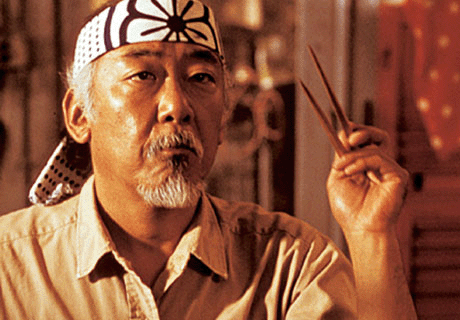

This and Best Original Screenplay tend to be favorite categories of mine year after year as I find that's where the most interesting work is. A nomination that best exemplifies that was the late, great Pat Morita's unforgettable turn as karate teacher Mr. Keisuke Miyagi in the kind of inspiring, mainstream supporting performance that's so good it's in danger of being taken for granted. The role of the old, wise mentor has unfairly been turned into a running joke by inferior performances before and since but that does nothing to diminish what the former Happy Days star was able to do with it. Few are even aware he was nominated, which is proof of how under-appreciated the performance is, as well as how infrequently the Academy actually pays attention. Luckily they did this time.


6. ELISABETH SHUE (BEST ACTRESS, LEAVING LAS VEGAS, 1995)
LOST TO: SUSAN SARANDON (DEAD MAN WALKING)


Nicholas Cage officially won an Oscar that he should cut in half and split with my favorite 80's actress Elisabeth Shue.  Both faced with the challenge of playing what's widely regarded as movie stereotypes (the drunk and the hooker with a heart of gold) they transcended those limitations, especially Shue who as the strong-willed Sera transforms it into something much sharper and smarter, free of any  cliches. Cage's work was so (justifiably) hyped at the time that voters could have easily snubbed her,  falsely assuming she was just along for the ride. But they didn't.  By her own admission she made questionable career choices following this and didn't translate the nod into greater success but that's okay. It's good enough for me that she can permanently and deservedly put the title "Academy Award nominated actress" in front of her name.


5. BACK TO THE FUTURE (BEST ORIGINAL SCREENPLAY, 1985) 
LOST TO: WITNESS


Yep, it was nominated for screenplay. Among the many nominations Back To The Future should have gotten and missed in 1985 (you could make a serious case for Picture, Director, Actor, Supporting Actor, and Original Score) it seems a little strange it got the nod for Robert Zemeckis and Bob Gale's original screenplay. Then again, it really isn't at all. It's the story, above everything else, that keeps bringing new fans to the movie and it's almost impossible to believe something so brilliantly constructed wasn't based on previously published material. That said, because it was overlooked in every other category it feels like the Academy's just throwing the film a bone here to make up for it. But it's the thought that counts, so thanks anyway. 


4. A CLOCKWORK ORANGE (BEST PICTURE, 1971) 
LOST TO: THE FRENCH CONNECTION


I know. I can't believe it either. They actually nominated Stanley Kubrick's controversial ultra-violent, sexually graphic, ahead of its time A Clockwork Orange for Best Picture. And even better than that, it lost to a respectable film in good year. I'm shocked they recognized it all, especially considering it was banned in England, released with an "X" rating in the U.S and at the time hardly carried the flawless reputation it does now. They even nominated Kubrick for director.  One of the few cases where the term "it's a thrill just to be nominated" actually holds true.  


3. DUSTIN HOFFMAN (BEST ACTOR, THE GRADUATE, 1967)
LOST TO: ROD STEIGER (IN THE HEAT OF THE NIGHT)


I had to go back and double check this because I actually assumed Hoffman had won. A lot of people probably did, which tells the story right there. Maybe the most influential nomination ever in this category, its reverberations still being felt this year with Jesse's Eisenberg's performance in The Social Network (and to an even greater extent his work in 2009's Adventureland). Hoffman threw Hollywood for a loop, completely changing perceptions of how a leading man is supposed to look and act. Who even remembers Steiger's performance now?


2. E.T. (BEST PICTURE, 1982)
LOST TO: GANDHI

Let's not even try to pretend Steven Spielberg has made a film since that's equaled what he accomplished with E.T. There's nothing wrong with Gandhi per se  but this is one of the few selections here that could reasonably top any list of Oscar's biggest injustices. You know it's bad when even the director of the winning film says he thought E.T. was robbed.


1. STANLEY KUBRICK (BEST DIRECTOR, 2001: A SPACE ODYSSEY, 1968)
LOST TO: CAROL REED (OLIVER!)


On the bright side, let's give credit to the Academy for at least acknowledging the greatest director to never win an Oscar with nominations for this, Dr. Strangelove, A Clockwork Orange and Barry Lyndon since his films, for all their brilliance, were extremely cold and polarizing, and definitely not for all tastes. His reclusive, press-shy reputation probably didn't do him any favors here, though we probably care more than he did that he lost, if he cared at all. What he cared about was the work and the results were evident on screen. Still... Carol Reed for Oliver!? Oliver! also won Best Picture, while 2001 went unnominated. Even those who hate 2001 would call highway robbery on this. Ironically, this year's big match-up has faint echoes of '68 with an unpopular perfectionist filmmaker attempting to defeat a safe, emotional, audience pleasing "Oscar movie." It'll be interesting to see if the Academy's finally learned from their mistakes.


MORE FAVORITES

Best Picture: Bonnie and Clyde (1967), The Graduate (1967), Star Wars (Best Picture, 1977), Apocalypse Now (1979), Raiders of the Lost Ark (1981), Pulp Fiction (1994), The Shawshank Redemption (1994), Babe (1995), Fargo (1996), There Will Be Blood (2007)

Best Actor: Peter Sellers (Dr. Strangelove, 1964, Being There, 1979), Dustin Hoffman (Midnight Cowboy, 1969), Jack Nicholson (Five Easy Pieces, 1970, Chinatown, 1974), Marlon Brando (Last Tango in Paris, 1973), Robert DeNiro (Taxi Driver, 1976), Woody Allen (Annie Hall, 1977), Burt Lancaster (Atlantic City, 1981), Robin Williams (Good Morning Vietnam, 1987), Tom Cruise (Born on the Fourth of July, 1989), Richard Dreyfuss (Mr. Holland's Opus, 1995), Billy Bob Thornton (Sling Blade, 1996), Robert Duvall (The Apostle, 1997), Nicolas Cage (Adaptation, 2002), Bill Murray (Lost in Translation, 2003), Mickey Rourke (The Wrestler, 2008) 

Best Supporting Actor: Alec Guinness (Star Wars, 1977), Gary Sinise (Forrest Gump, 1994), Samuel L. Jackson (Pulp Fiction, 1994), Brad Pitt (12 Monkeys, 1995), William H. Macy (Fargo, 1996), Burt Reynolds (Boogie Nights, 1997), Tom Cruise (Magnolia, 1999) 

Best Actress: Faye Dunaway (Bonnie and Clyde, 1967), Audrey Hepburn (Wait Until Dark, 1967) Jane Fonda (They Shoot Horses, Don't They?, 1969), Sissy Spacek (Carrie, 1976), Ellen Burstyn (Requiem For a Dream, 2000), Nicole Kidman (Moulin Rouge!, 2001), Diane Lane, (Unfaithful, 2002)

Best Supporting Actress: Janet Leigh (Psycho, 1960), Shelley Winters (The Poseidon Adventure, 1972), Jodie Foster (Taxi Driver, 1976), Melinda Dillon (Close Encounters of the Third Kind, 1977), Anne Ramsey (Throw Momma From the Train, 1987), Uma Thurman (Pulp Fiction, 1994), Minnie Driver (Good Will Hunting, 1997), Julianne Moore (Boogie Nights, 1997)

Best Director: Alfred Hitchcock (Psycho, 1960), Stanely Kubrick (Dr. Strangelove, 1964), Steven Spielberg (Close Encounters of the Third Kind, 1977, Raiders of the Lost Ark 1981), Quentin Tarantino (Pulp Fiction, 1994), Paul Thomas Anderson (There Will Be Blood, 2007), David Fincher (The Curious Case of Benjamin Button, 2008)  

Best Cinematography: Robert Surtees (The Graduate, 1967), Roger Deakins (Fargo, 1996, The Assassination of Jesse James by the Coward Robert Ford, 2007, No Country For Old Men, 2007), Emmanuel Lubezki (The New World, 2005) 

Best Original Score: John Williams (Superman, 1978, The Raiders of the Lost Ark, 1981), Ennio Morricone (The Mission, 1986) 

Best Original Song: "Eye of the Tiger" (Rocky III, 1982), "Ghostbusters" (Ghostbusters, 1984), "The Power of Love" (Back to the Future, 1985), "Blaze of Glory" (Young Guns II, 1990), "Save Me" (Magnolia, 1999) 

Best Original Screenplay: 2001: A Space Odyssey (1968), Easy Rider (1969), American Graffiti (1973), Star Wars (1977), E.T. (1982), Brazil (1985), Big (1988), Boogie Nights (1997), The Truman Show (1998), Bulworth (1998), Being John Malkovich (1999), Magnolia (1999), Memento (2001), The Royal Tenenbaums (2001), The Squid and the Whale (2005) 

Best Adapted Screenplay: Dr. Strangelove (1964), The Graduate (1967), A Clockwork Orange (1971), Apocalypse Now (1979), The Stunt Man (1980), Full Metal Jacket (1987), Field of Dreams (1989), JFK (1991), The Shawshank Redemption (1994), Leaving Las Vegas (1995), Wag The Dog (1997), Out of Sight (1998), Primary Colors (1998), Wonder Boys (2000), Adaptation (2002)

Monday, February 21, 2011

Five Favorite Scenes: The Social Network


As I keep digging into The Social Network Blu-ray (so how about that weird packaging and the brilliantly bizarre title menu?) I've come to the conclusion that if it wins Best Picture that's great, but if it doesn't, well then, that's fine too. The Academy has impressively avoided rewarding the most deserving film for the past 83 years so why start now? No validation is necessary here because this is far and away, hands down the best film of this past year or any other recent one and nothing even comes remotely close. Oscar or not. It's best just to celebrate the achievement on its own terms and remind oneself that Driving Miss Daisy won Best Picture. See? That feels better already. As we all know, losing might actually be the best thing for it. For all the controversy surrounding the truthfulness of the movie I think it says a lot about Time's "Person of the Year" Mark Zuckerberg for publicly being a good sport and taking this bullet like a man for the sake of his company. Aaron Sorkin's script loosely incorporates real facts into a semi-fictional work so damning it makes Oliver Stone's W. look like a tribute documentary and it wouldn't have taken but a phone call to his lawyers for Zuckerberg to stop this project altogether (or at least prevented the use of his name and Facebook's trademarks). But he didn't. Give him credit for being seemingly one of the few to actually grasp this is meant for entertainment. He had to be slandered and dragged through the mud for the film to work as well as it does.

Back in October, I attempted a somewhat objective assessment of the film knowing my time to rant and rave about its greatness would get here soon enough. So now it's here. Director David Fincher has gone on the record humbly insisting his film isn't as "important" as Zodiac and if we're going strictly by their topics, he's right.  Only movies are rarely about their actual topics. Such is the case with The Social Network, a film no one said could be made, based on a topic no one wanted to see explored on screen. The level of difficulty here was insurmountable. I'd say in terms of actual execution this feels more important than anything he's done so far. So, how did Sorkin and Fincher ever make a movie about Facebook? Well, for starters, they didn't. Ranked in non-chronological order below are my five favorite scenes/moments in the film, along with accompanying thoughts. Obviously, SPOILERS follow.


5. MEET SEAN PARKER 


This brief, but memorable scene toward the middle portion of the picture when the action moves to the West Coast marks the first onscreen appearance of Justin Timberlake as Napster founder Sean Parker. It also marks the first instance of applause erupting from the theater I saw it in (the second: the reveal of Mark Zuckerberg's "Ardsley Athletics" T-Shirt). Has there ever been a better character introduction? If I could pick one scene that exemplifies the strength of Sorkin's writing it would probably be this brief sequence. Even over the "Did I adequately answer your condescending question?" lawsuit deposition scenes. A strange statement, but I just love the way this whole exchange unfolds and doesn't take the predictable route you'd expect given the situation.

It's reasonable that Parker would know every little detail about Amy (Dakota Johnson) from Stanford because he's Sean Parker and he does his research. So there's a glimpse of actual common sense in a movie script. Yet somehow Sorkin writes the scene in such a way that she still seems right in step with him and doesn't come across as an airhead for not knowing who he is, or worse, just a slutty party girl who woke up as his latest conquest. Of course, he finds out about "Thefacebook" through someone else, which is typical, and sets the stage for his leech-like behavior later as a charismatic opportunist who sees his opening and takes it. It's easy to see how Zuckerberg fell under his spell and bought what he was selling and why the purely idealistic Eduardo would hate his guts. The more times I watch the film the better Timberlake's performance seems, dropping subtle clues that the likable but flawed Parker was destined all along to make that pathetic police station phone call to Zuckerberg at the end of the film because that's what always happens with him. We get our first glimpse of that here.


4. HARVARD CODE OF CONDUCT


One of the film's more exciting, overlooked aspects was being given full access to Harvard University without really being given access to Harvard, a setting we've really never seen fully exploited on screen before (let's not count 2001's Harvard Man). Fincher changes that, miraculously giving us a very specific sense of time and place without ever even filming at the actual location (Fincher was forced to use Wheelock College as a stand-in) and it's a feeling especially present in the opening campus scenes. The two self-professed "gentlemen of Harvard" who best exemplify this world and our preconceived notions of it are Cameron and Tyler Winklevoss, twin rowers who find their idea for a campus social networking site hijacked by Mark Zuckerberg. Supposedly the real twins were thrilled at their depiction in the film, which is hilarious on too many levels to list. Then again, everything involving the Winklevi is hilarious as played by Armie Hammer in the best depiction of preppy entitlement ever put to screen.

I like how Sorkin doesn't write them as villains or bullies, but hard-working guys who had an idea that really could have been stolen out from under them. And they've got a strong case, which leads to their meeting with clueless, hysterically patronizing Harvard President Larry Summers (Douglas Urbanski) in which they futilely attempt to convince him that Zuckerberg's in violation of Harvard's student "Code of Conduct." Their allegations sound as ridiculous to him as the idea of making a movie about them seemed to us. You could compile another separate list of the twins' greatest moments ("I'm 6'5, 220 and there's two of me!") but this scene best exemplifies how the actor immerses himself in two very different and distinct personalities. As dark and nasty as the film gets at times, Hammer insures that it's also a comedy.


3. RICH MAN


Leave it up to Fincher to somehow find the one Beatles song that hasn't been played out. In a career packed with memorable musical moments he always seems to pick just the right song and put it in the perfect place for maximum effect, but he outdoes himself here. You could argue that with Reznor and Ross' haunting score the entire picture is a musical moment unto itself (their brilliantly twisted version of "In The Hall of the Mountain King" during the twins' Henley Royal Regatta rowing race is obviously one of many highlights) but what else but the under-appreciated 1967 Beatles B-Side "Baby, You're A Rich Man" could possibly wrap up the conundrum that is Mark Zuckerberg, or at least the fictional version of him presented here.

The "likability" of the character, and his obsessive desire to be popular, is something that's returned to many times as we get the unofficial closer to his conversation with Erica at the bar, except this time in a conference room with attorney Marylin Delpy (Rashida Jones, getting to deliver that unforgettable final line).  He might end up as a billionaire but this Zuckerberg never cared about money at all which might be his only link to the real-life counterpart, making the ending song choice especially ironic. Sitting alone at the computer, pathetically refreshing the page to see if Erica accepts his friend request is also the least pathetic and most understandable choice Zuckerberg makes in the film, confirming the trace of humanity we suspected he had throughout.


2. THE BAR 


Supposedly, Fincher filmed 99 takes of this opening scene in the bar to knock all the acting out the two actors, which kind of makes sense when you consider they're delivering Sorkin's dialogue. Anyone who watched The West Wing or any of his other TV or film projects knows how wordy it is and how fast it needs to come out. If it it doesn't it can really sound like someone's reading from a script, which you obviously never want. The best thing about Eisenberg's performance is how he almost invisibly implies on his face all these emotions that his character seems incapable of even expressing to anyone.

As Erica, Rooney Mara has an even tougher job here, having to sell that she would even like and date this guy to begin with, then by the end of a single 8 minute conversation be believably fed up enough with his arrogant antics to just walk. She knows his game and won't stand for it, making all the misogynistic accusations leveled against the picture seem ridiculous, especially considering the women always seem much smarter than the guys throughout the film (save Eduardo's psycho girlfriend). With minimal screen time Mara makes us believe that letting Erica go is a mistake Zuckerberg won't ever be able to live down. When we get to the final scene the big revelation isn't that he built a billion dollar company to impress her, but that he believes giving it all up for another chance would be worth it. The scariest part: He's right.


1. EDUARDO SAVERIN'S MELTDOWN


Oh, that "Facebook movie." So cold, cynical, detached and unemotional. Such unlikable characters. Speaks to the mind, not the heart. No one has any FEELINGS. And that's only the second biggest misconception about the film. The biggest is one that Fincher's addressed in many interviews and involves the perception of the picture as some kind of cinematic landmark that speaks to a generation (one that ironically refused to support the movie and probably cost it a few Oscars). I expressed my own doubts on that when I reviewed it and see his point since it usually takes decades to make such a determine any film's value as a cultural touchstone. It also burdens the movie with added pressure it doesn't even need because it's important enough just as what it is: A perfectly directed, written and acted coming-of-age drama about the destruction of a friendship. And it all builds to this. 

Eduardo enters Facebook headquarters a boy but walks out a man after realizing he had the screws put to him by his best friend And in a movie packed with endlessly quotable lines, the criminally un-nominated Andrew Garfield gets to deliver its best to Timberlake's befuddled Parker, a verbal blow anyone caught in a volatile confrontation wished they could come up with in the heat of the moment. After being used and stepped on (though it's a credit to Garfield's performance it never exactly seems that way) Eduardo finally learns the hard way how to stand up for himself becoming the emotional center of what's otherwise been described as the most unemotional of films. He's our way in. Even though its characters talk endlessly, the film wisely holds a lot back in terms of what they're actually thinking and feeling until here, why is why this breaking point moment registers as powerfully as it does.

Images: DVD Beaver

Wednesday, February 16, 2011

Wall Street: Money Never Sleeps


Director: Oliver Stone
Starring: Michael Douglas, Shia LaBeouf, Josh Brolin, Carey Mulligan, Frank Langella, Susan Sarandon, Eli Wallach
Running Time: 133 min.
Rating: PG-13

★★★ (out of ★★★★)

Don't count me among those who thought it was a terrible idea for Oliver Stone to make a sequel to Wall Street over 20 years after its release, but for whatever reason, a lot of people seemed to think it was. In my mind there are few greater thrills than catching up with a memorable movie character decades later and finding out what they're up to. How many times has a film ended and you wonder what happened to the key players after the credits rolled? In many cases it's better to just not know and leave it alone, but sometimes you just can't resist because there's more story there. Gordon Gekko, the role that won Michael Douglas his 1987 Best Actor Oscar, is one of those rare exceptions where we just need to know, even at the risk of shattering our perceptions of a film that was always meant to be trapped in its own time period anyway. No one can convince me that the idea of dropping him in the midst of 2008's economic collapse has no dramatic value and Wall Street: Money Never Sleeps is a sequel that lives and dies on Douglas' supporting performance. The big draw is finding out what happened to Gekko and how one of our greatest actors will re-interpret his most iconic role. Everything else is just gravy. Featuring a hammy central storyline, the film lacks the bite of the original, but we knew it would. This is more a human, emotional drama very much unlike the corporate thriller its predecessor was. It's slicker and more calculated, but still works in its own way.

The film cleverly opens with Gordon Gekko (Douglas) collecting his belongings (which hilariously includes a relic 80's cell phone) before being released from prison in 2001 after serving an eight year sentence for insider trading and securities fraud. No one's waiting for him when he gets out. We flash forward seven years and Gekko's now a best-selling author and lecturer, all over television promoting his new book, "Is Greed Good?" which puts a new spin on his famous catchphrase. His sudden re-emergence grabs the attention of Jake Moore (Shia LaBeouf), a trader at Wall Street investment bank Keller Zabel and boyfriend of Gekko's estranged daughter, Winnie (Carey Mulligan), an idealistic political blogger who's inherited none of her father's ruthlessness and still blames him for her brother's death. But when Jake's boss and longtime mentor Louis Zabel (Frank Langella) finds his company on the brink of collapse due to vicious rumors and takes his own life, Jake knows whose help he needs. He makes a trade, promising Gekko a reconciliation with his daughter if he can help bring down rival CEO Bretton James (Josh Brolin), the man Jake suspects is responsible for it all.

There are two intertwined stories being told here, one a lot more interesting than the other. The Wall Street power struggle is old hat, just an excuse to bring Gekko back into the picture in a meaningful way and act as a backdrop. That plot is needlessly complicated, bogged down by business jargon and a villain is so cartoonishly over-the-top I half expected to him to grow a mustache just so he could twirl it. But for what needs to be accomplished from a goofy entertainment standpoint it works even if I found myself wishing less time were spent on those details and more on the re-entry of a seemingly more humbled Gekko into society after personally and professionally paying the price for his crimes. Jail has mellowed him, changing his outlook on things and the most fascinating aspect of the character is how Douglas puts on all these different masks to reveal varying shades of Gekko's personality when he's around certain people. A mellowed business titan dispensing sage wisdom as a lecturer. A cutthroat schemer advising Jake. and a pathetically inept father still cleaning up his messes in attempting to earn Winnie's trust. He makes it clear why Winnie wouldn't ever be able to trust him and feels betrayed Jake would even attempt to. The more reversals the plot takes the more appreciation you build up scene-by-scene for what Douglas does to adapt and add even more layers to his original creation.

At first glance the casting of LaBeouf as the protagonist would seem to be a miscalculation, but youth and inexperience count in his favor with the character's early success being explained away with him having the right connections. Given Shia's recent Indy 4 track record I was skeptical, but he brings his "A" game as a young broker green enough to be taken advantage of by the heavy hitters but still confident and determined enough to put up a fight to get what he wants. His role is absolutely huge, asked to carry every scene in the picture and he responds better than anyone could have suspected. Whatever issues there are with the film definitely don't fall on him or his chemistry with Douglas or Carey Mulligan. Good luck finding an actress working today who possesses a lovelier, more natural onscreen presence and I can't say it's wasted at all in this emotional role, which wouldn't have amounted to nearly as much had anyone else been given it.

As James, Josh Brolin's stuck as your typical stock villain but since he's Brolin and looks to be having such a blast playing it, we hardly notice or care. Speaking of having a blast, the unfortunate timing of Charlie Sheen's cameo (reprising his role of Bud Fox from the original), whether by design or not, does more to shine the spotlight on Sheen's celebrity reputation than the character and earns unintentional giggles above all else. Maybe a fun moment, but it should have been left on the cutting room floor as it turns his experience with Gekko years ago into a cheap punchline. Sporting a convincing Long Island accent, Susan Sarandon makes a few brief, but meorable appearances as Jake's mother, a real estate agent in over her head financially along with everyone else. The best creative addition Stone makes is musical, recruiting rock legend David Byrne of The Talking Heads' (whose song "This Must Be The Place" was featured in the first film and reappears here) to provide the soundtrack, which strangely fits the tone of this movie like a glove and feels like a major character.

Many will accuse Stone of wimping out with the ending and he does to an extent but you'd have to be pretty glum to wish for the finale we come close to receiving. That said, Stone carries things on a about a scene or two longer than he should when a more ambiguous final act would have served the story better and driven the point home harder, or at least given us more to think about. The wrap-up's a little too tidy for characters complicated enough to deserve better, especially Gekko. Continuing the action past that point and even through the closing credits (in a particularly befuddling sequence) was an ill advised choice, but doesn't really harm the overall integrity of the film. Anyone going into Wall Street: Money Never Sleeps expecting another Wall Street will feel let down. As it should be, this is far different since over two decades have passed and that movie couldn't be made today, nor would we need it to be. As much as the original stands as timepiece for 80's greed and excess this sequel provides a compelling, if Hollywoodized, snapshot of the recent economic collapse, but more interestingly allows us a glimpse into what one of our most memorable movie characters would have to say about it.

Friday, February 11, 2011

The King's Speech


Director: Tom Hooper
Starring: Colin Firth, Geoffrey Rush, Helena Bonham Carter, Guy Pearce, Timothy Spall, Derek Jacobi, Jennifer Ehle, Michael Gambon
Running Time: 118 min.
Rating: R

★★★ (out of ★★★★)

As expected, The King's Speech is an ordinary, old fashioned crowd pleaser custom built to entertain in all the predictable ways classic Oscar grabbing pictures do. It isn't disappointing at all, which is as much a testament to my low expectations going in as as it is to the film's quality. With its inspiring message of overcoming your fears to take the next step in life it's easy to see why it's striking such a chord amongst moviegoers. It's like the Rocky of stuttering king movies. And as much as I'd like to take cheap jabs at the film (nominated for 12 Academy Awards), it's important to note I'd be skeptical of any film released during any year standing in the corner opposite The Social Network in the Best Picture category. That's not director Tom Hooper's fault. He made a good film. That's it, but it's still something. What I can't possibly accuse it of is lacking heart or being irrelevant to our lives today despite taking place during what would appear to be a stuffy, restrictive time period, at least for entertainment purposes. This overcomes that stigma and is at times funnier than most comedies, which is a victory in itself.

When England's King George V (Michael Gambon) dies in 1936, the Duke of York (Firth) is passed over for the throne in favor of his hard partying older brother King Edward VIII (Guy Pearce). Edward's brief but embarrassing reign during which he carries on an affair with a twice-divorced woman connected to Hitler, results in him abdicating the throne. Next in line, the Duke (or "Bertie" as he's known to his friends) must now step up and take the crown as King George VI. There's only one problem: He stutters. It's actually less a stutter or stammer than a full-blown speech paralysis that's affected him since youth, preventing him from speaking publicly and also even rendering him speechless in certain stressful social situations. Initially reluctant to accept a life of royalty, the King's wife, Elizabeth (Helena Bonham Carter) seeks him the help of Lionel Logue (Rush), an Austrian speech therapist with some unorthodox ideas for treatment. The King must learn to trust him as well as admit that he wants to help himself before he can act as the leader and voice for his country as World War II begins.

Based on a true events, it's undeniable this story has built-in universal appeal. Everyone at one time or another had to face that one obstacle (or maybe more) that's prevented them from taking action and reaching their fullest potential. With his intelligence and strong sense of duty the King would seem to be the perfect candidate to hold the throne, but this stutter has crippled his confidence to the point that he's reluctant to be burdened with the responsibility. He could be great but doesn't want to, or maybe more accurately, is too afraid to be and the most interesting aspect of David Seidler's script is how well it zeros in on that psychological block, making the story about more than just a speech impediment. There's the physical manifestation of the problem and then there's the REAL problem. Lionel's methods for treatment of the actual affliction (which include breathing exercises and singing) take a backseat to the deeper issues instigating it as he acts as not only a confidant to the cranky, reluctant King, but as a life coach and mentor. While these two men from seemingly different worlds would likely never be friends under any other circumstances and the King tries to fight Lionel efforts all the way through, both do attempt reach a common ground on which they can effectively communicate. Their arguing back and forth (as repetitive as it sometimes is) results in more than a few laughs and quotable scenes of dialogue, one exchange in particular causing the otherwise tame film to receive an R rating, somewhat of a sham since the swearing in question isn't gratuitous at all and even essential to the advancement of the plot. Notoriously prudish when it comes to profanity and ignorant of its context, it's of little surprise the MPAA disagreed.

As the King, Firth is a revelation, giving one of the best performances of the year and proves to be more than worthy of all the attention he's received. He perfectly navigates both the physical requirements of the tricky role (never overplaying or underplaying the speech impediment) while also subtly conveying the character's massive insecurity and self-doubt. It helps having a great sparring partner in Rush who as the witty and sarcastic Lionel shows no hesitation in letting the King know he's in his house now and playing by his rules, royalty or not. Helena Bonham Carter is surprisingly fine in a role that doesn't require much at all but at least provides a welcome break from the Burtonesque gothic sideshow parts she's usually saddled with. Seemingly just along for the ride as the supportive spouse this is the first time I can remember where she doesn't stand out as an oddly unwelcome presence in a film. Guy Pearce has charisma to burn in just a few scenes as the King's screw-up brother, even if I was perplexed as to how he was cast as the older brother despite being much younger than Firth (and looking it).

The direction from Hooper (whose previous credits include HBO's John Adams and the soccer drama The Damned United) seems non-existent, as there's nothing noteworthy he needs to bring to a project that with few exceptions consists of conversations taking place in closed quarters. Despite being directed with no discernible imprint it's still easy to see how a less talented filmmaker could have botched it, causing the material to come across as a regal bore, as period dramas centering on the British monarchy have the unfortunate tendency of being. He makes a few interesting visual choices but aside from the performances this is mostly going to be remembered for Alexandre Desplat's score and the costume and production design. Technically the whole enterprise is handsomely put together so it's to Hooper's credit that he knew to just hang back and let the cards fall as they may, wisely letting the actors just do their thing.

I can't say I was on pins and needles waiting to see how this would all unfold. It's no mystery it will all come down to a big speech that must be delivered reasonably well, but not too well in order to maintain a realistically happy ending in much the same way Rocky did. Even while connecting with the deeper themes in the film. I found myself curiously unmoved by the time the final credits rolled, possibly because its intentions are so blatantly obvious. It's social relevancy comes in reflecting how much more is expected from our leaders than actual decision making with King George VI reluctantly finding himself at the forefront of an important shift, now required to do more than just ride his horse and wave. There's nothing wrong with The King's Speech, yet nothing spectacular about it either. While not merely about the King delivering a speech, at the end of the day the film somehow still feels like it's just about the King delivering a speech because it employs so many other familiar elements we're accustomed to seeing in inspiring underdog stories of Oscar's past. It's always nice to walk away from movies thinking about all that was done well, but more often than that a film can succeed by simply not messing things up and making it look easy.

Tuesday, February 1, 2011

Saw: The Final Chapter


Director: Kevin Greutert
Starring: Tobin Bell, Costas Mandylor, Bestsy Russell, Sean Patrick Flannery, Cary Elwes, Chad Donella
Running Time: 90 min.
Rating: R

★★ (out of ★★★★) 

Saw: The Final Chapter (released theatrically as Saw 3D), the seventh and supposedly final installment of this long-running horror franchise, is also its worst, combining all the weakest elements of the series into one gigantic mess. Police procedural confusion. Kills for the sake of kills. A needlessly complicated plot. Too many characters. Amateurish acting. Continued emphasis on a pointless feud. Jigsaw relegated to a cameo. Anyone hoping for answers or even just some semblance of coherency will be disappointed. Even the highly anticipated return of one of the franchise's most important figures is botched badly.

After coming off the surprisingly decent Saw VI, that film's director (and longtime series editor) Kevin Greutert returns after Twisted Pictures exercised a "contractual clause" in his contract preventing him from directing Paranormal Activity 2 to torture us with this instead. And that makes perfect sense since this looks and feels like someone was blackmailed into making it (possibly at gunpoint). The one thing it does have going for it is unintentional comedy, as there were many scenes where I couldn't stop laughing, providing some hope that maybe this will have a future shelf life as some kind of awful curiosity. But fans who stuck with this long-winded saga through thick and thin deserve a reward, not this cruel punishment.

As usual, we pick up exactly where the action of the last film left off as the battle over Jigsaw's legacy rages on between rogue detective Mark Hoffman (Costas Mandylor) and Jigsaw's ex-wife, Jill Tuck (Betsy Russell). After failing to kill him with the bear trap, she's now revealed his identity as Jigsaw's successor to authorities and is under protective custody, while officer Matt Gibson (Chad Donella) is hot on his former colleague's trail. But Hoffman's already set his sights on the next game subject, self-help guru Bobby Dagen (Sean Patrick Flannery), who's achieved success as an author and television personality by falsely claiming to have survived a Jigsaw trap. Now in order to save his wife, best friend, publicist and lawyer, he'll have to survive a real one. Further complicating matters is the mysterious reappearance of Jigsaw's most infamous survivor, Dr. Lawrence Gordon (Cary Elwes). At last, we finally find out what happened to him after he sawed off his foot and crawled out of the bathroom to apparent safety in the original film.

This installment does give us something we've never seen before in its opening with a trap that takes place in broad daylight as a crowd of onlookers witness two guys in a buzz saw battle for the life of their unfaithful girlfriend in a storefront display window. That's at least something different and bizarre, broadening the scope by moving away from the dark, dingy warehouses and garages the action usually takes place in. It's kind of surreal watching a Saw trap take place under these unusual circumstances, made unintentionally hilarious due to the laughable performances and cheesy gore effects. While the idea of the latest victim being a famous fake survivor milking other people's trauma for profit isn't as hilariously creative as Saw VI's plot of Jigsaw extracting revenge from beyond the grave on a health insurance executive for denying him coverage, it does have a lot of promise. Unfortunately it's undercut by a uninspired performance from Sean Patrick Flannery, who can't convey the charisma of a motivational speaker and isn't slimy enough for us to believe he's capable of manipulating anyone.

Flannery's "butter hands" Bobby character is portrayed as a total tool, so completely inept at Jigsaw's games that we never doubt for a second he'll die while failing to rescue everyone. This leads to the funniest scene in the film (and possibly the franchise's history) when he has to "guide" his blindfolded friend Cale (Dean Armstrong) across a series of wooden planks and get him a key before he's hanged. Poor acting and confusing direction results in the sequence playing like a Survivor challenge gone mad, causing tons of unintentional laughs. But as tempting as it is to recommend the film on just the basis of that spectacle, I'll resist.

The Saw series isn't  known for containing Oscar caliber performances but the acting all-around in this entry is by far the most embarrassing it's been, not helped any by the inexcusable absence of Tobin Bell who's featured in all of two (!) brief scenes as the deceased Jigsaw/John Kramer. Whether present in small or large doses, Bell's peerless performance was always the driving force behind these movies so here's hoping he doesn't get typecast for life and is given the opportunity to move past this in other roles. He often gave much more than the writing deserved, while hardly ever getting his due for it.

With the filmmakers apparently oblivious to the fact that in the final stretch it's imperative the plot return to its basic roots by being as simple and focused as possible, the ridiculous, never-ending feud between Hoffman and Jill takes center stage. But at least we finally get to see both characters for what they are: Albatrosses sinking this franchise since their initial major appearances in the fourth film. It's clear now that writers Patrick Melton and Marcus Dunstan never had plans for either aside from using them as poor stand-ins to distract us from the fact that Jigsaw wasn't around anymore. Their ongoing struggle, much what's happened in Saws IV through VII, and especially the character of Hoffman, is deemed entirely pointless by the events that conclude this film.

The movie delivers the ending we always wanted, not counting on the fact that by the time we get there, it's impossible to still care. It all feels thrown together at the last minute with the re-appearance of Dr. Gordon coming off as just a bone the producers are throwing at fans to make them happy because they ran out of options. Besides his flashback being clumsily edited and nothing that couldn't have been inserted into the previous sequels, a noticeably heftier Elwes is almost unrecognizable, which is unavoidable, but off-putting just the same. Since no effort was made to flesh out his back story or provide any kind of explanation for what he's been up to, the producers probably would have been better off just keeping his return a secret and working him into the narrative in a more surprising fashion. Or at least in a way that makes sense and doesn't negate the events that came before. Instead viewers are left feeling as if they've wasted their time.

The central idea this whole foundation of the franchise was built on is absent here, replaced with the most gruesome traps possible as the initial intriguing premise of a dying moralistic serial killer teaching victims a lesson is thrown out the window in favor of continuous, in-your-face murders and gore (the film was re-submitted six times to receive an R rating). The second the filmmakers turned their attention toward topping themselves with the most extreme and graphic traps, they lost their way and a series that started as a compelling mystery thriller devolved into torture-porn horror. If they do eventually reboot, the goal should be to go back to basics since we've already seen what a TV series like Dexter or a film like Se7en is capable of with a similar premise. Those should be the template, with skilled actors and a director experienced in extracting the most from that kind of material.

On the bright side, it's worth a round of applause that it took until the seventh film in the series for this to actually get as bad as everyone's accused it of being since the beginning. You could argue they just ran out of creative gas but in all honesty they've been running on fumes for a while now. It's indicative that as a longtime fan of the series, I couldn't even motivate myself to watch it in theaters (3D or not) and have problems mounting any kind of suitable defense for this fiasco. Going in I didn't believe for a second we'd seen the last of the franchise and now after seeing how open-ended they left it, I'm even surer. You can expect a re-boot a few years down the line, after the lingering stench of this final installment dissipates. Until then, it's game over.

Friday, January 28, 2011

Buried


Director: Rodrigo Cortes
Starring: Ryan Reynolds, Robert Paterson, Stephen Tobolowsky, Samantha Mathis, Ivana Mino
Running Time: 94 min.
Rating: R

★★★ ½ (out of ★★★★)

Of the three single location thrillers released in 2010, Buried had the toughest task ahead of it. Unlike something like Frozen and even 127 Hours, literally every second of the action takes place in one claustrophobic setting. It's 94 minutes of a man buried alive in a coffin with a Zippo and a BlackBerry. And those 94 enthralling minutes go by in a flash. Compared to the those other two films, its screenplay cheats the least and as a result it extracts the most out of its tight concept. After viewing a trailer I thought gave away too much information, my biggest concern was that there would be an unnecessary focus on how the character got into the predicament rather the crisis itself, turning this into a criminal procedural that happens to take place underground. But that's not what we get at all. We know just as much as we need to and there's just the right mix of thriller and survival story, capped off with a cruel, nihilistic twist that's actually rather brave for this kind of movie. It's a compelling human drama, but more impressively stands as the type of intelligent, resourceful thriller that would have made Hitchcock proud.

American truck driver Paul Conroy (Ryan Reynolds) wakes to find himself buried alive inside a wooden coffin in Iraq held for ransom after his convoy is attacked by terrorists. A cell phone with a dying battery and a weak signal is his only connection to the outside world and it's through his conversations with state officials and government buerauocrats we learn more details of Paul's history and what's needed to rescue him. With sand leaking through the coffin and a quickly depleting oxygen supply and an unexpected reptilian visitor it's a race against time made that much more frustrating by the voices on the other end of the phone (the most memorable provided by character actor Stephen Tobolowsky). They all have agendas of some sort, which may not necessarily involve locating and rescuing him. No flashbacks or dream sequences here. Director Rodrigo Cortes to find other more inventive ways to tell the story through lighting, camera angles and sound effects, creating an almost unbearably suspenseful atmosphere and making it feel much more cinematic than the restrictive nature of the setting should allow. He brings us right into that coffin with Paul as we root for his survival and feel the frustration at his inability to control his own fate.

Any doubts as to Ryan Reynolds' dramatic abilities are put to rest here as he passes what would be the ultimate test for any actor. Shot in extreme close-up the entire time there's no escaping the fact that this project's success is directly proportional to the believability of his performance. With no one else to bounce off of he must alone convey the emotional turmoil of this desperate, resourceful victim clinging to anything he can to survive. It's probably the best work of his career and it's easy to imagine a lesser actor lacking the ability to hold our interest or being able to carry this challenging premise past the finish line without it running out of steam. At one point there's a conversation Paul has with someone on the other line that's frighteningly realistic in its hopelessness, hitting almost too close to home. Watching, you'll ask yourself, "It all comes down to THIS?" But it does. Without giving too much away, it's an unexpectedly bold and ambitious statement from a film this small and Reynolds does a great job selling it.

Right from its opening, drenched in total darkness for nearly a minute, followed by an effective Saul Bass-inspired credits sequence, it's clear Cortes knew how huge an undertaking this was and came to play. With all the phone calls this could have gotten easily gotten repetitive with the questions surrounding Paul's predicament sucking the experience dry, but ironically not since Phone Booth has a film made as creative a use of a single location to create suspense. It's proof that sometimes the simplest plots can be the best as long as they're visually arresting and focused and Reynold's grueling performance deserves much of the credit for holding it all together. Buried won't be confused for a life-affirming survival tale with exotic locales, but as a thriller it surpasses all expectations of its very promising premise.

Tuesday, January 25, 2011

Oscar Nominations Announced (The Good and The Bad)

The 83rd annual Academy Award nominations were announced this morning. Here's the Full List along with the video below. I'll just get right to it with what I felt were the major snubs and surprises, along with some thoughts.


THE GOOD

-The Social Network. If we're looking at the glass half-full it got 8 nominations, including Best Picture, Director, Actor, Adapted Screenplay and Original Score. Thank you Academy.

-David Fincher. Hopefully soon to be known as "The Oscar-Winning Director of The Game, Fight Club, Zodiac and The Social Network."

- Shutter Island and The Ghost Writer shut out. Sorry, but neither were deserving and whatever  attention they got was due to the reputations of their filmmakers. Especially The Ghost Writer. 

-John Hawkes nominated for Best Supporting Actor for Winter's Bone. I hesitate filing this under "good" considering who he likely pushed out to get this slot (see below). That said, Hawkes deserves this.

-Jeff Bridges Best Actor for True Grit. After winning last year, now joins Tom Hanks, Robert DeNiro and others in the back-to-back nomination club. 

-Michelle Williams officially becomes the first Dawson's Creek actress nominated for an Academy Award in a lead category (for Blue Valentine). She was nominated in Supporting for Brokeback Mountain in '05 but now there's no getting around that I've lost that bet I made against her in 1998. Can't testify to the quality of this performance yet but she's clearly put in a lot of hard work to arrive at this point.

-Both 127 Hours and Toy Story 3 nominated for Best Picture. Expected, but I can deal with it.


THE BAD

-The King's Speech leads the pack with 12 nominations, which is unfortunately enough to secure the Oscar telecast record low ratings, regardless of how likable the hosts are are. I haven't seen the film yet (and honestly have little desire to) so I can only express disappointment at the fact that the The Social Network is trailing.  

-Christopher Nolan snubbed again for Best Director. Someone must really hate this guy. It's a disgraceful omission for sure, but honestly, I've seen worse. At least Inception was nominated for Best Picture. It's kind of ironic the director who's film inadvertently caused this 10 Best Picture nominee thing is now being shut out of the over-crowded Director category because of it.

-Andrew Garfield snubbed for Best Supporting Actor for The Social Network. Now THIS is worse. Forget about Nolan. I have my theories as to how this could have happened, but wow, what an injustice. Easily one of the top five performances of the year in ANY category.

- ONLY 8 nominations for The Social Network. Less than Benjamin Button? Something's wrong there. And only a single acting nomination (for Jesse Eisenberg). In addition to Garfield, a much bigger push should have been made to get Armie Hammer nominated as well.

-The Kids Are All Right nominated for Best Picture. Totally saw it coming, but that doesn't make it any less wrong or ridiculous.

-The Town doesn't get in for Best Picture. Not deserving at all, but I'd trade it in a heartbeat for The Kid Are All Right or Winter's Bone.

-Winter's Bone nominated for Best Picture. I liked it (barely) and its two acting nominations are well deserved, but this is just another case of the Academy thumbing their noses at casual moviegoers by embracing an obscure indie picture that's good, not great, but covers an important social issue (see The Hurt Locker and Precious last year).

-Some feel Ryan Gosling should have joined co-star Michelle Williams but if we're being completely realistic it's a shock a movie that small and under-seen got an acting nod at all. He'll have plenty more chances.

-No TRON: Legacy for visual effects or Daft Punk's original score. I don't even know what to say there.

-No Mila Kunis for Black Swan. It's funny how many Portman fans contend she did everything by herself when she seemed to have A LOT of help from everyone involved.