Showing posts with label Hal Holbrook. Show all posts
Tuesday, January 17, 2012
Water For Elephants
Director: Francis Lawrence
Starring: Robert Pattinson, Reese Witherspoon, Christoph Waltz, Hal Holbrook, Paul Schneider
Running Time: 121 min.
Rating: PG-13
★★★ (out of ★★★★)
Poor Reese Witherspoon. Forced to share the screen with an untrained sideshow spectacle who's poked and prodded at for audiences' enjoyment as an evil carnival barker urges them to pour out their pockets in hopes of getting a glimpse. No, it's not Rosie the elephant I'm referring to, but her other co-star, Robert Pattinson, who now faces the challenge of trying to be taken seriously as a dramatic actor after being established as a consumer product studios can make money off of. And outside of the Twilight franchise, even that assumption is uncertain. He's got a long road ahead of him and probably knows it, but all things considered, this is a decent first step. Water for Elephants is the right type of project for him to get his feet wet, playing to his strengths while offering him as few opportunities as possible to embarrass himself. So that's good news in itself. It also helps the film is an easy, enjoyable watch and at least slightly less ridiculous than I expected.
Adapted from Sara Gruen's popular novel and directed with old school flare by Francis Lawrence, the film employs one of my favorite narrative devices: An old man looking back on his life. Unfortunately, that promising device is executed about as clumsily as possible, treated as a mere afterthought before the film flashes back to The Great Depression when 23-year-old Cornell veterinary student Jacob Jankowski (Pattinson) loses both his parents in a car crash. Adrift in life, he starts riding the rails, ending up on the Benzini Brothers Circus Train. He meets the controlling August (Christoph Waltz) the circus owner and animal trainer who's married to the beautiful Marlena (Witherspoon), and prone to unpredictable fits of sadistic rage, treating her almost as badly as he does his animals. After an awkward first meeting, August hires Jacob as the circus vet but it becomes a complicated working arrangement when Jacob starts to fall for Marlena. It might be the one element in the circus that August can't control, with the results of that fledgling relationship having potentially dangerous consequences for all involved.
The big draw here is the circus setting and period atmosphere. From a technical standpoint it's virtually flawless and looks great. There are a bunch of Oscar nominees involved in the costuming, production, art direction and set design and it really shows. From a visual standpoint it actually feels like The Greatest Show on Earth or one of those old style Hollywood epics from the 1950's they don't attempt anymore. The script, however, makes it feel slightly smaller than it should. More like a TV movie, as the doomed lovers plot can't always keep up with the inspired circus backdrop. Pattinson, looking less pale and vampire-like than usual, effectively broods and longingly stares at Reese, but it's clearly the more experienced Witherspoon who's carrying this. She's a genuine movie star in the truest sense and the unattainable Marlena character fits her like a glove. Unlike her role, Pattinson's could have easily been swapped out with just about any other actor in his age range or older with no harm done to the film, but he holds his own, giving what resembles at times a passably strong performance. The two have okay (but not great) chemistry and their age difference isn't much of a factor. If anything, it's interesting to see a younger man and older women for a change, and an argument could be made it better suits the nature of this particular story of the protagonist being shown the ropes.
Watching I couldn't help but wish everything else had as much bite as Christoph Waltz's psycho circus ringmaster. Again channeling his sadistic streak from Inglourious Basterds he seems to be the go-to sociopath in movies these days, infusing each scene with his co-stars with a genuine sense of danger. There are points we fear for their lives, not to mention the life of the elephant. Besides the framing device mishap (which strangely has the younger Jacob narrating the story even though his older self, played by Hal Holbrook, is telling it in the present day) my biggest complaint is the film does lack that extra edge to put it over the top. Whether there was a fear in alienating faithful devotees of the novel, Pattinson fans or just a concern with preserving that audience friendly PG-13 tone, there are times it seems to be playing it safe when it really needs to cut loose with the romance and violence. Other than that it's difficult to pinpoint much Water for Elephants does wrong, and believe me I was looking. Chalk it up to low expectations if you must, but there's something to be said for telling a simple, but visually compelling story in a smart, straightforward way.
Wednesday, February 23, 2011
Top 10 All-Time Favorite Oscar Nominations (That Didn't Win)
Just to clarify, this is NOT a list of Oscar's biggest injustices or snubs, as you'd need a whole separate web site for that. While I'm sure there's little doubt Citizen Kane, The Wizard of Oz and Robert DeNiro were robbed in their respective years you won't find them anywhere near here. To give you a heads up these mostly start from the 1960's and beyond just because that's the Oscar history and films I'm most familiar with. These are my FAVORITE nominations, where just simply seeing them listed made me so happy I couldn't have cared less about the result (okay, I wish they won). The best news is that maybe only two or three of these would qualify as flat-out injustices and in a few cases what beat it was actually quite deserving. I'll keep the complaining to a minimum and just be grateful these were recognized at all since most years our favorites aren't, which made compiling this easier than it should have been. Below is a list of my favorite losing nominees and the ten I'd hand statues to right now. Here's hoping after Sunday The Social Network won't be joining them.
10. THE TOWERING INFERNO (Best Picture, 1974)
LOST TO: THE GODFATHER PART II
Tell me it isn't cool that they actually nominated The Towering Inferno. Some refer to the flagbearer of 70's disaster movies as the worst Best Picture nominee of all-time. Maybe they've never seen it, or if they have, lack a sense of humor. Paul Newman, Steve McQueen, Faye Dunaway, Fred Astaire a burning high rise and O.J. Simpson. What more needs to said? It's three hours of non-stop cheesy excitement and if it went on three hours longer than that I wouldn't have complained. With 10 nominees now I wish The Academy would make more wild, outside-the-box selections like this, provided they're deserving. This is. No shame in losing to The Godfather Part II.
9. HAL HOLBROOK (BEST SUPPORTING ACTOR, INTO THE WILD, 2007)
LOST TO: JAVIER BARDEM (NO COUNTRY FOR OLD MEN)
"In 'Into the Wild,' that scene in the truck where Hal Holbrook is asking to adopt the young man, that is one of the best performances I've ever seen. It broke me into pieces. In life, as you grow and become comfortable in your own skin and create who you are you can escape from what you are. Then the whole disguise falls apart and you are just a human being. With a mature actor, you see a face totally naked, someone who is just speaking and being in front of the camera, and that is so powerful. That explains why performing is an art, when somebody shows us the sculpture of the human soul. It hits you and makes you wonder what you are."
That quote comes from Javier Bardem, who beat Holbrook to win the Best Supporting Actor Oscar for No Country For Old Men and it couldn't be truer. 2007 was the strongest year for film in a while and no one can begrudge The Academy for their selection here in an ultra-competitive category. Had another actor played the aging retiree who befriends Chris McCandliss (the unnominated Emile Hirsch) on the final leg of his journey the film wouldn't have even come close to carrying the same impact it did. His understated, dignified work took the picture exactly where it needed to go in its crucial third act. Classic "support" in every sense.
8. KATE HUDSON (BEST SUPPORTING ACTRESS, ALMOST FAMOUS, 2000)
LOST TO: MARCIA GAY HARDEN (POLLOCK)
Um....on second thought. Is it possible the Academy knew? That they glimpsed into Hudson's acting future and were trying to protect us. Regardless, we're supposed to be judging the nominated performance not the actress or the embarrassing work that followed. But in a single film she created one of the screen's most indelible female characters in Penny Lane and briefly filled us with hope that we'd witnessed the arrival of a major talent. We didn't. She deserved the win, even if in hindsight they look like geniuses for not giving it to her. The wrong actress came out on top, but Harden can now sleep guilt free.
7. PAT MORITA (BEST SUPPORTING ACTOR, THE KARATE KID, 1984)
LOST TO: HAING S. NGOR (THE KILLING FIELDS)
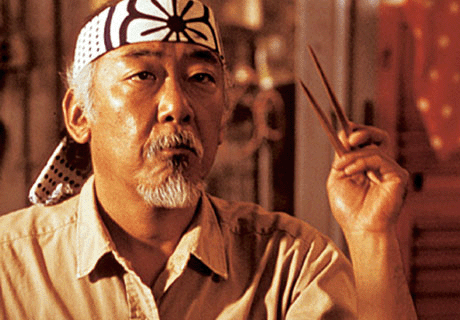
This and Best Original Screenplay tend to be favorite categories of mine year after year as I find that's where the most interesting work is. A nomination that best exemplifies that was the late, great Pat Morita's unforgettable turn as karate teacher Mr. Keisuke Miyagi in the kind of inspiring, mainstream supporting performance that's so good it's in danger of being taken for granted. The role of the old, wise mentor has unfairly been turned into a running joke by inferior performances before and since but that does nothing to diminish what the former Happy Days star was able to do with it. Few are even aware he was nominated, which is proof of how under-appreciated the performance is, as well as how infrequently the Academy actually pays attention. Luckily they did this time.
6. ELISABETH SHUE (BEST ACTRESS, LEAVING LAS VEGAS, 1995)
LOST TO: SUSAN SARANDON (DEAD MAN WALKING)
Nicholas Cage officially won an Oscar that he should cut in half and split with my favorite 80's actress Elisabeth Shue. Both faced with the challenge of playing what's widely regarded as movie stereotypes (the drunk and the hooker with a heart of gold) they transcended those limitations, especially Shue who as the strong-willed Sera transforms it into something much sharper and smarter, free of any cliches. Cage's work was so (justifiably) hyped at the time that voters could have easily snubbed her, falsely assuming she was just along for the ride. But they didn't. By her own admission she made questionable career choices following this and didn't translate the nod into greater success but that's okay. It's good enough for me that she can permanently and deservedly put the title "Academy Award nominated actress" in front of her name.
5. BACK TO THE FUTURE (BEST ORIGINAL SCREENPLAY, 1985)
LOST TO: WITNESS
Yep, it was nominated for screenplay. Among the many nominations Back To The Future should have gotten and missed in 1985 (you could make a serious case for Picture, Director, Actor, Supporting Actor, and Original Score) it seems a little strange it got the nod for Robert Zemeckis and Bob Gale's original screenplay. Then again, it really isn't at all. It's the story, above everything else, that keeps bringing new fans to the movie and it's almost impossible to believe something so brilliantly constructed wasn't based on previously published material. That said, because it was overlooked in every other category it feels like the Academy's just throwing the film a bone here to make up for it. But it's the thought that counts, so thanks anyway.
4. A CLOCKWORK ORANGE (BEST PICTURE, 1971)
LOST TO: THE FRENCH CONNECTION
I know. I can't believe it either. They actually nominated Stanley Kubrick's controversial ultra-violent, sexually graphic, ahead of its time A Clockwork Orange for Best Picture. And even better than that, it lost to a respectable film in good year. I'm shocked they recognized it all, especially considering it was banned in England, released with an "X" rating in the U.S and at the time hardly carried the flawless reputation it does now. They even nominated Kubrick for director. One of the few cases where the term "it's a thrill just to be nominated" actually holds true.
3. DUSTIN HOFFMAN (BEST ACTOR, THE GRADUATE, 1967)
LOST TO: ROD STEIGER (IN THE HEAT OF THE NIGHT)
I had to go back and double check this because I actually assumed Hoffman had won. A lot of people probably did, which tells the story right there. Maybe the most influential nomination ever in this category, its reverberations still being felt this year with Jesse's Eisenberg's performance in The Social Network (and to an even greater extent his work in 2009's Adventureland). Hoffman threw Hollywood for a loop, completely changing perceptions of how a leading man is supposed to look and act. Who even remembers Steiger's performance now?
2. E.T. (BEST PICTURE, 1982)
LOST TO: GANDHI
Let's not even try to pretend Steven Spielberg has made a film since that's equaled what he accomplished with E.T. There's nothing wrong with Gandhi per se but this is one of the few selections here that could reasonably top any list of Oscar's biggest injustices. You know it's bad when even the director of the winning film says he thought E.T. was robbed.
1. STANLEY KUBRICK (BEST DIRECTOR, 2001: A SPACE ODYSSEY, 1968)
LOST TO: CAROL REED (OLIVER!)
On the bright side, let's give credit to the Academy for at least acknowledging the greatest director to never win an Oscar with nominations for this, Dr. Strangelove, A Clockwork Orange and Barry Lyndon since his films, for all their brilliance, were extremely cold and polarizing, and definitely not for all tastes. His reclusive, press-shy reputation probably didn't do him any favors here, though we probably care more than he did that he lost, if he cared at all. What he cared about was the work and the results were evident on screen. Still... Carol Reed for Oliver!? Oliver! also won Best Picture, while 2001 went unnominated. Even those who hate 2001 would call highway robbery on this. Ironically, this year's big match-up has faint echoes of '68 with an unpopular perfectionist filmmaker attempting to defeat a safe, emotional, audience pleasing "Oscar movie." It'll be interesting to see if the Academy's finally learned from their mistakes.
MORE FAVORITES
Best Picture: Bonnie and Clyde (1967), The Graduate (1967), Star Wars (Best Picture, 1977), Apocalypse Now (1979), Raiders of the Lost Ark (1981), Pulp Fiction (1994), The Shawshank Redemption (1994), Babe (1995), Fargo (1996), There Will Be Blood (2007)
Best Actor: Peter Sellers (Dr. Strangelove, 1964, Being There, 1979), Dustin Hoffman (Midnight Cowboy, 1969), Jack Nicholson (Five Easy Pieces, 1970, Chinatown, 1974), Marlon Brando (Last Tango in Paris, 1973), Robert DeNiro (Taxi Driver, 1976), Woody Allen (Annie Hall, 1977), Burt Lancaster (Atlantic City, 1981), Robin Williams (Good Morning Vietnam, 1987), Tom Cruise (Born on the Fourth of July, 1989), Richard Dreyfuss (Mr. Holland's Opus, 1995), Billy Bob Thornton (Sling Blade, 1996), Robert Duvall (The Apostle, 1997), Nicolas Cage (Adaptation, 2002), Bill Murray (Lost in Translation, 2003), Mickey Rourke (The Wrestler, 2008)
Best Supporting Actor: Alec Guinness (Star Wars, 1977), Gary Sinise (Forrest Gump, 1994), Samuel L. Jackson (Pulp Fiction, 1994), Brad Pitt (12 Monkeys, 1995), William H. Macy (Fargo, 1996), Burt Reynolds (Boogie Nights, 1997), Tom Cruise (Magnolia, 1999)
Best Actress: Faye Dunaway (Bonnie and Clyde, 1967), Audrey Hepburn (Wait Until Dark, 1967) Jane Fonda (They Shoot Horses, Don't They?, 1969), Sissy Spacek (Carrie, 1976), Ellen Burstyn (Requiem For a Dream, 2000), Nicole Kidman (Moulin Rouge!, 2001), Diane Lane, (Unfaithful, 2002)
Best Supporting Actress: Janet Leigh (Psycho, 1960), Shelley Winters (The Poseidon Adventure, 1972), Jodie Foster (Taxi Driver, 1976), Melinda Dillon (Close Encounters of the Third Kind, 1977), Anne Ramsey (Throw Momma From the Train, 1987), Uma Thurman (Pulp Fiction, 1994), Minnie Driver (Good Will Hunting, 1997), Julianne Moore (Boogie Nights, 1997)
Best Director: Alfred Hitchcock (Psycho, 1960), Stanely Kubrick (Dr. Strangelove, 1964), Steven Spielberg (Close Encounters of the Third Kind, 1977, Raiders of the Lost Ark 1981), Quentin Tarantino (Pulp Fiction, 1994), Paul Thomas Anderson (There Will Be Blood, 2007), David Fincher (The Curious Case of Benjamin Button, 2008)
Best Cinematography: Robert Surtees (The Graduate, 1967), Roger Deakins (Fargo, 1996, The Assassination of Jesse James by the Coward Robert Ford, 2007, No Country For Old Men, 2007), Emmanuel Lubezki (The New World, 2005)
Best Original Score: John Williams (Superman, 1978, The Raiders of the Lost Ark, 1981), Ennio Morricone (The Mission, 1986)
Best Original Song: "Eye of the Tiger" (Rocky III, 1982), "Ghostbusters" (Ghostbusters, 1984), "The Power of Love" (Back to the Future, 1985), "Blaze of Glory" (Young Guns II, 1990), "Save Me" (Magnolia, 1999)
Best Original Screenplay: 2001: A Space Odyssey (1968), Easy Rider (1969), American Graffiti (1973), Star Wars (1977), E.T. (1982), Brazil (1985), Big (1988), Boogie Nights (1997), The Truman Show (1998), Bulworth (1998), Being John Malkovich (1999), Magnolia (1999), Memento (2001), The Royal Tenenbaums (2001), The Squid and the Whale (2005)
Best Adapted Screenplay: Dr. Strangelove (1964), The Graduate (1967), A Clockwork Orange (1971), Apocalypse Now (1979), The Stunt Man (1980), Full Metal Jacket (1987), Field of Dreams (1989), JFK (1991), The Shawshank Redemption (1994), Leaving Las Vegas (1995), Wag The Dog (1997), Out of Sight (1998), Primary Colors (1998), Wonder Boys (2000), Adaptation (2002)
Friday, March 7, 2008
Into The Wild
Director: Sean PennStarring: Emile Hirsch, Marcia Gay Harden, William Hurt, Jena Malone, Catherine Keener, Vince Vaughn, Hal Holbrook, Kristen Stewart, Brian Dierker
Running Time: 148 min.
Rating: R
**** (out of ****)
"I read somewhere... how important it is in life not necessarily to be strong... but to feel strong."
-Christopher McCandliss
Sean Penn’s Into The Wild isn’t merely a great movie, or just the visual documentation of an incredible journey. That’s selling it short. What really is, at its core, is a life-altering experience that reaches deep and touches your soul. Usually after I’ve seen a movie I give it some time to sit in my mind a little and let it "sink in" before attempting to write a review. It took a little longer this time since I actually had to emotionally compose myself when the film reached its conclusion.
It’s been about 8 years since I cried during a movie, but I guess I must have been due because I completely lost it during this one. And The Academy of Motion Picture Arts and Sciences have some serious explaining to do. I can deal with them not nominating works of deserving quality. That always happens. What I can’t deal with is them overlooking an important American cinematic achievement that speaks to who we are as individuals. Of all the Oscar snubs I’ve seen over the years, this is one of the worst.
When it ended I knew I witnessed something unique and special but it’s difficult to put the exact feelings into words. I’ve been trying to figure out why the movie moved me to the level it did what can be taken away from a story that can be viewed as either a modern day tragedy or an uplifting story of independence. You’re not sure whether to be angry at or feel sorry for this admittedly selfish protagonist and Penn wisely doesn’t force us to make such a determination. He’s not asking us to like McCandliss or condone his decision to abandon his life and family, but only to understand what he was doing made sense to him. Foolish as it may seem to us and those he encountered in his travels, he left this Earth on his terms. The degree of empathy you feel for him or his family may vary, but your heart will break for the people whose lives he touched a long the way.
Penn’s film adaptation of Jon Krakauer’s bestselling novel employs multiple timelines to translate the story of Christopher McCandless (Emile Hirsch), a top straight "A" student who upon graduation from Emory University in 1990 donates his $24,000 in savings to OXFAM, burns all the money in his wallet and sets off on a 2-year hitchhiking trek to Alaska. We join him at the end of that journey with Chris (going by the alias "Alexander Supertramp") hauled up inside his Alaskan "Magic Bus" as we’re given the details of the trip that brought him there. Flashbacks narrated by Chris’ sister Carine (Jena Malone) tell of their troubled family life that led him to rebel this dramatically. Their father (William Hurt), a strict disciplinarian who emotionally and physically abused their mother (Marcia Gay Harden), was arrogantly oblivious to the additional pain he was casuing his children. Talk of divorce never actually materialized, which just made the suffering drag on that much longer.
Chris’ parents have high expectations for the overachieving student to attend Harvard Law School after graduation but don’t realize he’s the type of person whose beliefs don’t come wrapped nicely in a box and can’t just be bought off with a new car. Material possessions are of little value to him as he questions society’s role for him, and many of those questions are good ones. A lot of movies have attempted to explore post-graduation angst but I think this is the only one to really ever get it right. It’s that feeling of not wanting to do anything and be completely freed from the shackles of responsibility placed on us by society and our parents. It’s every son or daughter’s worst nightmare to wake up one morning and discover they’ve turned into their mom or dad. This movie understands that. You could write Chris off as just an angry young punk but doing so would be failing to acknowledge that he brings up some real issues that we’re afraid to bring out into the open. And does the fact that we’re afraid to talk about them help create a Christopher McCandless?
The relationship between Chris and Carine represents the rarest sibling dynamic depicted in movies: A brother and sister who not only get along, but actually love each other very much. They lean on each other for support in the midst of their parents’ battles instead of choosing sides and drifting apart. She understands Chris’ decision to leave even though she can’t fully support it and the more lies and secrets he learns about his parents the more determined he becomes to continue on his ill-fated journey and cut them out of his life completely. And if it means cutting out his sister also then so be it.
It’s worth pondering whether his family's "punishment" is truly deserved or Chris is punishing himself more than anyone else. Jena Malone’s narration is the unsung crown jewel of the film, depicting all those conflicted feelings and her delivery of some of the script’s most emotionally stirring lines convinced me if she weren’t an actress she’d find permanent work doing voice-overs. The decision to use narration can make or break a movie and this is one of the best uses of it imaginable. The story couldn’t be told without it.
It’s insulting to call the individuals Chris encounters on his trip "characters." They’re real people with hopes, fears and strong opinions about life. Each of these actors, no matter how much screen time they’re given, flesh them out completely. We don’t want his time or our time with them to ever end. Vince Vaughn’s role as a farmer who briefly employs Chris is miniscule but it represents the most restrained work of his entire career. It’s the only time I’ve seen him not playing a goofier version of himself and mocking every line he delivers. He’s a real working-class person you care about and a voice of reason you hope can get through to this kid who clearly isn’t listening.
Catherine Keener and Brian Dierker play middle-aged hippies with relationship problems of their own and help center the story with their homey, down-to-Earth charm. They respect Chris’ free spirit, but like Vaughn’s character, see through him and can’t completely condone the direction he’s chosen to take his life. Kristen Stewart’s role as a teen singer who’s the ultimate temptation for Chris is smaller, but she’s unforgettable in it.
Hal Holbrook’s Academy Award nominated supporting performance comes late in the film but in just only 10 minutes he truly becomes Ron Franz, a lonely aging man who’s let time slip him by and becomes almost a surrogate grandfather to Chris. Something is awakened in both of them and when it’s time for Chris to move on to the final, inevitable leg of the journey his reaction becomes the beating pulse of the picture. I’ve always been a fan of Holbrook’s work in underrated gems like Capricorn One and Creepshow, but he never got the mainstream recognition he always richly deserved as being one of our most reliable supporting actors. I was so thrilled for him at age 83 to be given a role this meaningful that I felt like cheering. Sean Penn gave him the ball, but he ran with it. Regardless of what the Academy’s intentions may have been, this won’t be remembered as a one of those lifetime career sympathy nominations. He earned it as it’s the best role of his long, impressive career. And as tough as it was for me to keep it together during various points of the picture, I may have had the toughest time during Holbrook’s portion.
Emile Hirsch has slowly been building toward this for a while and it’s is an extremely difficult part to pull off well, not just because of the required physical demands (evident by his frightening skeletal deterioration at the end), but of the responsibility that comes with portraying a real person, especially one as complicated and potentially unlikable as Chris. This pushes the boundaries of what great acting can be. It’s a transformation, and it’s unfathomable that the Academy didn’t deem it worthy of recognition because this is usually the kind of immersive and self-sacrificing performance they shower with praise. 2007 may have been a strong year for films but it wasn’t THAT strong and I could name stronger ones off the top of my head (’94 and ’99 come to mind immediately). There’s no excuse for this.
Even worse are the oversights in other key Oscar categories. This isn’t a dialogue-heavy film and there are many scenes where it’s up to Eddie Vedder’s music and Eric Gautier’s gorgeous cinematography to tell the story. So many times I wanted to just hit PAUSE on my DVD player and take in the scenery. Every shot is like a love letter to nature. And who would have thought Vedder’s music could fit this so story so perfectly? There were about three or four songs in the picture that were so far superior to anything the Academy chose to nominate this year, or even in the past few years. It’s rare when music compliments a film this well.
There’s a point of no return for Chris and it comes in a scene where he gets a glimpse where his life would have been had he followed the road map his parents laid out. It just wasn’t for him and he wasn’t up to faking it anymore. After that moment he’s filled with a renewed sense of purpose in reaching Alaska and we realize then that there’s nothing anyone can do to try to stop him anymore. The most impressive aspect of Hirsch’s performance is how he hints that a small part of him does really want to forgive his parents badly. He just can’t bring himself to do it. I braced myself for what was inevitably coming (not that it made it any easier) but what really took me by surprise was HOW it ended, which I later found out differs from the account in Krakauer’s book. In the film’s beautiful final moments Chris’ and our eyes are opened, awakening us to the world as if we’re seeing it clearly for the very first time.
You could almost view this film as a warning to families everywhere who let issues fester and keep things bottled up inside. This is the worst possible result of that. Anyone harboring grudges and carrying anger will want to think twice about whether that’s really worth it after viewing this film. When it ended I was overcome with mixed emotions and wasn’t sure whether I should be angry at him for emotionally torturing his family or be happy that he stuck with his convictions until the very end living the life he chose for himself.
There was great potential in Chris that was both wasted and completely fulfilled at the same time, as strange as that seems. But I think the part that got to me the most was that he’ll never see those people he befriended on his journey again and there was never a chance to say goodbye. The movie perfectly captures that moment when someone special walks into your life and an important bond is formed, whether or not either party is consciously aware of it at the time. But as deep as those bonds were, there was nothing they could do to prevent this. Only Chris could save himself, and he didn’t want to. Or if he wanted to, he couldn’t.
It’s so ironic that a film like this came from Sean Penn. While a brilliant actor, he’s always come off as an independent minded individual who’s been difficult to get behind and root for, not unlike the protagonist. Maybe that’s partially what drew him to the material. Chris McCandliss may have been out for himself, but Penn wasn’t this time. He’s had a career full of cinematic contributions, but this stands as his greatest…and most important.
It’s been a year of strong films that were exercises in technical expertise, but they also left you cold and depressed when they were over. This is a tragedy, but it isn’t depressing. It’s life affirming. Maybe it’s for the best that it was overlooked at the Oscars because the Academy doesn’t deserve to own any of this film. It’s ours. It contains that extra ingredient that separates four-star movies from masterpieces. That feeling when you’re done watching it that you’ve seen something substantial that will always stay with you. Into The Wild really is about the journey.
Subscribe to:
Posts (Atom)