Showing posts with label David Fincher. Show all posts

Wednesday, November 15, 2023

The Killer

Director: David Fincher
Starring: Michael Fassbender, Tilda Swinton, Charles Parnell, Arliss Howard, Kerry O' Malley, Sophie Charlotte, Emiliano Pernía, Gabriel Polanco, Sala Baker, Endre Hules, Monique Ganderton
Running Time: 118 min.
Rating: R

★★★★ (out of ★★★★)  

The title character in David Fincher's The Killer prides himself on not being sloppy, or at least that's what he'd have us believe, as this unnamed assassin painstakingly walks through the steps of his job with enough precision and synchronicity to make Dexter look like a clueless hack. Just take his word for it, with a hypnotic voice over narration that not only runs down his static routine, but the skills and life philosophy needed for it. "Stick to the plan." "Don't improvise, anticipate." "Trust no one." "Forbid empathy." 

While those mantras are repeated throughout as we hang on every word, many his actions will eventually contradict them. He has the pre-kill ritual down to a science, eating, practicing yoga, and listening to The Smiths while waiting for his heartbeat to drop under 65 beats per minute before pulling the trigger. There's no room for trepidation or errors, until he actually misses and the fallout causes him to make some unexpected adjustments. Out for the revenge he can't admit to craving while carrying a guilt he's incapable of expressing, it's suddenly personal now.  

The killer (Michael Fassbender) hauls up in any empty office building across the street from a Parisian hotel, preparing to take out his latest target with a sniper rifle. But despite his obsessive preparation, the job goes horribly wrong, causing him to fall out of favor with his handler Hodges (Charles Parnell). Fleeing the country, he arrives back at one of his secret homes in the Dominican Republic to find girlfriend Magdala (Sophie Charlotte) viciously attacked by assassins sent by Hodges to satisfy the client. 

With vengeance in mind, the killer sets his sights on those responsible for ordering and carrying out the attack, targeting Hodges himself, the thuggish "Brute" (Sala Baker) living in Florida, the New York-based "Expert" assassin (Tilda Swinton) and billionaire client Claybourne (Arliss Howard). The question now becomes whether he can remain as calm and coldly proficient in his technique when the stakes are this high.  

Following a quick but transfixing opening title sequence and that meticulous setup, the killer missing his target hits particularly hard given all the precautions taken in avoiding this exact scenario. Wearing his bucket hat and Hawaiian shirt, he informs us his disguise is that of an easily avoidable German tourist, acknowledging the impossibility of going unnoticed in this day and age, aiming instead to be unmemorable. And he is, with everyone too busy, distracted or self absorbed to notice there's a murderer in their midst, providing valuable cover from his increasing carelessness.

Because we're so fully immersed in the killer's procedure, it's only more jarring when the wheels fly off, causing him to step outside a very familiar comfort zone. The assault on his partner is turning point since he could have just disappeared under one of his many fake names (a great running gag), sheltering himself and her from any further fallout, never to be seen or heard from again. Instead, he opts for payback, evolving from someone who despises improvisation into the rashest of improvisers. Either way, it's apparent he's much better at this in his head than reality.

Anything that can go wrong almost does, and multiple times, especially during a spectacular mid-film fight where the target's fate takes a backseat to his probability of survival. It may have been a lie at the beginning, but now the killer truly doesn't care, his recklessness most evident when confronting Tilda Swinton's previously untouchable assassin. Their extended one-sided conversation is the closest he gets to any kind of emotional connection, as it nearly breaks him discovering just how similar they actually are. 

The only quality differentiating him from Swinton's character is her ability to enjoy what appears to be a normal life in plain sight, free from the idiosyncrasies he leans on to do the job. She may have been worse at it this time, but it's not lost on him that their roles could have easily been reversed. And she won't let him forget that, regardless of her fate. None of his targets should really stand a chance since they're loose ends, but the unthinkable notion someone could be spared creeps through the further off course he veers, discovering buried pieces of himself along the way. 

Fassbender drolly delivers the unreliable but endlessly quotable voiceover, while also allowing each little movement, twitch and expression to do all the talking when he's not. An ideal fit for such oddly specific material, he quietly plays this without so much as a shred of humanity, squashing any chances the character will be experiencing any kind of epiphany or redemption.

Clinical to a fault, Fincher's chief interest lies in the process itself, with help from cinematographer Erik Messerschmidt's impressive location shooting, a propulsive, anxiety inducing score from Trent Rezor and Atticus Ross and a Smiths' soundtrack that humorously clashes with what unfolds. There isn't an ounce of excess fat here, with every scene and episodic stretch visually advancing Se7en writer Andrew Kevin Walker's script. Fincher's best in years, it also shares some of the same thematic elements of technical obsession contained in Zodiac and his brilliant but prematurely cancelled Mindhunter Netflix series.

The Killer is about a perfectionist suddenly left twisting in the wind, more desperate than ever to maintain his illusion of control. Skirting the line between genre exercise and art film, every move he makes feels compulsively purposeful, causing many to cite it as the definitive commentary on Fincher's own work. But it's also thoroughly rewatchable, finding the master again in top form, filling each frame with an abundance of details viewers experience entirely through the eyes and mind of an assassin who might be too fastidious for his own good.

Thursday, December 17, 2020

Mank

Director: David Fincher
Starring: Gary Oldman, Amanda Seyfried, Lily Collins, Arliss Howard, Tom Pelphrey, Sam Troughton, Ferdinand Kingsley, Tuppence Middleton, Tom Burke, Joseph Cross, Jamie McShane, Toby Leonard Monika Gossmann, Charles Dance, Bill Nye
Running Time: 131 min.
Rating: R 

★★★ ½ (out of ★★★★)

During David Fincher's Mank, drunk, bedridden screenwriter Herman J. Mankiewicz is told by a producer that the assigned screenplay he's writing for young, hotshot director Orson Welles is "too complicated," confusingly jumping back and forth through time and careening out of control as he approaches an impossible deadline. If the script was just a structural mess maybe that could be fixed, but the bigger complaint is its inaccessibility, sure to drive away mainstream audiences. That working draft, titled "American," would eventually evolve into Citizen Kane, and everything turned out pretty well. Or did they?  Definitely for the film, but not so much for those directly involved. Listening to the criticisms of Mankiewicz's script, you can't help but think that without careful planning it could also apply to the movie that's just been made about it. But we also know this is a director who's nothing if not deliberate.

In adapting his late father Jack Fincher's script to the screen, David Fincher makes a noticeable effort to go beyond taking us on a time travel trip through Hollywood's golden age to deliver an experience that looks and feels as if it could have been released during that era. It attempts to appeal to both diehards who will triple-check its accuracy and more casual viewers unaware of the difference, but respectful of the craftsmanship. And there's plenty to admire in that department, with Fincher expertly channeling this period of filmmaking through dialogue, editing, sound and cinematography that invoke some of Kane's more famous moments.  

The deeper we're submerged into this monochromatic world of shattered dreams, lit cigarettes and broken wine bottles, the clearer it becomes that more bubbles under the surface of Mank as it masquerades as a straight biopic of an immensely successful failure. Movies about movies not only need drama that's worth our attention, but also a unique hook that grabs hold. The creative and personal bloodshed over Citizen Kane should be enough, but in the hands of a master like Fincher, it ends up instead being a thorough psychological dissection of the man who wrote it.  

It's 1940 when Herman J. "Mank" Mankiewicz (Gary Oldman) gets a phone call from Orson Welles (Tom Burke) while recuperating in Victorville, California from a broken leg sustained in a recent car accident. Given complete creative freedom from RKO Pictures for his next project, the upstart Welles recruits an injured Mank to write the screenplay, centering around a wealthy, but morally bankrupt main character who shares more than just passing similarities with newspaper publishing magnate William Randolph Hearst (Charles Dance). 

With Mank dictating the script from bed, his secretary Rita Alexander (Lily Collins) notices this, as well as other parallels to studio executives and people he knew while he and his younger brother, Joseph (Tom Pelphrey) worked at MGM in the 1930's under Louis B. Mayer (Arliss Howard). Flashing back, we see how Mank's friendship with Hearst's lover and beneficiary, actress Marion Davies (Amanda Seyfried) grows, as the writer ingratiates himself and reserved wife Sara (Tuppence Middleton) into the Hollywood elite, entertaining fellow party goers at Hearst's San Simeon estate with his rambunctious personality and outspoken political views. We also see how his alcoholism derailed a successful career, with Welles arriving just in time to offer Mank shot at redemption and a big pay day, if he's still up for it. And doesn't mind forfeiting the credit. 

Those entering this expecting the cold calculation usually associated with Fincher may be surprised to find out that the film's somewhat dark, but not really depressing, moving at a spry, energetic pace that cuts back-and-forth between Mank's latest undertaking and key events in his studio career, most of which are littered with memorable characters and deadpan humor. The familiar device of utilizing screenplay-formatted title cards to indicate the year and location should seem almost too on-the-nose , but it fits exceptionally well here in framing a story about the writer of the most famous non-linear film ever made. 

Considering the feud between Welles and Mankiewicz over credit was historically bitter by even Hollywood standards, this instead mostly focuses on the people and experiences that plant the seeds in Mank to eventually start his greatest creation. In most of his brief appearances, Welles is presented as this deep-voiced, shadowy figure on the other end of the phone, channeling his concerns and demands about the project  through actor-producer John Houseman (Sam Troughton). Because we've had more than enough takes on this side of the Kane fallout before (see 1999's RKO 281 with Liev Schreiber as Welles), this isn't a flaw so much as a choice, and Burke's portrayal of him is sufficient enough given the limited screen time.

The backbone of the film lays in its flashbacks, transporting us into a wild, sepia-tinged world of wealthy, eccentric wheelers and dealers like MGM chief Mayer, who's delightfully played by Arliss Howard as the king of carnival barking studio con-men. He and producer Irving Thalberg (Ferdinand Kingley) tolerate and even like Mank to an extent, until it becomes apparent his best days have passed, and his drunken outbursts threaten the studio's cozy arrangement with Hearst. His eventual script will threaten it more. 

As Hearst, British actor Charles Dance gives the enigmatic publisher the treatment most probably expected would be expected for Welles, conveying a towering but curious presence that in only a few scenes me ets the complicated expectations that drew Mankiewicz and the young, meglomaniacal director to his story, however true or slanderous it ended up being. Mank was 42 when he wrote Kane, and while Oldman is noticeably older, it hardly matters since nearly everyone in this era looked a good fifteen to twenty years past their actual age anyway. Compound that with the fact that Mank was already drowning in the bottle for decades and you could argue the 62 year-old might actually seem too young for the role, especially considering the script's emphasis on him being so far past his prime. 

Anyone who loves that great sub-genre of movies about writers will find a lot to appreciate in Oldman's performance, which severely deviates from the usual trope of introverted writers getting lost inside their own heads. That very well may have been the case if Mank wasn't a self-destructive trainwreck, but he's undeniably the life of the party. And knows it. Two such highfalutin Hearst parties are at the centerpiece of the picture, with the the first memorably deteriorating into a political debate about author and socialist gubernatorial candidate Upton Sinclair (briefly played by Bill Nye the Science Guy). Mank also drunkenly crashes a second one a few years later, leading to an embarrassing display where he basically pitches the Kane story to Hearst's face. 

Self-deprecating enough to be extremely likable, though not entirely oblivious to the damage he leaves in his path, it's hard not to respect the nuance Oldman bring to a real-life figure many know little about aside from his famous writing credit. And some may not even be aware of that since Welles, as director, will always be most closely associated with Kane's success. Keeping Mank in check is his secretary, Lily Collins' Rita, a young woman undeterred by her boss' bluster, or crankiness, steering him on course whether he wants to be or not. Collins leaves a sizable mark, holding together the portion of the film that most centers on his actual writing of the script in between beverages.  

Movie star and Hearst companion Marion Davies is played by an enchanting Amanda Seyfried, who's unquestionably the best thing in this, stealing every scene, nearly all of which are opposite Oldman.  From the moment she appears, Seyfried subverts all expectations of how we'd expect this well known and unfairly maligned celebrity figure to be portrayed. Witty and observant right out of the gate, she plays Davies as a force of nature justifiably tired of being overlooked and underestimated by an "old boys club" that will only ever see her as a ditzy blonde actress. 

Almost instantly on the same wavelength, what's so special and engaging about Mank and Marion's friendship is that it seems real and not put on, breaking that tired cinematic rule that there always has to be romantic strings attached. There are none here and the movie's better for it, regardless of what did or didn't happen in reality. With her expressive eyes and unmistakable facial features Seyfried really looks and talks this part of a classic old Hollywood starlet, nailing a certain rapid-fire style of speech and mannerism that seems pulled out right out of the 30's or 40's. She also gets off one of the film's best lines when trying to convince Mank not to go ahead with a project so obviously taking jabs at her relationship with Hearst. The reasoning behind the objection isn't what you'd think, but perfectly in line with the fair, pragmatic outlook this character demonstrates throughout. 

While it wouldn't exactly be fair to classify this as geared entirely at a niche audience, an argument can be made that Mank isn't the kind of picture that would be considered a huge thrill ride by most, even as some of the best efforts often aren't. But despite the irony of its protagonist having actually won an Academy Award, it definitely isn't calculated enough to be criticized as Oscar bait, mainly because Fincher's incapable of pandering to anyone. For fans of this period and setting there's a lot to revel in with the story of this man's professional and emotional downfall racing by at a almost a breakneck pace, before he's afforded a kind of redemption that ultimately comes too late for him.  

Mankiewicz's standing as a forgotten figure of cinematic history has only increased since this project was first supposed to go in front of the camera for Fincher in the late '90's so its release now feels especially fortuitous. And while any film set in Hollywood during this time would have to address the political backdrop, it holds more relevance now than it otherwise would, made all the more potent by discovering how little has changed beyond the nastiness of the discourse. 

Perceptions have also evolved about the contemporary utilization of black and white photography, as it's been justifiably re-embraced since skepticism surrounded silent throwback The Artist's Best Picture win a decade ago. Those suspecting potential gimmickry should know this looks great and represents one of the better uses of this format, reserved for a story where it feels more like a requirement than a creative choice on Fincher's part. So not only could the timing not be any better for Mank, the movie world seems to have caught up, proving it to be more than worth the wait. 

Wednesday, November 5, 2014

Gone Girl


Director: David Fincher
Starring: Ben Affleck, Rosamund Pike, Neil Patrick Harris, Tyler Perry, Carrie Coon, Kim Dickens, Patrick Fugit, Casey Wilson, Missi Pyle, Sela Ward, Emily Ratajkowski, Lisa Banes, David Clennon, Scoot McNairy, Boyd Holbrook, Lola Kirke
Running Time: 145 min.
Rating: R

★★★★ (out of ★★★★) 

There's a certain amount of baggage that comes with arriving to a movie's party late. And while lateness, by today's standards, constitutes only about a week or two, it takes mere minutes for reactions to seep out and spoilers to leak. It seems in only a matter of hours, a movie's critical and commercial prospects are already written. A hardcover of Gillian Flynn's Gone Girl sits on my bookshelf still unopened, with the plan always being to dive in only after I've seen the film. But trying to go in cold is a pointless exercise, as it wasn't long before I accidentally found out more than I wanted to know. And that's tricky, because with this film, ANYTHING is more than you want to know. But it's not because it's some twisty thriller that heavily relies on plot, as could have been with a director other than David Fincher behind the controls.

There are twists and turns in this for sure, but it never feels like it's at the service of something other than exploring the psyches and motivations of these characters, as well as the disturbing, sickening corrosion of outwardly normal relationships. It's easy seeing how such a dark movie has managed to strike this universal chord, but explaining how without spoiling it becomes trickier. What it will do is likely scare anyone in a committed relationship, and maybe even those who aren't .

On the morning of his fifth wedding anniversary, Missouri bar owner Nick Dunne (Ben Affleck) returns home to find his wife, Amy (Rosamund Pike) missing. Signs of a struggle and blood at the scene shift a potential missing person case to a murder investigation with Detective Rhonda Boney (Kim Dickens) Officer James Gilpin (Patrick Fugit) honing in on Nick as their primary suspect. And apparently for good reason. Interspersed  flashbacks and voiceovers from Amy's diary reveal how they first met and became engaged in New York. He, a laid back, corn fed mid westerner. She, an aloof, Type A city girl whose wealthy parents (Lisa Banes and David Clennon) created a popular "Amazing Amy" book series based on her life, or at least their rose-colored version of it.

We slowly discover why they returned to his Missouri hometown and what eventually caused the deterioration of their marriage. With evidence mounting and Nick crumbling under intense media scrutiny, he's rapidly losing the support of everyone but his twin sister Margo (Carrie Coon), signaling it just might be time for him to lawyer up. All that can be safely said is that Amy's disappearance and potential murder isn't the mystery it appears to be.

"Amazing" isn't likely to be the first adjective anyone besides Nick would use in describing the ice cold Amy, as it's difficult to decipher what he initially saw in her that went beyond looks and a somewhat alluring, sophisticated presence. For him, it was enough. Then again, we're given the impression she never really saw it in herself either, always failing to measure up to the idealized fictional book character her parents created and profited from. This could be why something seems really off with this woman right off the bat, making her almost instantly unlikable and aligning our sympathies with him before even knowing the full details of their relationship. Early flashbacks establish in our minds he's too nice a guy for her and will probably be eaten alive. Until we find out he's no boy scout himself, wrestling with his own issues after they've tie the knot. Our allegiances shift back and forth, with only Amy's diary as our guide post, despite her reliability always being in doubt.

That Amy's played by English actress Rosamund Pike is important in so far that no one seems to have any idea who she is, even with a handful of major screen credits to her name over a decade-long career. I'd have trouble naming a single one of them, which is exactly the point. There's a blankness and anonymity to her that Fincher uses to his advantage, even going so far as to claim in interviews it's one of the primary reasons he cast her. We know literally nothing about the actress, which lets no preconceived notions in, allowing Flynn's story to be projected on a clean slate.

If ever there was a case where a big name actress wouldn't work it's here since objectivity (or at least the illusion of it) needs to be retained. It's a casting choice in the vain of mysterious blondes like Grace Kelly or Kim Novak that would make Hitchcock proud, but Pike does the rest of the work, which is more than we imagine it will be when the film begins. And what is "amazing" about Amy is how much life the actress breaths into the character with often only her eyes. Regardless of anyone's familiarity with Pike, this does at least feel like we're seeing her on screen for the first time, with Fincher using that anonymity as a weapon to club unsuspecting audiences.

How Affleck's image and persona is subverted and twisted is an even better example of how Fincher (much like Kubrick before him) uses his actors, transforming their real or perceived weaknesses into strengths that fit the story. Correctly considered a superior director than actor now, Affleck the performer is at his best when playing against his pumped up superstar persona and inhabiting desperate characters whose backs are against the wall. Seemingly overnight, Nick becomes an infamous celebrity and proves as ill equipped at it as anyone else would be in his situation. Unfortunately in his case, this behavior makes him comes across as a guilty sociopath when filtered and magnified through the media's glaring lenses.

Watching Affleck squirm, panic and appear dumbfounded at each new development that further stacks the deck against Nick becomes as exciting as watching a sports event in which you haven't a clue of the outcome. At times it's even darkly hilarious watching this guy's reactions and comparing it to how you think someone in his shoes would behave. It's understandable the police immediately suspect him, and use his apparent cooperation as a means of manipulation. Kim Dickens is perfect as the cop who's perfectly logical and professional. She's really just doing her job, only exceptionally well.    

The worst thing about Neil Patrick Harris' performance as Amy's ex-boyfriend Desi is that I can't address it, as revealing anything would be a spoiler. What can be addressed is that his portion of the film is the strongest and most suspenseful, which is really saying something. His total screen time probably doesn't exceed any more than 10 minutes, but those curious to see how NPH would fare in a seriously dramatic role guided by a top tier filmmaker should prepare to be blown away. Consider this restitution for the actor having to suffer through the final season of How I Met Your Mother and a thrill for viewers getting to see him earn an opportunity he's deserved for a long time. And he absolutely nails it.

The eclectic casting even extends to Tyler Perry as high powered defense attorney Tanner Bolt. Yes, that Tyler Perry. Again a small role, but he's superb in it, proving to be the eyes and ears of the audience sitting in disbelief and shock at what's unfolding. In the midst of  this craziness, he's our voice of reason. Toward the end of the film he has a hilarious line that's just classic and will surely be quoted for years to come because of how perfectly it summarizes Nick's mess.

This third collaboration between Fincher and composers Trent Reznor and Atticus Ross is by far their most unusual in that there's a lot lurking beneath the surface, more specifically these weird, unnerving electronic sounds that fade into the background only to kick up again and accelerate during pivotal scenes, ratcheting up the suspense. It works, creating a nearly constant sense of impending doom in even the quietest moments. The tense atmosphere extends not only to the story and music, but its look as cinematographer Jeff Croneweth manages to makes even daytime scenes feel and appear as if they're occurring in the dead of night. You can almost think of Gone Girl as the twisted cousin of Zodiac and The Game, with the former's theme of obsession meeting the latter's clues and puzzles that similarly constitute the "game" destroying Nick's life.

The last act makes you wonder how something so sadistic could still be this much fun to watch without compromising any of the seriousness. This wasn't necessarily going to be a slam dunk for Fincher, since his adaptation of The Girl With the Dragon Tattoo, also based on a best selling fictional crime novel, was a rare case of him being dragged down by the material. But this is nothing of the sort, instead returning the director to top form. It's impossible to know how much of the depth was fine-tuned by him and what originated from Flynn's screenplay, but the two prove to be a formidable creative alliance just the same.

There comes a point where it seems the narrative has written itself into a corner, with seemingly only one way out. "They wouldn't do THAT? Would they?" It's an ending that justifiably leaves you talking and thinking. Other directors would have just let the credits roll, but Fincher's smart enough to hang around a while and let the characters have that conversation themselves, and rub our noses in the aftermath. Just the idea that we never truly know who we're with and reveal only the parts of ourselves we want is frightening enough, but this ratchets it up to the most extreme level. After watching it, you'll come away contemplating a whole new meaning of being "trapped" in a marriage. 
            

Tuesday, February 19, 2013

House of Cards (Season One)


Creator: Beau Willimon
Starring: Kevin Spacey, Robin Wright, Kate Mara, Corey Stoll, Michael Kelly, Sakina Jaffrey, Kristen Connolly, Constance Zimmer, Sebastian Arcelus, Sandrine Holt, Michael Gill, Dan Ziskie, Ben Daniels
Original Airdate: 2013

★★★ ½ (out of ★★★★)

There's a scene that comes late into the inaugural season of Netflix's House of Cards where House Majority Whip and South Carolina congressman Francis "Frank" Underwood (Kevin Spacey) convinces the buffoonish Vice President Matthews (Dan Ziskie) to do something that can best be described as completely insane. It's hard to even believe we're listening to it, much less that the sitting V.P. of the United States would actually consider it as a serious option. But we do believe it. Frank's so persuasive it almost makes perfect sense, becoming clear that every manipulative move he's made from the very beginning has been building to it. Based on the acclaimed BBC miniseries and produced by The Ides of March screenwriter Beau Willimon and executive produced by David Fincher, House of Cards can't be accused of not living up to its title. One move leads to another and then to another until it's infected every facet of government and reaches the highest level possible, causing the house of cards to come toppling down. It's about control and manipulation, anticipating actions and reactions while adjusting accordingly. It's one man's plan to rise to the top of the food chain and take control from the inside-out, even if that means running over everyone in his path.
House of Cards Opening Title Card

You'd have to go all the way back to Kevin Spacey's Oscar winning turn as Lester Burnham in American Beauty to find a role he's been able to tear into like this. And he just chews into it like a juicy steak, reminding everyone just how gifted an actor he is when handed exceptional material. And the supporting players are just as impressive, with many underappreciated actors and actresses being afforded a golden opportunity and taking full advantage. The show isn't exactly perfect, but comes pretty close. There's nothing new or groundbreaking about its story of Washington corruption and calling it The West Wing on steroids wouldn't be completely off base. Where it exceeds expectations is in delivery and execution. The direction, cinematography, performances, production design and even the soundtrack are first class, making for intelligent, gripping entertainment that could compete with anything today on basic cable. No one can claim Netflix didn't go all out here, recruiting top talent in front and behind the camera for their first major foray into scripted original programming. And it really shows.

The series starts slowly, with the first two episodes directed rather cinematically by Fincher. What's most intriguing is how those episodes look and feel exactly like you'd imagine a TV series directed by David Fincher would look and feel like with seemingly no obvious compromises made for the medium. At times it almost feels as if you were watching Zodiac or The Social Network on the small screen, but set in the capital. Fincher's chilly visual style permeates through the rest of the season, even as other talented directors like James Foley, Joel Schumacher and Allen Coulter take over the reigns for the remaining episodes with no drop in quality whatsoever. If anything, their episodes are probably stronger since so much set-up and establishing has to be done early that the show gets off to a methodical start that's sure to play even better when you revisit it. It's a slow burn that doesn't grab hold immediately or necessarily cause you to plow through the season at furious, breakneck pace. It plants seeds for what's to come, even if at first glance it appears that the characters could turn out to be unlikable cliches. That fear is squashed  after only a couple of episodes as the Shakespearean drama starts to unfold and the writing and performances lift the characters beyond that.
Reporter Zoe Barnes (Kate Mara) breaks a story

After being passed over by the President Walker (Michael Gill) for Secretary of State, the charismatically scheming Frank Underwood sets in motion a complicated, but brilliant plan for revenge with his ambitious, ice queen wife Claire (Robin Wright) and loyal chief of staff Doug Stamper (Michael Kelly) by his side. There are two major pawns in his game. One is a young Washington Herald reporter Zoe Barnes (Kate Mara) who's more than willing to cut a deal with Frank as an inside source to make a name for herself, and Pennsylvania congressman Pete Russo (Corey Stoll), who's tapped by Frank for Governor despite his battles with drugs and alcohol and the fact he's carrying on a secret relationship with his secretary Christina Gallagher (Kristen Connolly). Russo becomes Frank's pet project and the scenes involving him trying to clean this troubled candidate up for a run at office count among the season's strongest.

Equally compelling and driving the narrative is Frank's relationship with Claire, which more closely resembles a business venture than a loving marriage. Yet in some ways it's both as they conspire together to further each others goals, which sometimes conflict when his Machiavellian scheming gets in the way of her trying to successfully run her non-profit organization. Taking cues from the original BBC version, Frank often breaks the fourth wall to turn to the camera and make the audience co-conspirators. Sometimes it's to let us in on his diabolical plans, but mostly it's to make hilariously sarcastic asides. This could have been very pretentious (and the first few episodes I had my worries) but they get funnier and more revealing as each show passes to the point that I eventually conceded the device works really well. Much of why hinges on Spacey's enthusiastic delivery, as he truly looks like he's having the time of his life drolly selling these lines.
Frank and Claire Underwood (Kevin Spacey and Robin Wright)

Spacey makes it almost impossible to dislike Frank by playing him so charmingly and charismatically that you fall into a similar trap the characters do. He doesn't so much manipulate people as trick those he needs into manipulating themselves. And many of them aren't stupid. Wright's Claire never feels like she's just along for the ride, often coming off as cold-blooded as he, if not worse, since emotions rarely pierce through her steely exterior (her reaction to a character's mid-season deathbed confession is particularly disturbing). Even when fighting over political leverage or extra-marital affairs the actors slyly make it feel as if they're still teammates disagreeing on the exact means they'll use to win. Both have skeletons in their closets and the writers are careful to reveal just enough, but not too much, such as when Frank returns to his alma mater where a new library is erected in his name. What results is the season's most revealing episode and Spacey's finest work, as Washington politics are temporarily put on the backburner to take a breather and explore the character of this man we've grown to simultaneously appreciate, respect and despise. Then it's back to business.

The series' take on the changing face of print media and journalism is timely if nothing else, resulting in some intentionally (and unintentionally) humorous scenes involving newspaper editors refusing to change with the tweeting times while stubbornly holding steadfast to "hard news." My biggest worry early on was the familiarity of Kate Mara's blogger Zoe, but she skillfully sidesteps a potential stereotype with a clever mixture of bratty entitlement and almost child-like innocence, playing her as professionally on point but personally inept. She'll do anything to advance her career and making a deal (the nature of which I won't spoil, but you can guess) with the devil himself, Frank Underwood, is quickest way to do it. With first Rooney and now Kate (who really displays quite a range here), Fincher can't complain he hasn't gotten his money's worth out of the Mara sisters.

Corey Stoll is doomed Pennsylvania congressman Pete Russo
The season's major sub-plot involving Pete Russo's run for governor is so compelling, and Corey Stoll's performance so revelatory, that it shows up nearly everything else in the series. Despite his weaknesses for drugs, alcohol and hookers, he's strangely the most moral character. We think we're in for another arrogant jerk, but Stoll (best known for playing Ernest Hemingway in Woody Allen's Midnight in Paris) digs surprisingly deep, revealing an essentially decent, honest guy who wants to do the right thing by his constituents and family but is being sabotaged at every corner, sometimes by himself, but mostly by others wanting to prop him up for their own advantage. Frank smells his vulnerability and is more than willing to exploit it in order to make him a political puppet.

In a series full of characters whose misfortunes are almost always well deserved, Stoll still succeeds in extracting a high level of sympathy for Russo in a performance that, assuming it qualifies, is more than worthy of a supporting Emmy nomination. A practically unrecognizable Kristen Connolly, who hardly left an impression on me starring in The Cabin The Woods last year, makes a far more memorable mark here as Russo's staffer and girlfriend Christina, whose loyalty and determination lift what could have a the most cliched of relationships into a genuine partnership we end up invested in. Her and Stoll work together so well it's hard imagining their characters even functioning without each another.

Anyone hoping for closure to the major story arc this season may as well go elsewhere, as a "to be continued..." title card may as well have flashed on the screen at the end of the finale. If there's any flaw in the season, it's that a major game-changing event occurs before we reach the end and after that some steam is lost heading toward the finish. Ironically, the very beginning and very end of the season just might be the weakest (if such a word could even be used) sections while everything in between is downright phenomenal.There's really two ways to approach writing a TV series. You can either go the self-contained route and tell a different story each season or you make the entire run of the series an ongoing saga. It's apparent Fincher's going The Breaking Bad route of telling one story stretched over time, which is becoming  an increasingly popular approach in this golden age of serialized dramas.

David Fincher directs Kevin Spacey and Kate Mara
While much fuss has been made about this being Netflix's first major foray into scripted original programming, their distribution model of unloading an entire season at once won't feel new to anyone who's been binging on their favorite shows, or maybe discovering new ones, for the past couple of years. If there's any adjusting to be done for the viewer, it's getting used to these episodes being labeled by chapter numbers rather than actual titles, which sometimes creates confusion when trying to reference a specific episode, but further recreates the feeling you're watching one long movie. This approach definitely feels more convenient than ever, but would mean nothing if the quality wasn't there. But it is. And for a change it's nice to see a show's success or failure judged on merit rather than ratings.   

Friday, March 23, 2012

The Girl With The Dragon Tattoo (2011)


Director: David Fincher
Starring: Daniel Craig, Rooney Mara, Christopher Plummer, Stellan Skarsgard, Robin Wright, Yorick Von Wageningen, Steven Berkoff, Joely Richardson, Goran Visnjic
Running Time: 158 min.
Rating: R

★★ ½ (out of ★★★★)

It's a terrible feeling when a highly anticipated release lets you down. It's an even worse feeling when it's made by your favorite director. But in the interest of looking at the glass half-full, David Fincher's The Girl With The Dragon Tattoo remake is probably as good as it could possibly be and it's easy to imagine a worse result had another filmmaker tried to tackle it. I haven't read author Stieg Larsson's first book in his "Millenium Trilogy," nor have I seen the 2009 Swedish film adaptation that starred Noomi Rapace in the title role. But what's interesting is how little interest I want to after seeing this. And that's not to say the picture is a full-on failure by any stretch. From a direction, production and acting standpoint it's actually outstanding, which leads me to believe the source material is the culprit here, preventing this project from ascending to a higher level. It feels like a David Fincher film. It looks like a David Fincher film. But the soul is missing. Two intersecting stories are being told and while one is moderately successful the other is unmistakably ordinary. The acting and direction almost save the day, struggling to lift the material out of routine thriller territory.   

Disgraced journalist and co-owner of the Swedish Millenium magazine Mikael Blomkvist (Daniel Craig) has just lost a very public libel case brought against him when he's hired by millionaire Henrik Vanger (Christopher Plummer) to investigate the disappearance and possible murder of his grandniece Harriet 40 years ago. It's a case full of holes and mysteries in which Blomkvist relies on old photographs, notebook scribblings and feuding siblings to unravel the sordid secrets of the dysfunctional Vanger clan in hopes of finding leads. Upon requesting a research assistant, he's given tatooed, body-pierced computer hacker Lisbeth Salander (Rooney Mara), who has a history of physical and sexual abuse. A ward of the state due to mental incompetency, she's forced to perform sexual favors for her rapist guardian Nils Bjurman (Yorick Von Wageningen) in order to receive an allowance. That is until she breaks free. Cold and untrusting, Lisbeth isn't the easiest partner to work with but she and Blomkvist make an effective team as they inch dangerously closer to discovering the truth about Harriet's disappearance.

It takes almost an hour and a half into the almost 3 hour film before Lisbeth and Blomkvist even meet with much of the preceding time allotted to setting up the mystery and getting to know the leads. With Lisbeth's situation it's time mostly well spent but Blomkvist's investigation and the case is a drag, too often playing like a poor man's Zodiac. It just isn't interesting at all and at times seems completely indistinguishable from a missing persons TV crime drama case. Even more alarming is that none of the plot developments caught me off guard despite having zero familiarity with source material or the original Swedish film. It's also odd the revelations would be so dry, especially considering how cool and edgy the film has been touted as being. Most of that edginess comes when the focus is on Lisbeth and remarkably I had no problems believing the relationship that develops between her and Blomkvist or how quickly it was consummated. In fact, given how psychologically damaged she is and how bored he must have been from investigating this case, it almost seems inevitable.

Mara's performance is about as great as you've heard, sporting a remarkable, unwavering Swedish accent and doing her best to supply depth where there's seems to be very little coming from Steve Zaillian's script. Though I was still unsure at many points how I was supposed to feel about Lisbeth as a character. Regardless of how she's depicted in the novels or original films, I did sense a play was being made to make her increasingly sympathetic to the point of almost being a lovesick puppy as the film entered its final act, which seems at odds with how uncommercial everything else is. Daniel Craig's miscast as a passive bookworm but turns in typically strong work anyway. If anything, this role really highlights the challenges facing Craig in a non-James Bond project since it's inescapably off-putting seeing him play such a non-heroic part, especially in a thriller. I had to keep reminding myself Blomkvist was just a journalist who can't shoot his way out of any situation. Stellan Skarsgard, Robin Wright, Joely Richardson and Steven Berkoff are given roles of varying importance and quality to the story.

That the film's sole Oscar win for editing is a head-scratcher, unless the honor refers to the least amount of editing. There were many spots during the first hour where I felt certain scenes could have been chopped and tightened for clarity, as it marks the first instance in a Fincher film where copious details don't justify an exorbitant running time or add depth to the story in any meaningful way. This is especially true at the tail end where there's a perfect point to start wrapping up the picture following a chilling sequence that's highlighted by an unforgettably creepy musical moment. But then proceedings drag on for almost a half hour longer. It's bad enough this coda seems pointless, but it's also presented in a needlessly confusing manner, sucking the energy out of the narrative as the film limps past the finish line. Whether it's true to the source material or not, if it wasn't going to be presented crisply then there's no reason to include it. If the editing is close to being a disaster the opposite should be said of Jeff Cronenweth's cinematography and Trent Reznor and Atticus Ross' haunting score, both of which  compliment the murky atmosphere. The opening credit sequence (set to Karen O and Reznor and Ross's cover of Led Zeppelin's "Immigrant Song") looks tremendously cool in a high-tech music video type of way, even if I couldn't thinking that was its only purpose. In any event, I'd be crazy to say the movie doesn't look great.

That this all almost still works despite these flaws is a credit to Fincher, who's slumming it here with pulpy material below his talent level. For the first time he actually feels like a hired gun. Here's hoping he doesn't sign on to film the two sequels and moves on to something else as there's nothing left for him to try to elevate here. But he does remain true to form in managing to provoke a strong reaction, even if that reaction is negative. Given the filmmaker, it's always possible I could return to this down the road and come out with a new appreciation, but a single viewing definitely feels like enough right now. There's just very little depth or subtext to the story, which is especially problematic if an actress is going to be put through what Mara is. She hasn't even looked the same since this wrapped and that she's already contractually committed to continuing this is unfortunate. It shouldn't be too much to ask that a film featuring brutal rape and murder have something to say, especially if it's taking up this much time, talent and money. I knew going in The Girl With The Dragon Tattoo wasn't be an amusement park ride and didn't want it to be. But what really surprised me was just how little it amounted to.

Friday, February 25, 2011

Oscar Predictions

Let me preface these by saying that I want to be wrong when it comes to the categories of Picture and Actor. With any luck this is just me being overly pessimistic, hoping for the best but planning for the worst. Hopefully I fall to the floor in shock when Tom Hanks or Jack Nicholson or whoever it is this year opens the envelope announcing The Social Network as Best Picture while Fincher, Sorkin, Eisenberg and company storm the stage to collect what's theirs. But as I've previously stated, it's fine if that doesn't occur and for all my complaints about The Academy Awards at least they'll never be The Grammys. Even when the Academy's actual selections are questionable, it's always an intelligent (if sometimes boring) adult-oriented show that at least attempts to nominate and reward quality work. I'd rather they go in this direction and come off as stuffy, pretentious snobs than sell-out and nominate the latest Twilight movie or Justin Beiber's concert film. And consider it a relief the show's producers sensibly reach for ratings with their choices of hosts and presenters, figuring out ways to freshen up the telecast each year, while at least trying to fix what doesn't work. With that in mind...  


Best Picture

"127 Hours"
"Black Swan"
"The Fighter"
"Inception"
"The Kids Are All Right"
"The King's Speech"
"The Social Network"
"Toy Story 3"
"True Grit"
"Winter's Bone"

Analysis: The Social Network is inspiring also. When it ended I couldn't wait to overcome the odds and start my own web site, screw my friends out of millions (no, BILLIONS) of dollars, train to compete in rowing races and awkwardly offend every female I come in contact with. In all seriousness, that's exactly what most voters were thinking when they marked their ballots...for The King's Speech. Of course, the big joke there is that The Social Network was never meant to be inspiring, at least in the way that more conventional drama is. And for the record, I didn't think The King's Speech was really that inspiring at all and I was more moved (not superficially inspired) by The Social Network. But hey, that's just me. Should something crazy happen The Fighter and Black Swan would be next in line, and in that order. Outside of that, no other film stands a chance, especially not The Kids Are All Right and Winter's Bone, and not even Inception or True Grit.  It's a two-horse race, with a Social Network victory still very possible, though unlikely. Expect The King's Speech to be joining Dances With Wolves, Crash, Slumdog Millionaire and The Hurt Locker in the $5 DVD bin shortly. None are bad films, only undeserving of going down in the annals of film history as one of the best. The Social Network is. Plus, it's actually fun to watch. What more could you ask for?

Will Win: How Green Was My Valle...I mean, The King's Speech
Should Win: Give me a break. 
Could Win: Please!  
Snubbed: Nothing really. Everyone will always have a different list of what they felt the ten best films of the year were. All things considered, they did a respectable job not leaving anything out.


Best Director

Darren Aronofsky, "Black Swan"
David Fincher, "The Social Network"
Tom Hooper, "The King's Speech"
David O. Russell, "The Fighter"
Joel and Ethan Coen, "True Grit"

Tom Hooper seems like a nice enough guy, which is why it would be a shame if he had to bare the burden of possibly being one of the most undeserving Best Director Oscar recipients in history. It's bad enough he could beat Fincher, but throw in Aronofsky, Russell and the Coens and it almost makes you glad Chistopher Nolan wasn't nominated just so he doesn't have to experience the embarrassment. But I'm cautiously hopeful that won't happen. The King's Speech was well directed for sure but anyone claiming it couldn't have been directed as well (or much better) by Hooper's competitors, or more than a dozen other random filmmakers, need their head examined and I think the Academy will see that. Fincher has a better chance at winning this than his movie does of winning Best Picture, but unfortunately not by much. I think he'll pull it out though. More than any other recent year, this one presents the greatest chance of there being a split between Picture and Director. If that happens I'll take it since anything would be better than The King's Speech dominating every category all night long. One request: If Fincher loses just please let it be to Aronofsky, the only filmmaker close to being in his league and deserving on the grounds of being able to squeeze such a high quality performance out of Portman.

Will Win: FINCHER
Should Win: FINCHER
Could Win: Tom Hopper
Snubbed: Christopher Nolan (Inception)


Best Actor

Javier Bardem, "Biutiful"
Jeff Bridges, "True Grit"
Jesse Eisenberg, "The Social Network"
Colin Firth, "The King's Speech"
James Franco, "127 Hours"

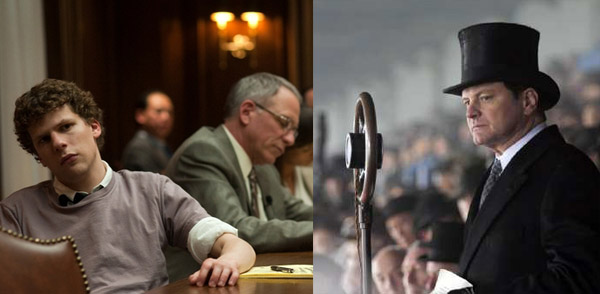
Analysis: I'm not exactly sure what planet we're on where Colin Firth is being trumpeted as being long "overdue" for an Oscar. Firth could probably get in line with about 50 award-less actors and wouldn't be at the front. He's a superb actor, but it's difficult to envision anyone thinking him not possessing a gold statue is a horrifying injustice that needs to be corrected immediately. But this is the Academy and sometimes there's just no rhyme or reason to what they do. You could say his win is really a make-up for an even better performance he gave last year that was snubbed in A Single Man, which not enough people saw for him to be rewarded. So, Eisenberg never really had a chance here as it was decided in voters' minds Firth would win before his film was even released or they saw his performance. The controversy surrounding how "true-to-life" his unlikable Mark Zuckerberg is won't help either. Plus, Firth brilliantly plays a character with a handicap who overcomes the odds. So go ahead and just hand him the Oscar right now. It's a great performance, but Eisenberg's is better, if not so much for what he does chooses to do, but what he doesn't. He'll lose due entirely to politics, as is often the case with these races. Bardem, Bridges and Franco-- thanks for coming. And given how busy Franco's been lately an Oscar would probably just be an unneeded distraction.

Will Win: Colin Firth
Should Win: Jesse Eisenberg
Could win: Jesse Eisenberg
Snubbed: I don't know. DiCaprio maybe? Clooney? Gosling?  Not exactly a banner year in this category.


Best Actress

Annette Bening, "The Kids Are All Right"
Nicole Kidman, "Rabbit Hole"
Jennifer Lawrence, "Winter's Bone"
Natalie Portman, "Black Swan"
Michelle Williams, "Blue Valentine"

So, let's talk about Portman. In my review of Black Swan I was really hard on her. Probably too hard, especially considering I loved the film and her performance, which lived up to all the hype and then some. My criticism of her as actress does actually come from a positive place. I just feel she never fully delivered on the promise she showed as a child in films like The Professional and Beautiful Girls in the early '90s. I expected a great career that never really materialized and its place came Star Wars prequels and other suspect choices with middle-of-the-road performances, so that's probably much of the basis for my disappointment. That said, me basically saying the movie is about her being a bad actress (she isn't) or comparing this to Sandra Bullock's victory last year (which I actually didn't have a huge problem with anyway) was a bit unfair. This work is clearly more substantial and her career trajectory far less embarrassing. And, believe it or not, no complaints from me that she's starring in movies like No Strings Attached and Thor because I always thought her biggest problem was that she needed to loosen up and try different roles like that. There's no question she deserves this, which is really saying something considering her competitors in this category, especially Lawrence who was incredible. Haven't seen Kidman or Williams yet but just knowing their previous work as actresses it wouldn't surprise me if either (or both) gave a better performance than Natalie. But they have no shot. This should be a lock, but prepare yourself just in case. No matter how ridiculous the character she played was, Bening is the only one here capable of matching Portman in a popularity contest, plus she's "overdue" (there's that word again).


Will Win: Natalie Portman
Should Win: Natalie Portman
Could Win: Annette Bening
Snubbed: Emma Stone (Easy A)


Best Supporting Actor

Christian Bale, "The Fighter"
John Hawkes,"Winter's Bone"
Jeremy Renner, "The Town"
Mark Ruffalo, "The Kids Are All Right"
Geoffrey Rush, "The King's Speech"

Analysis: In a category sometimes prone to upsets we have two frontrunners battling it out. The result of this will likely tell the tale of just how much momentum The King's Speech has because if longtime Academy favorite Geoffrey Rush can upset Bale here it could mean very bad news for The Social Network. It would signal early that the film will sweep clean across the board, possibly even adding Supporting Actress to its awards haul for the night. Just the fact that Rush even got in here with a nod and Andrew Garfield didn't is revealing (and alarming) enough in itself so that endorsement has to be factored in when trying to call a winner. But at least Rush is in the right category this time as opposed to 1996 when he won a Lead Actor Oscar for what was arguably a supporting performance in Shine. Now is probably a good time to mention that I haven't seen The Fighter, but we all know anyway the smart money's on Bale who underwent another astonishing physical transformation, this time dropping an alarming amount of weight to play crack addict/former boxer Dicky Eklund. Having won the Globe and the SAG already it's unlikely (though not impossible) that he'd lose. As great as it would be for Dustin from Eastbound and Down and Lennon from Lost to win an Oscar, I don't see it happening (this year at least) for the awesome John Hawkes, who would probably split my vote with Renner, whose performance is actually better than it's been getting credit for. But their nominations are reward enough, especially considering all the deserving actors left out. Someone who is actually overdue, Mark Ruffalo, finally gets nominated for something, but the role's just too lightweight to make an impact in this race.

Will Win: Christian Bale

Should Win: Having not yet seen Bale's performance, and based on what I've seen, I'd probably say Hawkes. 
Could Win: Geoffrey Rush (and it wouldn't be much of an upset either)
Snubbed: ANDREW GARFIELD- How is he not nominated? (The Social Network), Armie Hammer (The Social Network), Justin Timberlake (The Social Network), Vincent Cassel (Black Swan)


Best Supporting Actress

Amy Adams, "The Fighter"
Helena Bonham Carter, "The King's Speech"
Melissa Leo, "The Fighter"
Hailee Steinfeld, "True Grit"
Jacki Weaver, "Animal Kingdom"

The only category where literally ANYONE can win. It's like this every year, or at least since Marisa Tomei's 1991 win for My Cousin Vinny. For whatever reason this race always seems to be full of drama and excitement, usually commencing in gasps of shock and awe in the auditorium when the winning name is read. This year is no exception as Melissa Leo was thought to have this thing all wrapped up until she went rogue, taking out some controversial Oscar campaign ads for herself. Yes they're kind of silly and the timing wasn't the best but if voters actually hold this against her they need a reality check because their job is to judge the performance on screen. Plus, what choice is she left with when the studio refuses to promote her? There aren't exactly lots of golden opportunities out there for character actresses pushing fifty so if anything she should at least be commended for putting herself out there. If this stunt ends up costing her (and it could), Hailee Steinfeld will be the spoiler, but confusion over why a lead performance is being placed in a supporting category could kill her chances outright. Of the nominees, Leo's co-star Amy Adams is an underdog but many still feel she gave the better performance. That the undeserving Bonham-Carter even made it in (and sadly has a great chance of winning) is a credit to only how ridiculously overpraised The King's Speech is. Jacki Weaver was tremendous as a motherly sociopath in the gripping, underseen Australian crime thriller Animal Kingdom, if only enough voters knew about the performance and the film. But even she still has a very good shot here. This one's wide open.

Will Win: Melissa Leo
Should Win: Pass...until I see all the nominees 
Could Win: Hailee Steinfeld 
Snubbed: Rooney Mara (The Social Network), Marion Cotillard (Inception), Mila Kunis (Black Swan) Greta Gerwig (Greenberg), Olivia Williams (The Ghost Writer), Chloe Grace Moretz (Kick-Ass)


OTHER CATEGORIES (WINNERS IN BOLD)

Best Animated Feature

"How to Train Your Dragon"
"The Illusionist"
"Toy Story 3"

Best Foreign-Language Film


"Biutiful" (Mexico)
"Dogtooth" (Greece)
"In a Better World" (Denmark)
"Incendies" (Canada)
"Outside the Law" (Algeria)

Best Original Screenplay

"Another Year," written by Mike Leigh
"The Fighter," written by Scott Silver, Paul Tamasy and Eric Johnson. Story by Keith Dorrington, Paul Tamasy and Eric Johnson
"Inception," written by Christopher Nolan
"The Kids Are All Right," written by Lisa Cholodenko and Stuart Blumberg
"The King's Speech," screenplay by David Seidler

Best Adapted Screenplay

"127 Hours," screenplay by Danny Boyle and Simon Beaufoy
"The Social Network," screenplay by Aaron Sorkin
"Toy Story 3," screenplay by Michael Arndt. Story by John Lasseter, Andrew Stanton and Lee Unkrich
"True Grit," written for the screen by Joel and Ethan Coen
"Winter's Bone," adapted for the screen by Debra Granik and Anne Rosellini

Best Original Score

"How to Train Your Dragon," John Powell
"Inception," Hans Zimmer
"The King's Speech," Alexandre Desplat
"127 Hours," A.R. Rahman
"The Social Network," Trent Reznor and Atticus Ross

Best Original Song

"Coming Home" from "Country Strong," music and lyrics by Tom Douglas, Troy Verges and Hillary Lindsey
"I See the Light" from "Tangled," music by Alan Menken, lyrics by Glenn Slater
"If I Rise" from "127 Hours," music by A.R. Rahman and lyrics by Dido and Rollo Armstrong
"We Belong Together" from "Toy Story 3," music and lyrics by Randy Newman

Art direction

"Alice in Wonderland," production design: Robert Stromberg; set decoration: Karen O'Hara
"Harry Potter and the Deathly Hallows -- Part 1," production design: Stuart Craig; set decoration: Stephenie McMillan
"Inception" production design: Guy Hendrix Dyas; set decoration: Larry Dias and Doug Mowat
"The King's Speech" production design: Eve Stewart; set decoration: Judy Farr
"True Grit" production design: Jess Gonchor; set decoration: Nancy Haigh

Cinematography

"Black Swan," Matthew Libatique
"Inception," Wally Pfister
"The King's Speech," Danny Cohen
"The Social Network," Jeff Cronenweth
"True Grit," Roger Deakins

Costume design

"Alice in Wonderland," Colleen Atwood
"I Am Love," Antonella Cannarozzi
"The King's Speech," Jenny Beavan
"The Tempest," Sandy Powell
"True Grit" Mary Zophres

Best Documentary (feature)


"Exit Through the Gift Shop," Banksy and Jaimie D'Cruz
"Gasland," Josh Fox and Trish Adlesic
"Inside Job," Charles Ferguson and Audrey Marrs
"Restrepo," Tim Hetherington and Sebastian Junger
"Waste Land," Lucy Walker and Angus Aynsley

Best Documentary (short subject)

"Killing in the Name," nominees to be determined
"Poster Girl," nominees to be determined
"Strangers No More," Karen Goodman and Kirk Simon
"Sun Come Up," Jennifer Redfearn and Tim Metzger
"The Warriors of Qiugang," Ruby Yang and Thomas Lennon

Film editing

"Black Swan," Andrew Weisblum
"The Fighter," Pamela Martin
"The King's Speech," Tariq Anwar
"127 Hours," Jon Harris
"The Social Network," Angus Wall and Kirk Baxter

Makeup

"Barney's Version," Adrien Morot
"The Way Back," Edouard F. Henriques, Gregory Funk and Yolanda Toussieng
"The Wolfman," Rick Baker and Dave Elsey

Best short film (animated)


"Day and Night," Teddy Newton
"The Gruffalo," Jakob Schuh and Max Lang
"Let's Pollute," Geefwee Boedoe
"The Lost Thing," Shaun Tan and Andrew Ruhemann
"Madagascar, carnet de voyage," Bastien Dubois

Best short film (live action)

"The Confession," Tanel Toom
"The Crush," Michael Creagh
"God of Love," Luke Matheny
"Na We We," Ivan Goldschmidt
"Wish 143," Ian Barnes and Samantha Waite

Sound editing

"Inception," Richard King
"Toy Story 3," Tom Myers and Michael Silvers
"Tron: Legacy," Gwendolyn Yates Whittle and Addison Teague
"True Grit," Skip Lievsay and Craig Berkey
"Unstoppable," Mark P. Stoeckinger

Sound mixing

"Inception," Lora Hirschberg, Gary A. Rizzo and Ed Novick
"The King's Speech," Paul Hamblin, Martin Jensen and John Midgley
"Salt," Jeffrey J. Haboush, Greg P. Russell, Scott Millan and William Sarokin
"The Social Network," Ren Klyce, David Parker, Michael Semanick and Mark Weingarten
"True Grit," Skip Lievsay, Craig Berkey, Greg Orloff and Peter F. Kurland

Visual effects

"Alice in Wonderland," Ken Ralston, David Schaub, Carey Villegas and Sean Phillips
"Harry Potter and the Deathly Hallows -- Part 1," Tim Burke, John Richardson, Christian Manz and Nicolas Aithadi
"Hereafter," Michael Owens, Bryan Grill, Stephan Trojanski and Joe Farrell
"Inception," Paul Franklin, Chris Corbould, Andrew Lockley and Peter Bebb
"Iron Man 2," Janek Sirrs, Ben Snow, Ged Wright and Daniel Sudick

Monday, February 21, 2011

Five Favorite Scenes: The Social Network


As I keep digging into The Social Network Blu-ray (so how about that weird packaging and the brilliantly bizarre title menu?) I've come to the conclusion that if it wins Best Picture that's great, but if it doesn't, well then, that's fine too. The Academy has impressively avoided rewarding the most deserving film for the past 83 years so why start now? No validation is necessary here because this is far and away, hands down the best film of this past year or any other recent one and nothing even comes remotely close. Oscar or not. It's best just to celebrate the achievement on its own terms and remind oneself that Driving Miss Daisy won Best Picture. See? That feels better already. As we all know, losing might actually be the best thing for it. For all the controversy surrounding the truthfulness of the movie I think it says a lot about Time's "Person of the Year" Mark Zuckerberg for publicly being a good sport and taking this bullet like a man for the sake of his company. Aaron Sorkin's script loosely incorporates real facts into a semi-fictional work so damning it makes Oliver Stone's W. look like a tribute documentary and it wouldn't have taken but a phone call to his lawyers for Zuckerberg to stop this project altogether (or at least prevented the use of his name and Facebook's trademarks). But he didn't. Give him credit for being seemingly one of the few to actually grasp this is meant for entertainment. He had to be slandered and dragged through the mud for the film to work as well as it does.

Back in October, I attempted a somewhat objective assessment of the film knowing my time to rant and rave about its greatness would get here soon enough. So now it's here. Director David Fincher has gone on the record humbly insisting his film isn't as "important" as Zodiac and if we're going strictly by their topics, he's right.  Only movies are rarely about their actual topics. Such is the case with The Social Network, a film no one said could be made, based on a topic no one wanted to see explored on screen. The level of difficulty here was insurmountable. I'd say in terms of actual execution this feels more important than anything he's done so far. So, how did Sorkin and Fincher ever make a movie about Facebook? Well, for starters, they didn't. Ranked in non-chronological order below are my five favorite scenes/moments in the film, along with accompanying thoughts. Obviously, SPOILERS follow.


5. MEET SEAN PARKER 


This brief, but memorable scene toward the middle portion of the picture when the action moves to the West Coast marks the first onscreen appearance of Justin Timberlake as Napster founder Sean Parker. It also marks the first instance of applause erupting from the theater I saw it in (the second: the reveal of Mark Zuckerberg's "Ardsley Athletics" T-Shirt). Has there ever been a better character introduction? If I could pick one scene that exemplifies the strength of Sorkin's writing it would probably be this brief sequence. Even over the "Did I adequately answer your condescending question?" lawsuit deposition scenes. A strange statement, but I just love the way this whole exchange unfolds and doesn't take the predictable route you'd expect given the situation.

It's reasonable that Parker would know every little detail about Amy (Dakota Johnson) from Stanford because he's Sean Parker and he does his research. So there's a glimpse of actual common sense in a movie script. Yet somehow Sorkin writes the scene in such a way that she still seems right in step with him and doesn't come across as an airhead for not knowing who he is, or worse, just a slutty party girl who woke up as his latest conquest. Of course, he finds out about "Thefacebook" through someone else, which is typical, and sets the stage for his leech-like behavior later as a charismatic opportunist who sees his opening and takes it. It's easy to see how Zuckerberg fell under his spell and bought what he was selling and why the purely idealistic Eduardo would hate his guts. The more times I watch the film the better Timberlake's performance seems, dropping subtle clues that the likable but flawed Parker was destined all along to make that pathetic police station phone call to Zuckerberg at the end of the film because that's what always happens with him. We get our first glimpse of that here.


4. HARVARD CODE OF CONDUCT


One of the film's more exciting, overlooked aspects was being given full access to Harvard University without really being given access to Harvard, a setting we've really never seen fully exploited on screen before (let's not count 2001's Harvard Man). Fincher changes that, miraculously giving us a very specific sense of time and place without ever even filming at the actual location (Fincher was forced to use Wheelock College as a stand-in) and it's a feeling especially present in the opening campus scenes. The two self-professed "gentlemen of Harvard" who best exemplify this world and our preconceived notions of it are Cameron and Tyler Winklevoss, twin rowers who find their idea for a campus social networking site hijacked by Mark Zuckerberg. Supposedly the real twins were thrilled at their depiction in the film, which is hilarious on too many levels to list. Then again, everything involving the Winklevi is hilarious as played by Armie Hammer in the best depiction of preppy entitlement ever put to screen.

I like how Sorkin doesn't write them as villains or bullies, but hard-working guys who had an idea that really could have been stolen out from under them. And they've got a strong case, which leads to their meeting with clueless, hysterically patronizing Harvard President Larry Summers (Douglas Urbanski) in which they futilely attempt to convince him that Zuckerberg's in violation of Harvard's student "Code of Conduct." Their allegations sound as ridiculous to him as the idea of making a movie about them seemed to us. You could compile another separate list of the twins' greatest moments ("I'm 6'5, 220 and there's two of me!") but this scene best exemplifies how the actor immerses himself in two very different and distinct personalities. As dark and nasty as the film gets at times, Hammer insures that it's also a comedy.


3. RICH MAN


Leave it up to Fincher to somehow find the one Beatles song that hasn't been played out. In a career packed with memorable musical moments he always seems to pick just the right song and put it in the perfect place for maximum effect, but he outdoes himself here. You could argue that with Reznor and Ross' haunting score the entire picture is a musical moment unto itself (their brilliantly twisted version of "In The Hall of the Mountain King" during the twins' Henley Royal Regatta rowing race is obviously one of many highlights) but what else but the under-appreciated 1967 Beatles B-Side "Baby, You're A Rich Man" could possibly wrap up the conundrum that is Mark Zuckerberg, or at least the fictional version of him presented here.

The "likability" of the character, and his obsessive desire to be popular, is something that's returned to many times as we get the unofficial closer to his conversation with Erica at the bar, except this time in a conference room with attorney Marylin Delpy (Rashida Jones, getting to deliver that unforgettable final line).  He might end up as a billionaire but this Zuckerberg never cared about money at all which might be his only link to the real-life counterpart, making the ending song choice especially ironic. Sitting alone at the computer, pathetically refreshing the page to see if Erica accepts his friend request is also the least pathetic and most understandable choice Zuckerberg makes in the film, confirming the trace of humanity we suspected he had throughout.


2. THE BAR 


Supposedly, Fincher filmed 99 takes of this opening scene in the bar to knock all the acting out the two actors, which kind of makes sense when you consider they're delivering Sorkin's dialogue. Anyone who watched The West Wing or any of his other TV or film projects knows how wordy it is and how fast it needs to come out. If it it doesn't it can really sound like someone's reading from a script, which you obviously never want. The best thing about Eisenberg's performance is how he almost invisibly implies on his face all these emotions that his character seems incapable of even expressing to anyone.

As Erica, Rooney Mara has an even tougher job here, having to sell that she would even like and date this guy to begin with, then by the end of a single 8 minute conversation be believably fed up enough with his arrogant antics to just walk. She knows his game and won't stand for it, making all the misogynistic accusations leveled against the picture seem ridiculous, especially considering the women always seem much smarter than the guys throughout the film (save Eduardo's psycho girlfriend). With minimal screen time Mara makes us believe that letting Erica go is a mistake Zuckerberg won't ever be able to live down. When we get to the final scene the big revelation isn't that he built a billion dollar company to impress her, but that he believes giving it all up for another chance would be worth it. The scariest part: He's right.


1. EDUARDO SAVERIN'S MELTDOWN


Oh, that "Facebook movie." So cold, cynical, detached and unemotional. Such unlikable characters. Speaks to the mind, not the heart. No one has any FEELINGS. And that's only the second biggest misconception about the film. The biggest is one that Fincher's addressed in many interviews and involves the perception of the picture as some kind of cinematic landmark that speaks to a generation (one that ironically refused to support the movie and probably cost it a few Oscars). I expressed my own doubts on that when I reviewed it and see his point since it usually takes decades to make such a determine any film's value as a cultural touchstone. It also burdens the movie with added pressure it doesn't even need because it's important enough just as what it is: A perfectly directed, written and acted coming-of-age drama about the destruction of a friendship. And it all builds to this. 

Eduardo enters Facebook headquarters a boy but walks out a man after realizing he had the screws put to him by his best friend And in a movie packed with endlessly quotable lines, the criminally un-nominated Andrew Garfield gets to deliver its best to Timberlake's befuddled Parker, a verbal blow anyone caught in a volatile confrontation wished they could come up with in the heat of the moment. After being used and stepped on (though it's a credit to Garfield's performance it never exactly seems that way) Eduardo finally learns the hard way how to stand up for himself becoming the emotional center of what's otherwise been described as the most unemotional of films. He's our way in. Even though its characters talk endlessly, the film wisely holds a lot back in terms of what they're actually thinking and feeling until here, why is why this breaking point moment registers as powerfully as it does.

Images: DVD Beaver

Tuesday, October 5, 2010

The Social Network


Director: David Fincher
Starring: Jessie Eisenberg, Andrew Garfield, Justin Timberlake, Rooney Mara, Armie Hammer, Max Minghella, Brenda Song, Rashida Jones
Running Time: 121 min.
Rating: PG-13

★★★★ (out of ★★★★)

SPOILERS FOLLOW 


You are going to go through life thinking girls don’t like you because you’re a nerd. I can tell you from the bottom of my heart that that’s not true. It’ll be because you’re an asshole.”  


David Fincher's The Social Network doesn't waste any time. It gets down to business right away and if you thought going in this would just be "The Facebook Movie" it takes only until the end of the verbally explosive opening scene to change your mind. In it, future Facebook CEO Mark Zuckerberg (Jesse Eisenberg) gets dumped by his girlfriend Erica Albright (Rooney Mara) after she tires of putting up with his obsession with gaining entry into Harvard's "final clubs" because they'll lead to a better life. They talk and talk, firing Emmy-winning writer Aaron Sorkin's dialogue at and over each other at machine gun speed in a crowded, dimly lit bar with the conversation becoming more contentious as he turns sarcastic and condescending. At first, she almost seems interested, almost amused, until it becomes obvious this is someone without a clue how to interact with people, and as shocked as he is at being dumped, we are at how he got a date with her in the first place. Then comes that blistering quote above. That question of whether Zuckerberg really is an asshole never completely goes away. And if he is, does that preclude him from being a genius? Or a visionary? Or maybe he's just lucky. We don't get what resembles an answer until the final scene but it's the aftershock of the opening one that reverberates through the rest of the picture.

That night, the brutal break-up sends Zuckerberg sprinting back to his dorm room to drunkenly blog about Erica and with the help of his best (and only) friend, Eduardo Saverin (Andrew Garfield), create a stir with a server-crashing page called "FaceMash," a "Hot or Not" type application where guys get to rate and compare the physical attractiveness of females on campus. With that the idea of Facebook is planted and one of the elements I appreciated most in Sorkin's screenplay is its full acknowledgment that Zuckerberg didn't exactly invent the light bulb here, but expanded on what was already being implemented shoddily by Friendster and MySpace. It's all in the execution, much of which revolves around the added ingredient of "exclusivity," or the notion that people want to feel as if they're in on something cool. That's what the other social networking sites were missing and once it's incorporated into what was then known as "THE Facebook" the possibilities became endless, as did the pitfalls. Ironically, Zuckerberg provides the perceived social acceptance for people online he could never receive himself on campus until meeting the Winklevoss Twins (Armie Hammer), crew team jocks who recruit him as programmer for their new relationship-based "Harvard Connection" web site emerging (coincidentally or not) just as Zuckerberg launches his.

The story is mostly told through flashbacks and interspersed with courtroom depositions from the two lawsuits eventually brought against Zuckerberg by the twins claiming intellectual property theft and from co-founder Saverin, who's cut out of his piece of the pie by his best friend as the company expands. The wedge driving them apart is Napster founder Sean Parker (Justin Timberlake), a hard partying hype machine looking to latch on to the next big thing after lawsuits from the music industry bled him dry. What's so funny is as the company grows bigger and bigger the further removed it becomes from the original conceit of re-creating the social experience of college online. With expansion comes at least some degree of exclusivity lost and you're left wondering whether the whole thing really would have been better off confined to campuses, since Facebook, as we know it now, has inadvertently come closer to re-creating the social experience of high school more than college. More importantly, we're also left wondering whether Zuckerberg would have been better off since the "better life" he wished for himself didn't necessarily include being the CEO of a billion dollar company. Money isn't the primary motivator for someone who shows up to courtroom depositions wearing jeans and Adidas flip-flops.

Jesse Eisenberg wasn't just the best choice for Zuckerberg, but the only actor who could have possibly done justice to the role, giving his most complex performance yet and one that should finally end those annoying and unjustified Michael Cera comparisons. Having already occupied one end of the spectrum with awkward portrayals of sensitive nerds who win the girl at the end, he leaves the nerd part intact, but removes nearly every other emotion. His trademark accessibility as a performer is muted, offering the character up as a damaged, rejected soul so frustrated at his social incompetence (which borders on Asperger's) and obsessed with fitting in that he uses the only weapon he has: His I.Q. Surprisingly, Timberlake's performance as opportunistic party animal Sean Parker isn't the strongest among the major supporting players but it's important to put that in perspective since he still steals every scene he's in. At first glance he appears to be playing an exaggerated version of himself but his work grows on you and the more you think back on it the more you have to love the irony of music's biggest superstar giving inspirational speeches extolling the virtues of internet piracy and file sharing.

British actor (and future Spider-Man) Andrew Garfield, steals the movie out from under everyone as Eduardo Saverin, the company's CFO who's betrayed by his best friend. We anticipate a smooth, cool operator in full control but Garfield conveys a certain vulnerability and wimpiness that suggests he's being taken for a ride and used as Zuckerberg's doormat, yet he still manages to find a way to make him not come off as a fool. He earns the most sympathy and while still not totally blameless emerges as the biggest victim no matter how many different sides of the story seem to be presented. It's his story as much as Zuckerberg's and you should probably get familiar with his laptop smashing meltdown at Facebook headquarters as you'll likely be seeing many clips of it over the next few months.

As twin rowers Cameron and Tyler Winklevoss (AKA the "Winklevii"), Armie Hammer, aided by Fincher's impressive Benjamin Button-level technology, creates two separate and unique personalities, identical only in never knowing how it feels to not get what they want, as Zuckerberg puts it. Consider how unlikable they could have been and appreciate how Hammer prevents that, to the point that you actually kind of feel bad for these privileged kids and want to take their side, if only because no one else will. With just two and a half scenes and under five minutes of screen time, Rooney Mara is unforgettably devastating as the catalyst of this social earthquake and it'll be a while before I forget that look on Erica's face when she realizes how Zuckerberg humiliated her. Facebook was about a girl, which makes perfect sense since everything always is. Speculation can now start as to whether she's real, fictitious or maybe resides in that gray area in between. 

Watching the deposition scenes and seeing each character's point of view gives us no better understanding of the truth since all that can be said for sure is that each character believes completely what they're saying. Similarly, you're left to watch and wonder how much if any of Sorkin's script (adapted in part from those depositions and Ben Mezrich's non-fiction novel, The Accidental Billionaires) can be considered a reliable interpretation of real-life events. Supposedly, the real Zuckerberg hasn't seen the film but has gone on record stating it's fictional and meant to be fun.  And on that count he's right, especially anything involving the twins and Zuckerberg's hilariously sarcastic "testimony."  Whether he's viewed it or not, or whether he actually means that or not, he may have unintentionally hit the nail on the head in terms of the right approach to take with this. And there are definitely worse things than being an important enough American figure to warrant a picture of this quality.

With Fincher and Sorkin involved I knew this wouldn't actually be ABOUT Facebook, but it's still amazing just how little it is about it and how much is accomplished with what looked on paper to be the most laughable of topics for a feature film. We should have known not to doubt them when we first hear Trent Reznor and Atticus Ross' unforgettably unnerving and moody score and see just how dark and gloomy everything looks, confirming that the director who made Fight Club and Zodiac most definitely made this. And as challenging as it should have been to maneuveur around a subject that potentially deals with a lot of talking and sitting around at computers and boardrooms, it's surprising the number of scenes that consist of that, and how tension-filled and exciting they are. 

Comparisons are being made to Citizen Kane, but in all fairness those stem mostly from narrative and thematic similarities, which are plentiful. Like Kane, Zuckerberg gets lonelier and more isolated as he rises to the top, except he manages to spread his loneliness to everyone else. We're all now as socially disconnected as he is, while strangely somehow feeling more connected, at least on some superficial level. Yet there's something admirable and anti-heroic about the character because he set out to achieve a goal and did it the only way he knew how.

How you enter The Social Network is a big determining factor as to how you'll feel when you leave, mainly because of that mysterious phenomenon known as "HYPE," a force capable of cutting down any film, regardless of quality. It seems for a change I was actually able to keep my insanely high expectations mostly in check, resulting in them being exceeded. And as difficult as it's been, I've been careful to contain my praise knowing plenty of opportunities should arise for me to gush about it further in the coming months. It'll be interesting to find out how a film so timely and dependent on current technology will age, but I bet if you showed it to an audience ten years ago and told them this is the direction we're headed, their eyes probably would have popped out of their heads.

It's entirely too early to determine whether it "speaks to a generation" but it definitely speaks to the moment and there is a feeling that its story of greed, loneliness and betrayal has a fighting chance at outlasting the social phenomenon that spawned it. Despite not caring much for Facebook, I'd never suggest the story behind it doesn't deserve to be told, especially when it's constructed as brilliantly as this. The Social Network makes the strongest case yet for Facebook's existence, being that we couldn't have gotten this film without it.