Showing posts with label Ryan Coogler. Show all posts

Friday, June 27, 2025

Sinners

Director: Ryan Coogler
Starring: Michael B. Jordan, Hailee Steinfeld, Miles Caton, Jack O' Connell, Wunmi Mosaku, Jayme Lawson, Omar Miller, Delroy Lindo, Peter Dreimanis, Lola Kirke, Li Jun Li, Saul Williams, Yao, David Maldonado, Helena Hu, Buddy Guy
Running Time: 137 min.
Rating: R

★★★ ½ (out of ★★★★)    

Writer/director Ryan Coogler takes a big swing with his supernatural drama Sinners, which burns slowly until erupting into a full blown horror spectacle. Following a first half that draws favorable comparisons to Killers of the Flower Moon, we're prepared for the possibility this too will be a historical exploration into generational trauma, racism and religion. And it is, only with Coogler taking a wildly different turn to get there, with music functioning as these characters' paths to salvation. 

Sharing a lot more in common with 1996's From Dusk Till Dawn than the franchise projects Coogler's known for, it's a uniquely conceived genre period piece that doesn't sacrifice the mainstream appeal of his previous work. But what sticks out most is how he deftly handles challenging material that could have gone wrong in any number of ways. While the writing and performances carry an opening hour we'd rather not see end, the real insanity starts when he pulls the trigger and all hell breaks loose.

It's 1932 and identical twins and World War I veterans Smoke and Stack Moore (Michael B. Jordan) return to their hometown of Clarksdale, Mississippi after working for the Chicago Mob for years. Upon purchasing an old sawmill from a local landowner, they plan to open a juke joint establishment for the Black community with singing, dancing and a bar. They're joined by their cousin Sammie (Miles Caton), an aspiring guitarist whose pastor father believes blues music is the devil and would far rather his son be at church. 

The twins also recruit Smoke's girlfriend Annie (Wunmi Mosaku) as cook, town drunk Delta Slim (Delroy Lindo) as their pianist, sharecropper Cornbread (Omar Miller) as a bouncer and local Chinese shopkeeper spouses Grace (Li Jun Li) and Bo Chow (Yao) as suppliers. Despite distractions stemming from the animosity Stack's mixed-race ex-girlfriend Mary (Hailee Steinfeld) harbors toward him and Sammie's infatuation with married singer Pearline (Jayme Lawson), the opening is a success. At least until the arrival of vampire Remmick (Jack O' Connell) with married Klu Klux Klan couple Bert and Joan (Peter Dreimanis and Lola Kirke), who crave much more than blood. 

If trailers and commercials didn't already hint where the story's headed, you'd wonder what the feared, respected Smokestack Twins are up to when they arrive, throwing their weight around like they own the town. Unfailingly loyal one minute, brutally violent the next, it's clear the money and connections they've made in Chicago has only strengthened their grip over Clarksdale. Distinguishable by their contrasting red and blue hats, they're also simultaneously loved and hated by residents, many of whom know better than to cross them. 

As the brothers attempt to get the joint off the ground, we see another side of them that's filled with regret and determined to create something that will bring this community together through a shared love of music. The loyalty is evident in their recruitment of Sammie, who limps into his father's church bruised and battered in the film's opening flashforward, offering a hint of what's to come. With music and excitement filling the air, an Remmick's gang crashes these opening night festivities as they attempt to assimilate everyone into their undead cult, resulting in a power struggle between good and evil.     

While the vampires seemingly share a hive mind, Irish immigrant Remmick plans to builds this family around an appropriation of Black culture, with Coogler introducing some not so thinly veiled symbolism regarding racism in the Deep South and the corrupting influence of hate. There to consume and exploit, the vampires view a highly vulnerable Sammie as their missing key due to his extraordinary musical talent. But before they can get to him, others are converted one-by-one with a single bite as they're hauled up inside fighting for their lives as seeds of mistrust are sown and alliances tested.

Jordan gives a powerhouse turn in his dual role as the intimidating, hotheaded Stack and a more contemplative Smoke, somehow managing to leave little doubt as to who we're watching in any given scene. And once the twins' seemingly unbreakable bond is broken, Jordan's performance shifts into another gear, enabling the actor to display his action chops. 

Newcomer Caton holds up his end of the deal as Sammie, tracking his journey from young, impressionable sharecropper to blues hero. Steinfeld also leaves an indelible mark as the white-passing Mary, who's pretty much beloved by everyone despite the messy unfinished business with Stack. Lindo, Mosaku, Lawson and Li are all equally exceptional in their varied roles, with each fully fleshed out and given a considerable amount of attention. And thanks to some astounding visuals and Oscar winner Luwig Göransson's blues and folk infused score, everything comes together in a way we quite haven't seen before.   

After the big showdown, there's no returning to yesterday, or even earlier that same afternoon. Once this band of mysterious intruders show up at their doorstep, the surviving characters' lives are permanently transformed and the real protagonist is forced to process it for the rest of his life. With that, Coogler sticks the landing in one of the few post-credit scenes to function not as a gimmicky device, but an unmissable coda the film couldn't exist without. It's a crucial reveal used to maximum effect, giving us a little more to contemplate and the urge to watch it all again through a different lens. 

Saturday, February 11, 2023

Black Panther: Wakanda Forever

Director: Ryan Coogler
Starring: Letitia Wright, Lupita Nyong'o, Danai Gurira, Winston Duke, Angela Bassett, Florence Kasumba, Dominique Thorne, Michaela Coel, José Tenoch Huerta Mejía, Martin Freeman, Julia Louis-Dreyfus, Michael B. Jordan
Running Time: 161 min.
Rating: PG-13

★★★ (out of ★★★★) 

It's usually a bad sign when a sequel gets released and you find yourself struggling to remember all that happened in the previous film. But in the case of Black Panther: Wakanda Forever, that might not be be such a bad thing considering how much this revolves around starting over. While the original came out in 2018, it may as well have been decades ago given all the speculation surrounding how Marvel Studios and director/co-writer Ryan Coogler would push the the franchise forward after star Chadwick Boseman's tragic passing. Just the idea of continuing seemed crazy given how much that movie's success rested entirely on his shoulders. Of course, we always knew they'd just forge ahead and do it anyway. But if it's true that the superhero genre isn't dependent on actors or stars for success, this could stand as the toughest test yet.

Moving past the initial uproar of someone else potentially "replacing" Boseman, the key was always in not making it feel that way by honoring his legacy. It's a difficult line to walk, but luckily the franchise's overarching themes and tone do make this slightly less challenging. Marvel was never going to put the series on the shelf, but it's better to do it now while the responsibility of doing right by Boseman, his family and fans hang over them. So it comes as a relief that Coogler accomplishes this by crafting a story feels like a natural progression for the universe and its characters. Realizing the best approach is often the honest one, everything springs from that cataclysmic loss, resulting in one of the more un-Marvel like movies in their canon.

After failing to save her terminally ill brother King T'Challa from a mysterious illness with the heart shaped herb, Shuri (Letitia Wright) and all of Wakanda mourn him, including his mother, Queen Ramonda (Angela Bassett). A year later Wakanda is now facing pressure from other nations to share their vibranium, soon finding themselves under attack for the resource. But when the U.S. military utilize a vibranium detector to locate a potential supply underwater, they're violently thwarted by a group of blue-skinned, water breathing Talokans led by Namor (José Tenoch Huerta Mejía). 

With the CIA inaccurately blaming Wakanda for the attack, Ramonda and Shuri are paid a visit by Namor who demands they bring him the scientist responsible for building the detector or he'll attack their nation. But once Shuri and Okoye (Danai Gurira) confront the scientist, an MIT student named Riri Williams (Dominique Thorne), chaos ensues. With Namor holding Wakanda responsible for the vibranium battle and determined to wage war on the surface world to protect Talokan, Shuri's faced with a choice: join him or suffer the consequences.

A prologue covering the death and funeral of T'Challa makes abundantly clear the challenge Wakandans will face without their king. It's only logical the story would now shift to his sister Shuri, and whatever controversy surrounded Letitia Wright's continued involvement with the franchise, she delivers as the film's centerpiece. If increasing her character's importance was the right call from a narrative standpoint, nearly all of Wakanda's universe is also expanded here, allowing others to shine in ways they couldn't in the preceding entry. So while it's difficult for anything to compete with the personal stakes of T'Challa vs. Killmonger, this next chapter avoids direct comparisons, as Coogler and co-writer Joe Robert Cole present a fresh set of obstacles, using elements from the original film as their blueprint. 

A commanding Angela Bassett is given a much bigger stage as Ramonda, conveying the character's pain of losing a son, protecting her only daughter and keeping Wakanda safe from outside forces. It's just unfortunate that the blue-skinned, indigenous, water breathing Talokans and colonization plot will likely draw endless Avatar comparisons because this story holds up pretty well on its own. Keeping the focus where it belongs, Shuri's torn between spirituality and science, this time with an angrier edge due to her brother's death. The eventual feud with Namor is more complex than expected since he's not exactly a one-dimensional villain, just as driven by the need to protect his people as Shuri, but utilizing dangerously aggressive, gatekeeping methods that lead to all out war. 

Lupita Nyong'o's stealthily skilled Nakia is in a far different place both literally and figuratively, with the actress given more to do this time around, reentering the fray with a renewed outlook and motivation following T'Challa's death. Dominque Thorne makes for a spunky sidekick as Riri, with the young genius from Chicago serving as a clever counterpart to Shuri while playing a vital role as the plot progresses. Martin Freeman and Julia Louis-Dreyfus have limited but functional roles as CIA operatives tied to the vibranium conflict, providing some fun interplay between some of the heavier action scenes.

With Namor believing a weakened Wakanda is ripe for the picking now that Black Panther is gone, someone else donning T'Challa's suit becomes as inevitable as the person who needs to do it. Coogler handles this as well as possible, leading to an ending that leaves enough on the table for future installments. The only caveat is that after a surprisingly enthralling two and a half hours, we still get a requisite CGI battle to close things out. But even that plays unusually well, thanks in no small part to the attachment we have to these characters. It's also one the rare times a Marvel mid-credits scene feels essential, serving this saga rather than potential cross-overs. That makes sense since the original film's biggest attribute was standing out from the pack. As a purposeful continuation that respectfully keeps the ball rolling, Wakanda Forever stays true to that, while also managing to navigate some emotionally difficult terrain.      

Thursday, May 5, 2016

Creed


Director: Ryan Coogler
Starring: Michael B. Jordan, Sylvester Stallone, Tessa Thompson, Phylicia Rashad, Tony Bellew, Graham McTavish, Wood Harris, Andre Ward, Gabriel Rosado, Ritchie Coster
Running Time: 133 min.
Rating: PG-13

★★★ ½ (out of ★★★★)

If it's true that everything starts with an idea, it helps to have a really good one and the ability to deliver on it. I'd imagine director/co-writer Ryan Coogler's pitch of a new Rocky film was initially met with a skeptical eye roll from both studio executives and maybe even a few of the actors he approached to be a part of it. And given the state of the franchise after some underwhelming sequels and a disappointing 2006 curtain call, it's hard to blame them. Despite not counting myself a huge fan of the original and among those frequently questioning its 1977 Best Picture victory in a highly competitive year, even I'd have trouble denying its cultural impact. It's one of the few Oscar winners still remembered and talked about to this day, regardless of the extent to which its sequels somewhat tarnished its legacy.

Anyone looking to recapture the feelings of goodwill that first film generated in so many you'd need a really strong narrative hook. With Creed, Coogler finds it. And in doing so he makes the ultimate Rocky movie and the one everyone's been waiting for without knowing they wanted it. In the most purely honest way possible, he tricks us into watching another entry by not making one. It isn't until the last scene that you realize what happened, and by the point, you're at too much of an emotional high to get hung up on it. By their very nature, sports movies follow a certain formula, but in the best ones there's this magic that takes place that transports audiences and makes them forget, even as the script and its characters sink deeply into it. Formulas do exist for a reason, but a good director, like a magician, never reveals his tricks. In Creed, all the wheels are turning but we're never consciously aware of the machinations.

Cleverly, the sequel/spin-off is jump-started with one question: What about Apollo Creed? We know Rocky's opponent, friend and mentor (played by Carl Weathers) died in the ring, but he left someone behind. A son from an extramarital affair named Adonis "Donnie" Johnson (Michael B. Jordan), who's been fighting and starting trouble since his days at a youth detention facility in the late 90's. It wasn't until Apollo's widow, Mary Anne (Phylicia Rashad) took him in that he started to have anything resembling a normal upbringing. Fifteen years later, he's on the fast track to a promotion at a Los Angeles-based financial firm, even as something eats away at him. He goes down to Tijuana on the weekends to box, demonstrating the burning desire to fight that's persisted since childhood.

After being rejected at his father's gym, he quits his job and heads to Philadelphia, landing at the doorstep of Adrian's restaurant and in front of the only man he knows can train him: His dad's opponent, friend and mentor, Rocky Balboa (Sylvester Stallone). Initially reluctant, Rocky agrees, but when word gets out that Donnie is Creed's son, the marketing potential of that teaming can't be ignored, so despite being nowhere near ready, Donnie must prepare for the fight of his life against the world lightweight champion, "Pretty" Ricky Conlon (Tony Bellew), an intimidating British brute preparing for a retirement bout before he heads to prison. And in doing this, Donnie must not only come to terms with taking on his late father's name, but do justice to his legacy even as he struggles with his own.

All this manages to work so well due to a series of creative decisions made by Coogler that are played to perfection, each piece of the puzzle organically falling into place to create a maximum entertainment experience from start to finish. It isn't much of a stretch to buy that Apollo Creed has an illegitimate son who felt abandoned, or that he'd harbor much of the rage his father did, not to mention many of his fighting skills. And it's even less of one to believe that the emotionally beat down Rocky we see here (an incarnation that's a far cry from any previous outing) wouldn't want to be near the ring again in any capacity, either as a cornerman or trainer because of what it dredges up. But we also know that he can't resist and as much as the underdog story parallels that of the original, it's surprising just how different it feels in both tone and execution, shot and edited to more closely resemble something grittier, like Southpaw or The Fighter. And Ludwig Göransson's soundtrack effectively pays tribute to pieces of Bill Conti's original score without attempting to slavishly mimic or overuse it.

There's an urgency here that went missing through most of the sequels and a familiarity in also acknowledging their purposeful existence in getting the characters to this point, most of whom we're meeting for the first time. The result feels new and fresh, releasing the franchise of the baggage and stigma that's weighed it down over the past couple of decades. This is the mentor role Stallone should have probably played already, but feels strangely even more appropriate now because he's at the stage of his life and career where he's caught up to us, and feels ready. In a way, it's similar to Mickey Rourke's role in The Wrestler in how it works on this meta level that almost makes it impossible to separate the role from what we know about the actor playing it. He's not at all "playing himself" but rather using his and the character's rich history to create this whole other layer from which he draws from to create this deep performance, his strongest and quietest dramatic turn since Copland.

When a development occurs that turns Rocky's world inside-out it should feel manipulative, but doesn't because Coogler and co-writer Aaron Covington understand that this is the natural progression for a lonely guy who's world really ended when Adrian died. Much like the series itself, he was just going through the motions. Training Donnie briefly alleviates that and Stallone's scenes opposite the perfectly cast Jordan are magnificent, recalling not only the best training sequences from the Rocky films, but some of the more memorable mentoring relationships captured on film, like that in The Karate Kid.

Previously working with Coogler when he played shooting victim Oscar Grant in 2013's Fruitvale Station, Jordan gave a superb performance in service of a film that didn't completely return the favor. With it came the responsibility of playing a real-life figure whose death ignited a firestorm of controversy. Here, he's shouldering a different kind of responsibility, and as the centerpiece and driving force behind an iconic franchise, he's the new Rocky. Or more accurately, the first Adonis Creed, with Jordan drawing on his own physical preparation for the role and natural charisma and intensity. He leaves little doubt Adonis is very much his father's son, and it's only when he comes around to fully accepting that, will he be able to step out from behind his shadow.

But his trajectory does seem to mirror Rocky's more than his dad's with not only his untrained underdog status as a fighter, but burgeoning relationship with Bianca (Tessa Thompson), a hearing impaired musician in his building whom he starts to date. Even this is handled exceptionally well, as intrinsically weaved into the plot as Rocky's romance with Adrian. It helps that the completely engaging and likable Thompson shines in every scene she's given, sharing excellent chemistry with her co-star. It's kind of one of those happy surprises that this turns out as well as it does, while also managing to be subtly touching at times, never forcing the issue. Just two great actors doing their thing.

For the first time in a while it feels like we're building to a fight worthy of the hype it's gotten through faux HBO video packages cleverly interspersed into the film, raising the stakes much higher than they've been in the franchise's recent history. Creed's opponent is a monster who carries himself like a serial killer and has about ten times the experience, practically mirroring Balboa's predicament in the original. With an outcome that's legitimately in doubt, the final fight is masterfully filmed and edited, giving us room to breathe and take in the action, showing just how far the staging of these sequences have come since the worst of the previous installments. Everything about this carries a "big fight" feel, and the result is the right one, despite my worries of its implications for the franchise moving forward.

As much as I care what happens to these characters, I'm still hesitant in wanting more. While I loved what we got, and maybe even prefer it to the original in many ways, part of me wishes they'd stop here before it's too late. We all know that won't happen as long as there's money to be made, but the last thing we need is a succession of inferior sequels made by rotating directors that devalue the achievement of Coogler and his talented cast. But who knows? Maybe it's possible to craft a worthy Creed follow-up if everyone's on the same page. But it'll be tough to top the rush you get here when the Rocky theme swells up at just the right moment, knowing it's being played again in a movie that's truly earned it.

Monday, March 31, 2014

The Spectacular Now, Fruitvale Station


The Spectactular Now  
Director: James Ponsoldt 
Starring: Miles Teller, Shailene Woodley, Brie Larson, Jennifer Jason Leigh, Kyle Chandler
Running Time: 95 min.
Rating: R

★★★ ½ (out of ★★★★)

High school coming-of-age movies have fallen a considerable height from the glory days of John Hughes, where teens were treated as three-dimensional people viewers of any age could root for and care about. A brief description of The Spectacular Now would easily fool anyone into thinking it's joining the recent scrap pile. Bad boy meets good girl and she has to redeem him. But director James Ponsoldt and (500) Days of Summer screenwriters Scott Neustadter and Michael H. Weber flip that premise on its head, delivering a smart, sensitive drama that doesn't pander to its audience, while insightfully observing real life problems without a hint of manipulation or contrivance. Each decision feels carefully considered, with so much resting on the standout performances of the two leads, who are given the opportunity to play flawed, likable characters we want to see happy, independent of whether they end up together or not.

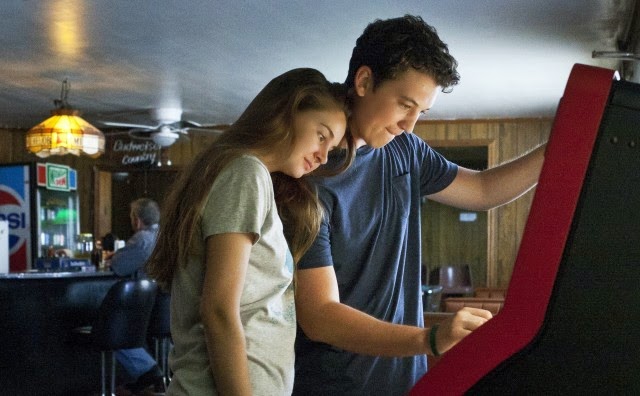
Miles Teller plays popular, but unambitious high school senior Sutter Keely, whose daily life consists of an endless stream of drinking and partying, with little thought given to his future. In a rare touch for the genre, Sutter's vices don't look fun in the least, depicted instead as a serious addiction that's taking over. He's basically a teenage alcoholic. His equally popular girlfriend (Brie Larson) dumps him and it's gotten to the point that even his mother (Jennifer Jason Leigh) can't put up with it anymore.

After a late-night partying binge he wakes up on the lawn of classmate Aimee Finnicky (Shailene Woodley), a pretty but socially invisible "girl next door" who reads manga and has a paper route. They start seeing each other. Sort of. That their relationship can't easily be classified because of how different they are is one of the film's biggest strengths and what follows is complicated, but in an authentic, messy kind of way.

Upon Sutter realizing he's actually falling hard for this girl, his thoughts shift to him not being deserving of her and there's this intriguing mystery that develops involving Sutter's long-absent dad (a brilliant Kyle Chandler). It's a supporting performance perfectly calibrated to subvert and challenge expectations of not only the character and story, but the actor playing him. Even seemingly minor players like Sutter's boss, Dan (Bob Odenkirk) are so richly drawn in their brief appearances you'd imagine a film focusing on them would be just as rewarding. As Sutter's older sister Holly, Mary Elizabeth Winstead conveys that there's even more to her than originally thought, the character's snobby demeanor merely a defense mechanism masking the emotional pain of their upbringing.    

Ponsoldt knows not to try too hard and at a turning point where everything could have flown off the rails, he resists the temptation, choosing even more honesty. That this takes place in unnamed "Smalltown, U.S.A" in an unidentifiable era brings a universality to the story, allowing it to exist in a timeless vaccum. No one will be laughing at the music and clothes years down the line, as is usually the case with most other high school movies. What will be remembered is how Teller and Woodley take familiar character types and make them feel completely fresh, him with offbeat goofy charm and her with a realness and authenticity that never come off as "acting." And just watch what she does in that killer final scene. She's too good to be toiling away in YA franchises, even if this was ironically adapted from a young adult novel. Let's just pretend the giant check she's cashing for Divergent is really for this.


Fruitvale Station
Director: Ryan Coogler
Starring: Michael B. Jordan, Melonie Diaz, Octavia Spencer
Running Time: 85 min.
Rating: R

★★ ½ (out of ★★★★)

Despite certain misgivings I have about about the film itself, none of them affect my feelings about Michael B. Jordan's performance as Oscar Grant, the young man shot and killed by a Bay Area Rapid Transit police at Oakland's Fruitvale Station on New Year's 2009. If anything, I wish that first-time writer/director Ryan Coogler's effort had the subtly and nuance of Jordan's performance, which sets a high bar the picture can't quite reach. There's little doubt that Oscar Grant was far from perfect. He was only human. And there's also little doubt what happened on that train platform was an avoidable tragedy with more than enough blame to go around, along with some unfortunate coincidences and bad luck. To say the transit cops handled the situation poorly would be a gross understatement, but it's hard not to feel Coogler's trying to unnecessarily stack the deck. The facts tell the story, yet he insists on going beyond that, to the point that by the film's finish it almost feels like we've gotten a public service announcement.

The film follows the last day of the 22-year-old Californian's life before being fatally shot on that train platform, circumventing the rocky relationship he has with his girlfriend and the mother of their infant daughter, Sophina (Melonie Diaz, really strong), and his own mother, Wanda (Octavia Spencer). It paints a picture of an ex-con trying to do right and get on the straight and narrow for his family. For all we know much of it may have gone down as depicted. But certain details feel too convenient, with Coogler going so far out of his way to avoid portraying his subject as a saint that he ends up doing exactly that.

There's an early scene in which Oscar tries to save a dying dog hit by a car. Besides the incident being drenched in heavy-handed symbolism and blatant foreshadowing, I could have done without animal cruelty (real or simulated) to show us Oscar's a good guy. And just to level things out we also get a scene where he threatens his boss. No one thinks this young man "deserved" what eventually happens so it's perplexing that we're being lectured on his morality with contrived situations. Maybe they happened. Maybe not. But it rings false in the context of this film.

It's when we finally get to that train platform that things start to feel real. How the situation escalates to the point it does is so fascinating and disturbing that you almost wish the whole movie was this incident in real time, if it wasn't so difficult to watch. Coogler's clearly a skilled director, making excellent use of shaky cam to give us a found footage feel and show various points of view from different witnesses. Certain details from earlier pay off in surprising ways, creating a storm of events that tragically converge at the station. The last half hour earns its emotional response by doing away with the editorializing and grandstanding and just showing what happened .

Anyone who's seen Friday Night Lights knows how great an actor Michael B. Jordan is and so much of that natural charisma and quiet intensity is on display here. We care about Oscar because of his performance, one that too often must battle to overcome the script's flaws. It's a problem when a film is based on true events and you can't believe much of what happened even it it's completely true. The last shot reveals the film's true intentions. And that's the roadblock when tackling a controversial real life issue. Judgments and intentions are best checked at the door.