Showing posts with label Miles Teller. Show all posts

Thursday, September 8, 2022

Top Gun: Maverick

Director: Joseph Kosinki
Starring: Tom Cruise, Miles Teller, Jennifer Connelly, Jon Hamm, Glen Powell, Ed Harris, Val Kilmer, Lewis Pullman, Monica Barbaro, Charles Parnell, Danny Ramirez, Bashir Salahuddin, Manny Jacinto, Raymond Lee, Lyliana Wray, Jean Louisa Kelly
Running Time: 130 min.
Rating: PG-13

★★★★ (out of ★★★★)

When the final book's written on Tom Cruise's career, it's a pretty safe bet that Top Gun: Maverick, the long awaited follow-up to his 1986 blockbuster, will be one of the primary talking points. The actor not only reenergizes familiarly nostalgic material so well you'd think he never left his rule-breaking pilot behind, but director Joseph Kosinki delivers a film that summons the spirit of Tony Scott's original. Expertly made with the sensibilities of a huge 80's action spectacle, it takes everything that was special about its predecessor and expands upon it, resulting in a pitch perfect sequel that surpasses the highest of expectations. On a technical level, there's little doubt these action scenes are superior, but what's more impressive is Kosinki's firm grasp on what was needed for this to really work, just as he previously proved with his criminally overlooked TRON: Legacy. 

The movie knows what it is and wastes no time getting there, making for one of the breezier, endlessly enjoyable 130 minutes you could spend watching a huge budget franchise movie. And while a quintessential big screen experience, it's still not hard to imagine viewers returning to it from the comfort of their own couches for a while to come. And by providing thrills that go beyond the adrenaline-fueled flight sequences, it further establishes Cruise as an expert at managing his own brand, again navigating the line that separates movie star and actor. This is the best possible combination of both, proving an ideal showcase for his talents and a welcome surprise for those understandably complaining they just don't make them like they used to.

Over 30 years after graduating from the TOPGUN program, U.S. Navy Captain Pete "Maverick" Mitchell (Cruise) is a test pilot whose constant insubordination and recklessness has kept him from rising up the ranks. But upon hearing that Rear Admiral Chester "Hammer" Cain (Ed Harris) is shutting down his jet program in favor of funding killer drones, Maverick responds by flying a prototype jet beyond Mach 10 and into high-hypersonic in a last ditch attempt to save the program.

Just as Caine intends to ground him for the stunt, Maverick's old friend and current U.S. Pacific Fleet Commander Tom "Iceman" Kazansky (Val Kilmer) intervenes to save his career, assigning him to NAS North Island, where he's ordered to train an elite group of TOPGUN graduates for an extremely dangerous mission. As a disinterested Maverick is tasked with leading a new team to the bottom of an enemy nation's canyon to destroy an unsanctioned uranium enrichment plant, Naval Air Force Commander Beau "Cyclone" Simpson (Jon Hamm) takes a strong disliking to the cocky, headstrong pilot, based mostly on reputation alone. 

Further complicating matters is that one of Maverick's students is Bradley "Rooster" Bradshaw (Miles Teller), son of his late best friend, Goose, who resents him for intentionally sitting on papers that held up his military career. He'll not only have to earn Rooster's respect, but that of the team's other pilots like flashy LT Jake "Hangman" Seresin (Glen Powell), determined LT Natasha "Phoenix" Trace (Monica Barbaro) and the unassuming oddball LT Robert "Bob" Floyd (Lewis Pullman). Struggling to let go of the past, Maverick reconnects with ex-girlfriend and bar owner Penny Benjamin (Jennifer Connelly). But he'll need to step up, as the future of the entire TOPGUN program and the safety of these pilots now falls entirely on him.

Where Maverick's head is at decades after the original's events concluded makes sense given what we've known about the character. He definitely wouldn't be a higher ranking officer given his rebellious propensities and was inevitable he'd still be punishing himself over Goose's death all these years later. But screenwriters Ehren Kruger, Eric Warren singer and Christopher McQuarrie use this as a jumping off point to inject fresh blood into the story, returning a beaten down but still highly skilled Maverick back to his old stomping grounds, as the last remaining vestige of a bygone era. 

Disrespected and underestimated by establishment loyalists like Cain and Cyclone, he's viewed as a hotheaded liability standing in the way of evolving technology. He's warned his day is coming, an ironic statement given how the film's built on honoring the past, or more specifically, repurposing the strengths of Scott's original for modern audiences. Middle-aged Maverick is still the same daredevil, but those tactics are frowned upon and whatever remains of his career depends on Iceman keeping him afloat.

Iceman gives Maverick this assignment not as some kind of favor, but because he's the right man for the job and the pilots need his guidance to form a cohesive unit. Iceman knows Maverick's his own worst enemy and their emotional scene together draws parallels between the characters' shared history,  weaving Val Kilmer's own cancer struggle into Ice's narrative in a manner that feels inspiring rather than tasteless. What Kilmer does in place of his vocal limitations makes this brief reunion soar, with the actor saying more with his eyes and facial expressions than most actors could in words. Cruise matches him beat-for-beat and the events that follow only lend more weight to a conversation that will have more than a few fans fighting back tears.

Rather than take the predictable, unimaginative way out in having Rooster blame Maverick for his father's death, the script tackles their tension from a different angle, with the mentor determined to keep a well-intentioned promise that's no longer as relevant as he thinks. The idea he's still suffering from PTSD of sorts over his best friend's death has led him to fear history repeating itself with Rooster, creating an intriguing dynamic and tension that permeates through their scenes together.

Rooster and Hangman's feud mirrors Maverick's classic one with Iceman and largely stems from their wildly different flying philosophies and hunger to be the best. Unfortunately, Rooster hasn't yet fully harnessed his capabilities and plays it safe while Hangman's showboating arrogance endangers everyone else. A well cast, mustachioed Miles Teller seems every bit Goose's son (especially in his scenes opposite Cruise) as Glen Powell channels Harrison Ford's Han Solo with a memorably charismatic supporting turn. 

The rest of the team have easily identifiable personality traits and quirks that make them easy to root for, but aren't overdone. The pilots have a job to do and the disciplined script keeps the focus there, with some well placed character moments and Top Gun call backs to compliment it. The original's campier elements are toned down, with the iconic but undeniably silly beach volleyball sequence channeled in the form of a similar football game that does a better job moving the story forward while eliminating the cringe factor.  

The Maverick and Penny romantic subplot cited by some as a weak spot is actually far from it, serving as a blueprint for exactly how such a storyline should be handled in this kind of picture. Casting Jennifer Connelly was a masterstroke, but the writers take a throwaway reference to this unseen admiral's daughter character from the original and cleverly expand upon it, correctly assuming diehards will get onboard and the uninitiated won't feel lost. That the pair already have an established shorthand and rocky history spares us an awkward introduction or feeling out process.We know just enough. 

Connelly never makes single mom Penny a Kelly McGillis replacement, but rather the only character besides Iceman who understands what makes Maverick tick having come from a similar world. As the rare age appropriate on screen love interest for the actor, she and Cruise share an effortless chemistry, now giving the long underrated, swooned over Connelly greater exposure with that elusive blockbuster hit she's deserved for decades. She also brings something completely different out of Cruise, who's probably never been this likeably human as a romantic lead before.  

The exhilarating last act utilizes practical effects along with some seamless CGI and VFX for the awe inspiring flight scenes. It probably helps that the actors are actually inside the cockpits with the cameras, and though they're not piloting the jets, were extensively trained as if they are. While the closing mission visually and narratively recalls the destruction of the Death Star at the end of Star Wars: A New Hope, it takes a turn with Maverick and Rooster relying on each other to survive what seems like an insurmountable predicament.

Kosinki and Cruise's Mission: Impossible editor Eddie Hamilton earn credit for keeping everything tight and exciting, leaving viewers hanging off their seats as they hurl toward a rousing resolution that doesn't overstay its welcome. Claudio Miranda's amazing aerial cinematography, Han Zimmer's throwback score (incorporating elements of the original's theme), and yes, even Kenny Loggins' "Danger Zone," bolster the overall package, ticking every box possible for a legacy sequel. 

Delayed in post-production with multiple writers attached, few took Top Gun: Maverick seriously going in. But again we underestimated Cruise's superhuman ability to enforce quality control in his projects. He'll eventually have to move onto smaller, more character driven parts, but that he can make this feel like one of those is why we can wait. A seamless blend of action and plot, he takes us on the ultimate ride, proving his onscreen authenticity and understanding of what audiences want is what's always separated him from the pack. After watching it, that Days of Thunder sequel suddenly doesn't seem like such a bad idea anymore.                                                

Sunday, January 18, 2015

Whiplash


Director: Damien Chazelle
Starring: Miles Teller, J.K. Simmons, Paul Reiser, Melissa Benoist, Austin Stowell, Nate Lang, Chris Mulkey, Jayson Blair
Running Time: 106 min.
Rating: R

★★★★ (out of ★★★★)

        ***SPOILER WARNING: THIS REVIEW DISCUSSES MAJOR PLOT POINTS IN WHIPLASH, INCLUDING THE ENDING***

"There are no two words in the English language more harmful than good job."

Whiplash audiences will undoubtedly be split into two groups: Those who find its shocking final minutes uplifting and inspirational, cementing the film as a motivational story of being pushed to become the very best in the face of insurmountable pressure. And others who will view it as a tragedy that warns of the dangers of walking too close to the edge of greatness, and the personal cost and sacrifice that often comes with it. Neither interpretation is necessarily incorrect since second-time director Damien Chazelle drops it all on our laps, our reactions revealing just as much about the viewer as it does the actual film.

After the credits roll it takes a couple of minutes to take a breath and process what's happened, until realizing you've been had. Not tricked or manipulated, but taken on the same exhilarating ride as the protagonist, down an organic, inevitable path we were as complicit in following as he the entire time. The thrilling crescendo is a brave, jaw-dropping sequence that pulls the rug right out from under us, presenting the harsh reality of what this film's really about while posing important questions audiences can ponder indefinitely. Everyone will have a different answers.

The ideas Chazelle presents here aren't ones I can ever recall being addressed in a movie, or at least never like this. The contemplation of whether emotionally traumatic experiences make us stronger or weaker is fertile ground and the mentor-student relationship is rarely explored at levels this complicated or confrontational. Executed within the claustrophobic confines of a psychologically tense thriller and a moving coming-of-age story, it turns the viewer into an active participant, on edge and anxiety-ridden over the developing situation. And at its center are two incredible performances backed by a powerful, jazz-infused soundtrack. Despite concerns it strikes such a nerve that it could be too draining or uncomfortable to even experience again, it's too well performed, written and directed for anyone to deprive themselves of multiple viewings.

Andrew Neiman (Miles Teller) is a 19-year-old jazz drummer accepted into the top-ranked Shaffer Conservatory in Manhattan where he's starting his fall semester. He spends most of his free time practicing, aspiring to become one of the drumming greats like Buddy Rich, to whom he frequently listens for inspiration. Andrew's dedication and skill catch the eye of renowned Shaffer conductor Terence Fletcher (J.K. Simmons), who holds a surprise audition that results in him joining his exclusive studio band. But it's clear early that Fletcher's instructional methods seem more in line with Full Metal Jacket's Gunnery Sergeant Hartman than a teacher at a prestigious music school. Screaming, cursing, throwing chairs and sometimes even physically assaulting his students, we're never quite sure if he's really this nuts or this is his plan, attempting to draw their best by motivating through fear and abuse.

Fletcher's favorite target is Andrew and we're not sure whether it's that he actually senses potential greatness in him or just smells weakness and needs to pounce. It's the potential promise of the former that keeps Andrew coming back, even as Fletcher uses that drive and desire to manipulate him, dangling a carrot of approval he'll never give and pushing him past his breaking point. It's approval he also doesn't get from his own family and a satisfaction he still can't even feel from being with his new girlfriend. He has to be the best. But what's the cost?

Hearts pound and pulses race when the clock hits 9 AM and the bald-headed, intimidating Fletcher, clad in all black, marches through the door and immediately starts in with the verbal abuse, terrorizing his students. He has huge outbursts, but the tenser and more quotable moments are found in the small, subtle jabs that make that make them feel three feet tall. There's this impending sense of doom and dread in every scene as the band plays, unsure when he's going to cut in and what he's going to say or do when that happens. With its emphasis on perfection and precision, music is the perfect outlet for a authoritarian personality like his, allowing him to pick apart every mistake, no matter how small. And still green as a freshman, Andrew makes many.

While it's frightening and deliriously entertaining to watch Simmons so thoroughly disappear into the skin of someone like this, what's most impressive is how he finds the shading to play him as a complicated person instead of the one-dimensional monster he could have so easily come across as. In the non-classroom scenes, he plays him as almost a regular (at times even empathetic) guy who hugs a friend, jokes around with a kid, strikes up meaningful personal conversations with Andrew and at one point mourns the passing of a former student. We're left wondering whether these are crocodile tears, but I'm speculating they're not. Fletcher does probably care, but for entirely different reasons and not in the same way most people would. He mourns only the loss of talent. What Simmons' work and Chazelle's script bring to Fletcher is this entire persona he puts on when he enters the classroom, almost as if it's his stage.

Those fleeting moments outside the classroom are what offer real psychological insight into Fletcher's philosophy, to the point where we can almost even understand where he's coming from.  One such conversation with Andrew results in that controversial quote above, cutting to the crux of the film and going a long way toward explaining his character's motivations. While the obvious comparison point to Simmons' turn is R. Lee Ermey's aforementioned drill instructor in Full Metal Jacket or maybe even John Houseman's law professor in The Paper Chase, even those performances don't carry the complexity and nuance his does here. Rarely has the Best Supporting Actor Oscar been this locked up, to the point that even announcing the winner feels like a formality.

Given Andrew's people pleasing personality and hang-ups, it's easy to see why he'd continue coming back to Fletcher for more, despite all the abuse. Miles Teller, who's often compared to a young John Cusack, usually lends an effortlessly easygoing and likable presence to his characters that's part goofy and confident, while also conveying an underdog quality of someone not yet comfortable in their own skin. Watching his journey is legitimately being put in the shoes of someone to which most can relate, with Simmons' performance becoming only that much stronger because of who's on the other end of it, and vice versa.

At first Andrew's a victim, but eventually his tolerance of it makes him an accessory, the obsession with being the best clouding his judgment of how much he can withstand. His dad Jim (Paul Reiser) is a failed novelist turned teacher who obviously cares deeply for his son, but this kind encouragement isn't going to push him to where he wants to be. A family dinner in which the other Neiman boys' accomplishments are thrown in his face only reinforces that. Besides feeling in need of a strong male role model, he's also at the crucial stage of his life where as much as he fears Fletcher, the idea of "failure" (as society defines it) scares him more.

Andrew could have gotten out of this at any time but doesn't. He keeps coming back for more, in search of approval he'll never get as he inches closer to the deep end. After finally gaining the confidence to ask out a pretty girl who works at the movie theater he frequents with his dad, he's again torn between who he is and eventually wants to be. Glee actress Melissa Benoist has only a few brief scenes as Andrew's girlfriend Nicole, but it's the unforgettable break-up that leaves the largest impression, revealing her as the true collateral damage of his obsession with greatness. Recalling the infamous bar scene that opened The Social Network, Andrew just talks and talks, unaware of the pain he's inflicting with each word. As a devastating mixture of sadness, anger and disbelief wash over her eyes, he keeps saying all the wrong things, pushing her away and moving even further from the Andrew we knew at the beginning of the film. Now fully consumed with becoming the best jazz drummer in the world, everyone else is just dead weight.  Even if he manages to mend his fractured family relationships, there won't be another Nicole.

Is there a line? Can you go too far?  In Fletcher's world you can never push someone hard enough if they want to be the best, which is a philosophy that fails to acknowledge that different talents respond differently. But according to him, those who can't cut it  weren't talented enough to begin with. Andrew gets to a place many have been, regardless of situation or circumstance, traveling so deep down the rabbit hole that he can't step back and assess how far this whole thing has gone. He may yet turn into a legendary drummer, but the envelope keeps getting pushed in terms of how much physical stress he can take (you'll be shocked how far the film goes in this regard) and how long Fletcher can get away with this without professional repercussions. For a little while there, we think Andrew has this epiphany, until Chazelle sets us up for the ultimate knockout blow.

It's in the final ten minutes that Andrew literally sheds his blood, sweat and tears pounding on the skins like never before to enter a performance zone neither he or Fletcher had anticipated was possible. Well, maybe Fletcher did. He delivers a chilling reveal at the beginning of the scene that jump starts the film's ride into masterpiece territory and all we can do is just nervously hang on, anticipating the outcome. He eventually gets what he wanted out of Andrew, confirming his methods pushed the student further than his perceived capabilities, into the realm of greatness. Was he right the entire time? Was this whole thing his plan? They both "win," seemingly extracting exactly what they wanted from each other, but the true long-term effects are yet to be measured.

Chazelle isn't condoning or condemning Fletcher's tactics since that's for us to decide. And this isn't a message movie. But it does speak volumes that at Andrew's lowest, most humiliating point he runs from the arms of his caring father right back to his tormentor, as the film transforms into a kind of educational Stockholm syndrome. And the look of awe on Paul Reiser's face conveys the many differing interpretations of this finale, as his son, if only momentarily, seems to earn the respect and approval of his abusive mentor. When Andrew hits that last drumbeat as we simultaneously cut to black, the film brilliantly withholds the key to solving its puzzle: His future. It's the ultimate twist because it literally redefines the idea of one, deflecting all the responsibility onto audiences attempting to decipher it.

Adapted from his own short film and as tight and carefully constructed as the jazz compositions you'll now likely be hearing in your nightmares, Chazelle accomplishes through kinetic editing and breakneck direction, an achievement that transcends its modest indie roots to become something truly great and universal. He creates a world in which it doesn't matter whether the events taking place could actually happen, because within the confines of this environment, they do. All the ideas and human complications Whiplash touches on are real, with its 106 minutes flashing by in what seems like an instant. It's not just a great film and the finest in a very strong year, but a twisted personality test that leaves you emotionally exhausted and physically spent. 

Monday, March 31, 2014

The Spectacular Now, Fruitvale Station


The Spectactular Now  
Director: James Ponsoldt 
Starring: Miles Teller, Shailene Woodley, Brie Larson, Jennifer Jason Leigh, Kyle Chandler
Running Time: 95 min.
Rating: R

★★★ ½ (out of ★★★★)

High school coming-of-age movies have fallen a considerable height from the glory days of John Hughes, where teens were treated as three-dimensional people viewers of any age could root for and care about. A brief description of The Spectacular Now would easily fool anyone into thinking it's joining the recent scrap pile. Bad boy meets good girl and she has to redeem him. But director James Ponsoldt and (500) Days of Summer screenwriters Scott Neustadter and Michael H. Weber flip that premise on its head, delivering a smart, sensitive drama that doesn't pander to its audience, while insightfully observing real life problems without a hint of manipulation or contrivance. Each decision feels carefully considered, with so much resting on the standout performances of the two leads, who are given the opportunity to play flawed, likable characters we want to see happy, independent of whether they end up together or not.

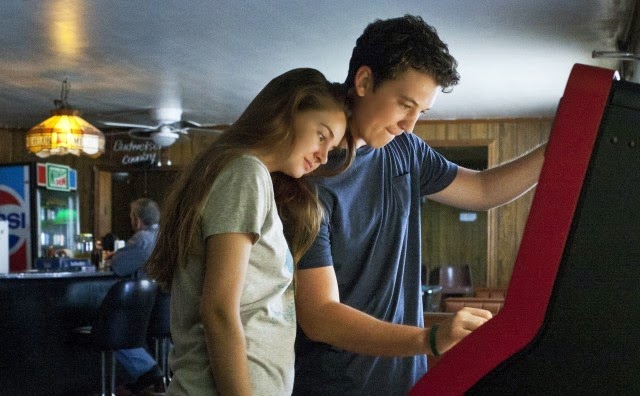
Miles Teller plays popular, but unambitious high school senior Sutter Keely, whose daily life consists of an endless stream of drinking and partying, with little thought given to his future. In a rare touch for the genre, Sutter's vices don't look fun in the least, depicted instead as a serious addiction that's taking over. He's basically a teenage alcoholic. His equally popular girlfriend (Brie Larson) dumps him and it's gotten to the point that even his mother (Jennifer Jason Leigh) can't put up with it anymore.

After a late-night partying binge he wakes up on the lawn of classmate Aimee Finnicky (Shailene Woodley), a pretty but socially invisible "girl next door" who reads manga and has a paper route. They start seeing each other. Sort of. That their relationship can't easily be classified because of how different they are is one of the film's biggest strengths and what follows is complicated, but in an authentic, messy kind of way.

Upon Sutter realizing he's actually falling hard for this girl, his thoughts shift to him not being deserving of her and there's this intriguing mystery that develops involving Sutter's long-absent dad (a brilliant Kyle Chandler). It's a supporting performance perfectly calibrated to subvert and challenge expectations of not only the character and story, but the actor playing him. Even seemingly minor players like Sutter's boss, Dan (Bob Odenkirk) are so richly drawn in their brief appearances you'd imagine a film focusing on them would be just as rewarding. As Sutter's older sister Holly, Mary Elizabeth Winstead conveys that there's even more to her than originally thought, the character's snobby demeanor merely a defense mechanism masking the emotional pain of their upbringing.    

Ponsoldt knows not to try too hard and at a turning point where everything could have flown off the rails, he resists the temptation, choosing even more honesty. That this takes place in unnamed "Smalltown, U.S.A" in an unidentifiable era brings a universality to the story, allowing it to exist in a timeless vaccum. No one will be laughing at the music and clothes years down the line, as is usually the case with most other high school movies. What will be remembered is how Teller and Woodley take familiar character types and make them feel completely fresh, him with offbeat goofy charm and her with a realness and authenticity that never come off as "acting." And just watch what she does in that killer final scene. She's too good to be toiling away in YA franchises, even if this was ironically adapted from a young adult novel. Let's just pretend the giant check she's cashing for Divergent is really for this.


Fruitvale Station
Director: Ryan Coogler
Starring: Michael B. Jordan, Melonie Diaz, Octavia Spencer
Running Time: 85 min.
Rating: R

★★ ½ (out of ★★★★)

Despite certain misgivings I have about about the film itself, none of them affect my feelings about Michael B. Jordan's performance as Oscar Grant, the young man shot and killed by a Bay Area Rapid Transit police at Oakland's Fruitvale Station on New Year's 2009. If anything, I wish that first-time writer/director Ryan Coogler's effort had the subtly and nuance of Jordan's performance, which sets a high bar the picture can't quite reach. There's little doubt that Oscar Grant was far from perfect. He was only human. And there's also little doubt what happened on that train platform was an avoidable tragedy with more than enough blame to go around, along with some unfortunate coincidences and bad luck. To say the transit cops handled the situation poorly would be a gross understatement, but it's hard not to feel Coogler's trying to unnecessarily stack the deck. The facts tell the story, yet he insists on going beyond that, to the point that by the film's finish it almost feels like we've gotten a public service announcement.

The film follows the last day of the 22-year-old Californian's life before being fatally shot on that train platform, circumventing the rocky relationship he has with his girlfriend and the mother of their infant daughter, Sophina (Melonie Diaz, really strong), and his own mother, Wanda (Octavia Spencer). It paints a picture of an ex-con trying to do right and get on the straight and narrow for his family. For all we know much of it may have gone down as depicted. But certain details feel too convenient, with Coogler going so far out of his way to avoid portraying his subject as a saint that he ends up doing exactly that.

There's an early scene in which Oscar tries to save a dying dog hit by a car. Besides the incident being drenched in heavy-handed symbolism and blatant foreshadowing, I could have done without animal cruelty (real or simulated) to show us Oscar's a good guy. And just to level things out we also get a scene where he threatens his boss. No one thinks this young man "deserved" what eventually happens so it's perplexing that we're being lectured on his morality with contrived situations. Maybe they happened. Maybe not. But it rings false in the context of this film.

It's when we finally get to that train platform that things start to feel real. How the situation escalates to the point it does is so fascinating and disturbing that you almost wish the whole movie was this incident in real time, if it wasn't so difficult to watch. Coogler's clearly a skilled director, making excellent use of shaky cam to give us a found footage feel and show various points of view from different witnesses. Certain details from earlier pay off in surprising ways, creating a storm of events that tragically converge at the station. The last half hour earns its emotional response by doing away with the editorializing and grandstanding and just showing what happened .

Anyone who's seen Friday Night Lights knows how great an actor Michael B. Jordan is and so much of that natural charisma and quiet intensity is on display here. We care about Oscar because of his performance, one that too often must battle to overcome the script's flaws. It's a problem when a film is based on true events and you can't believe much of what happened even it it's completely true. The last shot reveals the film's true intentions. And that's the roadblock when tackling a controversial real life issue. Judgments and intentions are best checked at the door.

Friday, May 18, 2012

Footloose (2011)


Director: Craig Brewer
Starring: Kenny Wormald, Julianne Hough, Dennis Quaid, Andie McDowell, Miles Teller, Patrick Flueger, Ray McKinnon, Kim Dickens
Running Time: 112 min.
Rating: PG-13

★★★ (out of ★★★★)

When the remake of Footloose was released last year I remember reading an interview with director Craig Brewer about how after initial reservations he was inspired to take on the project after viewing 2010's The Karate Kid remake with a cheering audience of 13-year-olds. He said that reaction put all his doubts aside and thought it would be arrogant for him to tell them the original is better and that they should be watching Ralph Maccio instead. And I can totally see his point.  I would never wish a child to have a bad time at the movies or try to tell him or her what they should or shouldn't be watching. I hope every kid who saw that remake loved it. After all, it was only made for them anyway. But that still won't change the fact I thought it was horrible and a blatant cash grab. So it's strange how his Footloose remake is the exact opposite of that, having more in common with both 1984 originals. It's actually for everyone. Yet they'll still be those who refuse to see it on the grounds that it shouldn't be happening at all and I respect that. Except this is really good, at points equaling (if not flat-out surpassing) the original. Of course it helps I don't hold the original film in such high esteem and could care less that they rebooted it, but a win's a win. Musicals just might be my least favorite genre so what a compliment it is that I never once felt I was watching a musical, but a story powered by the spirit of music its effect on the townspeople's lives.

The central idea around which the movie revolves always seemed kind of silly on paper and should have proven to be even more of a creative hurdle to clear when you set the story in the present day.  After a tragic car accident claims the lives of five youths in Bomont, Georgia following a party, the father of one of the victims and town reverend, Shaw Moore (Dennis Quaid) convinces the city council to pass an injunction that bans unsupervised public dancing within the city limits. Brewer cleverly sidesteps a flawed premise by actually showing the accident in the prologue. It may seem like a tiny change and it's certainly not depicted in any kind of graphic detail, but putting it onscreen makes the ban seem less ridiculous. Stepping into the iconic Kevin Bacon role, Kenny Wormald is Ren, a Boston teen arriving in the town to live with his aunt and uncle after his mother's death. He befriends the somewhat goofy Willard (Miles Teller, great in this) and is almost immediately attracted to Rev. Moore's daughter, Ariel (Julianne Hough), a wild child still acting out after losing her brother in the accident and shacking up with brutish dirt race driver Chuck (Patrick Flueger). As Ren and Ariel grow closer through their love of dancing, the rift between the adults and kids of the town continues to widen because of the ban.

Other than actually showing the inciting accident and replacing tractors with buses in a pivotal race sequence, there isn't much that's different from the original, but in this case, that's fine. There also seems to be a more eclectic mix of music this time around while still managing to squeeze in Kenny Loggins' infamously catchy title song (covered rather lifelessly by Blake Shelton over the closing credits) and Deniece Williams "Let's Hear It for the Boy." What Brewer does really well is flesh out the setting and its small-town characters so that everything looks and feels like it belongs a small southern town in 2011. There's a sense of time and place that never feels like you're watching actors on a sound stage. It won't ever be confused with Brewer's previous feature Black Snake Moan in that no scantily clad actresses get chained up to radiators but I was surprised just how much grit the movie managed with its PG-13. It's not exactly edgy but it isn't High School Musical either. There's also at least some kind of attempt at depicting racial diversity within the cast, which probably isn't an attempt so much as a reflection of reality inexcusably absent in most mainstream films about young people.  If its content qualifies it as mainstream fluff at least it never feels that way, even during the musical numbers which are well-placed and choreographed, rarely overstaying their welcome.

As Ren, Kenny Wormald is no Kevin Bacon but he is Kenny Wormald and that seems to work out. Bacon plays bad and tough better but his modern-day counterpart is likable and charismatic without being too vanilla. But it doesn't really matter since the movie belongs to co-star Julianne Hough in much the same way Bacon owned the original. While it's common knowledge she's an incredible dancer and really easy on the eyes, she goes the extra mile in delivering a surprisingly effective dramatic performance as a grieving daughter torn between the right and wrong side of the tracks, and commanding the screen well enough to launch a career that could easily extend beyond musicals. I keep hearing her being compared to a young Jennifer Aniston which was probably intended as a compliment from those forgetting Aniston wouldn't at any point be able to pull this part off. I'd even go as far as to say the movie succeeds mostly because of Hough, who's so perfectly cast it's almost a joke. Dennis Quaid appears initially to be just collecting another paycheck as the strict preacher but at the story progresses and the character develops he finds his groove, even if one key confrontational scene involving him in the third act seems a bit over-the-top and out of left field. And sure, the courtroom-heavy finale more closely resembles a school production of a mock trial than the fun that precedes it, but that's a small complaint when examining the big picture.

A satisfying explanation for this film's success couldn't possibly be provided by me as it's summed up best by Indiewire's Gabe Toro who wrote upon its release that "it captures exactly what MTV used to represent before the laws of capitalism swallowed the network whole." What a perfect description. Ironically MTV Films produced this, which almost feels like some kind of an accident as it harkens back to an era they've gone out of their way to bury. Embracing its cliches with confidence and sincerely wearing its heart on its sleeve, Footloose is completely honest and fun, reminding us not only of the reasons the original worked, but recreating the feeling of actually watching it. With so much mainstream entertainment dumbed down to the point that they may as well be commercials, here's a rare example of smart mainstream entertainment that's actually entertaining, evoking memories of 80's originals rather than the inferior remakes they continue to spawn.