Showing posts with label Jennifer Jason Leigh. Show all posts

Wednesday, May 26, 2021

The Woman in the Window

Director: Joe Wright
Starring: Amy Adams, Gary Oldman, Anthony Mackie, Fred Hechinger, Wyatt Russell, Brian Tyree Henry, Julianne Moore, Jennifer Jason Leigh, Tracy Letts
Running Time: 100 min.
Rating: R
 

★★ ½ (out of ★★★★)  

The most surprising aspect of Joe Wright's long gestating The Woman in the Window is how underwhelming the results are given the staggering amount of talent involved. Of course, this happens, as movies collecting dust in post-production are frequently dumped onto streaming services with little to no fanfare. But in this instance, Netflix actually went to some lengths to promote it, perhaps hoping the cast's pedigree would overcome its creative flaws, which keep piling up as its story becomes more involved and convoluted. It starts with rather transparent aspirations of honoring Hitchcock or De Palma before devolving into an inferior Scream sequel in its second half, complete with a clumsy reveal. And that's a shame since you can kind of see the skeletal framework of a film that may have really worked under different circumstances, as a few stronger performances seem in search of the better material these actors mistakenly thought they signed onto.

Based on a 2018 bestseller by A.J. Finn, that this script was adapted by Tony-winning playwright (and gifted character actor) Tracy Letts leads you to believe something got lost on its journey from his pen to the screen. That it was supposed to be released in late 2019 confirms as much, as viewers will be jumping through hoops to deal with some of the arbitrary contrivances before reaching an ending that lands with a thud. While there are laughs to be had, it mostly takes itself too seriously for that, especially when information comes to light that would have ended the film ten minutes after it started. Knowing this, it's unlikely many would have stuck around for the over-the-top third act that wraps up what's been a strange and wildly inconsistent mystery.

Depressed, agoraphobic child psychologist Anna Fox (Amy Adams) lives alone in her Manhattan brownstone apartment after separating from her husband Edward (Anthony Mackie), who currently has custody of their daughter, Olivia (Mariah Bozeman). Mixing drinks and medications on a daily basis, Anna's psychiatrist Dr. Landy (Letts) becomes concerned with her obsession of watching all the neighbors from a second floor window, while also acknowledging that interest could be a subtle sign of progress in her therapy. But when spouses Alistair (Gary Oldman) and Jane (Julianne Moore) Russell move in across the street with their teen son, Ethan (Fred Hechinger), Anna's takes her spying to another level.

After two separate encounters with a clearly dispondant Ethan and a flighty Jane, Anna begins suspecting the mother and son are trapped in an abusive household. When she believes she sees Jane get stabbed to death by husband Alistair through her zoom lens, his furious denials and attempts to discredit Anna to Detective Little (Brian Tyree Henry) begin. Anna's basement tenant, singer-songwriter David (Wyatt Russell), provides little help in corroborating her story while possibly hiding some secrets of his own. With her mental state deteriorating and everyone gaslighting her into doubting what she saw, Anna works overtime to put together clues that prove this horrific crime was really committed and not merely a construct of her fragile psyche.

While the film is all over the map in terms of plot, the amount of time it spent on the shelf probably helped it in some ways, at least as far as its themes of isolation seeming timelier than they otherwise would. And for about half the film, the script does seem very seriously interested in taking us into the fractured headspace of this woman who obviously experienced a severe trauma we only later discover the details of. 

Losing herself in classic movies and TV, Anna's exiled herself inside this apartment with her cat, and the remainder of her entertainment is provided by spying on this wealthy, dysfunctional family across the street. Other than  sporadic phone conversations with her estranged husband and the weekly psychiatric counseling, she's in her own world, reality hanging by a thread after an adjustment to her meds. 

Adams is really strong in these opening scenes and her interactions with Hechinger, as this desperately off, needy teen, are unnerving and affecting. But it's the entrance of an entertainingly loopy Julianne Moore as "Jane Russell" that sends everything into a tailspin, but not an altogether welcome one, through no fault of Moore's performance, which is probably better than the story deserves. 

After Anna witnesses Jane's murder the entire scenario goes down this rabbit hole where everyone starts questioning her sanity and the mystery unfolds as to whether everything's playing out in her head. The more information that's revealed the sillier it gets, more closely resembling one of those 90's direct-to-video thrillers than the Hitchcockian whodunnit it initially purported itself as being. 

Most of the film's charms are found in these supporting turns, with the possible exceptions of Gary Oldman's relegation to stock villainy and Jennifer Jason Leigh being given the least to do of anyone as the supposed "real" Jane Russell, an eleventh hour wrench thrown into the plot. While the characters are comparable to pieces on a game board, both Hechinger and Wyatt Russell make the most of what they're given, with the latter proving more than capable of handling darker material you'll wish was better after seeing his performance. And despite fairly limited screen time, Moore makes the biggest impact in her extended scenes opposite Adams, teasing the potential for a gripping mystery that just never quite gets off the ground.

This is one of those projects where the harder the script works, the returns only seem to keep diminishing. It's not a chore to sit through and Adams has a great grasp on her character, but whatever subtly the story had at its start literally goes, if you'll forgive the pun, out the window with a fascinating mess of a finale. Featuring a gotcha revelation that's partially confusing and not as surprising as you'd think, it really does channel one of those cheap slasher endings in all the wrong ways. 

Since Adams basically headlines every other film released these days, this feels like a bigger departure for Wright, who's a long way off from Atonement and Hanna, dipping his feet into the waters of a bargain basement thriller he tries his best to elevate. We'll never know the exact circumstances surrounding how The Woman in the Window turned out like it did, making it almost uncomfortable to assign blame. But even those able to have fun with this would have a tough time claiming it reaches its full potential, whatever that was intended to be.       

Monday, March 31, 2014

The Spectacular Now, Fruitvale Station


The Spectactular Now  
Director: James Ponsoldt 
Starring: Miles Teller, Shailene Woodley, Brie Larson, Jennifer Jason Leigh, Kyle Chandler
Running Time: 95 min.
Rating: R

★★★ ½ (out of ★★★★)

High school coming-of-age movies have fallen a considerable height from the glory days of John Hughes, where teens were treated as three-dimensional people viewers of any age could root for and care about. A brief description of The Spectacular Now would easily fool anyone into thinking it's joining the recent scrap pile. Bad boy meets good girl and she has to redeem him. But director James Ponsoldt and (500) Days of Summer screenwriters Scott Neustadter and Michael H. Weber flip that premise on its head, delivering a smart, sensitive drama that doesn't pander to its audience, while insightfully observing real life problems without a hint of manipulation or contrivance. Each decision feels carefully considered, with so much resting on the standout performances of the two leads, who are given the opportunity to play flawed, likable characters we want to see happy, independent of whether they end up together or not.

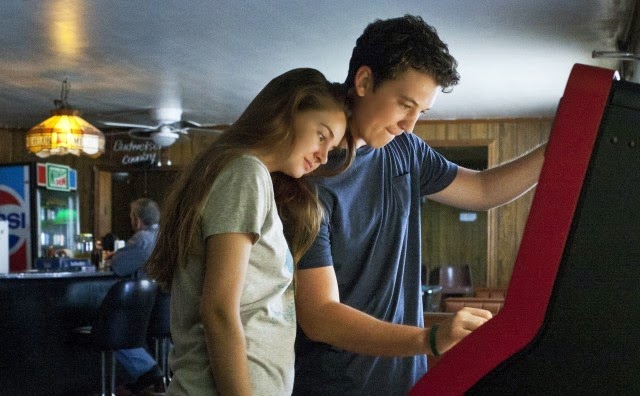
Miles Teller plays popular, but unambitious high school senior Sutter Keely, whose daily life consists of an endless stream of drinking and partying, with little thought given to his future. In a rare touch for the genre, Sutter's vices don't look fun in the least, depicted instead as a serious addiction that's taking over. He's basically a teenage alcoholic. His equally popular girlfriend (Brie Larson) dumps him and it's gotten to the point that even his mother (Jennifer Jason Leigh) can't put up with it anymore.

After a late-night partying binge he wakes up on the lawn of classmate Aimee Finnicky (Shailene Woodley), a pretty but socially invisible "girl next door" who reads manga and has a paper route. They start seeing each other. Sort of. That their relationship can't easily be classified because of how different they are is one of the film's biggest strengths and what follows is complicated, but in an authentic, messy kind of way.

Upon Sutter realizing he's actually falling hard for this girl, his thoughts shift to him not being deserving of her and there's this intriguing mystery that develops involving Sutter's long-absent dad (a brilliant Kyle Chandler). It's a supporting performance perfectly calibrated to subvert and challenge expectations of not only the character and story, but the actor playing him. Even seemingly minor players like Sutter's boss, Dan (Bob Odenkirk) are so richly drawn in their brief appearances you'd imagine a film focusing on them would be just as rewarding. As Sutter's older sister Holly, Mary Elizabeth Winstead conveys that there's even more to her than originally thought, the character's snobby demeanor merely a defense mechanism masking the emotional pain of their upbringing.    

Ponsoldt knows not to try too hard and at a turning point where everything could have flown off the rails, he resists the temptation, choosing even more honesty. That this takes place in unnamed "Smalltown, U.S.A" in an unidentifiable era brings a universality to the story, allowing it to exist in a timeless vaccum. No one will be laughing at the music and clothes years down the line, as is usually the case with most other high school movies. What will be remembered is how Teller and Woodley take familiar character types and make them feel completely fresh, him with offbeat goofy charm and her with a realness and authenticity that never come off as "acting." And just watch what she does in that killer final scene. She's too good to be toiling away in YA franchises, even if this was ironically adapted from a young adult novel. Let's just pretend the giant check she's cashing for Divergent is really for this.


Fruitvale Station
Director: Ryan Coogler
Starring: Michael B. Jordan, Melonie Diaz, Octavia Spencer
Running Time: 85 min.
Rating: R

★★ ½ (out of ★★★★)

Despite certain misgivings I have about about the film itself, none of them affect my feelings about Michael B. Jordan's performance as Oscar Grant, the young man shot and killed by a Bay Area Rapid Transit police at Oakland's Fruitvale Station on New Year's 2009. If anything, I wish that first-time writer/director Ryan Coogler's effort had the subtly and nuance of Jordan's performance, which sets a high bar the picture can't quite reach. There's little doubt that Oscar Grant was far from perfect. He was only human. And there's also little doubt what happened on that train platform was an avoidable tragedy with more than enough blame to go around, along with some unfortunate coincidences and bad luck. To say the transit cops handled the situation poorly would be a gross understatement, but it's hard not to feel Coogler's trying to unnecessarily stack the deck. The facts tell the story, yet he insists on going beyond that, to the point that by the film's finish it almost feels like we've gotten a public service announcement.

The film follows the last day of the 22-year-old Californian's life before being fatally shot on that train platform, circumventing the rocky relationship he has with his girlfriend and the mother of their infant daughter, Sophina (Melonie Diaz, really strong), and his own mother, Wanda (Octavia Spencer). It paints a picture of an ex-con trying to do right and get on the straight and narrow for his family. For all we know much of it may have gone down as depicted. But certain details feel too convenient, with Coogler going so far out of his way to avoid portraying his subject as a saint that he ends up doing exactly that.

There's an early scene in which Oscar tries to save a dying dog hit by a car. Besides the incident being drenched in heavy-handed symbolism and blatant foreshadowing, I could have done without animal cruelty (real or simulated) to show us Oscar's a good guy. And just to level things out we also get a scene where he threatens his boss. No one thinks this young man "deserved" what eventually happens so it's perplexing that we're being lectured on his morality with contrived situations. Maybe they happened. Maybe not. But it rings false in the context of this film.

It's when we finally get to that train platform that things start to feel real. How the situation escalates to the point it does is so fascinating and disturbing that you almost wish the whole movie was this incident in real time, if it wasn't so difficult to watch. Coogler's clearly a skilled director, making excellent use of shaky cam to give us a found footage feel and show various points of view from different witnesses. Certain details from earlier pay off in surprising ways, creating a storm of events that tragically converge at the station. The last half hour earns its emotional response by doing away with the editorializing and grandstanding and just showing what happened .

Anyone who's seen Friday Night Lights knows how great an actor Michael B. Jordan is and so much of that natural charisma and quiet intensity is on display here. We care about Oscar because of his performance, one that too often must battle to overcome the script's flaws. It's a problem when a film is based on true events and you can't believe much of what happened even it it's completely true. The last shot reveals the film's true intentions. And that's the roadblock when tackling a controversial real life issue. Judgments and intentions are best checked at the door.