Showing posts with label Bryan Cranston. Show all posts

Saturday, August 16, 2025

The Phoenician Scheme


Director: Wes Anderson
Starring: Benecio del Toro, Mia Threapleton, Michael Cera, Riz Ahmed, Tom Hanks, Bryan Cranston, Mathieu Amalric, Richard Ayoade, Jeffrey Wright, Scarlett Johansson, Benedict Cumberbatch, Rupert Friend, Hope Davis, Bill Murray, Charlotte Gainsbourg, Willem Dafoe, F. Murray Abraham, Stephen Park
Running Time: 101 min.
Rating: PG-13

★★★ (out of ★★★★)       

For anyone wondering how a Wes Anderson directed international espionage picture would play out, an answer comes with The Phoenician Scheme, which looks and feels a lot like previous Anderson efforts. But that's only bad news if you happen to detest his dry humor, twee tone, penchant for recycling the same actors in different roles, or even that unmistakable Futura font. And while it all converges into a distinctive style sometimes known as the "Anderson aesthetic," it has just as many fans as detractors, many of whom eagerly await each new release. 

When cinephiles rank Anderson's' divisive output there's largely agreement on what they've seen, often causing them to love and hate chosen titles for exactly the same reasons.  But after the visual and narrative spectacle of Asteroid City hinted at more complex themes bubbling just under the surface of its meta structure, this satire reprsents the latest signpost for his brand of mannered quirkiness. And though it can't help but feel like a slight step back in comparison, there's no denying it still showcases what he does best. 

It's 1950 and eccentric arms dealer/industrialist Anatole "Zsa-Zsa" Korda (Benicio del Toro) is busy trying to evade multiple assassination attempts until a horrific plane crash nearly does him in. Fearing time may be running out, he attempts to reconnect with his only daughter, Liesel (Mia Threapleton), a Catholic nun repulsed by her father's behavior and suspicious he murdered her mom. Still, he persuades her to leave the Church to help run his business on a trial basis, also hiring Norwegian entomologist and family tutor Bjørn (Michael Cera) as administrative assistant.

Risking his wealth on a scheme to overhaul Phoenicia's infrastructure with slave labor, Korda plots to thwart the government's plans to bankrupt him by duping investors into covering the budget shortfall. Joined by Liesel and Bjørn, he starts with Californians Leland (Tom Hanks) and Reagan (Bryan Cranston) before moving on to French nightclub owner Marseille Bob (Mathieu Amalric), Newark investor Marty (Jeffrey Wright), and even his own cousin, Hilda (Scarlett Johansson), an heiress to the family fortune. Infuriating them with his lies, Korda refuses to enlist the help of estranged half-brother Nubar (Benedict Cumberbatch) due to their troubled history. But as Liesel spends more time with her dad, she reluctantly holds out hope that he's capable of change.

Somehow both convoluted and mind numbingly simple, the plot's almost beside the point, serving as an excuse for its characters to engage in the absurd, but highly entertaining hijinx put in motion by Korda's embarrassing scheme. Much of why involves the road trip element, which gives Anderson's troupe of regulars a chance to shine in wildly different roles. But none of that would be possible without del Toro's brilliantly bonkers performance as Korda, a clear amalgamation of narcissistic industrialists like William Randolph Hearst and Aristotle Onassis. 

Anderson employs a treasure trove of cultural, historical and cinematic references to fill out this story centering around his main character's eccentric peculiarities, such as adopting as many kids as possible and organizing his business files into separate shoeboxes. Del Toro has to walk a thin line line here, playing a selfish swindler, deadbeat dad and charmingly likable rogue all wrapped into one, showing just enough humanity for us to understand why Leisel bothers sticking around.

Amid a flood of famous faces, it's a revelatory Threapleton who makes the strongest impression as Liesel, whose faith is tested when confronted with the prospect of not only forgiving her emotionally inaccessible dad, but somehow forging an actual relationship with him. And it's when her character experiences Korda's moral failings up close that Threapleton's sarcastic wit and bemused facial expressions supply the film its heart. And opposite both in his largest Anderson role to date, an ideally cast Cera plays the awkward, bumbling Bjørn to perfection, just as we'd expect.  

While Hanks and Cranston's appearances do feel more like celebrity cameos than fleshed out parts, they're still sort of a hoot as brothers, with Wright and Johansson managing to give the looniest, most worthwhile turns of the investors. Others like Bill Murray, Willem Dafoe, Hope Davis and F. Murray Abraham only pop in and out. It's really the uncomfortable camaraderie between Korda and his two travel companions that carry this, leading right into the eventual sibling showdown with Cumberbatch's scary, bushy eyebrowed Nubar. The result is a surprisingly sentimental finale that prioritizes substance over style. 

Anchored by a charismatically flawed character in the vein of odd, ornery Anderson protagonists like Royal Tenenbaum and Steve Zisssou, it's hard not to wish this was at least slightly better, or even a little less messy. But with a trio of tremendous lead performances, a clever structure and stretches of hilarity, there's a lot to appreciate. Those rooting for Anderson to completely step outside the box may have to wait a little longer, but in giving us more of the same he continues to prove that few do it better.                        

Sunday, July 23, 2023

Asteroid City

Director: Wes Anderson
Starring: Jason Schwartzman, Scarlett Johansson, Tom Hanks, Jeffrey Wright, Tilda Swinton, Bryan Cranston, Edward Norton, Adrien Brody, Liev Schreiber, Hope Davis, Stephen Park, Rupert Friend, Maya Hawke, Steve Carell, Matt Dillon, Hong Chau, Willem Dafoe, Margot Robbie, Tony Revolori, Jake Ryan, Grace Edwards, Aristou Meehan, Sophia Lillis, Ethan Josh Lee, Jeff Goldblum
Running Time: 105 min.
Rating: PG-13

★★★ ½ (out of ★★★★) 

The style vs. substance debate that's followed Wes Anderson throughout his career again rears its head with Asteroid City, an ambitious effort from a very distinctive filmmaker sure to split critics and audiences down the middle. He must be used to it by now, considering how each new release is accompanied by conversations about how Andersonian it really is. For rabid devotees, there's no such thing as too much, whereas just a couple of minutes is more than enough for the harshest detractors. But even as his singular aesthetic still prompts accusations of superficial repetitiveness, few contemporary directors have amassed a body of work so instantly recognizable. No matter what you think of it.  

For all the SNL skits or viral video spoofs, making a Wes Anderson picture is a market he'll always have cornered because there's an underlying sincerity to what he does that no one's been able to duplicate. Even when the execution seems like a parody of itself, there's more there. It's especially true of his best efforts like Rushmore and The Royal Tenenbaums, where style and substance overlap in character-driven stories that go to deeper, rawer places many feel he hasn't returned to since. The jury's still out on where this one lands, but it's definitely a departure of sorts. Or at least as much of a departure as we've gotten from the divisive director in a long time. 

The film's retro futuristic desert setting is a hugely impressive visual achievement brought to surreal life by Robert Yeoman's cinematography and Adam Stockhausen's production design. But there's also a meta layer that distinguishes it, as a stacked cast pulls double duty in both a black-and-white TV documentary special of a play and the play's events, presented in vibrant color. It's also a pastiche of postwar Americana, UFO paranoia and old Hollywood moviemaking that further explores the themes of grief and ostracization constantly present in Anderson's output. In other words, there's a lot to unpack.

The film opens in black-and-white as a TV host (Bryan Cranston) introduces renowned playwright Conrad Earp's (Edward Norton) production of "Asteroid City," a play that takes place in a fictional 1955 desert town of the same name. In it, war photographer Augie Steenbeck (Jason Schwartzman) arrives with his intellectual teen son Woodrow (Jake Ryan) and three daughters at the Junior Stargazer convention where Woodrow is being honored. But Augie's inability to tell the kids of their mother's recent death complicates his already fragile relationship with curmudgeonly father-in-law Stanley (Tom Hanks). 

Also in town is Midge Campbell (Scarlett Johansson), a famous, melancholy actress whose teen daughter Dinah (Grace Edwards) is also being recognized at the convention. Among the other attendees are elementary school teacher June Douglas (Maya Hawke) and her class, a cowboy band led by a singer named Montana (Rupert Friend), the brilliant but eccentric astronomer Dr. Hickenlooper (Tilda Swinton) and five star General Grif Gibson (Jeffrey Wright). 

When a major extraterrestrial event inexplicably occurs during the awards presentation, the U.S. government frantically intervenes to contain the site and quarantine witnesses in town. We're also shown glimpses of the TV special detailing the play's evolution, as the actors struggle to make sense of their roles, most notably Schwartzman's Jones Hall, who helplessly turns to director Schubert Green (Adrien Brody) for creative guidance.

It isn't clear where the story's going for much of the first forty minutes, or even if it's headed in a direction that would set it apart from what we've already seen from Anderson. And despite his penchant for attracting huge names, the involvement of Hanks and Johansson doesn't necessarily signify we're in for something especially unique, as sometimes even the biggest stars have taken back seats to the framing and visual presentation of his pictures. And this one is mind-blowing, shot by Yeoman with a bright, oversaturated artificiality that recalls 50's Westerns like Bad Day at Black Rock

As usual with Anderson, the actors dryly deliver their lines with a kind of detached bemusement that almost implies they're playing imitations or mockeries of themselves. Only the real kicker this time is that they actually are. The "play within a play" conceit allow the actors to carry aspects of their performer's uncertainty toward the material into the actual roles, adding an important contextual layer. This works especially well with Schwartzman and Johansson, who delicately depict Augie and Midge's ambivalence toward each another, dancing around their feelings before eventually connecting on a deeper level. Schwartzman's nuanced turn has you wondering why he isn't cast more often as a lead while Johansson perfectly captures this moody, morose Hollywood starlet with an edge. 

Once the UFO event unfolds with the appearance of a wacky looking alien, the script's characters really start to wrestle with various forms of loneliness and uncertainty. And like many Anderson films, it celebrates the quirky outsider, as the Junior Stargazers are far more tuned in and observant than any of their parents, scientists and especially government officials. Those Moonrise Kingdom vibes are definitely present in Woodrow and Dinah's relationship, while the film still manages to incorporate an endless parade of well known faces without it coming across as a stunt.

Hanks, Hawke and Swinton make the most impact with what they're handed and even the smaller parts occupied by Hope Davis, Liev Schreiber and Willem Dafoe humorously fill out the corners of this bizarre world. If there's a true highlight, it's Margot Robbie's sensational single scene opposite Schwartzman, which ties the movie's metaverse in knots to gain invaluably greater insight into Augie and the actor who plays him. Most assumed Hanks' cranky part was originally intended for Bill Murray, but the latter was actually cast as Steve Carell's motel manager before having to pull out. Regardless, Hanks puts his own spin on Stanley and Carell's tiny role would likely be a waste of Murray anyway. 

From the moment an entertainingly deadpan Cranston appears on screen channeling Rod Serling in a Playhouse 90-style special, it's apparent we're in for a rarer breed of nostalgic escape than Anderson usually delivers. A single viewing of Asteroid City won't determine its ranking in his filmography or win over doubters, but much of what the trailer hinted at pans out with Anderson flair, again making it difficult to separate the filmmaker from his creation. But like these characters, we'll just have to accept that understanding everything isn't the goal, or really even necessary at all.

Tuesday, August 23, 2022

Better Call Saul (Season 6)

Creators: Vince Gilligan and Peter Gould
Starring: Bob Odenkirk, Jonathan Banks, Rhea Seehorn, Patrick Fabian, Michael Mando, Giancarlo Esposito, Tony Dalton, Mark Margolis, Michael McKean, Bryan Cranston, Aaron Paul, Carol Burnett, Ed Begley Jr., Betsy Brandt, Jessie Ennis, Juan Carlos Cantu, Sandrine Holt, Tina Parker, Pat Healy, Max Bickelhaup, Peter Diseth, Julie Pearl, Kevin Sussman, Jeremy Shamos, Julie Ann Emery, Joe DeRosa
Original Airdate: 2022

**The following review contains major 'Better Call Saul and 'Breaking Bad' Spoilers**

★★★★ (out of ★★★★)

When Better Call Saul premiered seven years ago, there was an unspoken understanding that co-creators Vince Gilligan and Peter Gould's primary job was to show how the likeable but scamming public defender Jimmy McGill (Bob Odenkirk) devolved into Walter White (Bryan Cranston) and Jesse Pinkman's (Aaron Paul) egomaniacal "criminal lawyer" Saul Goodman on Breaking Bad. We were under the impression this transformation would occur quickly, perhaps as early as its first season. The writers even acknowledged as much in interviews, all while doling out those post-BrBa black-and-white flash forwards of Jimmy/Saul toiling away in a lonely, depressing existence as Omaha Cinnabon manager Gene Takavic. But then a strange thing happened as seasons went on and they inched closer to the prospect of Jimmy going full Saul: we feared seeing it. 

Anticipation turned to dread as we waited for the catalyst. It wasn't the guilt over his brother Chuck's (Michael McKean) death, getting disbarred, becoming entangled with the cartel or even his role in Howard Hamlin's (Patrick Fabian) demise. These and many more incidents undoubtedly contributed to the transformation, but what really did it was losing Kim (Rhea Seehorn). It was always about Kim. And few could have guessed after being given only about five minutes of screen time in the pilot, she'd end up as one of the richest written and performed female characters on modern television.

Kim was always different, as theories circulated as to what would happen to explain her absence during Breaking Bad. And now we have our answer. She wasn't "disappeared," like Walt, Saul and Jesse eventually were, in prison, or killed. Sickened by what she became with Jimmy, she made a conscious, pragmatic choice to leave her husband, unintentionally solidifying his persona of "Saul Goodman." But more accurately, it's Jimmy who manufactured Saul, wrapping himself in this over-the-top con man as if it were his late brother's space blanket. Goodman's as much a psychological defense mechanism as Chuck's illness, if not more so, and the definitive answer to whether this obnoxious, loud dressing criminal lawyer was an extension of Jimmy or a mask he donned to dull the pain. Of course it was the latter, and maybe we should kick ourselves for thinking he'd be able to drop it so easily after everything that's gone down. But they got us. 

We wanted a happy ending for Gene Takavic, but Gilligan and Gould have frequently depicted a moralistic world where actions lead to justifiable consequences. All the clues were there that Gene would completely fly off the rails in Nebraska, self-destructing under the weight of his own guilt. He almost succeeds, taken back from the edge in a final episode and season that ranks among TV's greatest finales and the rare spin-off to rival its predecessor in quality. It may have seemed impossible when this started, but the writers haven't only avoided disrupting Gilligan's original creation, but enhanced our appreciation of both, ensuring neither can be watched exactly the same way again.  

A panicked but resourceful Nacho (Michael Mando) is on the run, having no place to go after helping fast food drug kingpin Gustavo Fring (Giancarlo Esposito) seemingly knock off suave supercriminal Lalo Salamanca (Tony Dalton), who faked his own death. He's laying low, plotting to extract revenge on Gus by exposing the Superlab, while Nacho's taking heat from both sides and inevitably can't survive much longer. 

Nacho's exit is both tragic and heroic, carried by the intensity of Mando's performance and the idea that, despite poor choices, he follows a code of honor that Gus' future right hand fixer Mike Ehrmantraut (Jonathan Banks) can appreciate. In protecting his father Manuel (Juan Carlos Cantu) Nacho makes the ultimate sacrifice, going out on his own terms and in a blaze of glory, putting the screws to the wheelchair bound, bell dinging Hector Salamanca (Mark Margolis) one last time. Of course, Gus is smart enough to know Lalo is very much alive, quietly preparing himself for war when he reemerges.  

As charismatic mastermind Lalo, Tony Dalton slid in to fill the void left by Michael McKean's exit as the show's central antagonist. And did he ever deliver, playing this sociopath so frighteningly and entertainingly that we don't want to see him go, while knowing full that departure is a must given the circumstances. His final stand enabled Gilligan and Gould to again do what's become their trademark: methodically and deliberately subverting audience expectations. All this while Jimmy and Kim reach the finals stages of their elaborate plan for Howard which, due to Lalo's reemergence, carries catastrophic consequences. 

Taking what Mike likes to call "Bad Choice Road," Kim can't help but turn her car around and finish the Howard scheme with Jimmy, marking an amoral point from which there's no coming back. And in doing so she throws away Cliff Main's (Ed Begley Jr.) invitation to continue doing what she loves, instead doubling down on discrediting Howard to force the Sandpiper case settlement. While it's difficult to watch Kim tragically sink even lower than Jimmy, the character's behavior is consistent with what we know of her, and far from a total blindside. 

Flashbacks to Kim's relationship with her alcoholic mother as a child isn't meant to explain, excuse or even provide a reason for all this, but they do offer context about who she is and what motivates these choices. Barely parented at all in a household where duplicity was rewarded, it makes sense she'd gravitate toward upholding the law. Unfortunately, it also tracks that she'd be drawn to the thrill and excitement of breaking it that accompanies her relationship with Slippin' Jimmy. And now they've gone too far, by a lot. 

Patrick Fabian's series-long performance Howard Hamlin might be its most underappreciated, with the character initially earning viewers' disdain for reasons that have more to do with how we'd expect him to be portrayed on a lesser show. Largely respecting Jimmy's hustle at HHM, he was always in an awkward spot trying to carry out Chuck's dirty work. Even if there were moments of Howard mistreating Kim, she and Jimmy aren't doing this out of vengeance, but because it's fun, which is far worse. 

Despite resenting Howard for healthily coming to terms with Chuck's death, even Jimmy expresses hesitation before "successfully" seeing through the plan that paints Howard as a cocaine addict and demolishes his reputation. Lalo's arrival in their apartment feels like the tragic culmination of Jimmy's cartel involvement and Kim just not knowing when to quit. They are toxic for each other and the Sandpiper payout is now blood money, with Mike swooping in to clean up what's become their defining mess. Easily the show's most victimized character, Howard was at the wrong place at the wrong time, and just the kind of loose end Lalo wouldn't think twice about eliminating.

The legal and cartel worlds of the show collide in the most literal sense with Lalo and Howard sharing a grave under what will eventually become the Superlab. But if if we know one thing about Mike it's that he doesn't like innocent people being dragged into the "game." His instructions to delicately handle Howard's corpse is in line with the code he's always operated under, or at least convinced himself he has. The talk with Nacho's father reveals a cold, harsh dose of reality that not everyone lives for revenge. No matter what he tells himself about how he's not the bad guy, none of it will bring this man's son, or his own. Shot behind bars in that scene, Mike's in a prison of his own making, and like so many of the show's other characters, he can't seem to break the habits destroying him.

As for Gus, the events leading to his Superlab showdown with Lalo have exposed a more vulnerable version of the coldly calculating crime boss from Breaking Bad. Scared, flustered and not fully in control here, he gets the job done nonetheless, setting the stage for the criminal mastermind we'll get later. But he isn't that until he outsmarts Lalo, still laughing and smiling as he draws his last breath. He may have done too good a job conning everyone, as Hector's carried away by the cousins in his wheelchair, still ringing that bell.

Gus gets a brief, fleeting moment to bask in his victory, which reveals more about him personally than we've gotten in either series thus far. His bar scene with wine sommelier David (Reed Diamond) initially presents itself as a throwaway until you realize the writers acknowledge the biggest elephant in the room while giving us a rare look at the man outside his work element. Seeing him flirting and connecting with another person proves there's a human in there somewhere, with the sad coda being that the criminal life he's chosen dictates a world that could never include anyone else. Like Mike, he's dedicated himself to revenge, but gets a rare breather to take it all in before the real action starts in about four years.   

In so many ways, episode 6.9 ("Fun and Games') serves as Better Call Saul's true finale, putting a bow on this era and timeline, not to mention also Kim and Jimmy. HHM dies with its last surviving partner and Howard's memorial is attended by the only two people who know he wasn't a suicidal drug addict. Taking Mike's advice, they are doing their best Laurence Olivier and Meryl Streep, as to not arise suspicion in his grieving widow, Cheryl (Sandrine Holt). But Kim takes it further by outright gaslighting her, recognizing the need to completely squash Cheryl's suspicions in order to cleanly close this out. 

That was the last time. Kim's done, even if she won't be able to live with herself afterwards. Unlike the self-denying Jimmy, they'll be no pushing it down or waking up one morning to discover she hasn't thought about it. At this point she's right that together they're poison, bad for each other and everyone around them. And as Kim packs up and leaves, we're reminded of all the forthcoming danger she thankfully avoids, and how differently both will process this moment. Enter Saul Goodman.

The shocking flash forward jump from Kim leaving Jimmy to Saul waking up in his rotating bed next to a sex worker speaks volumes. We see him picking out flashy suits and ties while perfecting his trademark comb over in the same mansion authorities were cleaning out in this season's first episode (golden toilet and all). 

Hopping in the Cadillac and yelling at Francesca (Tina Parker) through that earpiece, we buckle up for the Breaking Bad era, only to realize we're still a few years away from when high school chemistry teacher Walter White walks into his office as "Mr. Mayhew." Gilligan and Gould know there's little reason to retrace those same steps or follow Saul any further, at least for now. More thematically relevant glimpses of that will come during Gene's journey in the 2010 timeline, which is where the series spends the majority of its remaining hours.

Thinking we'd be lucky to get at least maybe one full episode centered on Gene Takavic, there are essentially four. All of them function as kind of a multi-part closing epilogue reminiscent of Breaking Bad's "Granite State" and "Felina," which served as a post-script to the electrifying "Ozymandias," still considered by many that show's unofficial finale.   

Shot entirely in black-and-white, the polarizing tenth episode, "Nippy," gives us our wish in focusing exclusively on Gene. When we last left him his cover was about to be blown by cab driver Jeff (Don Harvey), an Albuquerque native who  recognized him as the infamous Saul Goodman. That Harvey's scheduling conflict forced a recast oddly ended up working in the story's favor. 

A small, but key part that grows in importance, Harvey briefly portrayed Jeff as slightly menacing and threatening, causing us to further commiserate with Gene. This season, Pat Healy steps into the role and his very different take on Jeff coincides with the evolving dynamic, as Gene commits to handling this guy himself and asserting control, revealing a more hapless, pathetic side to Jeff that Healy knocks out of the park. 

The jaunty, immensely enjoyable department store caper Gene orchestrates (recalling early Slippin' Jimmy scams) isn't exactly high stakes, but that's not the point. It's a gateway to get Gene out of his rut and back in the game, albeit in the unhealthiest way possible. Still, seeing him socialize again and befriending the mall security guards (in an incredible montage) is a stark reminder of how much he's missed any kind of human connection. And Gilligan and Gould's use of 89 year-old comic legend Carol Burnett as Jeff's mother Marion pays off in ways no one could have envisioned when her inclusion was surprisingly announced for the final stretch. Gene's wrangling her into his con but that she takes an immediate liking to him is only natural considering Jimmy's long history with the elderly. But it also makes the attempted manipulation of her especially cruel, even by Saul's lowest standards.   

Any hesitation viewers had in fully embracing "Nippy" as a standalone are entirely erased in the subsequent Thomas Schnauz-directed episode 11, "Breaking Bad," which contains the eagerly awaited appearances of Walter White and Jesse Pinkman, with many guessing exactly how they'd return. But what few anticipated is how relevant their scenes would be to Gene's plight. Since it was the Breaking Bad episode titled, "Better Call Saul" that first introduced the sleazy criminal lawyer into Walt and Jesse's orbit, it's only fitting they both now reappear in this Better Call Saul episode, which flashes back to that initial encounter in the desert, but with a twist. 

Abducted by a masked Walt and Jesse and kneeling over an open grave, Saul's frantic throwaway (at the time) line about Lalo and Ignasio takes on deeper significance now that the series has retroactively explained its inclusion. But it's the other previously unseen conversations between the three men in the RV that's more important. Besides the thrill of seeing Walt and Jesse bickering again, we're confronted with the fact that neither of them would have gotten as far as they did without Saul, who saw his opportunity and took it, despite Mike's warnings. He just couldn't leave well enough alone, as history repeats itself in Omaha with Gene attempting to relive his Saul glory days, neglecting to acknowledge that's what caused his downfall. 

Gene thinks he's found a new Walt and Jesse in Jeff and Buddy (Max Bickelhaup), but he's really just an addict using whomever and whatever is at his limited disposal to get a quick Saul hit. The teased fifth season phone call to Francesca was from Gene, but it's not the important one. Sure, he gets an update on how hot the situation is, our confirmation of Jesse's El Camino status and what's happened to some remaining players, but the real thrill comes in him dropping the Gene guise for a couple of minutes, even if a justifiably aggravated Francesca wants none of it. 

It's the mention of Kim in Florida and his subsequent call to her that pushes Gene off the deep end. The identity theft scam Gene ropes Jeff and Buddy into (another great montage) is uncharted territory in both its pointlessness and physicality. He doesn't need the money, but has now resorted to drugging people and breaking into their homes for kicks. Buddy's refusal to rob kindly cancer sufferer Mr. Lingk (Kevin Sussman) doesn't trigger Gene's sympathies, but rather reignites his disdain for another cancer patient, Walter White. "We're done when I say we're done." Unfortunately, he'll have to do it himself this time

Risks be damned, he breaks into Lingk's house, making no effort to cover his tracks, as if he wants to be caught And if that call with Kim completely destroyed him, it's also brought this addictive opportunist back to the surface, as Schnauz cuts between this break-in and a flashback of Saul entering Walt's school, confirming that some things never change.While all this doesn't exactly reimagine events, it reframes the character of Saul in Breaking Bad as something more dangerous than just a sleazy criminal attorney.  An instrument of destruction who saw an opportunity and pounced, he propped up a chemistry teacher who would have otherwise been killed by the cartel or DEA within a couple of months, just as Mike had predicted. Walt was a monster, but Saul's been conveniently ignoring his own role in unleashing him.  

To see what's become of Kim Wexler six years after she last saw Jimmy is jarring, knowing that so many of her most identifiable, positive characteristics have been suppressed or buried in the wake of what they did to Howard. But unlike Jimmy, she's painfully aware of it and determined to punish herself on a daily basis. Working a 9 to 5 office job at Palm Coast Sprinklers, Kim chats with middle-aged Karens, wears dowdy clothes and struggles over the choice of mayonnaise or Miracle Whip with a boring live-in boyfriend. Her blonde ponytail replaced with brunette bangs, there's nothing inherently wrong with this new life other than who's leading it. She didn't have to change her identity or live in constant fear of the authorities like Gene, but this isn't her.

Always certain of what she wanted, the most alarming aspect about 2010 Kim is her indecisiveness, as if she feels making any choice will lead to disaster. This is a different kind of prison than surrounds Gene, but one that's intentionally safe, mundane and filled with predictable routines. The tragedy comes in knowing she's not doing what she loves and was always best at: practicing law. When we do eventually see their phone conversation, all she can legally and morally offer him is silence, along with relief he's still alive. But when he lashes out in response to Kim's suggestion he turn himself in and flips it all back on her, the realization sets in that she can't do this anymore. It's time. 

Kim's return to Albuquerque is a depressing reminder of how the years have marched on, leaving everyone from the past behind. Mike's former parking attendant job has been replaced by a machine, "Better Call Saul" benches now bare ads for defense attorney Bill Oakley (Peter Diseth), and saddest of all, Kim watches a young, idealistic lawyer prepping her client for court. HHM is a distant memory, as are Howard, Chuck, Jimmy and herself. It didn't have to be this way, but it is, and while we can't read all of the affidavit Kim brings to Cheryl, we see enough to know it's a full confession. And Gus, Mike and Lalo all being dead still may not eliminate the potential consequences for her. That's ultimately up to Cheryl. 

It's revealing that Kim doesn't let Cheryl know Jimmy's alive, still protecting him to some extent. The picture of steely composure and certainty for six seasons, it's taken this confession for her to finally let it out, with Rhea Seehorn delivering her most powerful acting moment in the series when the tears start flowing on the bus. Uncomfortable to watch, but necessary to have happen, it's one of many literal invocations of the Gilligan written and directed episode's title, "Waterworks," his first pulling double duty since Breaking Bad's finale. It was worth that wait.

The affidavit isn't the only legal document we see in the episode, as Saul stalls and anxiously awaits Kim's arrival to sign divorce papers at his "Cathedral of Justice" back in 2004. If his attitude wasn't enough to convince her the Jimmy she knew is long gone, the clientele sitting in his office seals the deal. One of them is drug dealer Emilio (John Koyama), who just so happens to have a hoodie and baggy pants-wearing friend waiting for him outside in the rain. Did we absolutely "need" a scene with Kim and Jesse? Plot-wise, probably not. But under the circumstances it definitely makes sense enough not to feel shoehorned in, representing what might be the ultimate overlap of both series. It's fan service, but totally works since the two characters occupied such similar roles in their show's separate but interlocking universes. 

At opposite ends of their respective journeys, Jesse recognizes Kim from representing Combo and briefly expresses some doubts about this Saul guy. In an alternate world she warns him, and even if the events of Breaking Bad still happen, maybe they don't go as far? It's the earliest incarnation of Jesse we've seen, but you sense even in this brief interaction that he values this woman's legal advise or he wouldn't have asked. But after signing of those papers, she understandably wasn't in the mood. Is Saul Goodman a good lawyer? "When I knew him, he was." It's as diplomatic an answer as Kim can muster considering she really doesn't know him at all anymore.

A now middle-aged Aaron Paul steps back into an early twenties Jesse and plays him as he always did, with some clothing, lighting and camera angles taking care of the rest. This appearance probably works better physically than the previous episode's RV scenes with Cranston and Odenkirk, where he had only half a mask to hide his head and face and was frequently shot in close-up. The voice is noticeably deeper but that adjustment is out of the way quickly as he falls right back into all the Jesse mannerisms we know and love without skipping a beat. Since he's much younger than Cranston, his aging could have been a distraction, but they do as good a job as possible making it an afterthought, allowing us to excitedly lose ourselves in Cap'n Cook's return. 

While Kim struggling over how much or little her confession numbs the guilt, Gene hits rock bottom. It comes not when he considers smashing Lingk over the head with his deceased dog's urn, but during a final interaction with Marion, who he greatly underestimated. Besides watching two comedic geniuses in Burnett (who's guest Emmy worthy) and Odenkirk go toe-to-toe in a tension-filled scene as deadly serious as anything in Breaking Bad, it's only fitting that a senior citizen bring him down. Marion's discovery of those "Better Call Saul" commercials on her new laptop shows he let his guard down, playing it a little too loose in corrupting poor, deluded Jeffy.  

Gene tightening the phone wire in his hands as he approaches Marion just might be the most terrifying moment in the history of the series. We believe he could kill her and it's only when she tells him, "I trusted you" that something breaks through, perhaps reminding him of his better days practicing elder law. That was when Jimmy stuck up for people like Marion, who's now looking into the eyes of a desperately unhinged Cinnabon manager. When he lets go and she presses the Life Alert button, he's forced to flee, with the tiniest hint that maybe a piece of Jimmy could be left after all. 

If "Waterworks" is Seehorn's showcase, then the Peter Gould written and directed series finale "Saul Gone" belongs to Odenkirk, who's never gotten the chance to play as many versions and personas of this character within a single episode. It's a trip, but one that won't draw comparisons to "Felina," which saw Walt storm back into ABQ like an avenging cowboy, gunning down Nazis and rescuing Jesse before going out in a hail of bullets. That was great, but this show isn't Breaking Bad, the recognition of which has always been one of its most valuable attributes. 

Different in tone and tenor, Gilligan and Gould drew from its predecessor's blueprint to craft an intimate, character-driven series that's a little more cerebral, trusting patient audiences to feel rewarded by their attention to detail. So much of the show's drama has been built on characters using their intellect to wiggle out of insurmountable dilemmas. And given how it all started, it's oddly appropriate the last episode contains nearly every element that's characterized its impressive run. 

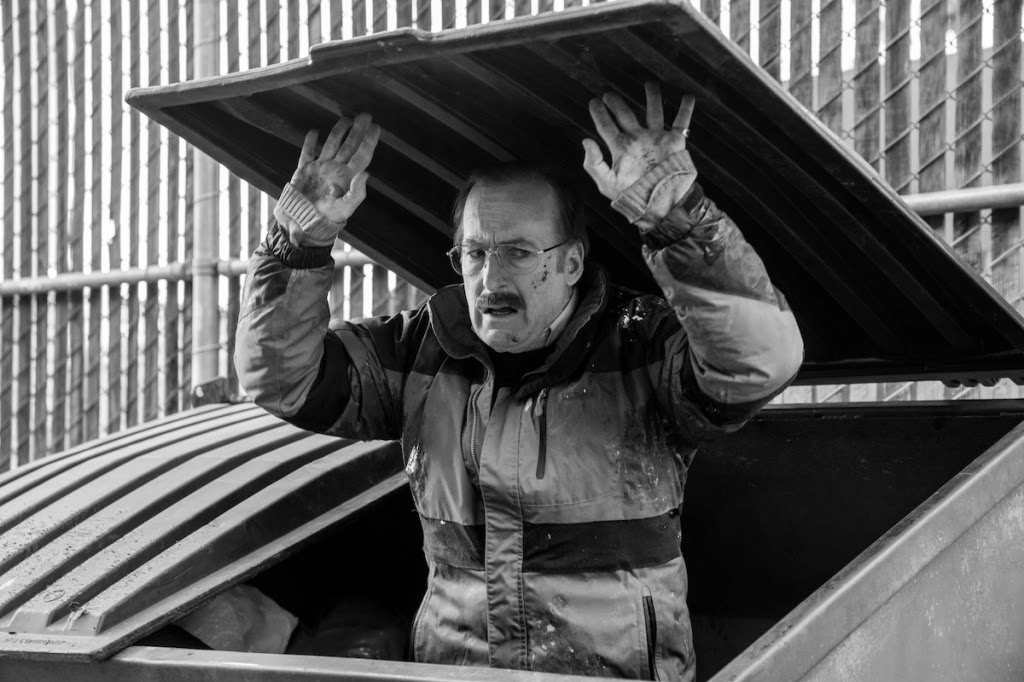
Within minutes, Gene is appropriately apprehended in a garbage dumpster, and just like that, he's back in the system, hilariously calling upon former legal nemesis Bill Oakley for help. But sans mustache and in full Saul mode, he doesn't need any help so Bill's forced to only sit back and enjoy the ride. Facing a laundry list of charges and staring down a life sentence plus 190 years, the master goes to work, manipulating the feds into agreeing to a sweetheart of a plea deal. 

Once more, Saul uses the truth to spin an elaborate lie, while a visibly disgusted Marie Schrader (a returning Betsy Brandt) listens to his story about being threatened and intimidated into doing the dangerous Heisenberg's bidding. He knows it only takes one juror to believe it, and the feds fold, offering him an unprecedented seven-and-a-half year sentence. But for Saul for real revelation comes next when he hears of Kim's confession. It may take away what little leverage remained, but he was just toying with them anyway. Suddenly the satisfaction of screwing the system again doesn't seem quite as enticing as before. 

The idea that Saul, and human beings in general, are incapable of change is explored in three pivotal flashbacks involving Mike, Walt and Chuck. All of them are long gone, but in previously unseen moments he spends with them, we witness a different side of Saul, seemingly lost and looking for help, yet still not quite ready to own up. And while he's clearly trying to own up to his mistakes, did he ever find the three wrong people to turn to for guidance. 

Mike might be the exception, as we flash to a conversation during the memorable fifth season "Bagman" episode where he and Jimmy were stranded in the desert. At least he sees Jimmy's hypothetical time machine scenario as an opportunity for introspection, citing the day he took his first bribe as the moment he'd change. But despite clearly presenting that question in hopes that Mike can coax the truth out of him, Jimmy again buries his true feelings and changes the subject. 

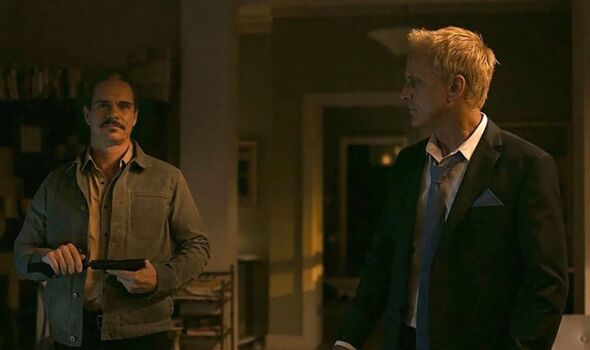
Confirming predictions of many, Cranston's second Walt appearance arrives via Breaking Bad's penultimate episode, "Granite State," when he and Saul briefly roomed in Ed the disappearer's vacuum store before separately starting over with assumed identities. This is end game Heisenberg and it's amazing how Cranston can just pick up exactly where he left off in attitude and demeanor, with Walt insufferable as ever. Arrogantly dismissing Saul's time machine question as scientifically impossible, he at least cuts to the core of the issue by recognizing that he's actually asking about regret. 

Further confirming what a pompous blowhard he is, Walt starts in again with his arguable, unproven claim Elliott and Gretchen forced him out of Gray Matter. Always the victim, nothing is ever his fault, but unlike Saul, it wasn't circumstances that changed him. Prideful and desperate for respect, "Heisenberg" was always bubbling under the surface, looking for an excuse to emerge. 

It's telling that's Walt again blames his biggest regret on others, conveniently overlooking all the chaos and death he initiated afterwards. But confounding us again, he stares at the watch Jesse gave him, implying maybe one other regret, which we know he eventually makes right. If even Heisenberg can reach some sort of realization about his selfishness, it's definitely not too late for Saul, who wasn't "always like this," as Walt accuses. That's a description better reserved for himself.

Saul won't admit in either of those two conversations that his biggest regret is Chuck, and while it wasn't a given Michael McKean would reappear in a finale, how could he not? There's enough blame between the brothers to go around and both could have made better choices, but it feels momentous to revisit the very early days of the series (or just before it started), with Jimmy making those deliveries to Chuck's house. He did a lot for his older brother while getting nothing but grief and judgment in return, but this scene (besides revealing the origin of "The Time Machine" book confiscated from Saul's mansion) shows a different side to that. Aside from the mental illness, Chuck was also lonely and isolated, to the point that it's kind of sad to see him genuinely wanting to connect with Jimmy and get nowhere, mainly because neither will budge.

Chuck's obsession with sabotaging Jimmy's legal career was a self-fulfilling prophecy, helping to create the "chimpanzee with a machine gun" he intended to stop. And after Jimmy realized he'd never get his brother's love or approval, he went about destroying him instead. 

Chuck and Jimmy may have been incapable of change, but they share a couple of small moments here that hint a common ground could have possibly been reached if both tried a little harder. Of the finale's three tremendous flashbacks, this is the deepest and most consequential, especially considering what follows.

After getting the call from DA Ericsen (Julie Pearl) that Saul's testimony in Albuquerque could negatively affect her, Kim enters the courtroom fearing the worst. It's "showtime" alright, but with a big catch, as he repeats his Heisenberg sob story to the judge before making a dramatically sharp turn into the truth that seems to surprise even him. 

With Bill hilariously flailing to withdraw himself from the case as the feds look on in delight, Jimmy  torpedoes his meager seven-and-a-half year sentence to admit he facilitated Walt's worst crimes. His voice cracking and trembling, he not only takes full responsibility for what happened to Howard, but also the cancellation of Chuck's insurance that led to his suicide. Now Kim knows he's for real.

Jimmy seeing the person he most respected and accepted him for what he was come clean proved to be the example he couldn't get from Walt, Mike or Chuck. Unlike them, he was able to break the cycle. There's nothing in it for him when he throws away that sentence to spend the next 86 years in prison, other than Kim's potential forgiveness. And his own peace of mind. 

Jimmy can't control Cheryl's potential civil suit against her, but does the right thing anyway, dropping the mask and finally being honest with himself. The almost invisibly subtle change in Seehorn's body language and facial expression while Kim watches confirms this breakthrough, as does the buzzing of the EXIT sign, a brilliant visual nod to Chuck's courtroom meltdown in "Chicanery." Saul's gone but "James McGill" will get to share another smoke with Kim as a tiny bit of color reenters their world, coming full circle from the series' pilot episode. 

This is about as "happy" an ending as Jimmy could have gotten considering the circumstances, and judging by the prison inmates' enthusiastic reaction to meeting the legendary Saul Goodman, he'll be just fine not having to constantly look over his shoulder as Gene. Kim just might be okay too, as her volunteering at that legal office indicates she may now feel somewhat freed of the burden that's held her down.

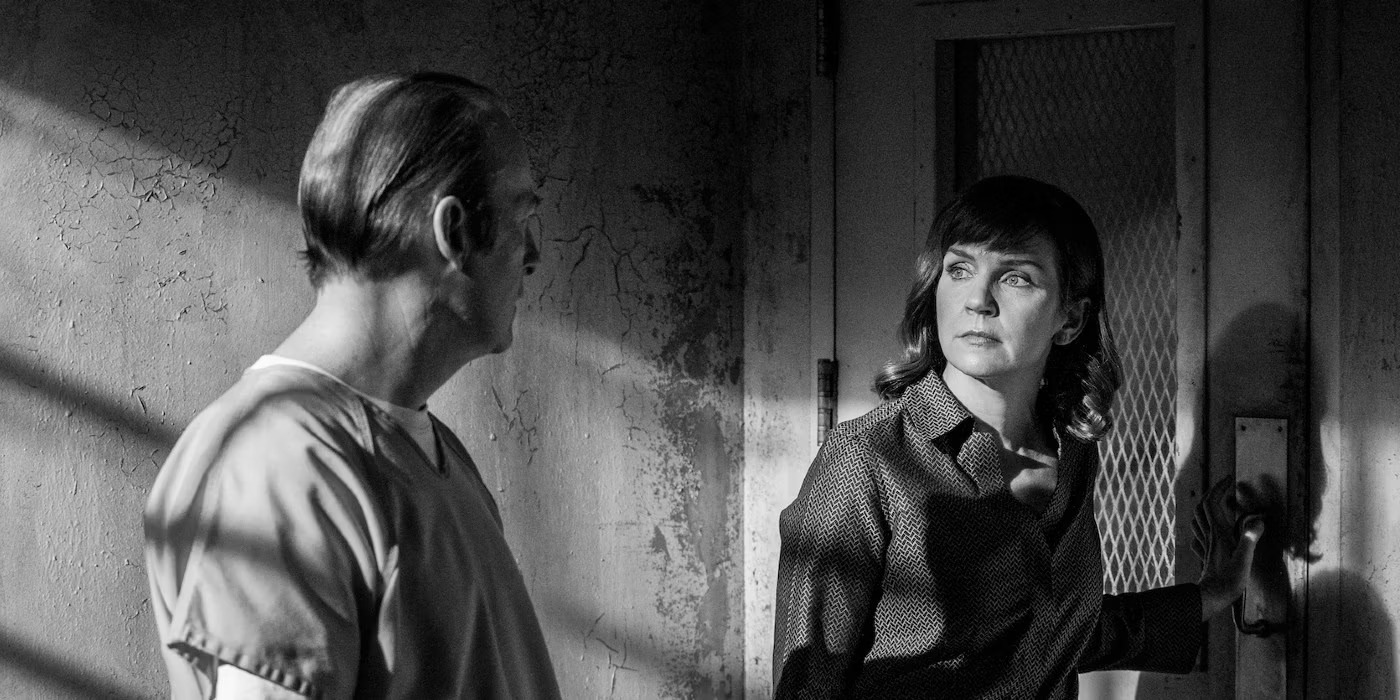
When Kim visits Jimmy in prison, she's carrying herself differently than we saw in Florida, showing small signs of her old, confident self. And despite using her unexpired New Mexico bar license to get in, it's fair to say that'll be the extent of her future scamming. 

It's possible Kim resumes practicing law again somewhere, maybe even working to have Jimmy's sentence commuted. When he gives her the finger guns as she leaves, it's hard not to acknowledge the possibility this isn't the final time they see each other. Or at least we can keep telling ourselves that.

Better Call Saul succeeds where most finales don't in absolutely sticking the landing, with every scene, line and visual choice purposefully building to a conclusion that was in the cards the entire time, while still managing to completely surprise. And that's not easy when you're constructing a prequel where more than a few events and character fates are predetermined. Its final hour and a half not only works as a hits compilation, but the concluding moments spotlight what the entire story was about. So many finales fail at this, instead settling to safely sign off in a manner that upsets the fewest fans. 

If Breaking Bad was about Walt's love for "Baby Blue" this was always all about a very different, more complicated bond between Kim and Jimmy. Initial skepticism about the show's direction played out over multiple seasons, but Gilligan and Gould had a game plan, adjusting accordingly as they went along to ensure all the pieces fit. And now as this entire universe presumably comes to a close, there's a new yardstick against which all future TV spinoffs and prequels can be impossibly measured.           

Thursday, July 21, 2022

Jerry and Marge Go Large

Director: David Frankel
Starring: Bryan Cranston, Annette Bening, Rainn Wilson, Larry Wilmore, Michael McKean, Ann Harada, Jake McDorman, Anna Camp, Uly Schlesinger, Tracie Thoms
Running Time: 96 min.
Rating: PG-13
 

★★★ (out of ★★★★)

Jerry and Marge Go Large is the type of small, breezy dramatic comedy from the 90's and early 2000's that middle-aged moviegoers flocked to theaters for on the weekend. It's the very definition of a throwback, feeling almost completely out of time, and while that might not seem like the most passionate endorsement, it's actually a high compliment. You wouldn't be wrong calling it "fluff," but director David Frankel seems to know that, competently and inoffensively holding your interest throughout in telling this true story about a couple exposing a flaw in the lottery system. Its title may be terrible and the first half is slightly stronger, but on the whole, it comes as a relief to get a well made, audience-friendly picture for a change. 

An unceremonious streaming drop on Paramount Plus isn't surprising for a genre that now seems as extinct as the dinosaur, but because of this, what was once commonplace suddenly feels special again, despite how few landing places there are for it. Writer Brad Copeland's screenplay (adapted from Justin Fagone's 2018 article) definitely won't be dazzling anyone with twists and turns because it's just not necessary for what essentially amounts to enjoyable human interest entertainment. And sometimes that's enough. But most of the credit should go to its two legendary leads, sharing the screen together for the first time as spouses, expertly inhabiting roles so normal and relatable that you forget how good they actually are.   

Forced into retirement after working over forty years as a production line manager for Kellogg's, Evart, Michigan resident Jerry Selbee (Bryan Cranston) is preparing to enter his golden years with wife Marge (Annette Bening). He struggles with the transition, looking for ways to spend his free time and keep himself useful while Marge is just excited to have him around the house more. With their supportive but adult children Ben (Jake McDorman) and Dawn (Anna Camp) busy with lives of their own, big thinking, detail oriented Jerry continues to sweat the small stuff, much to his friend and accountant Steve's (Larry Wilmore) mild irritation. 

Jerry's free time comes in handy when he discovers a loophole in Michigan's WinFall lottery system that leads the Selbees to cross state lines to purchase an obscene amount of tickets, resulting in substantially more cash. Soon, Jerry and Marge are inviting friends and neighbors to buy into a piece of their new venture, intending to use the earnings to renovate and revitalize their cash strapped town. But when a cocky Harvard student Tyler (Uly Schlesinger) discovers the same flaw, he formulates a plan to corner the market and force Jerry and Marge out of business for good.

At least initially, there's an About Schmidt vibe to all of this, following an uncertain retiree as he clumsily navigates his way through the next stage of life, whatever it may be. This relies more on plot machinations than that superior film, but the universally liked Jerry isn't nearly as ornery as Warren Schmidt, making this less of a character driven drama than a feel good fable. Once the lottery element is introduced, it shifts into what could be considered a traditional studio comedy, which in this case isn't such an awful thing. 

The script doesn't go too far into the weeds about the scheme other than making it clear Jerry recognizes a loophole and crunches numbers with Marge to buy up thousands of WinFall tickets to increase their odds. This requires semi-regular excursions to a small roadside store in Massachusetts that has the machines and an eccentric manager named Bill (Rainn Wilson). While the state's lottery commission doesn't care as long as the money's rolling in, complications arise with the competing Harvard students and Maya (Tracie Thoms), a curious Boston Globe reporter sniffing for a story.

Jerry and Marge including the Evart residents in their shared mission to resuscitate their close-knit, fledgling town lead the couple to embark on an adventure together for seemingly the first time in ages. That's especially true for Jerry, who feels a sense of renewed purpose after spending decades relatively satisfied and respected while punching the clock at work. But now his obsessive attention to detail is making a major impact on people's lives, as he slowly recognizes how he may have overlooked the obvious joys in his own. 

Cranston and Bening are playing a bit older than their ages, but effortlessly pull it off, elevating what's already respectable material to a higher level. Cranston's post-Breaking Bad career has been filled with interesting choices that display just how far his range extends and this continues that. But it's hard not to make an obvious Walter White comparison with Jerry, whose mundane existence is turned upside down after coming upon a life transforming scheme While the retiree's perfectly legal exploitation of the system to save his town is altruistic and a long way from a dying chemistry teacher's drug empire, it's a testament to Cranston that he can so comfortably slip into this like a pro. 

Bening makes for the ideal partner and an exciting presence as Marge, stealing scenes and making impeccably timed sarcastic quips at her husband while keeping him honest. And the rest of the supporting cast (including an underused Michael McKean) add just the right amount of quirkiness and local color to this small town. Even Uly Schlesinger's slimy Harvard antagonist is bearable, with Copeland's script wisely focusing on the generational gap between the two opposing sides. It also resists giving him a schmaltzy or undeserved redemptive arc, knowing that greedy, self-serving actions have consequences and leaving it at that. 

Showing a decent amount of respect for viewers' intelligence, Frankel (who also helmed 2011's tonally similar The Big Year) makes mainstream comedies better than most, utilizing a big screen sitcom  approach that's reminiscent of the late Garry Marshall. At one point a character sarcastically refers to Evart as "Mayberry," and that's not so far off. There's a down home quality to the material that he nails, basking in the inherent goodness of the characters and situation without crossing over into cornball territory. And with Cranston and Bening deftly handling material others of their stature would likely scoff at, the whole film's better off, paving the way for what ends up being a surprisingly pleasant and painless experience.              

Monday, February 22, 2021

Your Honor

Creator: Peter Moffat
Starring: Bryan Cranston, Hunter Doohan, Hope Davis, Sofia Black-D'Elia, Isiah Whitlock Jr., Michael Stuhlbarg, Carmen Ejogo, Lilli Kay, Amy Landecker, Tony Curran, Lamar Johnson, Benjamin Flores Jr., Jimi Stanton, Chet Hanks, Andrene Ward-Hammond, David Maldonado, Melanie Nicholls-King, Lorraine Toussaint, Margo Martindale, Maura Tierney
Original Airdate: 2020

★★★ ½ (out of ★★★★)

When Breaking Bad ended its run in 2013, all this speculation followed as to what Bryan Cranston would do next. Or, in other words, how do you top THAT? Of course, the answer is that you can't, nor is it necessary to. The freedom and clout to do whatever he wanted led him to dabble in a little bit of everything, resulting in a successful case study in how to build off an enormous once-in-a-lifetime  career juggernaut. A character actor long before that series came along, he'd pick up where he left off, albeit with much better projects and collaborators from which to choose. Having done some TV, feature films and Broadway, even winning a Tony for playing LBJ in All the Way (a role he'd reprise in the HBO adaptation), he definitely hasn't been hurting for quality work, enjoying the benefits of  effortlessly slipping in and out of supporting and lead roles without viewers thinking twice, even now. 

While Cranston would probably be the first to say there are far worse things than forever being linked to one of the greatest roles ever written for an actor, his inspired, ecelectic choices since have strayed pretty far from it. Until Now. Showtime's limited series Your Honor (loosely adapted from the Israeli series, Kvodo) not only marks Cranston's return to long-form episodic TV drama, but the first part since his seminal series wrapped that screams, "WALTER WHITE." If the similarities between the chemistry teacher turned drug kingpin and this put-upon judicial protagonist are undeniable, Cranston (also sharing executive producing credits and directing the finale) and showrunner Peter Moffat wisely don't avoid them, ironically helping to cement the character and series as uniquely its own despite a "parent covers kid's crime" plot that's kind of become a television trope of late.

Though Cranston's big screen work as a desserting husband in 2017's unfairly overlooked Wakefield still ranks way up there, this is arguably his strongest post-Breaking Bad project and performance, returning him to the kind of desperate, flailing do-gooder he's a master at playing. Like his most famous role, the character begins with noble intentions and as an upstanding citizen attempting to do the right thing. Then something happens and a single lie turns into a bigger one, and into an even bigger one still, and before long, he's breaking the very law he took an oath to uphold. You could actually argue he's relatively well-intentioned until about half-way through these ten episodes, when the lies start becoming more elaborate and immoral, affecting lives far beyond those directly involved. 

Even with all its dizzying twists and turns, this remains Cranston's show and we get the feeling his character's actions could easily enter Walt territory if the series continued past its limited number of episodes. By the end, he's almost already there, stuck squarely in the middle of a dangerous cat-and-mouse game where his survival depends on staying multiple steps ahead as the walls close in. And that alone should make many Breaking Bad fans feel right at home.     

On the one year anniversary of his wife's murder, respected New Orleans judge Michael Desiato (Cranston) is placed in an impossible situation when his 17 year-old college-bound son Adam (Hunter Doohan) accidentally runs down and kills another teen in a hit-and-run. Panicked and in the throes of a full-blown asthma attack, he initially tries to resucitate him, attempting to call to 911 before fleeing the scene in shock and fear. After confessing to his father, Michael's plans to have Adam turn himself in are derailed when it becomes apparent the victim is Rocco Baxter (Benjamin Wadsworth), son of organized crime kingpin, Jimmy Baxter (Michael Stuhlbarg) and his cutthroat wife Gina (Hope Davis). 

Fearing certain retaliation if Adam's crime is exposed, Michael's priorities shift to covering up his son's actions by calling in some favors and covering their tracks. He starts with best friend and politician Charlie (Isiah Whitlock Jr.), whose crime connections could help make the vehicle disappear.  He'll also have to control and manipulate the involvement of suspicious detective Nancy Costello (Amy Landecker) and former protégé and lawyer, Lee Delamere (Carmen Ejogo), both of whom Michael called immediately following the accident, much to his regret. 

With Michael's cover-up triggering consequences devastating enough to escalate an already raging gang war within the city, the Baxters reign over the corrupt NOPD with every resource at their disposal, ensuring it isn't long before they find out what really happened to Rocco. Further fueling their vengeance is that their eldest son, Carlo (Jimi Stanton) is incarcerated while spunky teen daughter Fia (Lilli Kay) is rebelling against her Catholic upbringing in the wake of their brother's tragic death. 

The biggest hole in Michael's convoluted plans just might be the moroseful, introspective Adam, who hasn't yet recovered from his mother's death long enough to truly process what he's done. While an ongoing illicit affair with his photography teacher, Frannie (Sofia Black-D'Elia) only compounds this anxiety, it's the overwhelming guilt surrounding the accident that's breaking him, and may unintentionally unravel his dad's schemes to prevent Jimmy Baxter from uncovering the truth, and killing them both. 

Everything keeps coming back to the car, as Michael either directly or indirectly involves nearly half of New Orleans' population in his plans to dispose of the vehicle, only to have it come right back and bite him at the worst possible moments. But what's so impressive about Cranston's performance is that we believe this is a man who overthinks every detail to the point that he's almost outthinking himself in a frantic bid to make sure every base is covered. As a result, he gets sloppy, overcovering his tracks to the point of micromanagement, too often drawing unecessary attention in all the wrong ways. 

Michael's decision to go through all these channels to have the car "taken care of" temporarily gets Adam off the hook, but causes a chain reaction that essentially destroys the lives of Kofi Jones (Lamar Johnson) and his little brother Eugene Jones (Benjamin Flores Jr.), two young black kids running in the wrong circles. In a series full of senseless tragedies, what ends up happening with them is easily the most senseless and undeserved. And unfortunately for Adam, he'll never truly be off the hook.

What Michael has most in common with Walter White is his inventive responses to each new impossible obstacle put in his way, in turn opening the floodgates for another calamity that's usually twice as damaging. In some ways it's the toughest kind of episodic storytelling to write because there has to be an escalating tension based off events and actions that require a certain degree of sloppiness to get the story where it needs to go. Creative risks often accompany the manufacturing of these messy scenarios, and as far as over-the-top legal thrillers go, this does snuggly fit within that wheelhouse. 

The amount of sympathy and understanding we have for the Desiatos start at a high point, gradually descending the further their big lie extends, even while acknowledging few would have the courage to do what's most obviously the right thing from the start and confess. But is it? Michael's clearly correct in assessing the ruthless Jimmy Baxter wouldn't hesitate to off Adam if he ever found out he killed his son, however accidental it was. As viewers, we're instinctively protective of a kid who made a snap bad judgment in a scary scenario while having an asthma attack. So even while conceding that both his immediate and long-term actions afterward are wrong, the criminal threat of the victim's family muddies already murky ethical waters. 

We reach a point where the mildly justifiable becomes indefensible, most especially as it relates to Michael. Adam, on the other hand, seems to be behaving in such a way that he wants to get caught. Either that, or the writing has holes big enough to drive a truck through. There's just no other way to explain him returning to the scene of the crime, hanging around courts and prisons, blabbing to people in such a way that implicates himself, attending a public memorial for his victim, and in the grandaddy of them all, getting involved with Fia Baxter, a move that subsequently raises the stakes and tension. If the deck isn't already stacked enough against Adam, his affair with Frannie (which doesn't seem to come exclusively from a place of lust, ranking as almost tame compared to other illegalities on the show) could make the teacher more vulnerable than she even knows. The same could be said for his grandmother, and Michael's mother-in-law, Elizabeth (the great Margo Martindale), whose political position as a senator is yet another hurdle Michael must clear.

Jimmy Baxter hardly needs an excuse to commit heinous crimes, but now with something resembling an actual excuse to, and the means, the threat he poses is frighteningly real. Frequently unrecognizable from role to role, Michael Stuhlbarg is able to go incognito again with this subtly powerful performance, made all the more impactful that it's opposite Cranston. 

Just seeing these two acting titans go face-to-face is really what we're really here for and it doesn't disappoint, with Stuhlbarg playing the grieving Jimmy with a quiet sensitivity that's interspersed with sporadically violent fits of rage. It's inevitable he'll find out what Michael's up to as we wait for the other shoe to drop, but how that happens, and the adjustments he must make, is where all the surprises are found. 

The wildcard is Carlo, the eldest Baxter son who's doing time, but still a massive amount of damage from within his prison cell. Michael and Adam's very survival could depend on whether his dad can wield his judicial influence to help the thuggish, drug-dealing, murdering brute, and in the process potentially betraying everything and everyone he holds dear. This is where Cranston's performance kicks into the highest gear possible as Michael frantically scrambles to come up with solutions that could spare him and his son's life, if only even for just another day.

With a trial as its closing arc, this series disproves the theory that all legal thrillers need to be spend an inordinate amount of time in the courtroom bogged down by procedure and expository dialogue. Presiding over a case that has to go a certain way, Michael's in a position where he can't so obviously tip the scales as to draw attention to his own impropriety. Playing in a chess game rather than overseeing a trial, every single move counts and even the slightest ruling the wrong way could be catastrophic. He can control a lot, but not everything, and it becomes torturous fun watching all the curve balls thrown his way and how Cranston conveys Michael's flummoxed reactions. 

Fitting into a far larger discussion in how popular entertainment is choosing or not choosing to incorporate the pandemic into storylines, the assumption that these events were taking place prior to that are shattered when masks start showing up in the last quarter of the series. Well, kind of. There doesn't seem to be much consistency in their depiction, but give the writers credit for ingenuity and comic relief as Michael actually uses "social distancing" as an excuse to pull off one of his manipulative tactics during the trial.

Much like HBO's Treme, this dives far into the atmosphere of New Orleans, framing the city as important a character as the rogues gallery of corrupt law enforcement, nefarious politicians, lawmakers, family and gang members that put our protagonist in the worst of company. And there's still yet another side that exposes a sense of bustling community in the streets and an underlying and overriding sense of loyalty amongst its people to protect their own, making the betrayals that occur especially heartbreaking. 

The broken system Michael attempts to navigate proves impenetrable, even for someone with his standing. Its ending has been accurately compared to a Shakespearian tragedy, concluding on a note depressing enough to make Better Call Saul feel like a trip to Disney World. There's a mad dash to wrap it all up with many dangling threads, but it's an appropriately straightforward closer considering what got us there. It's easy to believe this was only intended as a limited series with no plans to go further. But if we've learned anything, it's always possible to continue, no matter how creatively inadvisable that may seem. The bigger question is why you'd bother when within its ten episodes Your Honor manages to jam more in than most series have in their entire extended runs.                                   

Tuesday, October 15, 2019

El Camino: A Breaking Bad Movie


Director: Vince Gilligan
Starring: Aaron Paul, Charles Baker, Matt Jones, Jesse Plemons, Scott Shepherd, Scott MacArthur, Tom Bower, Kevin Rankin, Larry Hankin, Tess Harper, Marla Gibbs, Jonathan Banks
Running Time: 122 min.
Rating: NR

★★★ ½ (out of ★★★★)

**Warning: The Following Review Contains Major Spoilers For 'El Camino: A Breaking Bad Movie' **

When Breaking Bad's last episode, "Felina," aired in 2013, it was one of the few examples of a legendary show sticking its landing, delivering a series finale that many considered a perfect send-off. Running five seasons and not a single episode longer than warranted, creator Vince Gilligan knew the story he wanted to tell, and while pieces on the board may have been moved along the way, you got the impression the eventual destination was always clear. It's also the rare finale that's grown in stature since it aired, with initial rumblings of Walter White's (Bryan Cranston) Mr. Chips to Scarface journey wrapping up a little too tidily beginning to dissipate over time. So the big issue becomes whether any part of this is worth toying with.

With a current prequel series in AMC's Better Call Saul creatively performing better than it has any right to, you'd figure Gilligan would want to get out while he can, further preserving the integrity of both shows. But there's always been that nagging Jesse Pinkman (Aaron Paul) issue. When Jesse escaped that Nazi compound in the final minutes of the series, screaming in agony and joy as he drove that El Camino right through the gate, we were left to speculate what would become of him, while also wondering if we're better off not knowing. And whether our imaginations could provide a more satisfying conclusion for him than anything Gilligan could cook up, leaving it a thread better left unresolved. So the big question becomes whether any of this is even worth toying with.

With Netflix's feature film, El Camino, Gilligan takes a calculated risk in attempting to continue Jesse's story by adding an epilogue to "Felina," while also creating an entity that holds its own in the Breaking Bad universe he revisits. Is it necessary? Not terribly, as what happens in the 122 minute film to the embattled, traumatized Jesse following his escape is probably very similar to what fans envisioned in their minds. Does it in any way harm the series? Absolutely not, as the quality of writing and directing here is very much on the same level of the show at its peak with key differences being the narrative stakes and the absence of its previous protagonist/antagonist. This is Jesse's story now and probably the most impressive thing about El Camino is how far it leans into that, delivering a claustrophobic character study effectively doubling as a taught, suspenseful crime thriller. And for a series consistently praised for how cinematic it looked, the feature provides additional evidence as to why.

This doesn't feel like an extended episode of the series, or a forced reunion. There's a very functional structure to the screenplay, sharing commonalities with the show's best episodes that seamlessly alternate between character-centric flashbacks and present-day action scenes. And it does this while somehow feeling entirely different from all the episodes that preceded it. As a standalone movie, it's tremendous, even as its success as a continuation of the show will proabably be debated. But it's ultimately all about Aaron Paul's complex, nuanced performance as one of TV's greatest characters. Experiencing Jesse's desperation, it's easy to forget whether or not we "need" to return to this. It just simply feels great to be back.

Walter White is dead. Gaining revenge on the Nazis while sacraficing himself to save Jesse, the latter fled the compound in captor Todd Alquist's (Jesse Plemons) El Camino. Physically and emotionally scarred from his imprisonment, a bearded, dissheveled Jesse must now decide what's next, remaining a"person of interest" in the Heisenberg case.  Considered a dangerous fugitive with reports of the compound massacre all over the news, he manages to evade authorities long enough to make it to the two people he knows he can trust: good friends Badger (Matt Jones) and Skinny Pete (Charles Baker). Far from criminal masterminds, the two burnouts come through in giving their pal a place to clean up and hide untill they come up with a plan. But with authorities rapidly closing in, Jesse quickly sets out on his journey with a very specific goal in mind. To get there, he'll have to make sacrifices, rely on his resourcfulness and come to face-to face with his past in order to even get a shot at starting over or having any kind of future ahead of him.

The narrative signposts in El Camino are always to clear to Jesse before becoming apparent to us, with Gilligan keeping the character a step ahead the entire time and completely driving the action. This keeps us on pins and needles anticipating his every move, often taking him on detours and destinations we rarely expect he'll go. In hindsight, each step makes sense, but in the moment we become Jesse's captive audience, wondering who or what he'll run into next, or how it'll tie to the ordeal he's been through.

It's to Gilligan and Paul's credit the psychological implications of Jesse's recent imprisonment isn't brushed over, nor is the very real possibility he'll be put into a situation where he'll need to kill again, if his survival depends on it. Considering everything he's been through, it makes logical sense that he's a functioning PTSD sufferer haunted by not only his own morally questionable past actions, but all the manipulation he endured at the hands of Walt. While the deaths of Jane (Krysten Ritter), Andrea (Emily Rios) and Mike (Jonathan Banks) haunt Jesse, they're never explicitly mentioned. We get it. And Gilligan gets that we do, letting Jesse's actions and a few carefully chosen flashbacks do all the work.

Since the finale was in many ways already an epilogue unto itself (with many still considering "Ozymandius" the true climax) rather than a continuation, it's a touchy subject which characters should reappear. If this was merely "fan service," it's safe bet we'd see Hank (Dean Norris), Skylar (Anna Gunn), Walt Jr. (RJ Mitte), Marie (Betsy Brandt), Gus (Giancarlo Esposito), either in flashbacks or the present, depending upon their fates. Of course, it doesn't help that Jesse's business with those aforementioned characters is either extremely limited, non-existent, or finished. With only two encounters with Skylar during the series and not so much as a a scene with Walt Jr., there's little reason for them to intereact now.

Similarly, it would take too much work to be able to logically tie the post-BrBa events of Better Call Saul to Jesse's journey, so an encounter with Saul's (Bob Odenkirk) Cinnabon Gene alter ego was always going to be a long shot. If there are any complaints about Gilligan's creative decisions, it'll likely be regarding who does show up and why, since there's a big question mark surrounding what any potential returnee could add at this point.

Jesse Plemons' Todd wasn't likely topping anyone's prediction list to return considering his death in the finale, but here he is, in an extended flashback sequence that initially comes off as a curious use of time. After all, was anyone really begging for a deeper glimpse into Todd's disturbed psyche, especially considering our knowledge of how things turned out for him. But a funny thing happens as Gilligan keeps returning to this oddly specific flashback and Plemons' role grows larger, evolving into what amounts to a co-lead for what seems like half the picture. When the basis for Todd's inclusion presents itself and we discover how he directly and indirectly impacts Jesse's present quest, it all starts coming together. This makes it easy to further appreciate Plemons' performance opposite Paul, and just how twisted their dynamic became while Jesse was imprisoned, revealing Todd as even more childlike and sociopathic than originally suspected. But Gilligan's blueprint is clear: This will be about what Jesse needs to collect in order to move forward.

From then on, it's a pretty wild ride, with Jesse trying to evade capture and gather enough cash to reach what we should have known all along was his ultimate goal: A rescheduled appointment with Ed "The Disappearer" Galbraith (Robert Forster). Having missed his initial pick-up with the vacuum repairman, he's now looking for another chance at a new identity, just as Walt and Saul received before him. Hopefully, with better results. But it won't be easy since Ed has his principles and doesn't like being stood up, priding himself on doing business the right way.

Jesse's verbal interplay with Ed makes for the film's strongest section, as Forster reprises and significantly expands on the crucial role he so intriguingly played in the series' penultimate episode, "Granite State." All that occurs when Jesse enters this vacuum store is gold, with the extended sequence crackling with nervous tension, sarcasm and humor. Much will made made of this being Forster's final role (with the Oscar-nominated actor passing the day of its release), but regardless of that tragic irony, it's a carefully measured performance worthy of the highest praise, cool and calm as can be in the presence of Paul's manic energy. If the latter owns this movie, then Forster's the next best thing in it.

While it was never a question that Bryan Cranston would show up as Walter White, the "when" and "how" remained a well-guarded secret. It does kind of come out of nowhere, while managing to make perfect sense when considering every flashback and present-day encounter in the film centers around Jesse coming to terms with his past in order to build a future for himself. It's fitting we join the two when their partnership was at its early stage, before Walt's hubris poisoned it. He was still ex-chemistry teacher "Mr. White," and his cancer diagnosis made him as desperate for money as former cooking partner Jesse is now, looking to build a nest egg for his family when he's gone. That's how things started, and while we know how they turned out, it's intriguing that Gilligan picked this previously unseen diner conversation for Walt's cameo, with their trusted, duct taped RV parked in the lot.

Of course, Cranston slides right back into the role like he never left, playing a weak, uncontrollably coughing version of Walt who has yet to become the alpha in their partnership. Instead, he relies on Jesse, while expressing a genuine concern and disappointment at why his former student wasn't thinking about his own future, as a friend or father would, if not for that hint of condescension.  At first, the scene seems almost superfluous within the context of this movie, but try not to marvel again at the surreal sight of them sitting across from each other again. Or deny that much of Jesse's survival now depends on the many lessons imparted and inflicted on him by Walt, the very person that caused his life to unravel. Wrong and arrogant about a lot, Walt's belief that Jesse was wasting his potential was always spot-on, even as the mentor failed to take his own advice, looking for success in all the wrong places. It just took all of this to go down for Jesse to finally realize it.

It's appropriate that the two characters Jesse gleaned the most from and forged his most meaningful human connections bookend his story. Mike and Jane may both be victims of Walt and while it's too late for them, he still has a shot if he can evade authorities and make it out of this alive. Fans complaining Walt had too tidy a resolution will likely have a field day criticizing Jesse's send-off, but it's unquestionably the right ending, and really the only one, even if you feel no further closure was necessary. But for a character whose screen time did become increasingly limited as the series drew to a close, it's no small feat that we know more about Jesse Pinkman now than we did going in.

To say no one needed El Camino more than Aaron Paul isn't a knock on his immeasurable talent, but instead an indictment on an industry that failed to give him the showcase he's deserved since the series concluded. Back in the role he belongs, we're reminded that in the six years since it would be highly unusual for him, or any other working actor, to get material at that level. And while it may be true that the series or its fans didn't need it, we'd be fools to complain about getting more, especially since it's about as accurate a representation of Breaking Bad's best that we'll ever get in feature form.