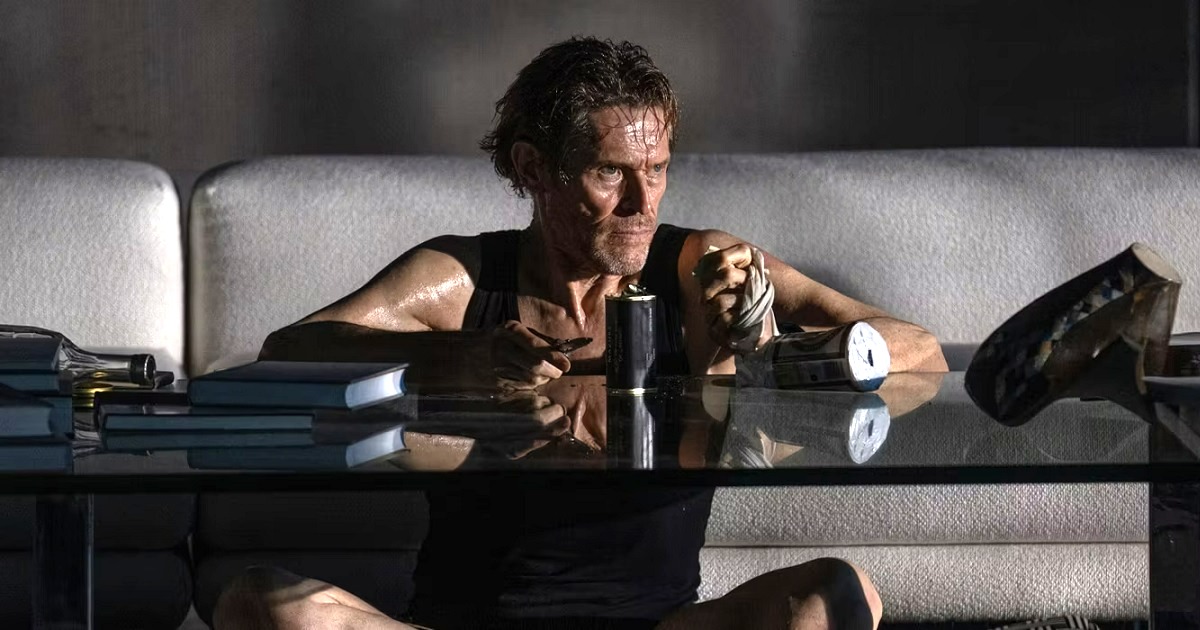
Showing posts with label Willem Dafoe. Show all posts

Saturday, August 16, 2025

The Phoenician Scheme


Director: Wes Anderson
Starring: Benecio del Toro, Mia Threapleton, Michael Cera, Riz Ahmed, Tom Hanks, Bryan Cranston, Mathieu Amalric, Richard Ayoade, Jeffrey Wright, Scarlett Johansson, Benedict Cumberbatch, Rupert Friend, Hope Davis, Bill Murray, Charlotte Gainsbourg, Willem Dafoe, F. Murray Abraham, Stephen Park
Running Time: 101 min.
Rating: PG-13

★★★ (out of ★★★★)       

For anyone wondering how a Wes Anderson directed international espionage picture would play out, an answer comes with The Phoenician Scheme, which looks and feels a lot like previous Anderson efforts. But that's only bad news if you happen to detest his dry humor, twee tone, penchant for recycling the same actors in different roles, or even that unmistakable Futura font. And while it all converges into a distinctive style sometimes known as the "Anderson aesthetic," it has just as many fans as detractors, many of whom eagerly await each new release. 

When cinephiles rank Anderson's' divisive output there's largely agreement on what they've seen, often causing them to love and hate chosen titles for exactly the same reasons.  But after the visual and narrative spectacle of Asteroid City hinted at more complex themes bubbling just under the surface of its meta structure, this satire reprsents the latest signpost for his brand of mannered quirkiness. And though it can't help but feel like a slight step back in comparison, there's no denying it still showcases what he does best. 

It's 1950 and eccentric arms dealer/industrialist Anatole "Zsa-Zsa" Korda (Benicio del Toro) is busy trying to evade multiple assassination attempts until a horrific plane crash nearly does him in. Fearing time may be running out, he attempts to reconnect with his only daughter, Liesel (Mia Threapleton), a Catholic nun repulsed by her father's behavior and suspicious he murdered her mom. Still, he persuades her to leave the Church to help run his business on a trial basis, also hiring Norwegian entomologist and family tutor Bjørn (Michael Cera) as administrative assistant.

Risking his wealth on a scheme to overhaul Phoenicia's infrastructure with slave labor, Korda plots to thwart the government's plans to bankrupt him by duping investors into covering the budget shortfall. Joined by Liesel and Bjørn, he starts with Californians Leland (Tom Hanks) and Reagan (Bryan Cranston) before moving on to French nightclub owner Marseille Bob (Mathieu Amalric), Newark investor Marty (Jeffrey Wright), and even his own cousin, Hilda (Scarlett Johansson), an heiress to the family fortune. Infuriating them with his lies, Korda refuses to enlist the help of estranged half-brother Nubar (Benedict Cumberbatch) due to their troubled history. But as Liesel spends more time with her dad, she reluctantly holds out hope that he's capable of change.

Somehow both convoluted and mind numbingly simple, the plot's almost beside the point, serving as an excuse for its characters to engage in the absurd, but highly entertaining hijinx put in motion by Korda's embarrassing scheme. Much of why involves the road trip element, which gives Anderson's troupe of regulars a chance to shine in wildly different roles. But none of that would be possible without del Toro's brilliantly bonkers performance as Korda, a clear amalgamation of narcissistic industrialists like William Randolph Hearst and Aristotle Onassis. 

Anderson employs a treasure trove of cultural, historical and cinematic references to fill out this story centering around his main character's eccentric peculiarities, such as adopting as many kids as possible and organizing his business files into separate shoeboxes. Del Toro has to walk a thin line line here, playing a selfish swindler, deadbeat dad and charmingly likable rogue all wrapped into one, showing just enough humanity for us to understand why Leisel bothers sticking around.

Amid a flood of famous faces, it's a revelatory Threapleton who makes the strongest impression as Liesel, whose faith is tested when confronted with the prospect of not only forgiving her emotionally inaccessible dad, but somehow forging an actual relationship with him. And it's when her character experiences Korda's moral failings up close that Threapleton's sarcastic wit and bemused facial expressions supply the film its heart. And opposite both in his largest Anderson role to date, an ideally cast Cera plays the awkward, bumbling Bjørn to perfection, just as we'd expect.  

While Hanks and Cranston's appearances do feel more like celebrity cameos than fleshed out parts, they're still sort of a hoot as brothers, with Wright and Johansson managing to give the looniest, most worthwhile turns of the investors. Others like Bill Murray, Willem Dafoe, Hope Davis and F. Murray Abraham only pop in and out. It's really the uncomfortable camaraderie between Korda and his two travel companions that carry this, leading right into the eventual sibling showdown with Cumberbatch's scary, bushy eyebrowed Nubar. The result is a surprisingly sentimental finale that prioritizes substance over style. 

Anchored by a charismatically flawed character in the vein of odd, ornery Anderson protagonists like Royal Tenenbaum and Steve Zisssou, it's hard not to wish this was at least slightly better, or even a little less messy. But with a trio of tremendous lead performances, a clever structure and stretches of hilarity, there's a lot to appreciate. Those rooting for Anderson to completely step outside the box may have to wait a little longer, but in giving us more of the same he continues to prove that few do it better.                        

Monday, March 17, 2025

Nosferatu

Director: Robert Eggers
Starring: Lily-Rose Depp, Bill Skarsgård, Nicholas Hoult, Aaron Taylor-Johnson, Willem Dafoe, Emma Corrin, Ralph Ineson, Simon McBurney, Adéla Hesová, Milena Konstantinova
Running Time: 132 min.
Rating: R

★★★ (out of ★★★★)    

On paper, another cinematic Dracula interpretation would seem to be the last thing anyone wants or needs, especially if it happens to be a remake of F.W. Murnau's 1922 indisputable German classic, Noseferatu. And while it's the rare project that risks trampling on sacred ground for film buffs and horror fanatics alike, most can agree that if an updated version has to happen, Robert Eggers is probably the best director for the job. And following The Witch, The Lighthouse and The Northman, it also feels like the next logical step for a filmmaker who's already proven himself more than capable of handling similar material. 

Given how there are still mainstream moviegoers unfamiliar enough with the original, Eggers now gets the opportunity to put his own stamp on the story without alienating newer audiences or offending purists. And that's just what he does, offering up an unusually distinctive vision that mostly meets those expectations. While an altogether disturbing, grotesque and unpleasant experience to sit through, that's sort of the point, as Eggers delivers on exactly what he sets out to accomplish.  

It's 1838 and the newly married Ellen Hutter (Lily-Rose Depp) and her realtor husband Thomas (Nicholas Hoult) are living in the German town of Wisburg when he accepts a job from prospective employer Herr Knock (Simon McBurney) to sell off the dilapidated Grünewald Manor estate. Upon Thomas learning the buyer is the mysteriously reclusive Count Orlok (Bill Skarsgård), a frightened Ellen begs him not to go, realizing this is the same supernatural creature she gave herself to in her youth. But knowing how this opportunity will financially benefit them, he goes, leaving Ellen to stay with wealthy friend Friedrich Harding (Aaron Taylor-Johnson), his wife Anna (Emma Corrin) and two young daughters. 

Warned by the locals to stay away from Orlok, Thomas arrives at the castle to finalize the sale before becoming suddenly ill in his presence. But the Count rejects his desperate pleas to leave, giving him little choice but to attempt an escape. Meanwhile at Friedrich's, Ellen is suffering from violent seizures, sleepwalking and hallucinations, leading eccentric Swiss scientist and occult expert Albin Eberhart von Franz (Willem Dafoe) to diagnosis her as being under the spell of the demonic, plague carrying vampire Nosferatu (a.k.a. Orlok). As she continues to conceal her connection to the monster, Thomas heads back to Wisburg, but Orlok isn't far behind, planning to claim Ellen as his own, but not before causing unimaginable bloodshed and death. 

After a methodical opening the horror truly begins at this old, cavernous estate when Thomas comes face-to-face with this vampire lurking in the shadows who lets it be known through his foreboding voice and presence that he's not just looking for a good property deal. What Orlok really covets is Ellen, who's not only terrified, but appears to be in no position to stop the potential trap Thomas has walked into.  Rendered helpless under Orlok's spell, Ellen gets little support from the Hardings, specifically a skeptical, patronizing Friedrich who refuses to acknowledge any supernatural component to this at all. 

Friedrich's disbelief reaches new heights with the arrival of Dafoe's scientist, who the actor skillfully plays as something of a loony cross between Dr. Loomis from Halloween and the psychiatrist at the end of Psycho. The film's most repulsive events unfold while Thomas is trapped inside this Transylvanian castle where's he bitten, chased by wolves and unintentionally signs his wife's life away. But once Orlok sets his sights on Ellen, the story enters its creepiest, most exciting territory as he unleashes his plague on Wisburg.

If the first half belongs to an effective Hoult as the hapless husband in way over his head, from that point on Depp is devastating as Ellen, whose traumatic past opens a gateway for destruction. In a vividly unhinged performance that conveys her character's sense of impending doom, she's over-the-top, but appropriately so, leaving no doubt what's at stake. And much like her dad, she has this peculiar onscreen charisma that seems ideally suited to Gothic horror genre. As Orlok, an unrecognizable Skarsgård makes the most of what he's given by conveying the desperate motivations of this damaged beast through what must be pounds of prosthetic makeup. 

Thrilling at times, depressingly hypnotic at others, the film definitely looks beautiful, with Jarin Blaschke's dimly lit cinematography and some visually stunning production design from Craig Lathrop bringing a nightmare to life. Functioning as an homage to the original while still remaining unmistakably his own, Eggers deserves credit for going all out with a cast that looks and feels completely at home in this demonic world, even if it can be an unsettling watch. Though more likely to evoke feelings of respect than outright admiration from some, it won't be difficult for others to embrace this with even fewer reservations.                                                                    

Wednesday, December 4, 2024

Saturday Night

Director: Jason Reitman
Starring: Gabriel LaBelle, Rachel Sennott, Cory Michael Smith, Ella Hunt, Dylan O' Brien, Emily Fairn, Matt Wood, Lamore Morris, Kim Matula, Finn Wolfhard, Nicholas Braun, Cooper Hoffman, Andrew Barth Feldman, Taylor Gray, Nicholas Podany, Kaia Gerber, Robert Wuhl, Tommy Dewey, Catherine Curtin, Jon Batiste, Willem Dafoe, Paul Rust, Tracy Letts, Matthew Rhys, J. K. Simmons, Brad Garrett, Josh Brener
Running Time: 109 min.
Rating: R

★★★ ½ (out of ★★★★) 

While certain obstacles accompany making a film about the 1975 premiere of Saturday Night Live, few compare to the challenges faced by the original cast and crew who got the show onto NBC, where it's resided for the past 50 years. Saturday Night co-writer/director Jason Reitman had to know this when committing to recreate a special brand of backstage chaos filled with actors chosen to pass as the most respected comedians of all-time. But they didn't start out on top. It was SNL that made them household names.

That's why it's so fitting Reitman stacks his cast full of young unknowns on the cusp of stardom, attempting to replicate the backstory of this bizarre show that didn't quiet resemble anything else on television. The running gag is how its frazzled but determined creator Lorne Michaels can't explain to executives something no one's seen yet. And he's right. But that doesn't mean what eventually airs in the midst of walkouts, firings, fires, threats and other production mishaps will even resemble the vision he has in mind. Flying by the seat of his pants, he'll be lucky if the network even lets him go through with it at all. 

For decades, critics and audiences would label each new SNL season and cast as its worst while overlooking how many huge talents it spawned. And this ensemble has the unenviable job of stepping into their shoes for one ridiculously stressful, debaucherous, profanity filled night that launches all their careers. But despite moving at a breakneck pace, certain faces do stand out long enough to make an impression as Reitman constructs one of his best recent efforts, and maybe the first that seems addictively rewatchable.  

It's October 11, 1975 and producer and creator Lorne Michaels (Gabriel LaBelle) arrives at NBC's New York City studio to prepare for the live airing of his new variety program, Saturday Night, which has the reluctant backing of increasingly nervous network boss Dick Ebersol (Cooper Hoffman). But disingenuous executive David Tebet (Willem Dafoe) is less optimistic, threatening to pull the plug and replace it with a rerun of The Tonight Show With Johnny Carson. 

The dysfunction Tebet witnesses does little to change his mind, as Michaels, comedy writer wife Rosie Shuster (Rachel Sennott) and head writer/actor Michael O' Donoghue (Tommy Dewey) try to wrangle their ambitiously makeshift cast of Chevy Chase (Cory Michael Smith), Gilda Radner (Ella Hunt), Dan Aykroyd (Dylan O' Brien), Laraine Newman (Emily Fairn), John Belushi (Matt Wood), Garrett Morris (Lamorne Morris) and Jane Curtin (Kim Matula). As show time rapidly approaches, everything that can go wrong does, putting the pressure on Michaels to prevent his dream from being shattered before it even airs.

Clocking in a tight 109 minutes, Reitman keeps things moving so fast it feels like twenty, letting viewers experience the crunch of how little time remains before the show goes live. And with relentless editing and rapid Sorkin-style dialogue, we're fully immersed inside this tumultuous backstage atmosphere with hardly a moment to breathe. On top of its impeccable, era specific production design, the whole film almost plays like a single continuous tracking shot, traveling from the street into the studio's halls, through the dressing rooms and onto the sound stage. Around every corner is another problem for Michaels to navigate, whether that's cutting sketches and performers with minutes to go, placating the stringent network censor (Catherine Curtin), or dealing with dissatisfied, coked up host George Carlin (Matthew Rhys). 

Michaels has to massage a lot of egos, and while history counts Chevy Chase as the most contentious cast member, it's actually Matt Wood's catatonic Belushi who proves completely uncontrollable, straddling the line between addict and eccentric genius. Wood, along with Cory Michael Smith's Chase and Dylan O' Brien's mustachioed Dan Akyroyd leave the biggest impressions of the main players, shunning any attempt at imitation to instead capture the freewheeling attitudes of super talented party animals who already consider themselves stars. 

Smith is particularly strong as Chase, establishing himself as the glue that holds this show together, impressing executives even while rubbing certain guests and castmates the wrong way. He'll get his comeuppance in a memorable confrontation with the gruff, ornery Milton Berle (a movie stealing J.K. Simmons) who humiliatingly cuts the cocky Chase down to size in front of girlfriend Jacqueline Carlin (Kaia Gerber). None of this likely happened, but the idea it could have is where the fun's at, as Reitman and co-writer Gil Kenan send up the stars' controversial reputations.

There are also other small moments in the midst of all this pandemonium that really click, like Garrett Morris's insecurity over his big break or actor Nicholas Braun's depiction of an ignored Jim Henson, who's captured with eerie specificity. And in a clever parallel to the spontaneous nature of SNL itself, Braun pulls double duty as Andy Kaufman, whose ubiquitous presence leads to a big payoff that doesn't disappoint. Gilda Radner, Laraine Newman and Jane Curtin aren't given much face time, at least in relation to how their contributions are viewed. But given the sheer amount of ground covered, it's inevitable certain players are shortchanged, which is also an accurate reflection of this show over the years. 

The casting of Dickinson actress Ella Hunt as Radner might be Reitman's only questionable call since those expecting the outsized personality of the comedic legend will be taken for a loop by Hunt's sweeter, more tender take. This isn't to say Radner didn't also possess those qualities, but it's easier  imagining co-star Rachel Sennott knocking that role out of the park. Instead, she proves invaluable as show den mother Rosie, who protects Michaels and the rest of the cast from their own worst instincts. Still, Reitman deserves praise for a a touchingly prophetic scene between Radner and Belushi that resonates in all the right ways as all these characters head into the final stretch.

Having already played a variation on another iconic creator in Steven Spielberg's The Fabelmans, Gabriel Labelle carries this picture on his back, leading the charge as Michaels wards off the constant stream of bad luck and a network itching to see him fail. He's always been described as generally low-key so it's interesting to watch how LaBelle's performance doesn't really contradict those accounts, even under the craziest of circumstances. A human punching bag who absorbs each successive blow, he'll soldier on, determined to see the show judged on its own merits. He knows what he has, even if putting it into words for the suits can get a little tricky. 

That NBC had no interest in ever airing this endeavor makes the film's closing scene hit that much harder, as everyone anxiously waits for a reaction signifying they've somehow pulled it off. Michaels is frequently warned against referring to the show as a "revolution," but after hearing late night's most famous intro for the first time, it's impossible not to understand what he meant. By capturing this in all its chaotic glory, Saturday Night shows how the most effective comedy can't just merely be described. When you see it, you'll know.                                                        

Tuesday, October 15, 2024

Beetlejuice Beetlejuice

Director: Tim Burton
Starring: Michael Keaton, Winona Ryder, Catherine O' Hara, Jenna Ortega, Justin Theroux, Monica Bellucci, Willem Dafoe, Arthur Conti, Santiago Cabrera, Danny DeVito, Nick Kellington
Running Time: 104 min.
Rating: PG-13

★★★ (out of ★★★★)

There's always this tendency to assume the worst when a beloved property like Beetlejuice is resurrected decades after the original's release. Years of rumors and false starts weigh on fans who can only hope it's not just a cash grab and some creative thought went into continuing the original's legacy. This concern is especially real with Tim Burton's intended sequel, which seemed perpetually stuck in pre-production since the early 90's. 

As time passes, expectations fall, which is why it comes as such a relief that Beetlejuice Beetlejuice resembles the kind of follow-up audiences wanted but didn't think they'd ever get. Signaling a welcome return to form for Burton, it rekindles flickers of his former glory throughout, while still looking and feeling like the Beetlejuice we know. The director's recent work on Netflix's Wednesday, could almost be seen as a prelude to this in that his twisted imagination is once again freed up to run amok with fewer boundaries.

It's 2024 and Lydia Deetz (Winona Ryder) is now a psychic medium hosting her own supernatural talk show, Ghost House, where she contacts the dead. But her sullenly skeptical teen daughter Astrid (Jenna Ortega) isn't interested, still harboring grief and resentment over the death of Lydia's husband and her father, Richard (Santiago Cabrera). And as Lydia's slimy TV producer boyfriend Rory (Justin Theroux) prepares to take their relationship to another level, professional artist and Deetz matriarch Delia (Catherine O' Hara) breaks the news to Lydia that her father Charles (played by Jeffrey Jones in the original) just died in a horrific accident. 

With the family reconvening in Winter River for Charles' funeral and preparing to sell their old home, Astrid falls for local teen Jeremy Frazier (Arthur Conti) while Lydia finds out the hard way that Beetlejuice (Michael Keaton) isn't done with her yet. Now working as an "Afterlife Manager" on the other side, he's being stalked by ex-wife Dolores (Monica Belucci), a murderous soul sucking cult member being hunted by action star turned ghost detective Wolf Jackson (Willem Dafoe). But when Lydia realizes Astrid's in danger and only Beetlejuice can help, she's reminded that any deal with this mischievous demon comes at a high price.

Recognizing there's such a thing as overkill, Burton strategically uses the Beetlejuice character, both in terms of screen time and his overall purpose. Of course, we all know he's keeping Keaton in his back pocket until the ghoul's ready to unleash his goofy madness, or more accurately, has a reason to. And writers Alfred Gough and Miles Millar come up with a good one, putting the now middle-aged Lydia at a place in life that makes sense given her past and tumultuous connection to Beetlejuice. 

Now a famous TV star, Lydia's addicted to pills, dating a creep and unable to connect with daughter Astrid on any level, particularly when it comes to discussing the latter's deceased dad. And if there's a benefit to have waited this long for a sequel, it's that Ryder's now old enough for her character to struggle parenting a version of her rebellious younger self. That she's played by a perfectly cast Ortega is only icing on the cake. 

While Keaton and Ryder have publicly expressed their desire to reprise these roles for a while, it's no secret the addition of Ortega is what finally got this greenlit. As strong a match for Astrid as Ryder originally was for Lydia, the pair's natural chemistry consistently shines through in every scene they share as mother and daughter. And though this iteration mostly plays it safe, Ortega's Astrid is given the film's bleakest, most compelling subplot, serving as the primary catalyst for Lydia and her stripe suited nemesis's reunion. 

Catherine O' Hara delightfully hams it up as Delia, spending most of the running length in hysterics over Charles' death, while also remaining strangely unfazed by it, keeping with Burton's quirky, bemused take on the macabre that's punctuated much of his previous work. And while there was no chance of Jeffrey Jones returning as Charles, it's a treat watching how brilliantly Burton works around it, using photos, paintings and an extremely clever animated stop-motion sequence to help make him an even bigger presence dead than alive.

Once Beetlejuice is fully involved, Keaton runs with it, and if family drama justifiably monopolizes the film's early goings, he dictates the rest by recapturing Juice's brand of sarcastic quips and physical comedy. The plot involving his murderous ex Dolores is probably the script's weakest, but it's still well executed, notable for a brief but memorable black-and-white flashback depicting the couples' sordid history. And when the action shifts into the Afterlife and takes all the characters along, it picks up steam before arriving at a wacky, divisive ending that really flies off the rails without veering far from the franchise's roots. 

This doesn't approach prime Beetlejuice or Edward Scissorhands territory, but it's fun seeing everyone slide back into their roles as we revisit a universe that hasn't changed much at all. Between Danny Elfman's score, the similar production design and a continued emphasis on practical effects, Burton clears the toughest hurdle by recognizing any legacy sequel's biggest competition is its own nostalgia. By effectively tailoring the story to present day, he forgoes cheap fan service, instead crafting a worthy successor that will leave viewers wanting even more.

Tuesday, March 19, 2024

Poor Things

Director: Yorgos Lanthimos
Starring: Emma Stone, Mark Ruffalo, Willem Dafoe, Ramy Youssef, Christopher Abbott, Suzy Bemba, Jerrod Carmichael, Kathryn Hunter, Vicki Pepperdine, Margaret Qualley, Hanna Schygulla, Keeley Forsyth
Running Time: 142 min.
Rating: R

★★★ ½ (out of ★★★★)

It's hard to pinpoint the exact moment Yorgos Lanthimos's Poor Things pivots from an extremely weird, Frankenstein-inspired horror fantasy into something really special, but you'll know when it gets there. An oddly acquired taste that only grows stronger with each wacky, sensational development, in some ways it stylistically recalls the best of Terry Gilliam or Tim Burton before both got swallowed up by the system. But while still somehow managing to feel completely original, it's also a great twisted social satire, unironically navigating morally complicated waters to provide a thrilling, frequently hilarious experience. 

Given the MPAA's famously low tolerance for sex and nudity, Lanthimos's ability to escape with an 'R' rating is a feat in itself, as what starts as a Universal monster movie morphs into this globe trekking, fantastical comedy-adventure. With a steampunk infused look and imaginative production design, its atmosphere is unmatched by anything else in the genre, even as it's sometimes difficult to classify what that genre exactly is. It covers a lot of ground, all of which is navigated in Emma Stone's fearless performance. And while everyone's been talking about her willingness to go all out for the film's many graphic and controversial scenes, that's secondary to the other unexpected places she takes this unique character.

In Victorian London, an eccentric, facially disfigured surgeon named Godwin Baxter (Willem Dafoe) is looking after the childlike Bella (Stone), a young woman who while pregnant killed herself by jumping off a bridge. Now functioning with an infant's mind after Godwin replaces her brain with that of her unborn baby's, he recruits med student Max McCandles (Ramy Youssef) to track Bella's progress. But after falling in love with her and proposing marriage at Godwin's insistence, sleazy lawyer Duncan Wedderburn (Mark Ruffalo) arrives to finalize the contract.  

In the midst of exploring her own body and burgeoning sexual desires, Bella agrees to run off with Duncan, leaving Max behind, while Godwin moves on to another human project. But the mismatched couple's adventurous romp turns into a disaster when an increasingly curious Bella yearns to experience the world on her terms. As a whiny, insecure Duncan attempts to tighten the reigns and assert control over her, Bella must use the experience she's gained to decide between following this troublesome path or returning to the only life she knows. 

Based on Alasdair Gray's 1992 novel, this begins in classic horror territory, right down to an obsessively brilliant doctor's experiment and Robbie Ryan's stark black and white cinematography. Even before Godwin's pressured by Max for answers, it doesn't take long to figure out Bella is as much a test subject as the mutant animals found on the grounds. But it's Stone's mannerisms, physicality, line delivery and  distinct walk that reflects a child's mental and emotional inability to function within this adult woman's body. 

Lanthimos and Stone to make some bold choices that will immediately have viewers rooting Bella on, even in the cringiest of scenes. While Bella's decision to run away with Duncan is clearly a response to her character's sexual curiosity, it's the slimy suitor who seems more desperately in need of a brain and personality transplant, revealing himself a far bigger baby than Bella. But it's through his shenanigans that real change overtakes her, though not necessarily the kind Duncan wants. Stone may be remarkable but Ruffalo is perfect as her foil, bringing a quirky likeability to a drunken, debaucherous man child who's mentally unraveling at the mere thought of Bella openly questioning the rules of sophisticated society.

After a hugely entertaining dance number that serves as the first act's centerpiece, Bella and Duncan embark on a transformative cruise that Lanthimos fills with vibrant colors and jaw-dropping effects that resemble a dreamscape come to life. And there's a great interlude involving two passengers (played by Jerrod Carmichael and Hanna Schygulla) that further fuel Bella's philosophical curiosity and Duncan's eventual breakdown. 

When Bella winds up working in a brothel under the loony Madame Swiney (Kathryn Hunter), we already have ideas where this can go, at least until Tony McNamara's script subverts those expectations, using it as a thematic launching pad for Bella's final challenge. Going back to face the ailing father figure who deceived her and fiancé she abandoned, an even bigger obstacle awaits in reconciling the person she was with who she's now become.

By returning to the husband and life she had before leaping to her death, Bella attempts to flee from the men in her life, only to find herself back in a similar prison. General Alfie Blessington (Christopher Abbott) is just like the rest of them, but worse, leaving little wonder as to why "Victoria" felt there was no escape. With Bella now occupying the vessel that woman once resided, a new reality emerges when she takes matters into her own hands, utilizing the knowledge and experience she's gained to assert her independence. 

The victim of a medical procedure gone awry, or maybe exactly as planned, Bella navigates the world through different eyes, discovering it's just as cruel and unforgiving as when she first left it. Fully equipped with the tools to break those shackles, she gets the last laugh by shaping her own destiny. Brilliantly bizarre but hardly inaccessible, Lanthimos knows what he doing, endlessly imaginative in how he brings all these realistic sensibilities to a demented fairy tale. But everything comes down to Stone, who hits all the notes an actress possibly can in a single role, taking us on a wild, mind bending trip that isn't easy to shake.                                         

Monday, May 22, 2023

Inside

Director: Vasilis Katsoupis
Starring: Willem Dafoe, Gene Bervoets, Eliza Stuyck
Running Time: 105 min.
Rating: R

★★½ (out of ★★★★)

As much an endurance test for viewers as it is the film's protagonist, director Vasilis Katsoupis' Inside finds a thief trapped in a Manhattan high-rise penthouse apartment, making you wonder about the effectiveness of its high tech security system. But working from a script by Ben Hopkins, Katsoupis clearly hopes no one's looking at his debut feature that literally, instead too absorbed in the metaphorical implications of a man inadvertently caged. The movie's title carries two meanings, both describing the predicament itself and how we're taken deep inside the mind of someone slowly unraveling as he loses touch with reality. 

Fitting squarely into the pandemic era of isolation cinema, it's somewhat of a slog, kept afloat by Willem Dafoe's tour de force turn, which goes a longer way toward redeeming this than you'd expect. Described as "a solitary exhibition" on its poster and promotional ads, that's exactly what it is, compelling much of the way through thanks to him. But for an existentially themed project this reliant on observing human behavior, it doesn't exactly linger long in the mind or go anywhere you'd hope.

Disguised as a handyman, art thief Nemo (Dafoe) breaks into the New York City penthouse of a wealthy art collector (Gene Bervoets) to steal three valuable Egon Schiele paintings, one of which is missing. Despite this, he attempts to leave, in the process accidentally setting off the security system and locking him inside the apartment. With his walkie talkie contact abandoning him and a now broken thermostat causing the temperature to wildly fluctuate, Nemo frantically searches for a way out.

Running dangerously low on food and water, a chance at rescue could come from a maid named Jasmine (Eliza Stuyck) he sees on the security camera and gradually becomes obsessed with. Basically tearing the place apart, he works on building a structure that could possibly facilitate an exit. But hallucinating and starving, Nemo's losing all grasp on reality, turning this personal prison into a messy, disastrous art exhibit reflective of his lonely existence.     

The film starts with a introspective voiceover from Nemo about the permanence of art, foreshadowing that this posh dwelling may soon become the gallery where he leaves his expressionistic mark. There are some clever aspects to the setup, but after a while the challenges of following through with such a concept start piling up as high as the furniture Nemo stacks in his attempts to climb out. Fun gags like a refrigerator door playing the Macarena or him dining on dog food and drinking from the sprinklers hold our attention largely because Dafoe rarely needs words to convey the anguish and dark comedy of this thief's situation. 

The irony isn't lost that the apartment is completely inaccessible to any class of person in the building but its owner, who at any point you half expect to see just casually walk in and discover Nemo's bruised, malnourished body on the floor of this now trashed residence. The set design team deserves a lot of credit for creating a sterile "smart home" space that's aesthetically paradise, but proves unlivable because of the overbearing technology. If a seasoned art burglar could be trapped in this seemingly impenetrable fortress, it stands to reason the same scenario could easily befall anyone attempting to enter or leave.

With Nemo physically and mentally deteriorating, you realize this has essentially turned into an indoor Cast Away minus Wilson the volleyball. He also starts looking like absolute hell and all of his good ideas to get out are accompanied by some unexpected obstacle preventing it. Security camera access should provide creative potential but that never really goes anywhere, nor does his fascination with the housekeeper. As he spirals further downward into the ugly recesses of his mind, there are numerous questions. How long has this been? Is the apartment ever cleaned? And you wouldn't be wrong  assuming the alarms should notify police or the owner, which seems even likelier in a residence containing priceless pieces of art.

Fatigue sets in after an impressive dream sequence, as the narrative crawls along until petering out and coming to a close. In the meantime, it's fun imagining all the untapped scenarios this premise could have provided and wondering why none occurred. Even accounting for Katsoupis' attempts to replicate in audiences a similar sense of his tortured character's disorientation, it seems as if major opportunities are missed. 

Playing better as self-contained acting showcase than a twisty psychological thriller, this is still highly watchable, at least until frustrations start bubbling over. While it isn't exactly fair to expect a single location picture titled Inside to open things up a little more, there is some truth to that complaint. Without a clue of what's happening on the outside, stakes lessen as we approach an anti-climactic finish, leaving its lead performance and top notch production design to pick up the slack.                   

Wednesday, February 23, 2022

Nightmare Alley

Director: Guillermo del Toro
Starring: Bradley Cooper, Cate Blanchett, Rooney Mara, Toni Collette, Willem Dafoe, Richard Jenkins, Ron Perlman, David Strathairn, Mary Steenburgen, Peter MacNeill, Holt McCallany, Paul Anderson, Jim Beaver, Clifton Collins, Jr., Tim Blake Nelson
Running Time: 150 min.
Rating: R 

★★★ (out of ★★★★)

Part remake, part noir homage, Guillermo del Toro's Nightmare Alley will likely go down as one of those more respectable reimaginings that gets more right than wrong, making for an immersive, entirely agreeable experience. Free of the supernatural elements that have categorized much of del Toro's work, all the attention shifts to the soullessness and moral corruption that resides within. And there isn't a much better a setting for that than traveling sideshow carnivals of the 30's and 40's, populated by downtrodden characters being either used, abused or manipulated as scams and cons run amok. With a script from del Toro and co-writer Kim Morgan, the second feature adaptation of William Lindsay Gresham's 1946 novel doesn't stray too far from the source material in the narrative sense, instead stylistically distinguishing itself in a class of its own, as del Toro's output tends to. 

With a stacked, all-star-cast and awe inspiring production design, the plot's essentially one long con game, and while the second half payoff's considerably more impactful than what precedes it, the whole setup looks better in retrospect, especially once the story arrives at its inevitably tragic destination. There's a certain aesthetic superficiality at play that matches its characters, so even while it doesn't transcend the horror genre to evolve into something more profound, you'd still be hard-pressed to find a a movie of its ilk more technically proficient or firing on as many cylinders.

It's 1939 and Stanton Carlisle (Cooper) takes a job as a carny after burning down his house with a dead body inside. When the carnival's owner, Clem Hoatley (Willem Dafoe) recruits him to help with the show's geek, who's fallen ill, Stan moves up to begin working with clairvoyant Madame Zeena (Toni Colette) and her alcoholic husband, Pete Krumbein (David Strathairn), who teaches him the secrets of their act. While learning and studying their cold reading and coded language tactics, he begins to fall for shy performer Molly Cahill (Rooney Mara), offering up some valuable new ideas for her electrocution act. But after Pete dies from consuming wood alcohol, Stan takes the lessons he's learned on the road with Molly as his assistant, leaving their carnival days behind to reinvent himself as a psychic act for Buffalo's wealthy elite. 

Ignoring Pete's warnings about leading people on when it comes to contacting the deceased, Stan's bluff is called by mysterious psychologist Dr. Lilith Ritter (Cate Blanchett), who attempts to publicly expose  his act as a fraud, with little success. Humiliated but intrigued by the scammer, she offers him a deal involving a rich but potentially dangerous patient named Ezra Grindle (Richard Jenkins) whose lover died years ago from a forced abortion. Despite Molly's objections, Stan makes promises to Grindle about his late partner he may not be able to keep, ensnaring himself in a web of lies and deceit from which there may be no escape. 

What makes this all mostly work is that there's just enough revelations and twists in the script, while still remaining relatively simple at its core. Themes of greed, avarice and betrayal are front and center, eventually coming full circle in a powerful ending, but not before some convoluted happenings occur along the way. Del Toro strikes just the right tone, especially in the early carnival scenes that set Stan on his dark path, eventually dragging Mara's Molly down along with him, though she admittedly registers a bit flat as a character.

Cooper's incredibly effective depiction of the protagonist's transformation from wide-eyed, ambitious awe into obsessive greediness is facilitated by the supporting cast. Whether it's Strathairn's hopeless drunk, Collette's tarot reader or Dafoe's swindling huckster, they all more than carry their share of the load. As does Tamara Deverell's production design and Dan Laustsen's cinematography, which immerses them all in this weathered, dirty, depressing "freak show" world. That this was also released in black and white actually makes a lot of sense, as it's hard to think of any recent picture with a content and visual style better suited to that treatment without it feeling like a gimmick. 

It isn't until Stan takes his act on the road with Molly and encounters Dr. Ritter that the movie really comes alive, with the possibility presenting itself that the ultimate player has finally met his match.  Blanchett's femme fatale looms largest of any character, bringing a cunning, seductive sense of danger and intrigue to Ritter with each carefully calculated move she makes. Her nomination-worthy performance is the ideal fit for this material, with the chemistry she shares with Cooper fueling the film's most tension-filled moments, even as it's clear the direction del Toro's heading in the last act. 

There are clues and brief flashbacks emphasizing a past Stan needs to run far away from, but can't, no matter how hard he tries. With this mentalist show, he's devised a one-way ticket to the big time, unaware his own weaknesses are about to be exploited and exposed as callously as his clients have been by him. What starts as a scheme goes entirely too far, his eventual comeuppance arriving in the final scene, sentenced to the very life he so desperately tried to escape, at any cost imaginable.    

Even as Del Toro's direction trumps the script, you'd often never know it, as the atmosphere and performances carry the day, specifically Bradley Cooper's. Further extending his run as maybe the most consistently reliable actor and movie star working today, he delivers again with his portrayal of this ambitious, narcissistic carny more than willing to sell his soul, or anyone else's, for a quick buck. Relentlessly depressing and darkly humorous, Nightmare may not be for all tastes, but it's still a keeper, likely to be revisited down the line as something slightly more accomplished than its critical and commercial reputation suggests.  

Sunday, September 7, 2014

The Fault in Our Stars


Director: Josh Boone
Starring: Shailene Woodley, Ansel Elgort, Nat Wolff, Laura Dern, Sam Trammell, Willem Dafoe, Lotte Verbeek, Mike Bibiglia
Running Time: 126 min.
PG-13

★★★ (out of ★★★★)

There's an affliction that exists in movies often mockingly referred to as "Beautiful Girl Doomed with Cancer" Syndrome. We've seen it enough over the years that it's almost become a running gag. In The Fault in Our Stars, adapted from John Green's bestselling YA novel, Shailene Woodley gives what just might be the best "Beautiful Girl Doomed With Cancer" performance of all-time. And that's not meant sarcastically or as some kind of backhanded compliment. She's wonderful precisely because she so naturally makes us feels like we're never watching one of those. And yet it delivers exactly what the trailers and commercials promised and its book's tween girl fanbase were clamoring for. It's definitely a teen romance through and through. But what's shocking is how this isn't a deal-breaker or even necessarily bad news since it proudly owns that designation while reaching for something more. The movie honestly wears its heart on its sleeve, completely committing to what it wants to do without any fear of coming off sappy or ridiculous.

According to doctors, 16 year-old Hazel Grace Lancaster (Woodley) is on borrowed time. She has been for a while now, suffering from Stage 4 thyroid cancer that's spread to her lungs. While an experimental drug has temporarily improved her quality of life, the simplest of daily activities are difficult. But with a sarcastic sense of humor and a realistic outlook on her condition, she sees herself as anything but a victim. When her mother Frannie (Laura Dern) suggests she attends a cancer patient's support group at a local church to make friends, she meets the charismatic Augustus Waters (Ansel Elgort) a former high school jock whose ongoing battle with osteosarcoma resulted in the loss of his leg.

The two start spending a lot of time together bonding over their favorite books, but despite Augustus' persistence and charms, it's a relationship she insists on keeping platonic, describing herself as a "grenade" ready to go off and destroy anyone who gets too close. But that stance is seriously tested when he provides her with the opportunity to fly to Amsterdam to meet reclusive author Peter van Houten (Willem Dafoe), who wrote her favorite novel, An Imperial Affliction, which centers around a young girl battling cancer. Whether she'll be well enough to even survive the trip and what eventually happens during it defines the relationship between Hazel and Augustus, which is rapidly evolving in ways neither expected.

For much of its first half the film follows a trajectory that would probably be familiar to not just anyone who read the book, but those who have seen any movie about a young person in love battling a terminal illness. But the difference here is that Hazel is unusually well-written and intelligent for a character of this type. She talks openly, humorously and sometimes even sarcastically about how horrible her condition is while maintaining a positive enough outlook that falls on the side of realistic rather than saintly. That's all Woodley's performance. Augustus isn't quite as deeply drawn and could easily be considered a "Manic Pixie Dream Boy," showing up seemingly out of nowhere to sweep Hazel off her feet by saying all the impossibly right things. But Elgort's so likable and the two actors share such incredible chemistry it's difficult for even that to be bothersome.

Their initial courtship is the film's strongest claim to "chick flick" territory with scenes that come off as somewhat cutesy in the moment until the full story later comes into view and they feel completely earned. The turning point is the Amsterdam trip and even some of the events leading up to that regarding Hazel's health. A lesser film would have just glided over the dangers and pitfalls of flying a Stage 4 terminal cancer patient on oxygen overseas. But the screenplay actually spends some time with her parents and doctors examining all the drawbacks, before coming to a reasonable resolution. We know the trip is technically a bad idea and likely impossible, but at least the characters are smart enough to understand that also.

Revealing anything about the jaw-dropping encounter Hazel and Augustus eventually have with her literary hero is giving away too much, but when a successful author's a recluse there's usually a reason why. And most of the time it's bad. Paraphrasing Hazel, Willem Dafoe ends up being the real "grenade" of the story, shifting things in an entirely different direction. The whole van Houten sequence is a legitimate shocker in how uncomfortable and angry it makes the viewer. I was literally squirming in my seat. If that's not enough, it's followed by another surprise that proves to be just as emotionally devastating, but equally well handled. In a rarity, the over two hour run time adds a bit of weight and heft to what could have seemed like a less substantial effort without the breathing room, even if it probably has one more ending than it should.

Woodley's simply a revelation in the role and try as the script might to sometimes take her into syrupy territory, she's having none of it, bringing a realistic vulnerability and toughness to Hazel that sidesteps as many cancer patient movie cliches as it can. With each passing scene she only pulls us in further, likely winning over any cynics who thought she was possibly too old for the role or didn't have the moxy to pull it off. She deserves much more than an MTV Award. Elgort is almost equally strong and in a way he had to overcome more in being thrust into the more obviously "written" part. He not only overcomes it, but creates doubt that Woodley couldn't have done this opposite just anyone else, effectively portraying this young man who isn't as sure of himself as he'd have everyone believe. An actor playing an actor, the only thing we know for sure is that his feelings for Hazel are very real.

It's easy to complain Laura Dern is being relegated to the mother role, but at least it's written and performed in such a way that it never feels like are noses are being rubbed in it. Walking the line between wanting Hazel to have a life and friends but aware of the precautions that need to be taken with her daughter's health, Dern makes her almost impossibly cool and normal without ignoring the emotional pain of the situation. Sam Trammell gets less time in as her dad, Michael, but he's portrayed and performed just as believably. Nat Wolff kind of feels hung out to dry as Augustus' blind best friend, more there as a wisecracking sidekick to provide comic relief amidst the gloom and doom. And it's already established that Dafoe steals the movie in his few, but monumentally pivotal scenes, bringing his trademark creepiness to the last movie you'd expect to find it in.

Indistinctly but efficiently adapted to the screen by relative newcomer Josh Boone, he may have just cashed in his directorial lottery ticket by simply not screwing this up. It's a victory that shouldn't be undersold since the number of ways a disease melodrama can go wrong are endless. Written by the duo of Scott Neustader and Michael H.Weber, this effort comes in a distant third behind their work in (500) Days of Summer and The Spectacular Now, but there's little shame in that considering those were two of the best scripts written about young love while this is somewhat handcuffed by the trappings of a super-popular YA adaptation. But remarkably, that same observational quality about relationships from those films is still very present.     
  
The Fault in Our Stars doesn't exactly go where you'd expect, or at least in the way you'd suspect it to. But it also kind of does. And still, nothing about it really seems juvenile or cloying, even if by every right it should. With a somewhat bizarre structure and a wordless scene near the end that will have you choking back tears, it still has its faults, but even a few of those are converted to strengths thanks to some smart choices and two performers that make everything feel real. They're worth every penny the studio paid them, as it's impossible imagining a similarly successful result with different actors in the roles.

Sunday, July 15, 2012

John Carter


Director: Andrew Stanton
Starring: Taylor Kitsch, Lynn Collins, Samantha Morton, Mark Strong, Willem Dafoe, Mark Strong, Thomas Haden Church, Ciaran Hinds, Dominic West, Bryan Cranston, Daryl Sabara
Running Time: 132 min.
Rating: PG-13

★★★ (out of ★★★★)

I really don't care how much money a movie makes or what it costs to make it, though it seems many in the media do, holding it up as a testament to its creative worth. Of course, it's nice for the people involved and the studio releasing it when their project cleans up at the box office, but just because an expensively made movie is a financial flop doesn't make it an artistic failure. Any more than it's necessarily a success if it rakes in the dough. In this era of sequels, prequels, remakes, reboots, Twilights, Transformers and Marvel movies, just about the only argument that can be made in favor of a relationship between quality and cost is an inverse one. Yet somehow, Disney's John Carter, a fun, spectacularly silly throwback adventure that has its heart in the right place has become this symbol of Hollywood greed and corporate avarice because it didn't recoup its high price tag. Really guys? You're gonna attack THIS?

Far from the Waterworld-sized debacle it's been touted as, JC is actually an intelligently told fantasy fable featuring a likable protagonist, an incredibly strong female lead and great visual scope. It's also a bit of a mess, albeit a fascinating one. The plot's too convoluted with about three or four different timelines and villains, and a more streamlined screenplay would have resolved some lingering issues, but that's the extent of it. Its worst crime just may have been being based on Tarzan author Edgar Rice Burroughs' 100 year-old series of stories that inspired the likes Star Wars, Superman, Flash Gordan and Avatar, but arriving onscreen last, unintentionally making it look and feel derivative when it's just late. With just a little tweaking, this really could have been a huge deal. And with his first foray into live action, longtime Pixar director Andrew Stanton certainly does a smoother job fleshing out a world and navigating intraplanetary politics than Lucas did with his prequels, as faint as that praise may seem. But it isn't faint, as more sci-fi adventures could stand to be as fun as this.    

After a brief, poorly placed prologue on Barsoom (A.K.A. Mars) that plays as a strange cross between Return of the Jedi and 300, we're informed of the death of John Carter (Taylor Kitsch) of Virginia, a Confederate Civil war Captain who left nephew Edgar Rice Burroughs (Daryl Sabara) a diary explaining the circumstances that eventually lead to his death. It flashes back years earlier to the Arizona territory where Union Colonel Powell (Bryan Cranston in a blonde wig and colonial garb!) arrests him, but he escapes, leading them both to a cave where Carter is confronted by a Martian Thern named Matai Shang (Mark Strong) and transported--via a mysterious medallion--to Barsoom, where he's discovered by a Green Martian Tharks and their leader Tars Tarkas (Willem Dafoe). With his new ability to jump incredible heights and perform superhuman feats, Carter's unwillingly thrust into the middle of a bitter feud between rival cities Helium and Zodanga, with the evil Sab Than (Dominic West) plotting to end their war by marrying the headstrong Princess of Helium, scientist Dejah Thoris (Lynn Collins). Rescued by Carter, she promises to get him home and with the help of Tarkas' daughter, Sola (Samantha Morton) and a lizard dog named Woola as they embark on a treacherous journey across the Red Planet.

While the plot's way too complicated and at times unfocused, but for a film of this scale it's surprisingly deep, with the meat and bones of the story working really well and clear care put toward character development. Despite seeming to take a library's worth of Burrough's stories (supposedly it's mostly adapted from just one, The Princess of Mars) and attempting to jam it into a single overplotted feature, it's a shock this isn't harder to follow. I'm usually no fan of extensive CGI and think it's criminally overused, if not outright ineffective in most films, but the effects here are fairly realistic-looking.Yes, the entire budget is right up there for everyone to see on the screen, but at least desert vistas actually look like desert vistas. I hesitate in describing the Tharks as resembling Jar Jar Binks (which they kind of do) since they're more crisply rendered with a mixture of CGI, motion capture, and make-up, and not nearly as annoying, possessing identifiable traits that serve the narrative. Lizard dog Woola looks so real you'll want to take him home, while the pair of giant white apes Carter tangles with in a gladiatorial showdown recall the monstrous wompa Luke faced off against in The Empire Strikes Back.

The story does lull and lag in places (particularly the middle portion) while spinning off in a few different, sometimes problematic directions, but there was never a moment when I didn't care about what was happening or lost interest Carter or Dejah's predicament. Taylor Kitsch is solid as the lead, if kind of a blank. Then again, a blank hero is called for in this situation. This isn't the kind of movie that rises or falls with his performance so trying to pin the imaginary "blame" on him is pointless since any actor could have been plugged into the role with the same result. Whether he should have taken it is a different discussion altogether, but I'm glad he did regardless of the fallout because at least it's a start. He'll survive this and hopefully move on to edgier work, which is where his strength more likely lies. But all things considered, he did really well. Parts as memorable as Tim Riggins on Friday Night Lights don't come around every day on the big or small screen, so we may have to wait a while for him to find something comparable.

As tanned, tribal tattooed warrior princess Dejah, Lynn Collins is a real find in her first leading role. After co-starring in a handful of smaller, underseen projects without really registering much, she sure registers here. Her character is strong, beautiful, independent and intelligent, representing exactly the kind of lead female role we need more of in adventure movies. Collins is more than up to the task, never making her feel like a damsel in distress. If there were any justice she'd be a huge star off the back of this film. Instead, being in her mid-thirties, she may not even be given another opportunity at this level again. That's a shame and a sentence I should never have to type, but a chilly reminder of how Hollywood works. Give Disney credit for casting a mature woman in a woman's role instead of a kid in hopes of reeling in teen audiences. Now doing THAT would have been greedy, not to mention detrimental to the film.

If John Carter's guilty of anything it's over-ambition both in terms of visual design, and in telling a more involved story than was necessary. Not much of a crime from where I sit. That overreaching is especially evident in convoluted, twist-laden ending, which takes a bit to come into focus, but pays off in a satisfying finish. Much like Disney' unfairly maligned Tron: Legacy, it's a family film, but PG-13 and not made exclusively to sell toys. It's closer to an old school sweeping sword-and-sandals fantasy epic than a superhero movie. Of course, no one knew what it was. But Stanton did, and his slavish devotion to the source material is a creative plus that alienated confused audiences unfamiliar with "John Carter From Mars," but found it difficult to get psyched for a film simply titled, "John Carter." Knowing how it concludes, the title change does actually make sense, working best under the assumption they'll be a sequel. Barring a sudden resurgence on DVD, that seems unlikely, but not out of the realm of possibility. I wouldn't mind seeing one, or revisiting this because at least it dares to be different. It mostly succeeds. With untested stars and an ambitious story, John Carter takes chances. And when movies like that stop being made, then we're really screwed.