
Creators: Vince Gilligan and Peter Gould
Starring: Bob Odenkirk, Jonathan Banks, Rhea Seehorn, Patrick Fabian, Michael Mando, Giancarlo Esposito, Tony Dalton, Mark Margolis, Michael McKean, Bryan Cranston, Aaron Paul, Carol Burnett, Ed Begley Jr., Betsy Brandt, Jessie Ennis, Juan Carlos Cantu, Sandrine Holt, Tina Parker, Pat Healy, Max Bickelhaup, Peter Diseth, Julie Pearl, Kevin Sussman, Jeremy Shamos, Julie Ann Emery, Joe DeRosa
Original Airdate: 2022
**The following review contains major 'Better Call Saul and 'Breaking Bad' Spoilers**
When Better Call Saul premiered seven years ago, there was an unspoken understanding that co-creators Vince Gilligan and Peter Gould's primary job was to show how the likeable but scamming public defender Jimmy McGill (Bob Odenkirk) devolved into Walter White (Bryan Cranston) and Jesse Pinkman's (Aaron Paul) egomaniacal "criminal lawyer" Saul Goodman on Breaking Bad. We were under the impression this transformation would occur quickly, perhaps as early as its first season. The writers even acknowledged as much in interviews, all while doling out those post-BrBa black-and-white flash forwards of Jimmy/Saul toiling away in a lonely, depressing existence as Omaha Cinnabon manager Gene Takavic. But then a strange thing happened as seasons went on and they inched closer to the prospect of Jimmy going full Saul: we feared seeing it.

Kim was always different, as theories circulated as to what would happen to explain her absence during Breaking Bad. And now we have our answer. She wasn't "disappeared," like Walt, Saul and Jesse eventually were, in prison, or killed. Sickened by what she became with Jimmy, she made a conscious, pragmatic choice to leave her husband, unintentionally solidifying his persona of "Saul Goodman." But more accurately, it's Jimmy who manufactured Saul, wrapping himself in this over-the-top con man as if it were his late brother's space blanket. Goodman's as much a psychological defense mechanism as Chuck's illness, if not more so, and the definitive answer to whether this obnoxious, loud dressing criminal lawyer was an extension of Jimmy or a mask he donned to dull the pain. Of course it was the latter, and maybe we should kick ourselves for thinking he'd be able to drop it so easily after everything that's gone down. But they got us.
We wanted a happy ending for Gene Takavic, but Gilligan and Gould have frequently depicted a moralistic world where actions lead to justifiable consequences. All the clues were there that Gene would completely fly off the rails in Nebraska, self-destructing under the weight of his own guilt. He almost succeeds, taken back from the edge in a final episode and season that ranks among TV's greatest finales and the rare spin-off to rival its predecessor in quality. It may have seemed impossible when this started, but the writers haven't only avoided disrupting Gilligan's original creation, but enhanced our appreciation of both, ensuring neither can be watched exactly the same way again.
A panicked but resourceful Nacho (Michael Mando) is on the run, having no place to go after helping fast food drug kingpin Gustavo Fring (Giancarlo Esposito) seemingly knock off suave supercriminal Lalo Salamanca (Tony Dalton), who faked his own death. He's laying low, plotting to extract revenge on Gus by exposing the Superlab, while Nacho's taking heat from both sides and inevitably can't survive much longer.
Nacho's exit is both tragic and heroic, carried by the intensity of Mando's performance and the idea that, despite poor choices, he follows a code of honor that Gus' future right hand fixer Mike Ehrmantraut (Jonathan Banks) can appreciate. In protecting his father Manuel (Juan Carlos Cantu) Nacho makes the ultimate sacrifice, going out on his own terms and in a blaze of glory, putting the screws to the wheelchair bound, bell dinging Hector Salamanca (Mark Margolis) one last time. Of course, Gus is smart enough to know Lalo is very much alive, quietly preparing himself for war when he reemerges.
As charismatic mastermind Lalo, Tony Dalton slid in to fill the void left by Michael McKean's exit as the show's central antagonist. And did he ever deliver, playing this sociopath so frighteningly and entertainingly that we don't want to see him go, while knowing full that departure is a must given the circumstances. His final stand enabled Gilligan and Gould to again do what's become their trademark: methodically and deliberately subverting audience expectations. All this while Jimmy and Kim reach the finals stages of their elaborate plan for Howard which, due to Lalo's reemergence, carries catastrophic consequences.
Flashbacks to Kim's relationship with her alcoholic mother as a child isn't meant to explain, excuse or even provide a reason for all this, but they do offer context about who she is and what motivates these choices. Barely parented at all in a household where duplicity was rewarded, it makes sense she'd gravitate toward upholding the law. Unfortunately, it also tracks that she'd be drawn to the thrill and excitement of breaking it that accompanies her relationship with Slippin' Jimmy. And now they've gone too far, by a lot.
Patrick Fabian's series-long performance Howard Hamlin might be its most underappreciated, with the character initially earning viewers' disdain for reasons that have more to do with how we'd expect him to be portrayed on a lesser show. Largely respecting Jimmy's hustle at HHM, he was always in an awkward spot trying to carry out Chuck's dirty work. Even if there were moments of Howard mistreating Kim, she and Jimmy aren't doing this out of vengeance, but because it's fun, which is far worse.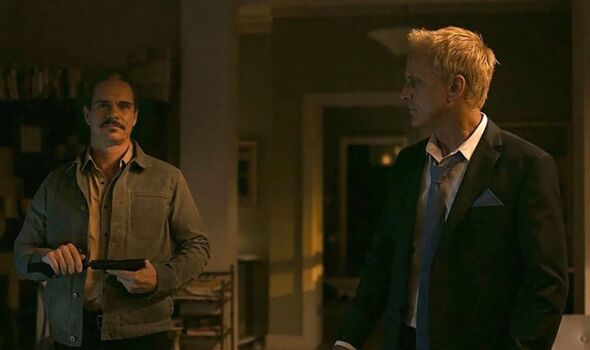
The legal and cartel worlds of the show collide in the most literal sense with Lalo and Howard sharing a grave under what will eventually become the Superlab. But if if we know one thing about Mike it's that he doesn't like innocent people being dragged into the "game." His instructions to delicately handle Howard's corpse is in line with the code he's always operated under, or at least convinced himself he has. The talk with Nacho's father reveals a cold, harsh dose of reality that not everyone lives for revenge. No matter what he tells himself about how he's not the bad guy, none of it will bring this man's son, or his own. Shot behind bars in that scene, Mike's in a prison of his own making, and like so many of the show's other characters, he can't seem to break the habits destroying him.
As for Gus, the events leading to his Superlab showdown with Lalo have exposed a more vulnerable version of the coldly calculating crime boss from Breaking Bad. Scared, flustered and not fully in control here, he gets the job done nonetheless, setting the stage for the criminal mastermind we'll get later. But he isn't that until he outsmarts Lalo, still laughing and smiling as he draws his last breath. He may have done too good a job conning everyone, as Hector's carried away by the cousins in his wheelchair, still ringing that bell.
In so many ways, episode 6.9 ("Fun and Games') serves as Better Call Saul's true finale, putting a bow on this era and timeline, not to mention also Kim and Jimmy. HHM dies with its last surviving partner and Howard's memorial is attended by the only two people who know he wasn't a suicidal drug addict. Taking Mike's advice, they are doing their best Laurence Olivier and Meryl Streep, as to not arise suspicion in his grieving widow, Cheryl (Sandrine Holt). But Kim takes it further by outright gaslighting her, recognizing the need to completely squash Cheryl's suspicions in order to cleanly close this out.
That was the last time. Kim's done, even if she won't be able to live with herself afterwards. Unlike the self-denying Jimmy, they'll be no pushing it down or waking up one morning to discover she hasn't thought about it. At this point she's right that together they're poison, bad for each other and everyone around them. And as Kim packs up and leaves, we're reminded of all the forthcoming danger she thankfully avoids, and how differently both will process this moment. Enter Saul Goodman.
Hopping in the Cadillac and yelling at Francesca (Tina Parker) through that earpiece, we buckle up for the Breaking Bad era, only to realize we're still a few years away from when high school chemistry teacher Walter White walks into his office as "Mr. Mayhew." Gilligan and Gould know there's little reason to retrace those same steps or follow Saul any further, at least for now. More thematically relevant glimpses of that will come during Gene's journey in the 2010 timeline, which is where the series spends the majority of its remaining hours.
Thinking we'd be lucky to get at least maybe one full episode centered on Gene Takavic, there are essentially four. All of them function as kind of a multi-part closing epilogue reminiscent of Breaking Bad's "Granite State" and "Felina," which served as a post-script to the electrifying "Ozymandias," still considered by many that show's unofficial finale.

Shot entirely in black-and-white, the polarizing tenth episode, "Nippy," gives us our wish in focusing exclusively on Gene. When we last left him his cover was about to be blown by cab driver Jeff (Don Harvey), an Albuquerque native who recognized him as the infamous Saul Goodman. That Harvey's scheduling conflict forced a recast oddly ended up working in the story's favor.
A small, but key part that grows in importance, Harvey briefly portrayed Jeff as slightly menacing and threatening, causing us to further commiserate with Gene. This season, Pat Healy steps into the role and his very different take on Jeff coincides with the evolving dynamic, as Gene commits to handling this guy himself and asserting control, revealing a more hapless, pathetic side to Jeff that Healy knocks out of the park.
The jaunty, immensely enjoyable department store caper Gene orchestrates (recalling early Slippin' Jimmy scams) isn't exactly high stakes, but that's not the point. It's a gateway to get Gene out of his rut and back in the game, albeit in the unhealthiest way possible. Still, seeing him socialize again and befriending the mall security guards (in an incredible montage) is a stark reminder of how much he's missed any kind of human connection. And Gilligan and Gould's use of 89 year-old comic legend Carol Burnett as Jeff's mother Marion pays off in ways no one could have envisioned when her inclusion was surprisingly announced for the final stretch. Gene's wrangling her into his con but that she takes an immediate liking to him is only natural considering Jimmy's long history with the elderly. But it also makes the attempted manipulation of her especially cruel, even by Saul's lowest standards.

Gene thinks he's found a new Walt and Jesse in Jeff and Buddy (Max Bickelhaup), but he's really just an addict using whomever and whatever is at his limited disposal to get a quick Saul hit. The teased fifth season phone call to Francesca was from Gene, but it's not the important one. Sure, he gets an update on how hot the situation is, our confirmation of Jesse's El Camino status and what's happened to some remaining players, but the real thrill comes in him dropping the Gene guise for a couple of minutes, even if a justifiably aggravated Francesca wants none of it.

It's the mention of Kim in Florida and his subsequent call to her that pushes Gene off the deep end. The identity theft scam Gene ropes Jeff and Buddy into (another great montage) is uncharted territory in both its pointlessness and physicality. He doesn't need the money, but has now resorted to drugging people and breaking into their homes for kicks. Buddy's refusal to rob kindly cancer sufferer Mr. Lingk (Kevin Sussman) doesn't trigger Gene's sympathies, but rather reignites his disdain for another cancer patient, Walter White. "We're done when I say we're done." Unfortunately, he'll have to do it himself this time
Risks be damned, he breaks into Lingk's house, making no effort to cover his tracks, as if he wants to be caught And if that call with Kim completely destroyed him, it's also brought this addictive opportunist back to the surface, as Schnauz cuts between this break-in and a flashback of Saul entering Walt's school, confirming that some things never change.While all this doesn't exactly reimagine events, it reframes the character of Saul in Breaking Bad as something more dangerous than just a sleazy criminal attorney. An instrument of destruction who saw an opportunity and pounced, he propped up a chemistry teacher who would have otherwise been killed by the cartel or DEA within a couple of months, just as Mike had predicted. Walt was a monster, but Saul's been conveniently ignoring his own role in unleashing him.
To see what's become of Kim Wexler six years after she last saw Jimmy is jarring, knowing that so many of her most identifiable, positive characteristics have been suppressed or buried in the wake of what they did to Howard. But unlike Jimmy, she's painfully aware of it and determined to punish herself on a daily basis. Working a 9 to 5 office job at Palm Coast Sprinklers, Kim chats with middle-aged Karens, wears dowdy clothes and struggles over the choice of mayonnaise or Miracle Whip with a boring live-in boyfriend. Her blonde ponytail replaced with brunette bangs, there's nothing inherently wrong with this new life other than who's leading it. She didn't have to change her identity or live in constant fear of the authorities like Gene, but this isn't her.
Kim's return to Albuquerque is a depressing reminder of how the years have marched on, leaving everyone from the past behind. Mike's former parking attendant job has been replaced by a machine, "Better Call Saul" benches now bare ads for defense attorney Bill Oakley (Peter Diseth), and saddest of all, Kim watches a young, idealistic lawyer prepping her client for court. HHM is a distant memory, as are Howard, Chuck, Jimmy and herself. It didn't have to be this way, but it is, and while we can't read all of the affidavit Kim brings to Cheryl, we see enough to know it's a full confession. And Gus, Mike and Lalo all being dead still may not eliminate the potential consequences for her. That's ultimately up to Cheryl.
It's revealing that Kim doesn't let Cheryl know Jimmy's alive, still protecting him to some extent. The picture of steely composure and certainty for six seasons, it's taken this confession for her to finally let it out, with Rhea Seehorn delivering her most powerful acting moment in the series when the tears start flowing on the bus. Uncomfortable to watch, but necessary to have happen, it's one of many literal invocations of the Gilligan written and directed episode's title, "Waterworks," his first pulling double duty since Breaking Bad's finale. It was worth that wait.
At opposite ends of their respective journeys, Jesse recognizes Kim from representing Combo and briefly expresses some doubts about this Saul guy. In an alternate world she warns him, and even if the events of Breaking Bad still happen, maybe they don't go as far? It's the earliest incarnation of Jesse we've seen, but you sense even in this brief interaction that he values this woman's legal advise or he wouldn't have asked. But after signing of those papers, she understandably wasn't in the mood. Is Saul Goodman a good lawyer? "When I knew him, he was." It's as diplomatic an answer as Kim can muster considering she really doesn't know him at all anymore.
A now middle-aged Aaron Paul steps back into an early twenties Jesse and plays him as he always did, with some clothing, lighting and camera angles taking care of the rest. This appearance probably works better physically than the previous episode's RV scenes with Cranston and Odenkirk, where he had only half a mask to hide his head and face and was frequently shot in close-up. The voice is noticeably deeper but that adjustment is out of the way quickly as he falls right back into all the Jesse mannerisms we know and love without skipping a beat. Since he's much younger than Cranston, his aging could have been a distraction, but they do as good a job as possible making it an afterthought, allowing us to excitedly lose ourselves in Cap'n Cook's return.
Gene tightening the phone wire in his hands as he approaches Marion just might be the most terrifying moment in the history of the series. We believe he could kill her and it's only when she tells him, "I trusted you" that something breaks through, perhaps reminding him of his better days practicing elder law. That was when Jimmy stuck up for people like Marion, who's now looking into the eyes of a desperately unhinged Cinnabon manager. When he lets go and she presses the Life Alert button, he's forced to flee, with the tiniest hint that maybe a piece of Jimmy could be left after all.
If "Waterworks" is Seehorn's showcase, then the Peter Gould written and directed series finale "Saul Gone" belongs to Odenkirk, who's never gotten the chance to play as many versions and personas of this character within a single episode. It's a trip, but one that won't draw comparisons to "Felina," which saw Walt storm back into ABQ like an avenging cowboy, gunning down Nazis and rescuing Jesse before going out in a hail of bullets. That was great, but this show isn't Breaking Bad, the recognition of which has always been one of its most valuable attributes.
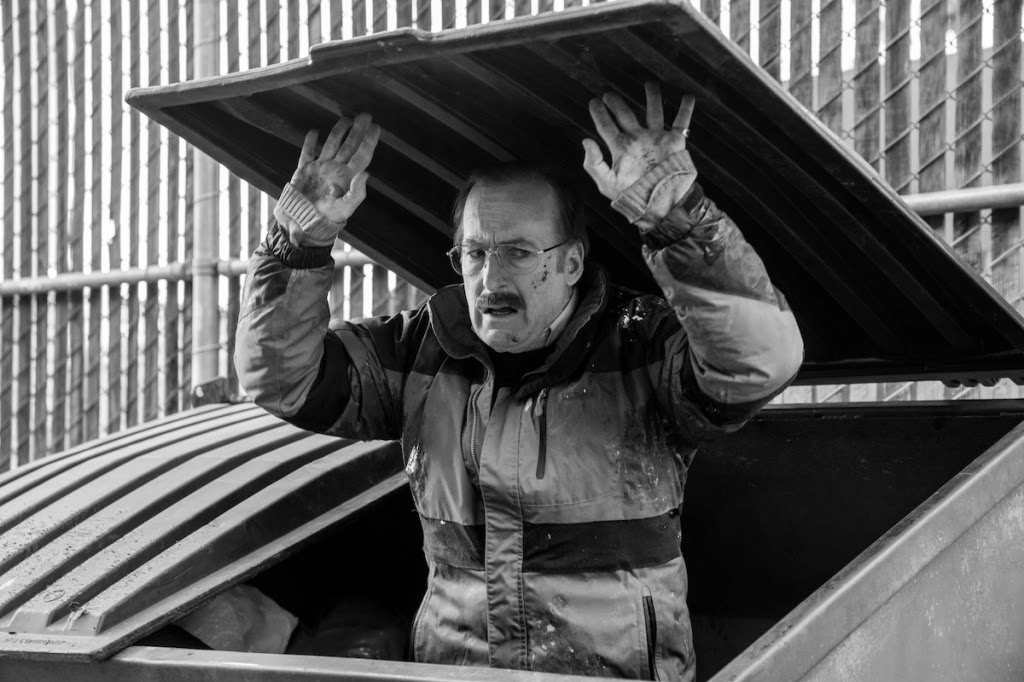
Within minutes, Gene is appropriately apprehended in a garbage dumpster, and just like that, he's back in the system, hilariously calling upon former legal nemesis Bill Oakley for help. But sans mustache and in full Saul mode, he doesn't need any help so Bill's forced to only sit back and enjoy the ride. Facing a laundry list of charges and staring down a life sentence plus 190 years, the master goes to work, manipulating the feds into agreeing to a sweetheart of a plea deal.
Once more, Saul uses the truth to spin an elaborate lie, while a visibly disgusted Marie Schrader (a returning Betsy Brandt) listens to his story about being threatened and intimidated into doing the dangerous Heisenberg's bidding. He knows it only takes one juror to believe it, and the feds fold, offering him an unprecedented seven-and-a-half year sentence. But for Saul for real revelation comes next when he hears of Kim's confession. It may take away what little leverage remained, but he was just toying with them anyway. Suddenly the satisfaction of screwing the system again doesn't seem quite as enticing as before.

Mike might be the exception, as we flash to a conversation during the memorable fifth season "Bagman" episode where he and Jimmy were stranded in the desert. At least he sees Jimmy's hypothetical time machine scenario as an opportunity for introspection, citing the day he took his first bribe as the moment he'd change. But despite clearly presenting that question in hopes that Mike can coax the truth out of him, Jimmy again buries his true feelings and changes the subject.
Confirming predictions of many, Cranston's second Walt appearance arrives via Breaking Bad's penultimate episode, "Granite State," when he and Saul briefly roomed in Ed the disappearer's vacuum store before separately starting over with assumed identities. This is end game Heisenberg and it's amazing how Cranston can just pick up exactly where he left off in attitude and demeanor, with Walt insufferable as ever. Arrogantly dismissing Saul's time machine question as scientifically impossible, he at least cuts to the core of the issue by recognizing that he's actually asking about regret.

It's telling that's Walt again blames his biggest regret on others, conveniently overlooking all the chaos and death he initiated afterwards. But confounding us again, he stares at the watch Jesse gave him, implying maybe one other regret, which we know he eventually makes right. If even Heisenberg can reach some sort of realization about his selfishness, it's definitely not too late for Saul, who wasn't "always like this," as Walt accuses. That's a description better reserved for himself.
Saul won't admit in either of those two conversations that his biggest regret is Chuck, and while it wasn't a given Michael McKean would reappear in a finale, how could he not? There's enough blame between the brothers to go around and both could have made better choices, but it feels momentous to revisit the very early days of the series (or just before it started), with Jimmy making those deliveries to Chuck's house. He did a lot for his older brother while getting nothing but grief and judgment in return, but this scene (besides revealing the origin of "The Time Machine" book confiscated from Saul's mansion) shows a different side to that. Aside from the mental illness, Chuck was also lonely and isolated, to the point that it's kind of sad to see him genuinely wanting to connect with Jimmy and get nowhere, mainly because neither will budge.

Chuck's obsession with sabotaging Jimmy's legal career was a self-fulfilling prophecy, helping to create the "chimpanzee with a machine gun" he intended to stop. And after Jimmy realized he'd never get his brother's love or approval, he went about destroying him instead.
Chuck and Jimmy may have been incapable of change, but they share a couple of small moments here that hint a common ground could have possibly been reached if both tried a little harder. Of the finale's three tremendous flashbacks, this is the deepest and most consequential, especially considering what follows.
After getting the call from DA Ericsen (Julie Pearl) that Saul's testimony in Albuquerque could negatively affect her, Kim enters the courtroom fearing the worst. It's "showtime" alright, but with a big catch, as he repeats his Heisenberg sob story to the judge before making a dramatically sharp turn into the truth that seems to surprise even him.
With Bill hilariously flailing to withdraw himself from the case as the feds look on in delight, Jimmy torpedoes his meager seven-and-a-half year sentence to admit he facilitated Walt's worst crimes. His voice cracking and trembling, he not only takes full responsibility for what happened to Howard, but also the cancellation of Chuck's insurance that led to his suicide. Now Kim knows he's for real.

Jimmy seeing the person he most respected and accepted him for what he was come clean proved to be the example he couldn't get from Walt, Mike or Chuck. Unlike them, he was able to break the cycle. There's nothing in it for him when he throws away that sentence to spend the next 86 years in prison, other than Kim's potential forgiveness. And his own peace of mind.
Jimmy can't control Cheryl's potential civil suit against her, but does the right thing anyway, dropping the mask and finally being honest with himself. The almost invisibly subtle change in Seehorn's body language and facial expression while Kim watches confirms this breakthrough, as does the buzzing of the EXIT sign, a brilliant visual nod to Chuck's courtroom meltdown in "Chicanery." Saul's gone but "James McGill" will get to share another smoke with Kim as a tiny bit of color reenters their world, coming full circle from the series' pilot episode.
This is about as "happy" an ending as Jimmy could have gotten considering the circumstances, and judging by the prison inmates' enthusiastic reaction to meeting the legendary Saul Goodman, he'll be just fine not having to constantly look over his shoulder as Gene. Kim just might be okay too, as her volunteering at that legal office indicates she may now feel somewhat freed of the burden that's held her down.
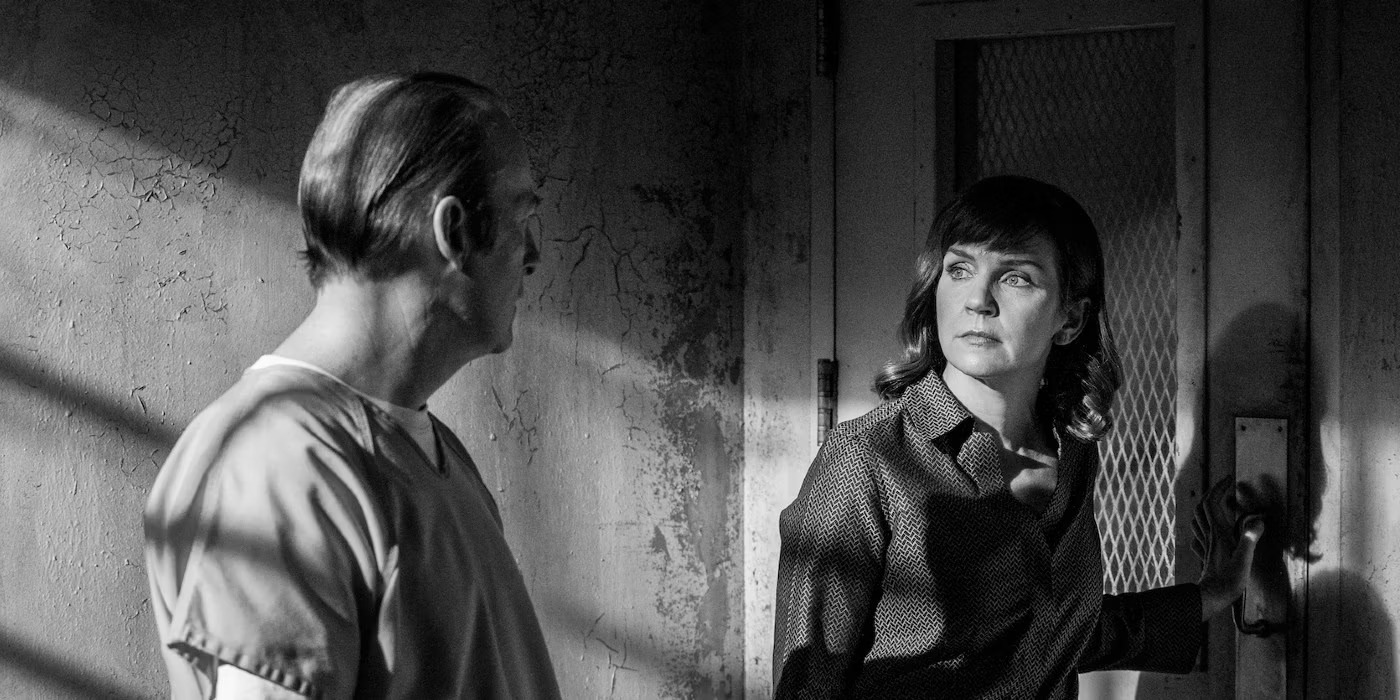
When Kim visits Jimmy in prison, she's carrying herself differently than we saw in Florida, showing small signs of her old, confident self. And despite using her unexpired New Mexico bar license to get in, it's fair to say that'll be the extent of her future scamming.
It's possible Kim resumes practicing law again somewhere, maybe even working to have Jimmy's sentence commuted. When he gives her the finger guns as she leaves, it's hard not to acknowledge the possibility this isn't the final time they see each other. Or at least we can keep telling ourselves that.
Better Call Saul succeeds where most finales don't in absolutely sticking the landing, with every scene, line and visual choice purposefully building to a conclusion that was in the cards the entire time, while still managing to completely surprise. And that's not easy when you're constructing a prequel where more than a few events and character fates are predetermined. Its final hour and a half not only works as a hits compilation, but the concluding moments spotlight what the entire story was about. So many finales fail at this, instead settling to safely sign off in a manner that upsets the fewest fans.


 Posts
Posts


