Thursday, August 24, 2023

No Hard Feelings

Director: Gene Stupnitsky
Starring: Jennifer Lawrence, Andrew Barth Feldman, Laura Benanti, Matthew Broderick, Natalie Morales, Scott MacArthur, Ebon Moss-Bachrach, Kyle Mooney, Hsan Minhaj, Zahn McClarnon
Running Time: 103 min.
Rating: R

★★★ (out of ★★★★)

It's kind of amazing it took this long for Jennifer Lawrence to star in a major mainstream comedy, despite every indication she's always had the timing to make a huge impression in one. You can chalk it up to a busy schedule, the right project not coming along, or declining enthusiasm for the genre, but it just never materialized. Now, with the 90's throwback sex comedy No Hard Feelings, her invaluable presence sets the bar high for co-writer/director Gene Stupnitsky (2019's Good Boys), who also has to deliver on a promising trailer that probably left too little to the imagination. 

Borrowing elements from R-rated romps of decades past and boasting a clever, risky premise, it didn't take long for many to worry if the movie would go "soft," sacrificing laughs to deliver a serious moral message. But that's only the partial truth, as it's smarter and more low-key than anticipated, successfully mixing a handful of situational gags with a heartfelt coming-of-age dramedy that subverts a lot of what the advertising implied.

Maddie Barker (Lawrence) is a 32-year-old Uber driver and bartender living in her late mother's home in Montauk, New York that she owes taxes on. Facing bankruptcy when her car is repossessed, she notices a Craigslist posting by the Beckers (Matthew Broderick and Laura Benanti), a wealthy couple offering a Buick in return for a prospective young woman to "date" their shy, inexperienced 19-year-old son Percy (Andrew Barth Feldman) before he goes off to college at Princeton. 

While slightly older than the Beckers expect, Maddie talks them into giving her the job and assumes she'll bed Percy in no time, ignorant to any possible complications. After a shaky introduction and a few dates where they actually start enjoying each other's company, it's apparent this can only end badly for the teen, who's a lot more capable than his helicopter parents think. In the process, Maddie makes some unpleasant discoveries about herself, realizing this deal could carry far worse consequences than she assumed.

That Percy isn't the butt of all the film's jokes is a pleasant surprise considering the type of comedy this seems set up to be. It's almost too easy to portray him as an awkward, bumbling loser so there's a fair amount of restraint taken in the script and Feldman's performance to humanize him. He's introverted and withdrawn, but far from the lost cause his parents make him out to be, possessing a sense of humor and intelligence that suggest he's still just figuring things out. 

Even with Percy's parents causing more harm than good by pushing him into something he should be experiencing on his own, there aren't many males likely to complain about being in this particular scenario, so Lawrence has to work extra hard and does. So believably out of her mind as the overbearing, aggressively flirtatious Maddie, it makes sense he'd be somewhat terrified, especially considering the age gap. The real reversal is that this manufactured relationship is more damaging for her than him, giving you the impression he'll eventually be hurt, but survive and move on. She's a different story. 

At times Lawrence and Feldman play off each other so well you temporarily forget about the whole end game. As she gets Percy to come out of his shell, a stuck Maddie is reminded of her bad choices and strained relationships with married friends Sara (Natalie Morales) and Jim (Scott MacArthur) and jilted tow driver ex Gary (Ebon Moss Bachrach). They all look at her with pity, wondering if she'll ever come to the epiphany that it's time to grow up and move on.

With the big reveal eventually playing out smoother than expected, those craving an effort in the vein of American Pie or There's Something About Mary may be slightly disappointed. One of the few instances where it encroaches into that territory is with Lawrence's full frontal nude beach fight, which would rank as the most shocking thing in the picture if not for whatever's happening with Matthew Broderick's hair.

The damaged character Lawrence plays here isn't all that different from roles she's tackled in more dramatic turns and that isn't necessarily a negative. Even if it's tonally off or a little messy in parts, you still care about the two leads thanks to the delightfully dysfunctional chemistry she shares with Feldman. They both fully understand the assignment, even if certain viewers will gripe that this isn't worse, dumber or more offensive than they were supposedly promised.

Thursday, August 17, 2023

Showing Up

Director: Kelly Reichardt
Starring: Michelle Williams, Hong Chau, Maryann Plunkett, John Magaro, André Benjamin, Amanda Plummer, Matt Malloy, Judd Hirsch, James Le Gros
Running Time: 108 min.
Rating: R

★★★ (out of ★★★★) 

The best way of describing the down on her luck protagonist in co-writer/director Kelly Reichardt's latest, Showing Up, is as someone feeling defeated by life. This of course is Michelle Williams' stock in trade, having built her well deserved screen reputation on observant, thought provoking independent projects that rarely pull punches. Re-teaming with frequent collaborator Reichardt, it lands squarely in her wheelhouse, while also standing out as one of their more accessible ventures. And with people rather than an obviously manufactured narrative driving its plot, we get a quirky, offbeat look at the goings on in a small art community. 

While some may find it a slog or grumble it doesn't really go anywhere, it's not especially meant to, nor is the main character. Things have kind of settled into what they are, leaving us to make our own assumptions about how she's handled these challenges and what the future might hold. By the end, we sense a break in the clouds, implying that she might be in for better days than the previous ones, even as she continues to juggle a constant onslaught of personal and professional responsibilities.

Lizzy (Williams) is an artist who works as an assistant to her mother Jean (Maryann Plunkett) at the Oregon College of Art and Craft, while also preparing for an upcoming showing of her painstakingly designed clay sculptures. Lacking hot water and unable to shower for several days, Lizzy complains to  friend and landlord Jo (Hong Chau), who casually brushes off the issue to prepare for two shows of her own. 

After Jo finds an injured pigeon Lizzy's cat attacked the night before and dumps the task of taking care of it back on her, Lizzy suddenly has less time than ever to work. She also has to deal with her eccentric father Bill (Judd Hirsch) taking in a freeloading hippie couple (Amanda Plummer and Matt Malloy), as well as her reclusive, paranoid brother Sean (John Magaro). With the show rapidly approaching, more disasters accumulate, but she must somehow forge forward, making a few important discoveries in the process. 

Right away you sense the instability in Lizzy's world, specifically when it comes to the dynamic with a mom who's also her employer, making their already strained interactions even more uncomfortable. It turns out everything about Lizzy's daily routine is steeped in that kind of awkwardness, as she's seldom afforded the time or opportunity to work on her clay pieces, which ironically consist of women posed in distressed states.  

Lizzy seems happiest and most focused when sculpting, but has little interest in the promotional hustle that the self-absorbed Jo's mastered, mostly by prioritizing her needs above anyone else's. It's almost a survival mechanism she's honed, unfortunately ensuring that her one tenant won't be showering anytime soon. Wishing she could let things slide off her back as easily, Lizzy resents herself for being too nice, envious of Jo's assertiveness. But whenever she unconvincingly tries to duplicate that, it just doesn't fit, and her frustration grows. Their rocky friendship forms the crux of the film and knowing so little about the history of it only makes these interactions more intriguing, allowing the actors to fill in the rest.  

Between an estranged father letting strangers crash at his house and a mom who dismisses his son's serious mental illness as some misunderstood form of genius, Lizzy has even less luck coping with her own family. Hearing voices and digging holes in the backyard, Magaro brings an unnerving tension to these scenes as Sean, with Lizzy and her mom treading carefully throughout, fearing any move they make could push him off the deep end. 

Inhabiting a deep thinker overwhelmed by work, family and a friend who seems to be anything but, Williams physically and emotionally disappears into this morose artist to the point she's nearly unrecognizable. Everything in her posture, expressions and body language subtly suggest a woman who believes she's fallen short of the career and life she envisioned, whatever exactly that may have been.

Hong Chau expertly plays Jo's inconsiderate behavior as coming from a lack of self-awareness rather than intentional maliciousness. It's far cry from her other recently acclaimed supporting turns in The Menu and The Whale, but a welcome one in its free-spirited obtuseness. André Benjamin brings a natural charisma to Lizzy's co-worker Eric, who operates the kiln at the college. He's complimentary of her work, while proving to be a little more oblivious than she thought.     

The only real bond Lizzy has is with the injured pigeon, likely since it's the one thing she feels capable of fixing. Despite it starting as yet another example of Jo taking advantage, she still recognizes her own fault in the situation and can't bare the thought of someone as irresponsible as Jo taking care of it. The totality of Lizzy's troubles come to a head when all these issues collide at her showing, resulting in a strangely symbolic but fitting realization.

The magic of Williams' performance is how it implies that self-consciousness and insecurity isn't unique to Lizzy, but partially a bi-product of this tiny creative enclave Reichardt immerses us in. As spare and minimalist as it is, the film still manages to be humorously uplifting in just the right spots, making it an easier watch than you'd expect, mesmerizing in how it captures the rhythms of everyday life. While watching Showing Up you can probably recall half a dozen indie titles it recalls in tone, but that doesn't diminish what Reichardt and Williams pull off, or lessen our interest in spending time with these undeniably eclectic characters.

Sunday, August 13, 2023

The Super Mario Bros. Movie

Directors: Aaron Horvath and Michael Jelenic 
Starring: Chris Pratt, Anya Taylor-Joy, Charlie Day, Jack Black, Keegan-Michael Key, Seth Rogen, Fred Armisen, Sebastian Maniscalco, Kevin Michael Richardson
Running Time: 92 min.
Rating: PG

★★★ (out of ★★★★) 

Whatever you may think of it, The Super Mario Bros. Movie looks and feels exactly how most imagine the video game would if adapted into a large-scale animated family film for the masses. But more importantly, directors Aaron Horvath and Michael Jelenic capture the feeling associated with playing it and how that can be translated to the screen in ways that satisfy kids unfamiliar with Mario and parents who grew up on him. It's a delicate line to walk, bound to irritate some in the latter group with specific ideas about what the ideal approach should be, as many are still recovering from the disastrous 1993 live-action version that caused studios to swear off the property for decades. 

Illumination comes to the rescue with a refreshingly simple story that distills the character to its purest, most accessible form, hooking the next generation of Nintendo fanatics by sticking to what works and playing it safe. While the noticeable drawback is how closely it resembles all the other modern animated and Disney/Marvel related content, this at least deserves credit for landing on the higher end of that scale. A visual feast that delivers an Oz meets Lego Land vibe, clever Easter eggs are dropped for longtime fans without forgetting it's a kids movie through and through. And that's exactly what this needed to be.    

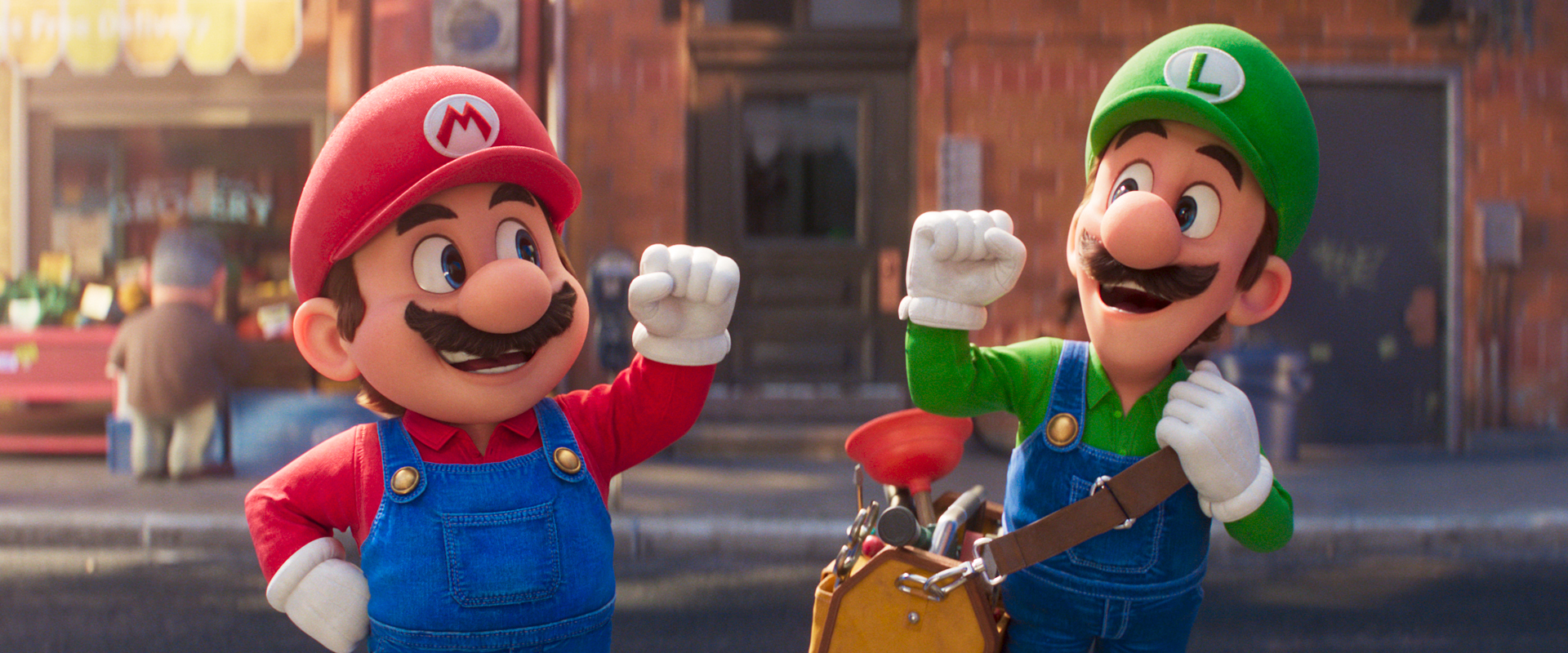
Italian brothers Mario (Chris Pratt) and Luigi (Charlie Day) just opened their own plumbing business in Brooklyn, free from the reigns of their brutish ex-boss Spike (Sebastian Maniscalco). After a rocky first service call, the pair rush to the scene of a giant water main leak, only to be sucked into a Warp Pipe that takes Mario to the bright, candy colored Mushroom Kingdom ruled by Princess Peach (Anya Taylor-Joy), while Luigi winds up in the Dark Lands, lorded over by evil Koopa king Bowser (Jack Black). 

Having gained access to the powerful "Super Star," Bowser threatens to destroy the Mushroom Kingdom unless Peach marries him, imprisoning Luigi to intimidate Mario. But after some much needed training from Peach, the red hatted plumber joins her and Toad (Keegan-Michael Key) in attempting to free Luigi and thwart Bower's dastardly plan with Donkey Kong's (Seth Rogen) help. In the process, the brothers learn what they're truly capable of, both together and apart.

With only a handful of game titles to draw from in cracking a story, substantial legwork was likely necessary to flesh out the characters and make them more easily digestible. Matthew Fogel's screenplay smartly takes a straightforward approach, and before calling that a "dumbing down," it helps to remember the challenging task he's dealt. Since overcomplicating an already paper thin premise doesn't serve any meaningful purpose, the movie lightly fills in the blanks and rarely rocks the boat, mostly to its advantage. Mario's a great source of nostalgia for many, but after forty years of  jumping over pipes, eating mushrooms and rescuing princesses, our favorite short, mustachioed plumber in overalls doesn't need a showcase any deeper or more complex than what we get here. 

There's some confusion regarding Mario and Luigi's ages, at times acting like fully functioning adults running their own business, while also coming across as overgrown toddlers, complete with race car posters hanging on the walls of their adjoining bedroom. You can't help but laugh when a later flashback shows them as actual children, looking nearly the same, only slightly smaller and lacking their trademark facial hair. Otherwise, the presentation of these two are spot-on, establishing them as clumsy and endearing, before they're suddenly thrust into a fantastical scenario where Mario must rise to the occasion as a cowardly Luigi learns to overcome his fears. 

Luigi being held captive instead of Peach seems like a deliberate tweak to move past the dated "damsel in distress" concept, and even if this idea isn't as glaringly progressive now than in years past, it still gives Anya Taylor-Joy a lot to work with as the fiesty princess. Many have already complained about the voice casting of Chris Pratt and his attempt at a Brooklyn accent, but the performance is pretty much fine. It's just enough but not too much, with Pratt and Charlie Day bringing enough liveliness and likability to the roles that kids will lose themselves in the their wisecracking ways. As Donkey Kong, Seth Rogen pretty much plays himself in "take it or leave it" mode, but Jack Black exceeds expectations as Bowser, especially during his subversively hilarious singing interludes.

With respect to the slightly younger sibling, it's called Super Mario Bros. for a reason, so Luigi getting sidelined for a long stretch isn't a big issue, especially considering where that sub-plot goes. And game devotees will appreciate just how many details this slides in, like those immediately recognizable obstacles and traps during Mario's training, his Tanooki Suit and the catchy classic theme that provided a soundtrack to many childhoods. More popular songs are squeezed in, but even that works, as everyone involved recognizes how seemingly small stuff matters when attempting to please the entire audience.

Other than a third act Mario Kart sequence that sort of stalls out, the 92-minute run time is gratifying in a sea of bloated two and a half hour family films. If it's a little flat story-wise, that's understandable given the challenge, which could help explain why it took this long to get the franchise off the ground again. Given the limited number of avenues available to explore, the filmmakers shrewdly chose a sensible one, resulting in an effort that gets the important parts right, finally giving the character a chance to be seen and appreciated on the biggest stage possible.                              

Tuesday, August 8, 2023

BlackBerry

Director: Matt Johnson
Starring: Jay Baruchel, Glenn Howerton, Matt Johnson, Rich Sommer, Michael Ironside, Martin Donovan, SungWon Cho, Mark Critch, Saul Rubinek, Cary Elwes
Running Time: 121 min.
Rating: R

★★★ ½ (out of ★★★★)

The best thing about Matt Johnson's biopic depicting the creation of the BlackBerry mobile phone is how for extended periods you completely forget what it's supposed to be about. When the groundbreaking device makes its first appearance it actually feels like a shock, as if we haven't been building to that moment since its retro cool opening credit sequence. A mismatched pairing of two wildly different personalities, what transpires is far bigger than either envisioned, until eventually swallowing them both whole. But the best stuff comes before that when we see how this nerdy, inefficient entrepreneur reluctantly joins forces with a quick-tempered, cutthroat executive. And what should be a partnership from hell ends up working out better than expected, at least for a while.  

A character study to its core, this differs from other features about popular consumer products by deeply investing in the people involved, showing exactly how they were positively and negatively impacted by their venture. Unlike the recent Tetris, it doesn't try to be something it's not, instead examining the nuts and bolts of BlackBerry's rise to cultural prominence by getting inside the heads of those who made the magic happen. It explores their motivations and mistakes, while also charting the change they undergo when success arrives. It's not so much that they're flawed than unprepared for what awaits, suddenly forced to adapt or fall behind.

It's 1996 in Waterloo, Canada when Research in Motion (RIM) CEO Mike Lazaridis (Jay Baruchel) and best friend and co-founder Douglas Fregin (Johnson) present their new "PocketLink" cellular device to an unimpressed, distracted executive named Jim Balsille (Glenn Howerton). After their pitch bombs and Jim's hubris gets him fired from his firm, he reaches out to Mike and Doug again, offering to work with them if he's named CEO of RIM and gets half the company. Jim instead settles for a third of the pie and a Co-CEO title alongside Mike, quickly realizing they need more help than he thought. 

Upon discovering RIM is a ragtag, money losing operation with engineers spending their days playing video games and watching movies, an intimidating Jim makes swift changes, landing him and Mike a meeting at Bell Atlantic to demonstrate an early "PocketLink" prototype that will soon be rebranded the "BlackBerry." It's a breakthrough, but the device's astonishing popularity soon makes the company a target, as they're fighting off hostile takeovers, the SEC, and the sudden emergence of Apple's revolutionary iPhone. A thrilling run while it lasts, what they built is about to come crashing down. 

Loosely adapted from the 2015 book, "Losing the Signal: The Untold Story Behind the Extraordinary Rise and Spectacular Fall of BlackBerry," the whole setup is hilarious, with these men from two vastly different worlds somehow co-existing under one banner. Johnson's script really plays up just how awkwardly bumbling Mike and Doug are, making you wonder how they were let into Jim's office to begin with, much less founded a tech company of their own. The most creative liberties are probably taken here, but it helps make the story, as exceptional writing and performances breathe vibrant life into what could have easily been the driest of topics.

Mike and Jim need each other more than they know, since this brilliant but underachieving slacker  lacks the business savvy the latter brings to the table. Conversely, Mike possesses the technical expertise Jim can only fake. While they mix like oil and water, it's clear Jim sees potential in his impressionable co-chair that can be exploited so long as he handles the financial end. The film's pivot point is a Bell Atlantic meeting where Mike comes to the rescue, saving the pitch and setting them on a path where the company soars, growing at an uncontrollable rate neither can fully comprehend.

When BlackBerry takes over the cell phone market in the mid 00's, there's no turning back, which is bad news for bandana-wearing, movie obsessed co-founder Doug, who soon becomes the odd man out. Discovering an autonomy he never knew he had, Mike realizes his best friend's laid-back approach no longer fits into this new corporate structure and the days of needing Doug's input fall by the wayside. One of the funniest details come when RIM offices move, and despite the upgrade, 80's movie posters still hang, the goofing around persists and nothing changes beyond their location. But it needs to, and despite his Teenage Mutant Ninja Turtles wallet and video game tees, even Doug sees the writing on the wall that he's become the Woz to Mike's Steve Jobs. 

Having mortgaged his home to finance a project that's now made him richer than he ever thought possible, Jim's on top of the world. But he also has an enormous ego that's about to fly off the rails as he fends off scheming Palm CEO Carl Yankowski (Cary Elwes), installs a new no-nonsense COO in Charles Purdy (Michael Ironside) and attempts to purchase a hockey franchise. Mike and Jim's abilities to cover the other's flaws are undone by mounting legal woes that pale in comparison to their inability to counter the iPhone. The film's final scene isn't just an ingenious callback to Mike's obsession with problem solving, but how he's forced to do something he swore he wouldn't in order to keep going.

Best known for his supporting comedy roles Jay Baruchel gets a long deserved showcase, as he credibly conveys the inexperienced Mike's transformative ascent and eventual decline. Subtly indicating a constant sense of insecurity and guilt, he plays the character as if he fears everything is a fluke that could disappear at any moment. There's no such trepidation in Jim, with Glenn Howerton imbuing this greedy piranha with a slick, bombastic bluster that enables him to steamroll over everyone in his way. Knowing the clock's quickly running out, he's determined to milk every last bit of leverage, with self-sabotaging results. 

Matt Johnson provides the largest dose of comedic relief, further highlighting just how seismic a shift his friend undergoes. Doug's left in the dust, even if you can't help but think he comes out the least damaged of the three. Comfortably feeling every bit like a Canadian production in both its setting and casting, Johnson's most important contribution comes as co-writer and director, with the filmmaker showing the potential downsides of having an idea years ahead of its time. The public has to be ready for it, the technology flawless, and the capital available. If just one is missing, it's wise to brace for eventual failure.  

These guys knew exactly where the future was headed, but the obstacles proved too much, turning this into a cautionary tale that isn't entirely dissimilar to The Social Network or the great AMC series Halt and Catch Fire. It's nice to get there first, but a greater feat to actually be the last left standing at the end. BlackBerry rarely needs to remind us we're looking at the individuals who invented the smartphone, as they appear equally in awe themselves, struggling to figure it all out as they go along.

Thursday, August 3, 2023

Are You There God? It's Me, Margaret.

Director: Kelly Fremon Craig
Starring: Abby Ryder Forster, Rachel McAdams, Kathy Bates, Benny Safdie, Elle Graham, Amari Alexis Price, Katherine Kupferer, Kate MacCluggage, Aidan Wojtak-Hissong, Landon S. Baxter, Echo Kellum, Zackary Brooks, Isol Young, Mia Dillon, Gary Houston
Running Time: 106 min.
Rating: PG-13

★★★ (out of ★★★★)  

After rejecting offers for nearly half a century to adapt her most widely known novel, Are You There God? It's Me, Margaret. into a feature film, celebrated children's author Judy Blume finally gave in. But considering the extent of that book's impact on middle-school aged girls of a certain era, it's hard to fault her for waiting. And with only one of her many works having hit the big screen thus far, she's the rare seminal writer who's been spared the indignity of her stories being butchered by a Hollywood system inept at tackling this kind of material. That Blume founded "YA" well before the label even existed earns her a credibility few others have, deserving tons of credit for holding out until all the cards fell into place.

It's easy to see why Blume thought she found the ideal filmmaker for the job in writer/director Kelly Fremon Craig, whose 2016's The Edge of Seventeen sensitively covered somewhat similar terrain. And while Margaret isn't quite as strong an effort, it's still one of the few instances where we're not left worrying what an author might think about the result. There's little chance she'd be unhappy with this, aside from the disappointment more didn't go out of their way to see it. But if a coming-of-age dramedy centered around a tween girl set fifty years ago is already an impossible sell for audiences, just think how hard it must have been to get this right.

It's 1970 and after returning from summer camp in New Hampshire, eleven-year-old Margaret Simon (Abby Ryder Forster) is informed by her parents Barbara (Rachel McAdams) and Herb (Benny Safdie) that they're moving from New York City to the New Jersey suburbs due to her dad's job promotion. None too happy about leaving her friends and grandmother Sylvia (Kathy Bates) behind, Margaret tries adjusting, as she's befriended by new neighbor and classmate Nancy Wheeler (Elle Graham). Margaret soon joins Nancy's clique, which consists of two other girls, Gretchen (Katherine Kupferer) and Janie (Amari Alexis Price), and a strict set of membership rules that involve wearing bras and revealing the boys they like. 

When Margaret's sixth grade teacher Mr. Benedict (Echo Kellum) discovers her dislike of religious holidays, she begins questioning her mom about the family's history, which saw Barbara's devoutly Christian parents Paul (Gary Houston) and Mary (Mia Dillon) disown her after marrying a Jewish man. Now, as Barbara drifts further away from her love of painting and teaching by volunteering for various PTA committees, she'll have to unexpectedly confront that issue again. And despite talking to God about her problems on a regular basis, an anxious Margaret is not only confused about her own religious identity, but that other girls are already getting their periods. 

If a move over the bridge from NYC to Jersey doesn't seem like such a big deal, Craig's screenplay already captures the essence of Blume's prose in reminding us how everything that happens at this age feels life altering. It's especially true for the kind, world weary Margaret, who's tuned in enough to be greatly affected, her nerves often accompanied by a deer-in-headlights look recognizable to anyone who's experienced the pangs of adolescence. 

Young actress Abby Ryder Forster is terrific, conveying a likable sincerity while taking the title character on an emotionally rocky journey that ranges from crushing disappointment to inspiring optimism. We're invested in her, but the film's calling card are the cringe worthy interactions she shares with her friends, which are humorously awkward in their frankness, rarely evading the embarrassment of firsts these girls are experiencing. Struggling with her physical maturity and religion, Margaret also questions whether the pushy, overconfident Nancy is a real friend or has some other agenda. As the group's leader, she talks a strong game, but may prove to be just as insecure and scared as the rest. 

A subplot involving Margaret's secret crush on local neighborhood boy Moose (Aidan Wojtak-Hissong) is carefully handled, as is an even smaller arc revolving around shy, physically mature classmate Laura (Isol Young), who's picked on for her appearance. The latter effectively reinforces the theme that sometimes there's just no winning for a girl that age, as there will always be bullies ready to pounce on any perceived imperfections. How Craig navigates these waters to end on the note she does is impressive, as are the more humorous moments, such as an adventure in the drugstore buying sanitary pads. 

Kathy Bates runs away with her scenes as Sylvia, sarcastically joking around the pain she'll soon be alone when the family moves. And after initially not making much of an impression, Benny Safdie subtly humanizes Herb when he's confronted with the daunting challenge of again facing the in-laws who rejected him. But it's Rachel McAdams' performance as Barbara that holds all of this together, delivering a seemingly effortless, believable supporting performance worthy of serious awards consideration.

Quietly carrying the baggage of a mom's fractured relationship with her own parents, McAdams plays  Barbara as overprotective but supportive of Margaret, realizing she needs to give this girl enough room to discover, succeed, and fail on her own. She's so natural that this seems less like a role, but a glimpse into how parents sometimes wear masks to meet the challenges of raising a child, even one as good as Margaret. Inhabiting this free-spirited personality, the actress even turns Barbara's obsessive people pleasing into something sadder and more selfless, almost as a means to disappear. McAdams may have been flying under the radar of late, but this is some of her strongest work yet, reminding us just how much she's capable of.

There are two concurrent stories running at once with Margaret, and while they don't seamlessly congeal, both are well handled. More importantly, Craig's script has a voice that not only harkens back to the decade it's set with costuming and music, but also coming-of-age movies from the 80's and 90's, carving out a nice little niche that should still carry appeal for those outside the target demographic. A smart, authentically performed effort that gets a lot of small details right, it's a worthy accompaniment to the source material, deftly handling all the uncomfortable aspects of growing up that made Blume's book a generational touchstone.                                                

Friday, July 28, 2023

The Flash

Director: Andrew Muschietti 
Starring: Ezra Miller, Sasha Calle, Michael Shannon, Ron Livingston, Maribel Verdú, Kiersey Clemons, Antje Traue, Michael Keaton, George Clooney, Jeremy Irons, Temuera Morrison, Saoirse-Monica Jackson, Rudy Mancuso 
Running Time: 144 min.
Rating: PG-13

**The Following Review Contains Major Plot Spoilers For 'The 'Flash' **

★★ ½ (out of ★★★★) 

Contained within director Andrew Muschietti's The Flash are glimpses of the project Warner Bros. hoped could give DC's Extended Universe the ammunition it needed to redefine an overexposed genre and finally compete with Marvel. And despite roadblocks like its lead star's highly publicized legal troubles and the announcement of this as a closing chapter of the current DCEU, a genuine sense of optimism did surround that very real belief.

Using the 2011 comic crossover "Flashpoint" for inspiration, this was touted as a sci-fi driven time travel story marking the triumphant return of Michael Keaton as Batman, as well as a handful of other familiar faces. It's also a tale of two movies, as its emotionally resonant central plot is derailed by what sometimes feels like committee-approved fan service. That would be its biggest flaw, if not for the spotty visual effects that take over a memorable final act bustling with AI generated cameos of legends past. 

While there are still some really good ideas in here, it probably comes as little surprise that the film's biggest assets aren't a pair of bickering Barry Allens around which the majority of the action revolves, but Keaton's Batman and an impressive new Supergirl. It might be worth seeing just for their performances, even if each would be better served by a standalone entry of their own. But now, given The Flash's underwhelming reception and a misjudged ending, it's possible neither actor gets an opportunity to play these characters again. And that's the biggest disappointment in what turns out to be a fascinatingly mixed bag. 

In present day, forensic investigator and Justice League member Barry Allen/The Flash (Miller) still carries the trauma over his father Henry's (Ron Livingston) wrongful imprisonment for the murder of his mother Nora (Maribel Verdú) when he was young. Desperately trying to clear his dad's name, a conversation with former college crush and current journalist Iris West (Kiersey Clemons) gives Barry the idea to use the Speed Force to travel back in time and prevent his mom's death. Dismissing dire warnings from friend Bruce Wayne/Batman (Ben Affleck) that changing this could carry disastrous consequences, he goes anyway, attempting to save her in the least disruptive way possible to the timeline. 

Barry's trip is wrought with complications, as he's suddenly stuck in an alternate 2013 with mother Nora still alive, but coming face-to-face with his college-aged self the day he gained the Flash powers. Trapped in an alternate universe without the Justice League, both Barrys must work together to thwart General Zod's (Michael Shannon) invasion of Earth. But they'll need help, which may come from an older version of Bruce Wayne/Batman (Keaton), who they coax out of retirement in hopes of locating Superman. But after instead discovering his imprisoned cousin, Kara Zor-El/Supergirl (Sasha Calle), all four must work together to topple Zod and undo the catastrophic damage Barry accidentally caused.

There are definite parallels to what Marvel recently did with 2021's Spider-Man: No Way Home in incorporating multiverses and various versions of canonical characters. But in some sense, this contrasts what Marvel usually gets right, with DC buckling under the pressure to adopt that model rather than chart a different course. But while this plot draws from a highly regarded comic, a more noticeable influence is Back To The Future, or more directly, the paradoxical Part II. And even as the screenplay fully acknowledges its debt to the trilogy with a number of shout outs and a clever gag involving the aborted casting of Eric Stoltz, we're reminded just how high a bar this is trying to clear.

That Barry's well-intentioned quest involves a parent's death only compounds the butterfly effect, adding personal weight to Batman's involvement since it's a tragedy he knows all too well. Where problems arise are in execution, or rather the mind-numbing interaction between the two Barrys, which becomes the definition of beating a good joke into the ground. The idea of current day Barry showing his reckless and irresponsible younger counterpart the ropes after losing the powers his past self gains does work in principle. But present Barry must have the patience of a saint since this kid's unhinged behavior really tests the nerves, turning a situation initially ripe for comic possibility into the lost Multiplicity sequel no one wanted.

Though Miller excels at playing both and it's the least jarring effects work in the picture, you'll still be counting down the minutes until Keaton arrives. Until then, get used to seeing Barry stuffing his face with calories to maintain his super speed and arguing with the older doppelganger. And there's a nauseating amount of running inside, outside and everywhere else before the two arrive at Wayne Manor to find a reclusive, unkempt Bruce, who clearly hasn't seen much crimefighting since 1992. Initially showing little interest in donning the cape and cowl once more, his change of heart is unusually sudden, but welcome, since the over 70 year-old Keaton slides back into this iconic role as if no time passed at all. 

Not only does the entire film temporarily improve ten-fold with Keaton's arrival, the feuding Barrys become more tolerable when he subtly steps in as a mediator and guiding force. The best scenes take place within in the desolate batcave as the three formulate a plan to retrieve Superman in Siberia and restore older Barry's powers. Of course, it all provides the opportunity to again witness Keaton believably kick ass in the batsuit, putting to shame Affleck's sleepy performance from earlier. 

Michael Shannon looks bored to tears, possibly because the Zod plot feels shoehorned in as an excuse to tie the DC universe together and bring in auxiliary characters. Thankfully, we have Supergirl, played by an actress who redefines the big screen presentation of Kara. From the short pixie cut to that stone cold death stare, Sasha Calle is a real find, conveying an ideal combination of grit and vulnerability, more than proving herself deserving of another shot at this. Unfortunately, due the film's performance and DC's pigheaded future plans to recast every role in sight, she may not get it.

The visual effects do few favors for anyone, but as insane as the last act is, it at least differs from your usual 40 to 45 minute CGI superhero slugfest by centering around an Edge of Tomorrow-like time loop. And it might be fun to poll fans still sore over Luke Skywalker's treatment in The Last Jedi to find out if they're just as disgruntled about how Keaton's arc wraps. It's unlikely they'll care since anything that happens (or doesn't) in superhero multiverses can usually just be wiped out in the blink of an eye. Let's hope that's the case with this Batman and Supergirl, possibly keeping the door open for future appearances after all.

When Barry regains his powers and reenters the Speed Force alongside his 2013 self, this hurls toward a trippy ending that speaks to obsessing over what wasn't. Put in an unenviable position of accepting the lowest moment of his life in order to selflessly prevent worse, the two Barrys get a whirlwind tour of DC's past. This includes the likes of George Reeves and Christopher Reeve's Superman, Helen Slater's Supergirl, Adam West's Batman, audio samplings from Cesar Romero and Jack Nicholson's Joker, and in the deepest cut, Nicolas Cage's Superman from Tim Burton's unproduced Superman Lives. 

Though a few of these appearances bring back bad deepfake memories of Princess Leia in Rogue One, the technology has improved since, with the noticeable exception of a scarily de-aged Cage. Still, it's a moment, in addition to the powerful one Barry shares with his mom that shows how involving this story is when staying the course. The final scene exemplifies that mishmash of tones, with the filmmakers going for a self-referential joke that's not quite as amusing as they think. Supposedly, the original plan was for Keaton to step out of that car instead of Clooney, which would have resulted in a far more satisfying payoff. But at least the latter makes the most of his admittedly goofy Bruce Wayne cameo.

It may be messy, but Keaton and Calle shine, which isn't a knock on Ezra Miller, who excels in a tricky dual role that the writers go comically overboard with. And you start to wonder if those accusations about DC's lack of direction are true and whether this was worth the studio suffering through all that bad press. Superhero fatigue or not, the stakes seemed higher than usual, reinforcing how difficult it is to unlock an event movie's fullest potential. Extended portions of The Flash come close, providing a valuable look at what could have been under better circumstances.                                                      

Sunday, July 23, 2023

Asteroid City

Director: Wes Anderson
Starring: Jason Schwartzman, Scarlett Johansson, Tom Hanks, Jeffrey Wright, Tilda Swinton, Bryan Cranston, Edward Norton, Adrien Brody, Liev Schreiber, Hope Davis, Stephen Park, Rupert Friend, Maya Hawke, Steve Carell, Matt Dillon, Hong Chau, Willem Dafoe, Margot Robbie, Tony Revolori, Jake Ryan, Grace Edwards, Aristou Meehan, Sophia Lillis, Ethan Josh Lee, Jeff Goldblum
Running Time: 105 min.
Rating: PG-13

★★★ ½ (out of ★★★★) 

The style vs. substance debate that's followed Wes Anderson throughout his career again rears its head with Asteroid City, an ambitious effort from a very distinctive filmmaker sure to split critics and audiences down the middle. He must be used to it by now, considering how each new release is accompanied by conversations about how Andersonian it really is. For rabid devotees, there's no such thing as too much, whereas just a couple of minutes is more than enough for the harshest detractors. But even as his singular aesthetic still prompts accusations of superficial repetitiveness, few contemporary directors have amassed a body of work so instantly recognizable. No matter what you think of it.  

For all the SNL skits or viral video spoofs, making a Wes Anderson picture is a market he'll always have cornered because there's an underlying sincerity to what he does that no one's been able to duplicate. Even when the execution seems like a parody of itself, there's more there. It's especially true of his best efforts like Rushmore and The Royal Tenenbaums, where style and substance overlap in character-driven stories that go to deeper, rawer places many feel he hasn't returned to since. The jury's still out on where this one lands, but it's definitely a departure of sorts. Or at least as much of a departure as we've gotten from the divisive director in a long time. 

The film's retro futuristic desert setting is a hugely impressive visual achievement brought to surreal life by Robert Yeoman's cinematography and Adam Stockhausen's production design. But there's also a meta layer that distinguishes it, as a stacked cast pulls double duty in both a black-and-white TV documentary special of a play and the play's events, presented in vibrant color. It's also a pastiche of postwar Americana, UFO paranoia and old Hollywood moviemaking that further explores the themes of grief and ostracization constantly present in Anderson's output. In other words, there's a lot to unpack.

The film opens in black-and-white as a TV host (Bryan Cranston) introduces renowned playwright Conrad Earp's (Edward Norton) production of "Asteroid City," a play that takes place in a fictional 1955 desert town of the same name. In it, war photographer Augie Steenbeck (Jason Schwartzman) arrives with his intellectual teen son Woodrow (Jake Ryan) and three daughters at the Junior Stargazer convention where Woodrow is being honored. But Augie's inability to tell the kids of their mother's recent death complicates his already fragile relationship with curmudgeonly father-in-law Stanley (Tom Hanks). 

Also in town is Midge Campbell (Scarlett Johansson), a famous, melancholy actress whose teen daughter Dinah (Grace Edwards) is also being recognized at the convention. Among the other attendees are elementary school teacher June Douglas (Maya Hawke) and her class, a cowboy band led by a singer named Montana (Rupert Friend), the brilliant but eccentric astronomer Dr. Hickenlooper (Tilda Swinton) and five star General Grif Gibson (Jeffrey Wright). 

When a major extraterrestrial event inexplicably occurs during the awards presentation, the U.S. government frantically intervenes to contain the site and quarantine witnesses in town. We're also shown glimpses of the TV special detailing the play's evolution, as the actors struggle to make sense of their roles, most notably Schwartzman's Jones Hall, who helplessly turns to director Schubert Green (Adrien Brody) for creative guidance.

It isn't clear where the story's going for much of the first forty minutes, or even if it's headed in a direction that would set it apart from what we've already seen from Anderson. And despite his penchant for attracting huge names, the involvement of Hanks and Johansson doesn't necessarily signify we're in for something especially unique, as sometimes even the biggest stars have taken back seats to the framing and visual presentation of his pictures. And this one is mind-blowing, shot by Yeoman with a bright, oversaturated artificiality that recalls 50's Westerns like Bad Day at Black Rock. 

As usual with Anderson, the actors dryly deliver their lines with a kind of detached bemusement that almost implies they're playing imitations or mockeries of themselves. Only the real kicker this time is that they actually are. The "play within a play" conceit allow the actors to carry aspects of their performer's uncertainty toward the material into the actual roles, adding an important contextual layer. This works especially well with Schwartzman and Johansson, who delicately depict Augie and Midge's ambivalence toward each another, dancing around their feelings before eventually connecting on a deeper level. Schwartzman's nuanced turn has you wondering why he isn't cast more often as a lead while Johansson perfectly captures this moody, morose Hollywood starlet with an edge. 

Once the UFO event unfolds with the appearance of a wacky looking alien, the script's characters really start to wrestle with various forms of loneliness and uncertainty. And like many Anderson films, it celebrates the quirky outsider, as the Junior Stargazers are far more tuned in and observant than any of their parents, scientists and especially government officials. Those Moonrise Kingdom vibes are definitely present in Woodrow and Dinah's relationship, while the film still manages to incorporate an endless parade of well known faces without it coming across as a stunt.

Hanks, Hawke and Swinton make the most impact with what they're handed and even the smaller parts occupied by Hope Davis, Liev Schreiber and Willem Dafoe humorously fill out the corners of this bizarre world. If there's a true highlight, it's Margot Robbie's sensational single scene opposite Schwartzman, which ties the movie's metaverse in knots to gain invaluably greater insight into Augie and the actor who plays him. Most assumed Hanks' cranky part was originally intended for Bill Murray, but the latter was actually cast as Steve Carell's motel manager before having to pull out. Regardless, Hanks puts his own spin on Stanley and Carell's tiny role would likely be a waste of Murray anyway. 

From the moment an entertainingly deadpan Cranston appears on screen channeling Rod Serling in a Playhouse 90-style special, it's apparent we're in for a rarer breed of nostalgic escape than Anderson usually delivers. A single viewing of Asteroid City won't determine its ranking in his filmography or win over doubters, but much of what the trailer hinted at pans out with Anderson flair, again making it difficult to separate the filmmaker from his creation. But like these characters, we'll just have to accept that understanding everything isn't the goal, or really even necessary at all.