Sunday, August 14, 2022

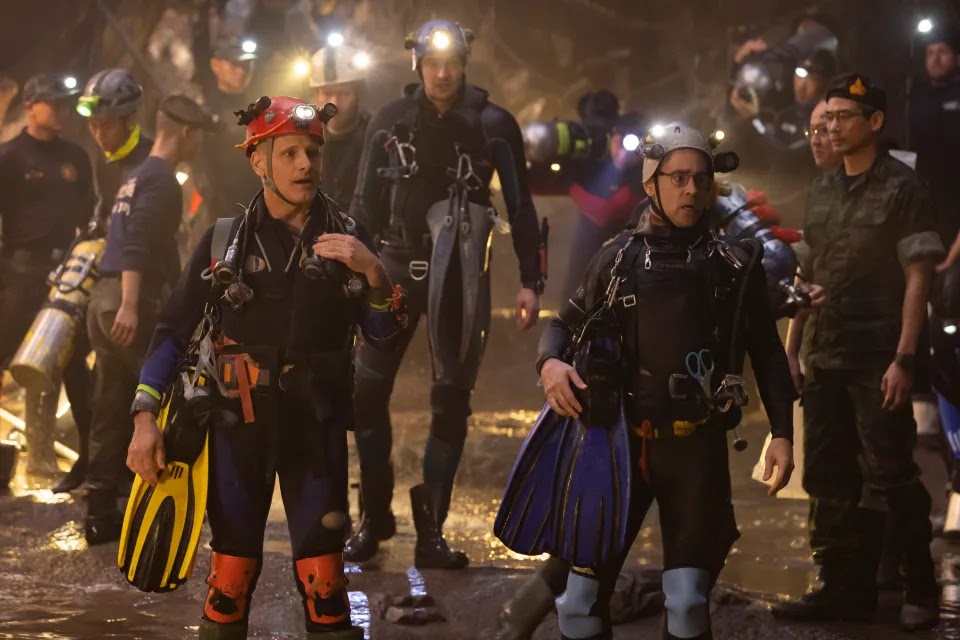
Thirteen Lives


Director: Ron Howard
Starring: Viggo Mortensen, Colin Farrell, Joel Edgerton, Tom Bateman, Sukollawat Kanaros, Thiraphat Sajakul, Sahajak Boonthanakit, Vithaya Pansringarm, Teeradon Supapunpinyo, Nophand Boonyai, Paul Gleeson, Lewis Fitz-Gerald
Running Time: 147 min.
Rating: PG-13

★★★ (out of ★★★★) 

When a junior football team and their assistant coach were trapped in a cave in northern Thailand following a practice in 2018, almost three weeks elapse before the boys and their coach are rescued, all of them miraculously surviving. Since so many details about the event have already been covered in first-hand accounts, news reports and 2021's documentary The Rescue, director Ron Howard's job of compellingly dramatizing it in Thirteen Lives becomes all the more difficult. And as he probably knows, any recreation pales in comparison to reality or descriptions from those who were actually there. But that's never stopped any filmmaker from tackling true stories before, so in framing this for those who know exactly what happened, the challenge comes in showing it.

Howard's up to the task, and while nearly all the information concerning the rescue would emerge later, families of the trapped kids were often kept out of the loop amidst bureaucratic and political disorganization. And no matter how much we know now, the method utilized to extract all twelve of these kids and their coach is still shocking, the most dangerous of last resorts under exceedingly hopeless circumstances. If the reliable, workmanlike Howard seems to be a sturdy if unimaginative choice for this material, at least he's the right one, giving the actors and story space while delivering a no frills account that's free of the oversentimentalizing many expected going in.

It's June 23, 2018 when the Wild Boars football/soccer team consisting of twelve boys between ages 11 and 16, along with their 25 year-old assistant coach, Ekkaphon Chanthawong (Teeradon Supapunpinyo) finish practice and head to explore the nearby Tham Luang Nang Non cave. With monsoon season arriving early and torrential, heavy rains inundating the area, the team becomes stranded in the cave's tunnels, unable to exit as downpours worsen and waters continue to rise. With day turning to night, parents express concern that their kids haven't returned home, and when the head coach is unable to contact the rest of the team, their whereabouts are soon confirmed by a teammate who stayed behind. 

Upon discovering the kids' muddy bicycles and belongings outside the cave, a team of Thai Navy SEALs divers are called in to find them, but their attempts are thwarted by continuous precipitation. It's only when local caver Vernon Unsworth (Lewis Fitz-Gerald) suggests to the Thai Governor (Sahajak Boonthanakit) they call in the British Cave Rescue Counsil (BCRC), that divers Richard Stanton (Viggo Mortensen) and John Volanthen (Colin Farrell) arrive on the scene. The two men make it far, overcoming poor visibility, rising waters and dangerous debris to make a heroic discovery. But that's only the beginning, as the far tougher challenge lies ahead.

The kids are in the cave for an absurdly long amount of time before anyone comes close to reaching them, with the days and hours ticking down until it's well over a week before they're even located, with Thai divers negotiating their way through narrow crevices and rising waters in search of the team. Not as enthralling, but no less important, is the controversy involving how much the families should know and when, as well as an elaborate strategy to redirect at least some of the rain away from the cave onto the fields. Essentially destroying local farmers' crops and livelihoods to give the children a better chance of survival elicits a response you wouldn't expect, reminding us that while William Nicholson's screenplay doesn't sidestep criticisms of the rescue's handling, the Thai people came together and sacrificed when it mattered most. 

Overcoming scrutiny and skepticism, former firefighter Stanton and IT specialist Volanthen prove themselves invaluable in not only locating the kids, but somehow coming up with a plan to get them out. Mortensen and Farrell give the kind of non-showy performances that are easy to for granted because they're so efficient at conveying the skills and demeanor of two professionals who know what they're doing, but could still easily fail. Aiding them in the rescue are Australian cave diver and medical doctor Richard Harris (Joel Edgerton) and fellow divers Chris Jewell (Tom Bateman) and Jason Mallinson (Paul Gleeson), each of whom are necessary to carry out a plan that has no business working, yet somehow does. Without giving too much away, its potential side effects carry its own set of entirely different risks, and watching it be done multiple times is about as suspenseful and nerve-wracking as it gets. Cinematographer Sayombhu Mukdeeprom also excels at taking us inside this underwater hell, creating an overwhelming sense of claustrophobia both above and below the surface.

One of Howard's more impressive outings in a while, it's kind of surprising Thirteen Lives hasn't gotten much attention, but that could be chalked up to just how closely he sticks to the task at hand. Appropriately lacking in directorial flare, there isn't a large amount of character development for the kids and their families, resulting in a relatively straightforward survival tale that doesn't exactly demand a rewatch. The action really kicks into high gear during the film's last forty minutes, as we hold our collective breath in disbelief at the impending rescue. That this was their best option is what's scariest, regardless of how familiar audiences are with how it all turns out.                           

Tuesday, August 9, 2022

Old

Director: M. Night Shyamalan
Starring: Gael García Bernal, Vicky Krieps, Rufus Sewell, Alex Wolff, Thomasin McKenzie, Abbey Lee, Nikki Amuka-Bird, Ken Leung, Eliza Scanlen, Aaron Pierre, Embeth Davidtz, Emun Elliott, Kailen Jude,
Gustaf Hammarsten, Francesca Eastwood, Matthew Shear, Kathleen Chalfant
Running Time: 108 min.
Rating: PG-13

★★ ½ (out of ★★★★)  

Before Jordan Peele, we had M. Night Shyamalan. And his latest, Old, promises we could very well be stuck with him for a while. While that's not quite as bad as it sounds, it's become impossible to overlook the constant comparisons between these two filmmakers, each of whom have cited The Twilight Zone creator Rod Serling as their primary inspiration. Peele can be grateful for having only directed three pictures, knowing he'll have a long way to go before his career could possibly be stained with the wild inconsistency that's plagued Shyamalan's. After a mini-resurgence of sorts with Split, he backslid again by trying to create his own Shyamalaniverse with the poorly received Glass. Now watching Old, you come to the realization that despite a superior concept to work from, not a whole lot has changed. 

Shyamalan seems interested in delivering impactful social commentary, but unlike Peele, it just doesn't seem to hold his interest for long, as he falls back on thrills, kills, and yes, final twists. The result here is a colossally mixed bag that's sometimes unpleasant to watch, both for its directionless hysterics and meandering execution. The oddest thing is that parts of it really work and you can imagine him delivering a successful screen adaptation of Pierre Oscar Levy's Swiss graphic novel, "Sandcastle," that's a compelling treatise on time and mortality. Elements in this compelling premise fleetingly connect, but aren't fluidly presented, resulting in some over-the-top moments that may bring back painful memories of the unintentionally hilarious lion attack scene in the director's own The Happening. It's interspersed with other wacky, wild sequences that just don't fit, leaving little doubt that Shyamalan was more interested in delivering non-stop action than following through on all the untapped thematic potential this idea contained.  

Currently going through a divorce, Guy (Gael García Bernal) and Prisca (Vicky Krieps) Cappa are taking their children Maddox (Alexa Swinton) and Trent (Nolan River) to a tropical resort for a final family vacation together. Welcomed with open arms by the resort manager (Gustaf Hammarsten) and employees (Francesca Eastwood and Matthew Shear), the kids befriend Idlib (Kailen Jude), the manager's young nephew, before they're all transported via van to a secluded beach. While there they meet three additional parties of vacationers: surgeon Charles (Rufus Sewell), his wife Chrystal (Abbey Lee), their young daughter Kara (Kylie Begley) and Charles' mother, Agnes (Kathleen Chalfant). Spouses Jarin (Ken Leung) and Patricia (Nikki Amuka-Bird), and a rapper known as "Mid-Sized Sedan"(Aaron Pierre). 

After the corpse of Mid-Sized's companion is discovered and strange incidents occur related to the travelers' preexisting medical conditions, it's clear something's very wrong. When another unexpected discovery reveals a phenomena on the beach that's causing everyone to age at alarming rates, they unsuccessfully attempt to escape. With beachgoers now suddenly dropping liking flies, the remaining survivors race against time to find out why, with the hope of preserving however many precious hours remain on their lives.

The film's most problematic portion arrives just as the nightmare scenario on the beach unfolds. In what feels like twenty minutes to a half-hour of pure chaos, various characters are scrambling like chickens with their heads cut off to figure out what's going on. In fact, decapitated chickens might be the only thing absent, as their misfortunes aren't merely limited to rapid aging, but violent knife attacks, suicides, cancerous tumors, psychosis and dead babies. How Shyamalan managed to escape an 'R' rating can only be chalked up to judicious editing that goes out of its way to avoid showing too much. This leaves us somewhere between a 'PG-13' horror thriller and an 'R' rated philosophical drama, though likely alienating both sets of audiences by not fully committing to either. 

None of this is offensively bad so much as repetitive and a little silly, as we're left wondering if there was a less hyperbolic way to introduce the premise. Shyamalan inexplicably plays coy by holding out on the rapid aging reveal, a surprise that would have worked better if the movie wasn't already titled Old and the trailers and commercials didn't give it away. But he persists, filming the two characters from behind, not showing them and using every visual trick he can to string us along before pulling back the curtain to reveal a new pair of older actors taking over the roles. 

In a sea of performers chewing on scenery (see Rufus Sewell's raging maniac), Thomasin McKenzie and Alex Wolff do provide affecting turns as teen versions of siblings Maddox and Trent. The movie is all the better for focusing on them, and when Shyamalan grabs control of the premise, it's easier to appreciate what's done well, such as the make-up and effects work that believably age the characters at five and ten year intervals. There's also a sequence involving the Cappa family that cuts to the core of what this film could have been. Of course, your level of attachment may vary since the sheer number of deaths and different actors playing the same characters serve to keep viewers at an arm's length for much of its running time.

Featuring a twist ending that's somehow eye-rolling and serviceable all at once, there's a sense the material didn't need to be this overcooked and we could have done without a body count high enough to make Michael Myers blush. Stakes diminish when multiple characters are expiring every two minutes, so it's kind of a miracle Shyamalan even pulls off what he does, especially considering how familiar we've become with his gotcha finales. He deviates from the graphic novel by leaving less up to the imagination, but as far as wrapping things up, it probably falls on the higher end of his writing output.

Those clocking the screen time of Shyamalan's trademark cameos will be either delighted or depressed to learn that this appearance is his biggest yet, both in terms of length and function. What's less of a surprise is that Old is all over the place, as the polarizing filmmaker again challenges himself and us by depicting protagonists threatened not only by an unseen, existential menace, but themselves. And much like most of his work, seeing this just to say you did isn't the worst idea in the world. At least by now, it's easier to know exactly what you're in for.             

Friday, August 5, 2022

The Eyes of Tammy Faye

Director: Michael Showalter
Starring: Jessica Chastain, Andrew Garfield, Cherry Jones, Vincent D'Onofrio, Mark Wystratch, Sam Jaeger, Louis Cancelmi, Gabriel Olds, Fredric Lehne, Jay Huguley, Grant Owens, Randy Havens
Running Time: 126 min.
Rating: PG-13

★★★ (out of ★★★★)

When Jessica Chastain won the Best Actress Oscar for 2021's The Eyes of Tammy Faye, her victory  elicited one of two reactions. Either that she was already owed statues for Zero Dark Thirty and The Tree of Life, or maybe more cynically, it extended the Academy's streak of awarding actors for playing a real life figure in a by-the-numbers biopic. And bonus points if it's an attractive star undergoing some kind of massive physical transformation like Charlize Theron in Monster. Michael Showalter's film (based on Fenton Bailey's 2000 documentary of the same name) proves that all these assumptions can be true at once, as the deservedly honored Chastain triumphs while buried under mountains of face paint and prosthetics as enigmatic televangelist Tammy Faye Bakker. 

For Academy voters known for crowning the most and biggest acting, the thought of Chastain tackling the disgraced Tammy Faye had to be a dream come true, even as audiences resisted. Without digging too deeply, the picture moves through key events at a breakneck pace that makes you wonder why it wasn't green lighted as a limited series in the vein of Hulu's The Dropout (of which Showalter directed episodes). But with more than a few tricks up his sleeve, this is as straight down the middle as a biopic can be in chronologically hitting its marks, with the leads physically and emotionally capturing two controversial figures in all their bluster, flamboyance, and superficiality. The last descriptor is  important in reconciling how one half of this couple comes off substantially more flawed than their partner, flying in the face of most of our preconceived notions about their story.  

It's 1960 when Tammy Faye LaValley (Chastain) meets Jim Bakker (Andrew Garfield) are both attending North Central Bible College in Minneapolis, Minnesota. To her mother Rachel's (Cherry Jones) disapproval, they drop out of college shortly thereafter to get married and begin preaching in Christian communities across the country. This catches the attention of televangelist Pat Robertson (Gabriel Olds) who hires them as hosts of their own children's show, "Jim and Tammy," on his Christian Broadcasting Network. But as Jim ascends to hosting CBN's "The 700 Club," Tammy clashes with conservative pastor Jerry Falwell (Vincent D'Onofrio) over her support of the gay community. 

Following the birth of their first child, the Bakkers go out on their own in 1974, creating the PTL Satellite Network, where they have free reign to control the programming content. As "The PTL Club" emerges as an enormously successful flagship show and ratings juggernaut, questions soon surface in the press about their finances and numerous allegations of abuse and extra marital affairs. With the empire they built from the ground up suddenly crumbling around them, Tammy takes refuge in prescription pills, fighting to save her reputation, career and marriage from the brink of irrelevancy. 

Depending on perspective, the film's either giving us a condensed, cliff's notes version of pivotal events in the trajectory of Tammy Faye and Jim's unraveling, or a tight, linear plot that hits all the important notes in an economical fashion. For much of the time it feels like the latter, as Showalter lets Chastain and Garfield loose, inhabiting young, likable idealistic dreamers who veer wildly off course when they conflate their desire to spread the good word with an insatiable appetite for money and fame. What's interesting about this is how Tammy really doesn't change or grow from when Jim meets her as this sweet, bubbly, Betty Boop-voiced innocent whose strict, overbearing mother would tell her little girl she's headed for hell. Tammy held on to this, but flipped it, vowing instead to spread love, kindness and compassion through her and Jim's ministry. 

National TV exposure is both the best and worst thing that happens to them, but mostly the latter, as Showalter does a strong job showing these two literally falling in love with the idea of themselves as celebrities. This leads to some of the film's best sequences, as the charismatic pair have audiences hanging on their every word, with Laura Fox's production design only further accentuating the garish 70's and 80's circus atmosphere of the programs. That the film's look reinforces the narrative's ideas is one of its many charms, even as we fasten our seat belts and await the big crash. Seamlessly merging actual footage with fictional scenes shot in the same throwback style, it's often difficult to tell where  fiction ends and reality begins for the couple. In studio scenes of their show's production carry almost an SNL spoof quality to them, such as a brief, but delightful recreation of a Colonel Sanders (Grant Owens) interview. 

That Tammy Faye remains who she is and always was makes her a worthier subject for study than the less complicated, more insincere and volatile Jim. She's portrayed as a guiding force who isn't without admirable qualities, which Chastain nicely balances with some of the louder aspects of Tammy's larger-than-life personality. Never the conformist, she stands up to Falwell, loudly rejecting the church's stance on homosexuality, believing that the exclusion of anyone flies in the face of everything they should stand for. This is prominently displayed in a sequence when she publicly supports a Christian pastor suffering from AIDS on the show, to Falwell's disgust. He'll eventually extract his revenge since Jim's immoral and illegal activities make him almost too easy a mark for the Baptist preacher.

Tammy's affair with music producer Gary Paxton (Mark Wystrach) is highlighted as the opening shot that demolishes the Bakker's careers and marriage, but unbeknownst to her, Jim's been behaving far worse and for much longer. It's his hubris that sinks the ship, and if Chastain's physical metamorphosis into Tammy has garnered much of the attention, there are points where it seems Garfield's wearing just as many layers of makeup and prosthetics as she is. But regardless of that, he gets Jim just right, turning on the charm with the warm, welcoming smile that never seems to leave his illuminated face, even when lying through his teeth. 

Though it's an odd comparison, the pacing, tone and style here is what we should have gotten from Marielle Heller's underwhelming 2019 Mr. Rogers biopic, A Beautiful Day in the Neighborhood, which attempted to explore a far different TV personality. But that couldn't quite get inside the show's production the way this does, immersing modern viewers in what the experience of watching it would have been. Wrongly worried that Rogers wouldn't be exciting enough a protagonist for his own story, they put the focus on a depressed journalist instead. There's no such issue with Tammy Faye, whom Chastain dynamically plays with a great capacity for goodness that's misdirected and overridden by greed and poor judgment. That such a scandal would generate far fewer headlines in today's overcrowded news cycle of moral depravity might be the saddest indictment of all. Back then, the media was beginning to perfect their sensationalizing and Tammy's implosion was an early case study, setting the stage for the rest who would follow.

A post script at the film's end serves as a harsh, ironic reminder that Jim not only outlived Tammy, but somehow caused even more trouble in the years following his release from prison. But it's telling that she's the one still talked about well over a decade after her death, saying something for perseverance and survival instinct. She eventually chose more respectable avenues for expressing her love of singing and the church. moving away from controversy. Showalter gives Tammy kinder treatment than she probably deserves, but it isn't inaccurate, with Chastain circumventing the many facets of a woman who, for better or worse, lapped up her time in the spotlight.                          

Friday, July 29, 2022

The Black Phone


Director: Scott Derrickson
Starring: Mason Thames, Madeleine McGraw, Ethan Hawke, Jeremy Davies, E. Roger Mitchell, Troy Rudeseal, James Ransone, Miguel Cazarez Mora, Rebecca Clarke, J. Gaven Wilde, Spencer Fitzgerald, Jordan Isaiah White, Brady Ryan, Tristan Pravong, Jacob Moran, Brady Hepner, Banks Repeta
Running Time: 103 min.
Rating: R

★★★ (out of ★★★★) 

A crime thriller and supernatural slasher make for strange bedfellows in writer/director Scott Derrickson's The Black Phone. Adapted from a 2004 short story by Joe Hill (son of Stephen King), it's easy to see why this has gotten so much attention since there's much to admire, with some really affecting performances from its young actors and an outrageously villainous turn from a major star that feels like a drastic departure. It also sees the underrated Derrickson (Sinister and Dr. Strange) further proving his chops by bringing a certain amount of respectability and craftmanship to some familiar tropes we've seen executed far clumsier in the past. And even when mechanically fulfilling certain required beats of the plot, he still manages to keep tension high throughout, thanks in no small part to a realistically unnerving period backdrop.

Containing some effective jump scares, it opens as almost a 70's true crime docudrama before merging with a horror entry mainstream enough for its antagonist to draw comparisons to Michael Myers, Jason or Jigsaw. His methods and idealology might be different, but the spectacle is there, with an instantly iconic look that would sell truckloads of Halloween masks each year if not for the marketing hurdle that the villain's a child abductor. And that's the push-pull of this creep fest Derrickson admirably navigates with a visual aesthetic dripping in the era in which it takes place. Because of the disturbing subject matter, certain moments can be taken very seriously, as the gears grind on a plot that delivers extreme discomfort alongside its entertainment.  

In 1978 a serial kidnapper nicknamed "The Grabber"(Ethan Hawke) roams the streets of a small Denver suburb in his black van searching for his next target while siblings Finney (Mason Thames) and Gwen Blake (Madeleine McGraw) struggle to contend with their alcoholic, physically abusive father Terrence (Jeremy Davies). At school, the shy Finney is constantly bullied, with his only friend Robin (Miguel Cazarez Mora) coming to the rescue but recognizing Finney will eventually have to stand up for himself. 

With The Grabber's victims growing in number as Finney's classmates disappear, Gwen (who's inherited her late mother's psychic abilities) starts having dreams about the crimes that pique police  interest. But they'll need her help when Finney's abducted by The Grabber, awaking in a grungy basement with a disconnected black rotary phone on the wall ringing mysteriously. To escape, he'll have to listen to the voices of the previous victims making contact on the line, guiding him as he finds the courage to outmaneuver this masked monster. 

Establishing itself in a way most horror entries don't, this carries an aura of authenticity that completely draws you into the setting. From the sights and sounds to the 70's soundtrack and wardrobe choices, it's all more than mere window dressing when juxtaposed with news-style footage of the kidnappings. This overpromises in teasing a scenario you're just not sure Derrickson's script (co-penned by C. Robert Cargill) can deliver on, as we dread what potential creative concessions will come to make it more audience-friendly. Those eventually arrive, but for its opening stretch, a mood and atmosphere is established that feels truly unique. 

Believably creating a deep onscreen sibling bond, Thames and McGraw's performances are might be the film's biggest asset, as their scenes opposite a bearded, unhinged Davies carry a uneasiness matched only by the school-set bullying sequences. And a couple of those are realistically violent enough to seem completely at home in the era, relying far more on the build than copious amounts of gore. Derrickson also wisely keeps The Grabber out of view in the initial stages, saving most of the character's best scenes for when Finney ends up in his clutches. 

Coming and going as the plot dictates, Gwen's psychic visions are the story's weakest link, but McGraw's such a revelation in the role you overlook it, bringing humor, warmth and spunk to a girl who doesn't toe the line and is as protective of her brother as he is of her. Still, it's tempting to imagine how it all could have played without her Shining-like powers dictating the plot since so much of this is already strong enough on its own. While the supernatural flourishes don't ever quite reconcile with the viciousness of the actual crimes, an exception comes with a spectacularly filmed sequence where Gwen's visions take her inside the personal history of someone who could have all the answers.

If the black phone of the title connecting Finney to The Grabber's victims sometimes feels gimmicky, the cat-and-mouse game between captor and captive doesn't. It mostly overcomes genre contrivances since Finney's backstory as an under-confident pushover powers the narrative forward as he attempts to somehow gain an advantage on his abductor. With a handful of black balloons and a smiling mask inspired by Lon Chaney's character in London After Midnight, Ethan Hawke's all in as this deranged child murderer fronting as an amateur magician. It's hard not to draw comparisons to Pennnywise or a demented Willy Wonka, but Hawke makes this top-hatted madman his own and the last act delivers what's expected about as well as possible. 

All the ingredients were there for this to entirely break from convention and put more standard horror fare to shame, but that's just not what the source material is, earning the remainder of its points from Brett Jutkiewicz's cinematography and Patti Podesta's production design. Of Blumhouse's recent releases, The Black Phone stands as one of its more ambitious, doing enough to please devotees of Hill's short story and fans of the unquestionably talented Derrickson, whose best film is likely still ahead of him.                            

Thursday, July 21, 2022

Jerry and Marge Go Large

Director: David Frankel
Starring: Bryan Cranston, Annette Bening, Rainn Wilson, Larry Wilmore, Michael McKean, Ann Harada, Jake McDorman, Anna Camp, Uly Schlesinger, Tracie Thoms
Running Time: 96 min.
Rating: PG-13
 

★★★ (out of ★★★★)

Jerry and Marge Go Large is the type of small, breezy dramatic comedy from the 90's and early 2000's that middle-aged moviegoers flocked to theaters for on the weekend. It's the very definition of a throwback, feeling almost completely out of time, and while that might not seem like the most passionate endorsement, it's actually a high compliment. You wouldn't be wrong calling it "fluff," but director David Frankel seems to know that, competently and inoffensively holding your interest throughout in telling this true story about a couple exposing a flaw in the lottery system. Its title may be terrible and the first half is slightly stronger, but on the whole, it comes as a relief to get a well made, audience-friendly picture for a change. 

An unceremonious streaming drop on Paramount Plus isn't surprising for a genre that now seems as extinct as the dinosaur, but because of this, what was once commonplace suddenly feels special again, despite how few landing places there are for it. Writer Brad Copeland's screenplay (adapted from Justin Fagone's 2018 article) definitely won't be dazzling anyone with twists and turns because it's just not necessary for what essentially amounts to enjoyable human interest entertainment. And sometimes that's enough. But most of the credit should go to its two legendary leads, sharing the screen together for the first time as spouses, expertly inhabiting roles so normal and relatable that you forget how good they actually are.   

Forced into retirement after working over forty years as a production line manager for Kellogg's, Evart, Michigan resident Jerry Selbee (Bryan Cranston) is preparing to enter his golden years with wife Marge (Annette Bening). He struggles with the transition, looking for ways to spend his free time and keep himself useful while Marge is just excited to have him around the house more. With their supportive but adult children Ben (Jake McDorman) and Dawn (Anna Camp) busy with lives of their own, big thinking, detail oriented Jerry continues to sweat the small stuff, much to his friend and accountant Steve's (Larry Wilmore) mild irritation. 

Jerry's free time comes in handy when he discovers a loophole in Michigan's WinFall lottery system that leads the Selbees to cross state lines to purchase an obscene amount of tickets, resulting in substantially more cash. Soon, Jerry and Marge are inviting friends and neighbors to buy into a piece of their new venture, intending to use the earnings to renovate and revitalize their cash strapped town. But when a cocky Harvard student Tyler (Uly Schlesinger) discovers the same flaw, he formulates a plan to corner the market and force Jerry and Marge out of business for good.

At least initially, there's an About Schmidt vibe to all of this, following an uncertain retiree as he clumsily navigates his way through the next stage of life, whatever it may be. This relies more on plot machinations than that superior film, but the universally liked Jerry isn't nearly as ornery as Warren Schmidt, making this less of a character driven drama than a feel good fable. Once the lottery element is introduced, it shifts into what could be considered a traditional studio comedy, which in this case isn't such an awful thing. 

The script doesn't go too far into the weeds about the scheme other than making it clear Jerry recognizes a loophole and crunches numbers with Marge to buy up thousands of WinFall tickets to increase their odds. This requires semi-regular excursions to a small roadside store in Massachusetts that has the machines and an eccentric manager named Bill (Rainn Wilson). While the state's lottery commission doesn't care as long as the money's rolling in, complications arise with the competing Harvard students and Maya (Tracie Thoms), a curious Boston Globe reporter sniffing for a story.

Jerry and Marge including the Evart residents in their shared mission to resuscitate their close-knit, fledgling town lead the couple to embark on an adventure together for seemingly the first time in ages. That's especially true for Jerry, who feels a sense of renewed purpose after spending decades relatively satisfied and respected while punching the clock at work. But now his obsessive attention to detail is making a major impact on people's lives, as he slowly recognizes how he may have overlooked the obvious joys in his own. 

Cranston and Bening are playing a bit older than their ages, but effortlessly pull it off, elevating what's already respectable material to a higher level. Cranston's post-Breaking Bad career has been filled with interesting choices that display just how far his range extends and this continues that. But it's hard not to make an obvious Walter White comparison with Jerry, whose mundane existence is turned upside down after coming upon a life transforming scheme While the retiree's perfectly legal exploitation of the system to save his town is altruistic and a long way from a dying chemistry teacher's drug empire, it's a testament to Cranston that he can so comfortably slip into this like a pro. 

Bening makes for the ideal partner and an exciting presence as Marge, stealing scenes and making impeccably timed sarcastic quips at her husband while keeping him honest. And the rest of the supporting cast (including an underused Michael McKean) add just the right amount of quirkiness and local color to this small town. Even Uly Schlesinger's slimy Harvard antagonist is bearable, with Copeland's script wisely focusing on the generational gap between the two opposing sides. It also resists giving him a schmaltzy or undeserved redemptive arc, knowing that greedy, self-serving actions have consequences and leaving it at that. 

Showing a decent amount of respect for viewers' intelligence, Frankel (who also helmed 2011's tonally similar The Big Year) makes mainstream comedies better than most, utilizing a big screen sitcom  approach that's reminiscent of the late Garry Marshall. At one point a character sarcastically refers to Evart as "Mayberry," and that's not so far off. There's a down home quality to the material that he nails, basking in the inherent goodness of the characters and situation without crossing over into cornball territory. And with Cranston and Bening deftly handling material others of their stature would likely scoff at, the whole film's better off, paving the way for what ends up being a surprisingly pleasant and painless experience.              

Friday, July 15, 2022

The Unbearable Weight of Massive Talent

Director: Tom Gormican
Starring: Nicolas Cage, Pedro Pascal, Sharon Horgan, Tiffany Haddish, Ike Barinholtz, Alessandra Mastronardi, Neil Patrick Harris, Lily Sheen, Paco León, Katrin Vankova, David Gordon Green
Running Time: 107 min.
Rating: R 

★★★ (out of ★★★★)

Tom Gormican's The Unbearable Weight of Massive Talent is a tale of two movies, both starring Nicolas Cage as himself, or at least some version of it. One film is the meta fantasy we anticipated from its insane trailer, while the other spoofs the actor's big budget action spectacles like Face/Off and The Rock. Actually, nearly everything Cage has ever done is referenced, and even though the portions exploring the psyche of one of our most fascinatingly weird and gifted performers surpasses a somewhat formulaic plot, both merge at a beautiful place in the end. Gormican even squeezes a bromance in there that feels completely on brand for star who always functioned as the ideal vessel for obsessive fandom. None of this cuts too deep, but remains completely self-aware in the way you'd want a Nic Cage film about himself to be, comically digging into the neurosis, insecurity and narcissism that accompanies a majorly recognizable star wrestling with a mid-life crisis. 

Those elements dovetail nicely into real-life criticisms of Cage working non-stop on mindless action vehicles for big paydays. But it's to his and Gormican's credit that the script doesn't shy away from that, even going so far as to revolve the entire story around it. As expected, we get what's probably a highly fictionalized version of the actor, which is almost beside the point when what matters is that the Cage on screen matches how audiences and fans perceive him in reality. It's a huge distinction the movie's smart enough to recognize, at times even shielding it from criticism as it ironically emerges to be one of the safer, more accessible mainstream pictures Cage has recently made. And yet it still remains delightfully odd since so much of his popularity stems from being able to infuse that unmistakable eccentricity into all of his work, regardless of genre. It'll draw the most comparisons to Adaptation in how it occupies a vaguely similar kind of meta-verse, but this time he's the subject, with Easter eggs, career call backs and inside jokes to spare. It's a real treat for both diehard and casual Cage fans, neither of whom will walk away disappointed.

Things aren't going well for legendary Hollywood actor Nicolas Cage. Having just been passed over for a career rejuvenating role in the latest David Gordon Green project, his relationship with ex-wife Olivia (Sharon Horgan) is strained and he's just made an embarrassing spectacle of himself at daughter Addy's (Lily Sheen) sweet sixteen party. Mentally tormented by a younger, more successful version of himself, his agent Richard Fink (Neil Patrick Harris) suggests he take million dollar payday to be the guest of honor at billionaire playboy and Cage superfan Javi Gutierrez's (Pedro Pascal) birthday party in Majorca. 

Despite Cage seriously contemplating retirement and wanting to be anywhere else, he takes the gig, eventually warming up to Javi as they bond over their shared love of films and even plan to develop a movie together based on Javi's screenplay. But when Cage is cornered by CIA agents Vivian (Tiffany Haddish) and Martin (Ike Barinholtz) with information that his new friend is a wanted arms dealer behind the kidnapping of a politician's daughter (Katrin Vankova), the actor's reluctantly roped into going undercover. Now suddenly the star of his own real-life action adventure, Cage needs to tap into what he's learned in his most famous roles to escape this mess and protect his own family.

An opening kidnap scene with Con-Air as its backdrop confirms that whatever we hoped to get from this wacky premise will be delivered, while mirroring back at us our own relationship with Cage's most memorable roles. Everything from Captain Corelli's Mandolin, The Croods II, Leaving Las Vegas to Guarding Tess are acknowledged in surprisingly funny ways that feel clever rather than forced, saying as much about fans' opinions of these titles and the actor as it does Cage himself. But hardly just a retrospective homage, the script's at its best when attempting to get inside the star's head as he wrestles with personal and professional failings. The former is a bigger problem since any attempts to connect with daughter Lily involve him shaming her into sharing his strange obsessions, like a love for the Cabinet of Dr. Caligari. His one-sided bonding attempts are met with exasperated eye rolls from her and mom Olivia, as both doing little to hide their contempt for years of neglect.

It's admittedly difficult to picture Cage having an ex-wife and daughter who are this normal and well- adjusted having been under the celebrity microscope for so long. But that's partly why it works since it would be too uncomfortably realistic and detrimental to the story if they acknowledged his multiple ex-wives who were often decades younger. Besides feeling like a cheap shot and clashing with the film's tone, him instead having a likable and relatable ex-wife and daughter disappointed in his behavior was definitely the way to go. It helps set up a payoff later when Cage has to step up to protect his family, showing signs of the father and husband they always hoped he'd be. 

In both purpose and execution, this has to be one of the better uses of de-aging technology in the past few years, as Cage argues incessantly with the imagined "Nicky," (credited as Nicolas Kim Coppola) a young, brash, fame-hungry version of himself circa his Wild at Heart and Honeymoon in Vegas era. He's crazy Cage on overdrive, chastising the actor about how much more famous and successful he used to be while preying on the his biggest insecurities. But luckily, new buddy Javi's admiration  knows no bounds, as proven by his shrine room dedicated to Cage's career, complete with a life-size Castor Troy wax figure.

Continuing a streak that began with The Mandalorian and continued into WW84, Pedro Pascal again proves his versatility as either hero or villain, almost stealing this out from under the actor it's supposed to be about. As an overexcited child who's finally gotten to meet his hero, he's the movie's beating heart, playing Javi as a creepily endearing ode to fandom itself, letting viewers vicariously celebrate the oddness of this one-of-a-kind pop culture icon through him. While a couple of their misadventures, drug-induced excursions and improvisational exercises together run longer than necessary (adding about 10-15 minutes of bloat to the film), that's forgiven since Cage and Pascal have such a great chemistry, geeking out at every turn over movies and, of course, their favorite movie star. 

Cage's performance is pitch perfect, bringing great comic timing and self-loathing to a character that's him, though not quite. There's also an effective payoff to Nick's ineptitude as an undercover CIA mole being forced to turn on his best friend and maybe the only person who truly understands the enigma that's his life. The movie knows what we want, delivering a few swerves before arriving at a third act with murder, disguises, explosions, betrayals, insanity and a really great surprise cameo. The Unbearable Weight of Massive Talent still may not be as crazy as even the gentlest of Cage's films, but it couldn't exist without them, no matter which incarnation of the actor you prefer.                            

Sunday, July 10, 2022

Stranger Things: Season 4 (Volume Two)

Creators: The Duffer Brothers
Starring: Winona Ryder, David Harbour, Millie Bobby Brown, Finn Wolfhard, Gaten Matarazzo, Caleb McLaughlin, Noah Schnapp, Sadie Sink, Natalia Dyer, Charlie Heaton, Joe Keery, Maya Hawke, Brett Gelman, Priah Ferguson, Matthew Modine, Paul Reiser, Jamie Campbell Bower, Joseph Quinn, Eduardo Franco, Mason Dye, Thomas Wlaschiha, Nikola Ðuričko, Sherman Augustus
Original Airdate: 2022

**The following review contains major 'Stranger Things' spoilers for all of Season 4 **

★★★ ½ (out of ★★★★)

Whatever your opinion of Stranger Things' two-part supersized fourth season, there's no denying its been the series' most ambitious yet, and for good reason. Wrapping up with two extended episodes and a finale that runs almost two and a half hours long, it's clear the Duffer Brothers were given free reign to run amok, with Netflix setting no creative boundaries. Or, what if they did? It's entirely possible what we've just seen is the result of exhaustive compromises and multiple edits that don't even reflect the complete scope of their vision. That's a scary thought.

All this becomes important to consider as the show readies for its last lap, amidst the looming possibility that things could get even bigger and crazier from here. So while this definitely could have been shortened with little lost, "Chapter 8: Papa" and "Chapter 9: The Piggyback" are far from a slog. Neither are what anyone would categorize as traditional TV episodes due to their running times, but judged as the full-length features they are, it's a massive success.

The penultimate episode is tighter with an explosive finish that helps set the stage for one of the busier, messier action-packed conclusions the series has seen yet. But what makes it work are all the emotional character moments and mystery concerning who makes it out alive, reaching a fever pitch when Eleven collides with Vecna in the ultimate battle of good and evil, with the soul of Hawkins, Indiana hanging in the balance. 

Given everything that could go wrong, it's amazing how much doesn't, largely because the Duffers find a way to keep all the factions of characters simultaneously involved and connected with the same goal despite being geographically separated. There's a lot of cutting back and forth, but it's done really well, leading to an ending with serious ramifications and more than enough juice to carry the story into its fifth and final season, whenever that should come.

With Volume One revealing Vecna (Jamie Campbell Bower) as both Henry Creel and 001, the splintered groups prepare for battle as Eleven (Millie Bobby Brown) is torn between the increasingly divergent philosophies and methods of Brenner (Matthew Modine) and Owens (Paul Reiser). El's powers are returning thanks to the NINA project, but getting back to Hawkins to stop the carnage will be a challenge, especially with Lt. Colonel Sullivan (Sherman Augustus) still determined to find and eliminate her.  

As Mike (Finn Wolfhard), Will (Noah Schnapp), Jonathan (Charlie Heaton) and Argyle (Eduardo Franco) continue their search for El, Dustin (Gaten Matarazzo) out west, Lucas (Caleb McLaughlin), Steve (Joe Keery), Nancy (Natalia Dyer), Robin (Maya Hawke), Eddie (Joseph Quinn) and Erica (Priah Ferguson) are all still in Hawkins, formulating a plan to infiltrate the Upside Down and vanquish Vecna for good. But they'll need to use Max (Sadie Sink) as bait, on the heels of her barely surviving her last frightening near-death encounter with the mind controlling creature. 

With the grandfather clock literally ticking away until Vecna can open the gates to the Upside Down and destroy Hawkins, the gang continues to face danger from every direction as Jason (Mason Dye) and the basketball team are still after the Hellfire Club "cult" they blame for Vecna's brutal murders. Meanwhile in Russia, Joyce (Winona Ryder) and Hopper (David Harbour) are finally reunited, but before they can return home there's some Demogorgon business that needs taking care of.

As its title implies,"Chapter 8: Papa" further fleshes out the emotionally complicated love/hate relationship El has with Brenner, not to mention her role in Henry's monstrous transformation, which was arguably well underway before she sent him spiraling into the Upside Down. And now after appearing to see the light in aiding Owens, mad scientist Dr. Brenner is back in full control freak mode, claiming El isn't yet "ready"for Vecna. It's the latest game being played by a psychotically twisted father figure whose cruel manipulation nurtured and created this monster, who then killed the children he bullied and exploited for years. 

El and Henry were unfortunately the most gifted of Brenner's test subjects, earning them the full brunt of his time and attention, with disastrous consequences. When El takes a stand and tells him off, it's a cold, but short-lived dose of reality, as Sullivan's troops arrive to extinguish them both. Of course, they're no match for a now fully powered El, who telepathically crashes their military chopper in  awesome, Vader-like fashion. 

Considering the Duffer's reluctance to kill off characters, it's somewhat of a breakthrough that Brenner  finally get his, or so it appears. Here's hoping his death sticks this time since backtracking on this would undo everything that's been accomplished in having El grow and mature enough to break from "Papa" for good. As usual, Brenner only shows a conscience or remorse when things go horribly wrong...for him. It's only when he's clinging to life and drawing his final breath that he realizes it might be time to let her go, and even then, he seems more motivated by being forgiven for the unforgivable. El doesn't seem interested, as he slips away, his lifeless body lying in the desert when she escapes into the Surfer Boy Pizza van, reunited with Mike and crew.

A lot of credit should go to Matthew Modine, whose performance took Brenner to another level, bringing shades of humanity to the series' most diabolical character. And that viewers are actually left contemplating how much of his concern was genuine or manufactured is a testament to the mark he left. Going into the final season without him feels right, if El is to move forward, not to mention this also facilitates Owens' inevitable return.

It isn't exactly a secret that Jonathan and younger brother Will were given the short shrift all season, possibly because the entire original group were separated across state lines, only to reconnect in the finale's last 30 minutes. How much of that plot arose from scheduling difficulties or some other considerations we'll never know, but the show makes the most of it, even if the dynamic could be inconvenient at times. Jonathan (whose triangle with Nancy and Steve seems pushed to the next season) and new addition Argyle are mostly used for stoner comic relief while the bigger question revolves around figuring out what Will's deal is. 

Assumptions about Will's sexuality have been simmering since the series' start, but for a character they've done less and less with since Season 1, the writers sure have turned him into a bigger discussion point upon Mike's arrival in California. Will's apparent jealousy over Mike's feelings for El and his emotional outburst in the van (noticed only by concerned older brother Jonathan) over that painting has seemed to only increase that speculation. 

Considering how frustrated diehard fans get over ambiguity and unresolved plot threads, there's likely there's a plan for Will, even if it's probably truer to the era for him to fear coming out at all. While an understandably oblivious Mike misses cues of his best friend's crush on him, it's worth remembering that a similar situation with Robin permanently altered her relationship with Steve, and not necessarily for the better (see this season's clumsily handled Robin sub-plot with the Molly Ringwald dressalike). So, the Duffers will probably need to tread carefully here, doing something that feels authentic to both the character and period, while still complimenting the overall story.

Anyone still wondering where Netflix's budget goes,"Chapter 9: The Piggyback" basically confirms how much of it gets poured into Stranger Things' visual effects, as most of the episode takes place in the Upside Down. While you could argue maybe a little too much time is spent there, it's definitely exciting, with the series again striking soundtrack gold with Eddie having his Metallica moment with the "Master of Puppets" guitar solo and El entering Max's mind to get at Vecna via the makeshift pizza tank, getting around the logistical impossibility of having the entire gang back in Hawkins in time. 

While Mike professing his love for El as she's on the heels of defeat could have come off as corny, it works, mainly because it was a big point in Volume 1 and he provides that extra jolt of motivation for her to get over the hump and win this fight against the big bad of the Upside Down. And by facing a monster in a world she unintentionally helped shape and open, it makes this a lot more personal than her previous season ending battles.

With a bigger than ever cast, the series finds its loophole in killing off key characters by introducing enough compelling new ones that the impact of their deaths feel equally important. Such is the case for Joseph Quinn's delightfully crazed, big-hearted metal head Eddie, who goes through the entire season misunderstood, on the run and hunted like an animal by townsfolk fingering him as a murderer. 

Targeted in what was the very definition of a witch hunt, Eddie's sacrifice and eventual demise give him a hero's exit that recalls Steve's selfless actions at the end of the first season. The emotional moment Dustin shares with Eddie's uncle is one of the series' most moving, enabling Matarazzo to go places with his character he often isn't asked to, providing fitting closure to a brief but impactful friendship that emerged as one of the show's true highlights.

If Wolfhard, Schnapp and Heaton's characters fell somewhat off the radar in these nine episodes, it did allow some other supporting faces to shine through, such as Modine's Brenner and Brett Gelman's Murray. Whether it needed to take nine episodes for Joyce and Murray to bust Hopper out of that prison (and back in again) will be up for debate, but all the hijinks involving Yuri (Nikola Ðuričko) and Enzo (Thomas Wlaschiha) do lead to a satisfying payoff. You could probably bet on not seeing either again, but at least the finale finds the trimmer, samurai-sword wielding Hopper back in full ass-kicking mode, ready to head back home where he belongs.    

Few could have guessed Vecna would again come so close to killing Max that, by all intent and purposes, he does. The blame for that largely falls on psycho jock Jason, as his breaking of the Walkman ensured there would be no Kate Bush to save Max this time. Only Lucas, who puts up a hell of a fight against Jason, and El, who eventually resurrects her. But the sight of Max floating in the air, this time with arms and legs twisting and breaking as blood drips down her face is easily the finale's most jarring moment, further solidifying this as Sadie Sink's season. 

It's usually bad form in entertainment for anyone to use their superpowers to bring back the dead but the Duffers get a pass on this since Max is not only in a coma by episode's end, but the price Hawkins pays couldn't be any steeper. The gates open anyway, Vecna's probably still alive, and what's reported to be an "earthquake" is clearly just beginning. Everyone's reunited (most notably El and Hopper), but they're all in a very bad spot, making this a far cry from the El victories we've become accustomed to.

Closing on a cliffhanger that requires the action to pick up exactly where it left off is a first, leaving unfinished business that seems to require immediate attention when the show returns. Another years-long wait for the remaining episodes might not be feasible this time so the pressure's on for the remaining episodes to have a far faster turnaround. Rather than betting on viewers being as tolerant for another season that equals this in length, you have to think that a return to the tighter, hour-long, seven to nine episode format is the best way to close things out.

Notwithstanding any potential spin-offs, when the book of Stranger Things is written, this could be the season that's most remembered, discussed and argued over. The open-ending appears to take any sizable time jump off the table for the fifth season premiere, but I still contend it would be fascinating for the series' final minutes to take place in present day, but with different actors playing older versions of the surviving characters. But they need to get there first and these two volumes may have helped build a bridge that brings them closer. Until then, this continues defying the odds as Netflix's only long-running series left with true cross-generational appeal. All that's left is sticking the landing.