Sunday, November 20, 2016

My Top 10 Films of 2011


*Note: The following is part of the continuing "10 FOR 10" series in celebration of ten years of Jeremy The Critic, in which my choices for the top 10 films of each year from 2006-2015 are revealed. Just a reminder that movies must have a U.S. release date of that particular year in order to qualify.

Previous Posts:
2006
2007
2008
2009
2010

2011

Unbeknownst to me until recently, more than a few critics considered 2011 to be a landmark year for movies. While I wouldn't go that far, it is actually a very strong one that ends up supplying the highest quality of films in this 10 For 10 series since '07. The only disclaimer I'd add is that if you're looking for uplifting, inspirational entertainment, you're out of luck. All these films except maybe the eventual Best Picture winner are dramatically heavy, including the action-oriented top pick, which veers considerably from anyone's definition of a traditional "action movie." More crowded than anticipated, this ends up being the only year that was so jam-packed I actually have leftover write-ups for films that didn't make the cut that could at some point see the light. And this time, there are actually TWO entries in the Top 10 for a pair of unreviewed films, one of which (We Need To Talk About Kevin) I watched in preparation for this post and ended up placing the highest of any new watch to date. The second, Contagion, was partially reviewed but unfinished, so that paragraph below largely reflects my original thoughts on it.

Perhaps no film looks better to me in hindsight than Bennett Miller's Moneyball, to the point that it was a serious threat to run away with the top spot if the competition wasn't so overpowering. When it comes to sports movies, baseball always seems to fair the best as there's just something about our National Pastime that translates better cinematically than nearly all other sports. Field of Dreams, The Natural, Major League, Bull Durham, The Sandlot, The Bad News Bears, Eight Men Out, Cobb, The Rookie. The list goes on and on and Moneyball joins it, becoming one of the few to present an entirely cerebral view of the game without sacrificing any of the emotion.

From the start, I pretty much knew it would boil down to Drive and Young Adult for the top spot, and while it could have easily come down to a coin flip on certain days, the overall experience of Refn's film has proven longer lasting. In a battle between the director-driven film and the writer-driven one, it makes sense that directing would triumph, even as Jason Reitman's Young Adult remains, to this day, the most criminally underrated release of 2011. But it may not have been helped coming out in a year loaded with thought-provoking dramas like the sprawling, meditative The Tree of Life, director George Clooney's smart, twisty (and still very timely) political thriller The Ides of March and Kenneth Lonergan's infamously long-delayed Margaret, which somehow still surpassed the unreasonable expectations for it.

The Artist ranks alongside Slumdog Millionaire as one of the most tolerable and rewatchable of recent Best picture winners while the NC-17 rated sex addiction drama Shame lost a real dogfight for the last slot that could have just as easily been occupied by Joe Wright's teen assassin actioner Hanna or the mesmerizing Martha Marcy May Marlene, a film I had a rare reversal of opinion on after initially dismissing. Other respectable titles missing the cut include: Warrior, Melancholia, Take Shelter, The Help, Hugo, 50/50, Win Win, Margin Call, Hesher, Source Code and The Beaver

It seems as if the sheer amount of movies released within the calendar year increased, or at least feels like it, as the gap between critics and audiences' tastes also grows wider than ever. Forget about being on the same page, they're no longer even reading the same book. If nothing, else the year provided a fascinating case study of how easy it is for dark human dramas to dominate lists like this, as depressing as that thought is for some. At their best, they just tend to feel the biggest in scope and most important by zeroing in on the issues that universally hit closest to home. In that respect, 2011 was a banner year.


10. Contagion


"With Contagion, Steven Soderbergh has crafts a form of dramatic entertainment I secretly hoped would come around again. It's comparable to a modern-day 70's disaster movie featuring ridiculously famous but exceptionally well cast actors. Only it doesn't feel like a disaster movie so much as pure horror. And apparently someone forgot to tell Soderbergh it's only supposed to be dumb fun. And yet, in a strangely dark way it is, while also managing to be scary and intensely realistic. Rarely does a moment pass when you're not questioning the possibility of something similar happening. While this performed moderately well at the box office when it was released late last year, it did get lost in the awards shuffle, failing to really catch fire. It's tough to warmly wrap your arms around a disease procedural or tell your friends you can't wait to see the new pandemic movie on Friday. And that's a shame since it's probably Soderbergh's most assured film in years, his cold, clinical style working like it never has before. Plus, it finally gives Gwyneth Paltrow's head a worthy follow-up to its work in Se7en."


9. The Ides of March


 "...the revelations in the film aren't shocking per se (though one blew me out of my seat), but instead meticulously constructed and executed, like a chess game with its pieces moving across the board. And all the players are perfectly utilized.(Clooney) deserves the praise, streamlining a complicated narrative into a clean, concise cinematic experience free of any excess fat. Consider it the Michael Clayton of political thrillers, right down to its chilling final image. If that film marked the turning point for Clooney as an actor then this is his as a director, easily surpassing all his three previous efforts behind the camera which were solid, but dry. There's nothing dry or slight about this. Here's a movie with something important to say. The political system may be broken but those engulfed in it shouldn't look further than the mirror to determine what's most in need of fixing." - 3/15/12


8. We Need To Talk About Kevin
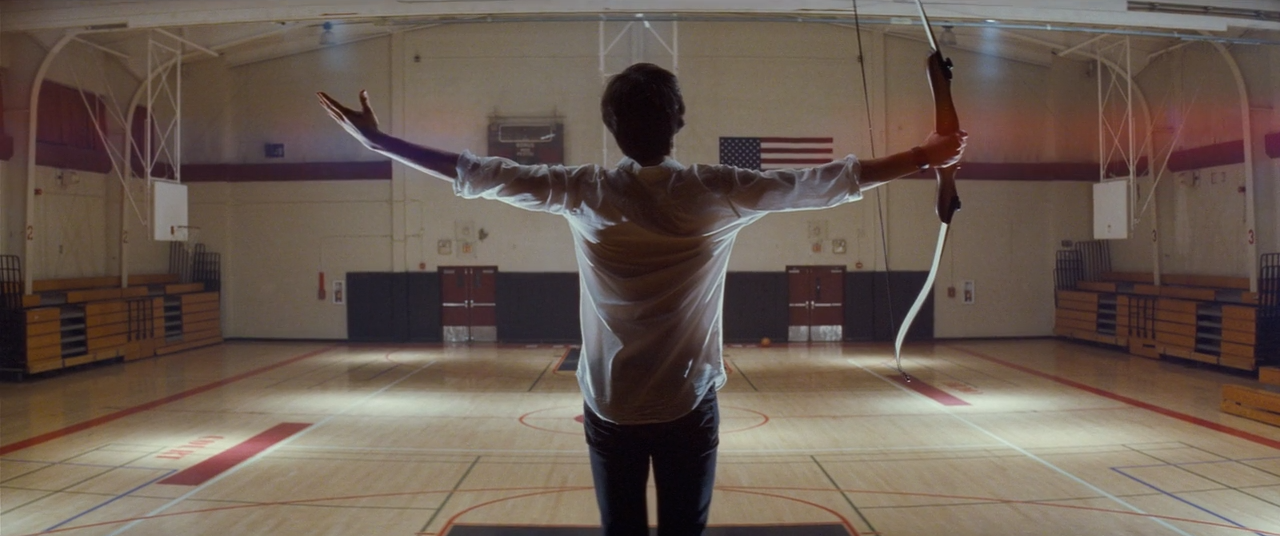

"From the start, we know something's not right and have a pretty good idea exactly what. But the best option is to surrender and let director Lynn Ramsey take us there, which she does, employing seamless transitions between the past and present to show the creation of a monster who eventually evolves into a 15-year-old (deviously played by Ezra Miller) on the cusp of committing an unspeakable crime.  But this is no traditional horror movie. It cuts too close to the bone for that, with an eccentric, free-spirited mother named Eva (Tilda Swinton at her iciest) unwittingly setting events in motion by having a child she's neither motivated nor emotionally prepared enough to raise. Swinton knows to play her as terrible mother who isn't a terrible person, just severely lacking in self-awareness. With her milquetoast husband (John C. Reilly) oblivious of the psychological carnage happening right under his nose, mother and child take turns hurting one another, with Kevin always having the upper hand.  It all seems so effortless, a muted confluence of scenes and images all leading to one tragically predetermined outcome Eva refuses to entertain. Ramsey dares to show it as it would happen, something that probably wouldn't be tolerated by the PC police just a few years later. Luckily, she pulls it off in time. Of course, we're left with the big question: Who's to blame? While a lesser film would have tried to answer that, this one knows there's more than enough of that to go around. "   


7. Margaret


"Multiple storylines and sub-plots are juggled effortlessly, with everything always returning to Lisa and the accident's aftermath for those directly or indirectly involved. But for Lisa, everything is always about her, and it's a credit to the writing and Paquin that we don't judge her for it and at times even empathize with her self-centeredness. She's in over her head and the more she does to make things better, the deeper the hole she digs. Whether it's calling a bad boy classmate (Kieran Culkin) over to lose to her virginity, stringing along her would-be boyfriend (John Gallagher Jr.), hitting on her geometry teacher (Matt Damon), or meddling in the bus driver and victim's lives to absolve her conscience, Paquin makes it all seem somehow refreshingly human and relatable. She's not altogether a detestable character so much as a confused one, making it excusable for us to go from hating to loving Lisa (or vice versa) within the confines of a single scene." - 8/25/12


6. The Descendants


"The Hawaii we're presented with here isn't one we've been made aware of before, at least in movies. The opening voiceover even let's us know that much. It's more depressing than exotic, so unlike the vacation destination we've seen on postcards that it doesn't even register as the same place. If only Hawaiian locals only went to the beach all day, rode waves and had drinks with little umbrellas in them like we we've been told they do for years. This is the first time it hasn't been depicted as pure paradise and in doing so Payne fittingly humanizes this film's setting as much his characters, showing real flaws and imperfections that somehow lead to a greater appreciation of both. While people who live in paradise still have problems, they're hopefully not as big as the ones plaguing real estate lawyer Matt King, played by George Clooney in a dialed down performance sure to net him another Oscar nomination." - 12/11/11


5. The Artist


"The exact moment when The Artist becomes really interesting arrives when silent film star George Valentin (Jean Dujardin) puts down a glass and it actually makes a sound. Until then, it's the first noise we hear other than the film's bouncy musical score. Then his dog Jack (Uggie) barks. Actresses walk by giggling. Valentin screams in frustration but he can't make a sound as the whole sequence plays out like a scene from The Twilight Zone. This nightmare quickly becomes reality for Valentin as Kinograph Studios' boss Al Zimmer (John Goodman) announces that the advent of "talkies" have led to them halting production on silent films and his services are no longer needed. Watching, it's hard not to think of actors being replaced by computer graphics and motion capture in an age of 3D technology, older actresses being marginalized in an industry that worships youth and, of course, the current economic crisis. Despite the old fashioned approach, it's surprising just how fresh and relevant it all seems, and while it's frequently funny, it's also a bit deeper than you'd expect." - 2/23/12


4. The Tree of Life


"Less a film than a symphony, interpretation and analysis is fun, but futile considering each individual will bring however much or little of themselves they want to it.  What it all means could be summed up as "everything," but that still doesn't even really touch it. We're born into this world, make connections with different people that can be fleeting or not, and then we leave it, never pausing to consider whether there's a universal scheme in place hurling us toward our inevitable destination. We've seen movies try to tackle the topic but this is the first to make sure it's felt completely. Similar to a collage of dreams or memories, everything is presented in a non-linear format rather than in a traditional narrative structure. Scenes flow freely to form emotions rather than necessarily tell a story, which is sort of a first. Almost embarrassingly messy and over-ambitious, it's a little early to judge its worth as a true masterpiece, but this does feel like something monumentally important that needs to be talked about for a while to come." - 7/5/11


3. Moneyball


"Director Bennett Millers' handling of the material is tremendous in how he visually simplifies what could have been a dense watch for non-sports fans, with the playing scenes only bolstered by Mychael Danna's anthemic score. At 2 hours and 13 minutes the film arguably could have used a snip or trim, but it's difficult to feel that way while watching. If anything, it's so level-headed and straightforward it's biggest problem may be that it's the type of film easier to respect than love. Time will have to tell. When Beane says "it's easy to be romantic about baseball" we expect nothing less than an easy, inspirational conclusion. Instead we get one that leaves you considering what constitutes "winning" and wondering whether Beane could have been toppled by the very approach he helped popularize. When the title card appears on screen revealing what became of him since that '02 season, I heard audible gasps of shock from the audience, perhaps a testament to how few still know what he accomplished in a sport primarily concerned with who won the last game." - 9/26/11


2. Young Adult


"It seems every year people like to say a certain film ' hits the zeitgeist.' The term is so casually thrown around it may as well mean nothing. But here's one that hits dead center, targeting our culture's current obsession with nostalgia and convincing ourselves that things were better back when we thought we were better, whenever that was. Like the celebrities we simultaneously despise and idolize, Mavis functions as the mirror in which we view ourselves at our worst and it isn't pretty. But it's honest. We expect certain things in films and a likable protagonist is one of them. And if they're not, they at least need to experience growth of some sort. While it might be a stretch to say she achieves none, it sure isn't much. Instead she's given a final act "pep talk" that further feeds her narcissistic delusion. It's clear her road to recovery will be a marathon rather than a sprint, if there's even recovery at all. And yet, that's strangely reassuring. This isn't a coming-of-age story but instead a vicious, bracingly blunt character study that goes for the jugular, creating some cringe-worthy moments that only sting that much more because they feel real." - 12/27/11


1. Drive


"This is exactly the kind of movie you can picture Quentin Tarantino kicking himself for not attempting. Could he do it as well?  Possibly, but he'd have to curb his penchant for having his characters talk about how cool it is they're in it rather than building tension and suspense. This is the result when the right director, cast and material all come together at once, and it's poor box office performance isn't a huge surprise given the polarizing risks Refn takes. It's just too challenging, representing the type of film mainstream audiences have been programmed to hate after being weened on truckloads of generic Hollywood garbage each year. Now when something's finally done right, it feels wrong, if only for daring to be different. Drawing from a myriad of influences that suggest it was transported from another era, Drive still feels wholly authentic and original, proving that action and violence mean little without an investment in the characters." - 10/5/11

My Top 10 Films of 2011
1. Drive (dir. Nicholas Winding Refn)
2. Young Adult (dir. Jason Reitman)
3. Moneyball (dir. Bennett Miller)
4. The Tree of Life (dir. Terrence Malick)
5. The Artist (dir. Michel Hazanavicius)
6. The Descendants (dir. Alexander Payne)
7. Margaret (dir. Kenneth Lonergan)
8. We Need to Talk About Kevin (dir. Lynn Ramsey) 
9. The Ides of March (dir. George Clooney)
10. Contagion (dir. Steven Soderbergh)

Sunday, October 30, 2016

10 Cloverfield Lane


Director: Dan Trachtenberg
Starring: Mary Elizabeth Winstead, John Goodman, John Gallagher, Jr., Bradley Cooper, Suzanne Cryer
Running Time: 103 min.
Rating: PG-13

★★★ (out of ★★★★)

**Spoiler Warning: This review gives away key plot details, including the ending**

10 Cloverfield Lane raises a fascinating question for any critic or audience member who might happen to share my general opinion of it. And there will likely be more than a few. What happens when 90 percent of a movie is amazing, but the last 15 minutes are so misguided and disappointing that it threatens to completely overshadow whatever greatness came before? In this case, there was a lot of it, from the overall premise to the atmosphere and performances, it shares very little in common with 2008's monster movie Cloverfield, which was throwaway fun. This isn't. It's something much more than that for a good deal of its running time. With its production, eventual release and title somehow managing to stay shrouded in secrecy, few knew this "spiritual sequel" to Cloverfield was even coming, much less what it would be about, or who would star. But more importantly, that it could be done this well. That may be why the ending is so infuriating, but for me a bigger reason is that I was treated to two of my favorite actors going toe-to-toe for 90 minutes in the service of a story that came so close to doing them and viewers proud, only to drop the ball at the end.

What eventually occurs in no way diminishes those performances, but that any studio thought the idea of John Goodman as a survivalist holding people captive in an underground bunker wasn't scary enough on its own is mind boggling. On top of that, the script attaches enough moral implications and questions to what he's doing to make Rod Serling proud. What he wouldn't be so proud of is the ending. And it's not so much that I'm completely against what they did (though I still didn't care for it), but rather how. So here's my advice: When you get to about the hour and twenty-five minute mark, just hit "STOP" on your remote and turn the missing minutes into one of those old school "Choose Your Own Adventure" books where you pick the ending. There's little doubt whatever scenario you come up with will be more compelling than what the filmmakers ultimately chose. And the sad part is, ending notwithstanding, it's still one of the year's most compelling films.

When we first meet Michelle (Mary Elizabeth Winstead), she's packing up and leaving New Orleans after an argument with her fiancé Ben (voiced by Bradley Cooper). Distraught and distracted by news of major blackouts across the country, her car suddenly hits something and careens off the road. She awakens in a basement chained to a wall with an IV in her arm. The man holding her there is the burly, intimidating Howard Stambler (John Goodman), an obsessive survivalist who's built a fallout shelter under his farmhouse in the event of an attack, nuclear or otherwise. According to him, such an attack has already occurred, claiming the lives of nearly everyone outside who breathed the contaminated air.

Michelle and a man named Emmett (John Gallagher, Jr.) who forced himself into the bunker, are told by Howard that under no uncertain terms can they leave until the poisoned air's safe, which could be two years at the earliest. Not buying the far-fetched story and assuming she's been kidnapped by a crazed lunatic (with Howard's actions doing little to contradict that), a terrified Michelle makes plans to escape, but will need Emmett's help. Even as evidence mounts that there might be some truth to Howard's claims that the terror awaiting them outside is far worse than anything he can dish out.

Whether or not this was an intentional inspiration, the premise thematically draws certain comparisons to the classic Twilight Zone episode, "The Monsters are Due on Maple Street," in which panicked, desperate neighbors turn against each another when faced with an inexplicable, otherworldly threat. This is obviously a more contained version of that but the basic idea of how far people is willing to go and the amount of force they'll exert over others for self-preservation and survival are very similar.

Frightening in its timeliness, the screenplay cleverly and indirectly tackles 9/11 paranoia, terrorism and national security through the character of Howard, who's very much grounded in the world in which we now live. With his emphasis on law and order and second amendment rights it's not hard to picture him heading out to the polls on Election Day, packing heat and wearing a "Make America Great Again" hat. That's not a knock on Trump supporters, but rather a reasonable interpretation of this character based on the evidence, as well as a credit to Goodman's complex, forceful performance, which wildly vacillates between cold and detached and enthusiastically charismatic at the drop of a dime. It's because of him that we're able to get that clear a picture of the man, knowing exactly what he stands for and what pisses him off. The writers should also take some credit for concocting a character that really hits a cultural zeitgeist they couldn't have possibly known about when this went into pre-production.

What we're fuzzier on are the stoic, often humorless Howard's exact intentions, which is where so much of the film derives its suspense. The first inclination is that he's a psychotic kidnapper since his doomsday scenario doesn't add up on any logical level and he seems to care way too much about Michelle and Emmett attempting to leave (escape?). Then the clues drop. While certain details suggest Howard could actually be telling the truth, or at least some version of it, he's still a controlling terror with whom sharing any kind of space is dangerous. And yet, because he's played by Goodman, there are these moments of humanity where it seems as if he's legitimately invested in their well being as if they were his offspring. Evolving into this dysfunctional family, they eat together, play board games and watch movies as if Goodman were reprising his role as Dan Connor on Roseanne. The whole thing is so oddly fascinating and atypical of what you'd expect, even as tension continues to build to a fever pitch around Howard's personal history and reasons for holding them.

After turning in impressive, overlooked work The Thing remake, small, character-driven indies like Smashed, Faults and Alex of Venice and in TV's short-lived The Returned, I've always contended that Mary Elizabeth Winstead is only about a role or two off from occupying the same spot her Academy Award-winning Scott Pilgrim co-star Brie Larson currently does. This film probably won't get her there but it still represents the latest in a long line of inspiring choices that show off a dramatic range few know she possesses. In fact, most of the film and her performance recalls the first act of Room, which only makes it that much more frustrating when this eventually deviates from that psychological template.

Michelle is caught in a desperate, hopeless situation right off the bat, and the thrill comes in watching her try to process that, read it, and determine how to react.  The wheels are always turning, as she attempts to negotiate her way out of this predicament and nearly every scene Winstead shares with Goodman carries this consequential weight that nearly suffocates you with suspense. There's a an unbearably tense scene at the dinner table when director Dan Trachtenberg milks the suspense to such a point that the payoff literally caused me to jump. Gallagher's Emmett at first seems to be a major dope blindly following Howard, until his personality and motivations start figuring into the equation in surprising ways.

Considering its title and the fact this supposedly takes place in the same universe as Cloverfield, an argument could be made that we know what we're getting into. I'll cop to that, but still doesn't make the final minutes of the film any less ridiculous, disappointing or poorly executed. The script eventually has to lay all its cards on the table and reveal whether this is a straight-up abduction or some kind of cataclysmic event has actually occurred outside and Howard's holding her there for her own protection and his. Or maybe it's some kind of combination of both. In other words, she has to eventually escape and see what's out there. We know this and it's fine. But even if you're satisfied with THE BIG REVEAL, they don't milk the moments leading up to it nearly enough or execute it with the amount of finesse necessary to justify it. Despite some defending the decision, it's simply incongruous with the tone of the rest of the picture. While I can get on board with the thematic justification and how it relates Michelle's backstory and overcoming the cycle of her abuse, that doesn't excuse involving aliens in a narrative that was fairly grounded up to that point.  

Trachtenberg, making his feature debut, does a masterful job creating a dread-fueled atmosphere, but even he's saddled with a pretty thankless task in the final minutes. He responds with the cinematic equivalent of clubbing viewers over the head multiple times. But he's really just shooting a screenplay that's gone off the rails and it's likely the writers (which includes Whiplash director Damien Chazelle) were only carrying out the wishes of J.J. Abrams or the studio, who determined it was more important to continue building a "universe" that satiates the appetites of comic-con crowds than put the proper coda on an otherwise excellent film. It appears to have been nothing more than a marketing-driven decision, and while it happens all the time, that still doesn't make it any less creatively bankrupt.

If stretching for positives in the disastrous final minutes, Winstead's performance remains strong even during this nonsense and the revelation that Howard wasn't lying casts the character's previous actions in a slightly different light, causing you to likely appreciate Goodman's performance even more on repeated viewings. But I'd argue the same exact thing could have been accomplished in half a dozen different and better ways than what they eventually went with. Since it's unfair to rag on an ending this much without offering up a reasonable alternative, it would have been far more effective to have the final 15 minutes continue to build legitimate doubt as to what exactly happened, how many people survived, whether the air is breathable, or the planet even habitable.

The few minutes Michelle has to investigate before the movie turns into a special effects circus are really good and should have been stretched longer. Then, and only then, if they want to pull the trigger on the reveal (even one as silly as this), it would at least carry greater impact and they could quickly get to the end credits to preserve the integrity of what came before. Of course, had it just been a more believable threat that matched the tone of the rest of the film there would be no need for this discussion. But that wouldn't sell tickets. That's what's so frustrating about 10 Cloverfield Lane, which for most of its running time delightfully shares as little in common as possible with its predecessor. And why it's difficult assessing how much a botched ending should be counted against the overall viewing experience. One major flaw doesn't erase everything else, but it does somehow strangely make it all mean a little less than it should.     

Sunday, October 23, 2016

Halt and Catch Fire (Season 3)


Creators: Christopher Cantwell and Christopher C. Rogers
Starring: Lee Pace, Scoot McNairy, Mackenzie Davis, Kerry Bishé, Toby Huss, Mark O' Brien, Annabeth Gish, Manish Dayal, Matthew Lillard
Original Airdate: 2016

★★★★ (out of ★★★★)

**Spoiler Warning: This Review Reveals Plot Points From All Three Seasons of the Series**

"The barriers between us will disappear. And we’re not ready. We’ll hurt each other in new ways. We’ll sell and be sold. We’ll expose our most tender selves only to be mocked and destroyed. We’ll be so vulnerable, and we’ll pay the price. It’s a huge danger. A gigantic risk. But it’s worth it. If only we can learn to take care of each other. Then this awesome, destructive new connection won’t isolate us. It won’t leave us, in the end, so totally alone."

It's a good feeling when you stick with something and it pays off. Two years ago, an 80's-set series about the personal computer revolution called Halt and Catch Fire premiered with a reasonable amount of promotion and unrealistic expectations for a network looking to "replace" Breaking Bad and Mad Men, as if that were possible. With alarmingly low ratings and wildly mixed reviews, its initially over-the-top, inconsistent storytelling dragged down a still promising series searching for a voice. Any voice. But even from the very beginning, something was there. The setting, acting, directing, cinematography, production design and overall concept had too much potential to just throw in the towel. This was a well made show that needed a lot finessing to reach its fullest potential, assuming it wouldn't be cancelled before then.

The cast of AMC's Halt and Catch Fire (Season 3)
After AMC surprisingly renewed this for a second season, the writers started working out the kinks, readjusting its focus, as we started to sense a journey for these increasingly nuanced characters, and the series, for the first time, seemed to be flirting with greatness. At that time last year I wrote that those improvements would probably need one more season to fully take hold, but if they did, breaking the through the glass ceiling to reach the upper echelon was legitimately possible. Unfortunately, with the show hemoraging even more viewers, that possibility of more episodes seemed to be a pipe dream. 

Credit should go to AMC for realizing that the TV model has changed enough that ratings matter less and the network's commitment to quality is part of how HACF has arrived here. Season 3 is not only its best, but it retroactively redeems and justifies all the decisions made up to that point, most especially those from its now underappreciated first season. And you can actually pinpoint the moment this all happens. It comes at the end of a season few thought would even happen, as creators and eventual showrunners Chris Cantwell and Chris Rogers make a narrative decision that quite literally changes the game, proving the show deserves to share the room with television's top dramas. And this while another far differently conceived computer-centric critical favorite, USA's Mr. Robot, struggled through a disappointingly dense sophomore season. In contrast, there's comfort in just how simple and unfussy HACF is. It would be easy to keep complaining that no one's watching a show this good, but if the network doesn't seem to care, then why should I?  I'm just glad to have it.

Whether it's personal computing, laptops, message boards or first-person shooter games, the ideas and innovations that come from the characters residing in the show's hardwired 80's universe are ahead of the curve. Sometimes frustrating so. They're always just a little too early for what's coming next, with the rest of the world either unprepared for what they've created or the technology not yet where it needs to be. This has almost become a running joke with many pointing out unfavorable comparisons to Forrest Gump, as they seem to have a presence or role in every key computing breakthrough of the past thirty years, even if it's just a walk-on. And up until this season, I may have agreed. But now they're right where they belong, on the precipice of something huge, everything else that's preceded it feels like a primer. A string of baby steps, hiccups and failures meant to get us here.

Joe MacMillan, founder of MacMillan Utility
It's 1986 and when we last left the slick, manipulative Joe MacMillan (Lee Pace), he had once again manipulated "Gordon, "stealing" his anti-virus program to build his own company, MacMillan Utility, and closing a deal for office space in California. It's a venture Gordon could have been involved in had he not been given an ultimatum by Donna (Kerry Bishé) to move with her and the kids from Texas out to Silicon Valley, as she and Cameron (Mackenzie Davis) relocate the latter's now rapidly growing startup, Mutiny. With his health woes continuing and the wounds inflicted by his recent affair still fresh, Gordon (Scoot McNairy) wasn't given much of a choice but to wipe the slate clean and start over.

Similarly, Cardiff Electric's former Sales V.P. and everyone's favorite ex-con, the incomparable James "Bos" Bosworth (Toby Huss) is also once again along for the ride, after a brief return to the corporate world reminded him how alive he felt at Mutiny, and how strained his relationship with his son still is. While it might be cliched to state that these characters are at a crossroads, the writing, acting and directing throughout this season pays that description off. In a brilliant bit of misdirection, every one of them is forced out of their comfort zone, forcing viewers to reevaluate them, before arriving at an emotional crescendo that brings the entire series full circle.

Clad in white linen pants and sporting a full beard, we're witnessing a more relaxed, Zen-like Joe MacMillan than in episodes past, clearly taking a cue from early Steve Jobs. And like Jobs, Joe's an idea man used to answering to no one, making the presence of a board his worst nightmare. This nightmare comes in the form of venture capitalist Ken Diebold (a mustachioed Matthew Lillard), who acts as a puppeteer, pulling the strings of an increasingly helpless Joe, who's company is slowly slipping away from him amidst a software pricing battle (ep. 3.3, "Flipping The Switch"). The little relief he finds comes from a working friendship with MacMillan Utilty's newest employee, Ryan Ray (Manish Dayal), a socially awkward ex-coder at Mutiny whose forward-thinking ideas were constantly shot down by Cameron.

Joe and Ryan brainstorming ideas
With Ryan under the tutelage of his hero, Joe MacMillan, the two begin working on something big, and it's an apprenticeship that not only echoes his days of working with Gordon on the Giant in the garage, but changes the course of the series. It's the first of many call-backs that somehow creates nostalgia in viewers for a series that's only been on a couple of years, and sets Joe on his eventual path of doing right by Gordon. It may be fair to call Ryan the most important supporting character the show's ever had, at least as far as being the trigger for these characters to land where they need to be. And if nothing else, he writes and verbally delivers what ends up being the series' manifesto, (ep. 3.8, "You Are Not Safe") a monologue both timeless and timely in how it accurately describes the dangers and benefits of a future where everyone is connected, while somehow still being completely disconnected from the world in which they live. In other words, the present day.

Growing at too fast a speed to keep up, Mutiny is slipping away from its free-spirited, rebellious founder Cameron and the more composed, business savvy Donna. They just don't know it yet. Or rather, one of them does, and the other won't listen. Unlike for Joe, outside assistance comes for Mutiny from a more benevolent source, venture capitalist Diane Gould (Annabeth Gish), an acquaintance of Donna who's seriously considering investing in the company provided a few obstacles are cleared. Without going into the specifics of how, all of this turns out to be a disaster ten times worse than what Joe's experiencing because at least you know he'll always have some kind of nefarious plan in his back pocket. It sets off a chain of events that puts Mutiny founder Cameron on a collision course with the supposedly more capable Donna, with Gordon and Bos caught in the middle.

Cameron and Donna, while never exactly friends, managed to make Mutiny work, and viewers were always clear where each stood on the company food chain. If the former is a talented, but extremely immature coder who fell into a CEO role she's entirely unsuited for and doesn't want, then the latter is the heart and soul of the company, as well as the show's moral compass. Coupled with Kerry Bishé's extremely warm, likable presence and do-it-all performance, it's easy to see why Donna's been the fan favorite since day one. It's certainly helped Cam has been written to be at her most petulant this season, panicking at criticism or compromise, firing people on a whim and disappearing for weeks at a time while Donna steers the ship, making tough decisions for Cameron to be pissed about when she decides to show up for work. Much of the time, Cam comes off as a scared little girl, which until now has been touchingly reinforced with her relationship with Bos, who's always viewed himself as her father figure of sorts. Except only for the fact that she did have a father who died in Vietnam and her trip back to Dallas (ep. 3.5,"Yerba Buena") to find closure, and potentially reconnect with the returning Tom (Mark O' Brien), finds even Bos justifiably fed up with her behavior, perhaps permanently straining their bond.

Gordon and Cameron playing Super Mario Bros.
If there's a silver lining for Cam this season, it's her surprising friendship with Gordon despite the fact she's at war with his wife. But Gordon's been marginalized too, essentially blackmailed into joining Mutiny, even as his role in the company remains completely undefined. Retreating to the confines of his closet with a ham radio as his symptoms of toxic encephalopathy intensify, it's the first time we're forced to consider that Donna might not be as perfect as we thought. Watching Cam and Gordon bond over beating Super Mario Bros. (ep. 3.6, "And She Was") not only works as pure nostalgia for viewers who grew up trying to do the same, but provides some of the season's few moments of joy for these characters. Gordon wants to help her in fight against Donna, or at least attempt help them find some common ground, but it's painfully clear that his professional allegiance will have to remain with his wife, no matter how rocky their relationship.

As the company heads toward a potential IPO it may or may not be ready for (ep. 3.7, "The Threshold") a funny thing happens to our perceptions of Donna and Cameron. Maybe it's okay to think you're right all of the time, and maybe even okay to lie and manipulate a little bit if you think it's in everyone's best interests, but if you do all these things, you better be right. As all the cards are laid out on the table, it appears Donna was dead wrong. The moment when Cameron slowly exits the Mutiny offices, doubled over, heaving and gasping for air as her eyes flood, it's apparent the series just landed its biggest emotional blow and Mackenzie Davis delivered it, further solidifying her as TV's best, most unheralded actress.

Despite all of Cam's childish, immature behavior throughout the series, we still feel real sympathy for her due to Davis' performance in that scene and everything leading up to it. Donna may have rapidly grown Mutiny and taken it to the next level, but it wasn't her idea. It was Cam's baby. And while it may be a disturbing parallel, Donna symbolically aborts it just as she literally aborted her own baby last season when Cameron secretly drove her to that clinic.

Cameron gets kicked out of Mutiny
Donna's made many sacrifices to achieve her professional goals but the explosive impromptu meeting that determines Mutiny's fate casts that in a different light. She's now a money person, and potentially even a sell-out, short-changing Mutiny's long-term prospects for a big payout and petty revenge. And the amazing thing is that Bishé doesn't really alter a single note in her performance of the Donna we've known and loved since Season 1. It's just a matter of the writers reframing everything that been in front of our faces the entire time. And yet it's still just as easily possible to defend her actions from a business standpoint and see why she felt the need to make these choices, as selfish as they seem.  In many ways, Diane is her role model, foreshadowing her eventual future as a single mother trying to conquer the business world.

If it seems nearly impossible for the season to continue after an event more befitting a series finale, this not only does that, but tops it twice over. Just as Cam's life comes crashing down, Joe's master plan with Ryan to break away from his own company ends in a tragedy that directly or indirectly alters the lives of every character, most specifically him. When Joe MacMillan awakens in his apartment to cops and an open terrace door, he seems for the first time truly shaken to his core. Dare we even say a changed man. The same Joe who hit an armadillo with his car in the pilot episode, sabatoged an entire project at Cardiff just to get press and burned a truckload of Giant computers, and earlier in the season even had an HIV scare, finally hits rock bottom and suddenly everything that came before starts to make a lot more sense.

Of course, this moment means nothing without all of those, and we can recognize both in Lee Pace's delivery and reactions that this guy, as we've known him, is done. In Joe's own words, even he "can't work with Joe MacMillan anymore." The character who seemed to start as a Don Draper-Patrick Bateman hybrid is now a fully developed, three-dimensional human being driving the narrative. A narrative that seems to have reached its conclusion with what again could have easily been a suitable series finale. And it's with no where else for its characters to go, that the writers pull off their grandest trick yet, leaving the 80's in the rearview mirror. They've gone as far as they can go.

Copyright, 1990.
Had it run long enough, that intriguing possibility that the series could pull off a major time jump or flashforward was always on the table. It just makes sense. And its arrival in the first episode (ep. 3.9, "NIM") of its two-part season finale, makes for thrilling television. It's the high-water mark for the show, aweing and rewarding audiences who stuck around long enough to witness its disorienting opening minutes where we're wondering what's going on. Time jumps have been misused and overused so much it's tough to remember when they weren't commonplace. But it's also just as easy to forget how well they can work, freeing up the writers' creative options and enhancing already strong characters by taking them in a new, fresh direction.

When we see the Windows 3.0 screen and realize the series has hit the reset button, making a seamless and organic transition to 1990, it's clear why those preceding episodes has such an air of finality to them. As we scramble to fill in the blanks of the past four years (and it doesn't take long) the true masterstroke of this idea is how the show is rapidly approaching an era where the world and technology is finally catching up to these characters' ideas. And if they took all took a strange detour over the past season, pushed and pulled in surprising ways, this move returns the series to its core. They all converge together again having grown and matured, while also realizing that the more things change, the more they've also stayed the same. Joe's itching to get back in the game, Donna's out on her own, divorced from Gordon, who's struggling to control his rebellious teen daughter and progressing illness while reentering the dating game.

The biggest change has come over a very different looking and acting Cameron, whose time spent in Japan as a successful Atari game designer married to Tom seems to have mellowed and wisened her to the point that she's now open to a reunion of sorts. If anything, THE BIG IDEA certainly seems important enough to warrant it. Bringing back the COMDEX convention (where the show staged one of its strongest first season episodes), is another great touch and a reminder that Joe and Cameron will always be damaged goods, yet intrinsically linked since that first scene in the pilot when he recruited her out of the classroom. It's a dynamic that's sort of taken a backseat to the rest of the action over the course of two seasons, while still bubbling just enough under the surface, destined at some point to reemerge. And the writers couldn't have possibly timed it better.

Joe and Cameron reunite at COMDEX
The brainstorming sessions that occur in the season's final episode (ep. 3.10, "NeXT") do more to reveal the history between these four than maybe any other previous interaction in the series because their interpersonal dynamic affects every technology-related discussion or argument they have. And those debates hold us captive, both because they directly relate to the present and Joe MacMillan's never better than in sales mode, only this time driven by inspiration rather than ego, envisioning the web as a door everyone and anyone can eventually enter and do inside what they wish.

We also sees a more mature, world weary Cameron taking agency in her own life and making a rational decision she couldn't have just a few years earlier. It appears that Donna may have finally gotten her receipt for killing Mutiny when she realizes Cam has cut her out of the very idea she brought to them in an effort to put the band back together. It's no coincidence that Donna's emotional breakdown echoes Cameron's reaction upon discovering she was kicked out of the company she built.  It feels right that the final image we see this season is of Joe, Gordon and Cameron huddled over a monitor working again, as if they've taken this long, sometimes torturous journey to come full circle. Only now they're ready and the timing is right for them to begin the project they've unknowingly been preparing for since day one.

The gang is back together
With the series now so clearly in the zone and completely sure of its voice, it seems nearly impossible to for this not too exit on an extremely high note. And with the recent announcement of Halt and Catch Fire's renewal for a fourth and final season, the writers can plan for a proper finish without that perpetual cancellation ax hanging over their heads. Regardless of how many are or aren't watching the show, its tremendous improvement and uncommonly high quality has, in the very least, earned it that privilege.

Wednesday, October 5, 2016

My Top 10 Films of 2010


*Note: The following is part of the continuing "10 FOR 10" series in celebration of ten years of Jeremy The Critic, in which my choices for the top 10 films of each year from 2006-2015 are revealed. Just a reminder that movies must have a U.S. release date of that particular year in order to qualify.

Previous Posts:
2006
2007
2008
2009

2010

For 2010, it comes down to ONE. And then there's everything else. In the biggest blowout to come out of these rankings thus far, David Fincher's The Social Network lays waste to the competition. In fact, there is no competition. It's not even close, and that's taking into account that this was actually a pretty good year. But the quality gap between the best and the rest is large enough that compiling this seemed like a formality, merely establishing what we already knew. Fincher and Aaron Sorkin crafted a film so gripping and timely that it would likely win any upcoming or previously covered year in this series. It's simply the best of the decade. Full stop. Since it's already been analyzed to death on this site over the years, I won't linger on the details other than to reiterate how it plays just as strongly for me now as it did when I first saw it in the theater six years ago.

While my top pick is bookended by two of the most successfully written, directed and performed in recent memory, everything in between manages to lives up to it, anchored primarily by Jesse Eisenberg's iconic performance as Facebook founder Mark Zuckerberg, presented (imagined?) here as a terminally antisocial, narcissist who, depending on whom you ask, either founded or stole an eventual technology empire to impress a girl. With Inception, Black Swan, Blue Valentine, True Grit, and 127 Hours following behind, this year's list could almost read as a who's who of greatest contemporary American directors putting out some of their best work. This only makes The Social Network's definitive triumph seem like that much more of a feat.

This time, two films make the list that went unreviewed here upon their original release and when writing about both for the first time here, it became immediately apparent the right choices were made. In the case of Banksy's Exit Through the Gift Shop, it becomes the second documentary in the four years covered thus far to make the Top 10. Not too bad, but an appalling reminder that I've still somehow yet to review a single film in that genre on this site. 

The Coen Brothers' True Grit remake just slid under the radar without until finally catching up with it a year or two after its release. It's tough to even imagine this list without it and while it could have easily ranked higher, I finally settled on what still feels like an uncomfortably low number 5. It's fair given the competition, but the ranking on paper doesn't accurately reflect my love for the film as much as the accompanying write-up. Between this and the underrated and unfairly maligned TRON: Legacy (coming in at number 8) it's tough to argue that Jeff Bridges didn't fully capitalize on his '09 Oscar win.

Two strangely similar character driven films rounding out the list aren't too shabby either, as Sophia Coppola's hypnotic Somewhere and Noah Baumbach's difficult Greenberg may seem small in story, both are told in a style that allows them to linger in the mind long after they've concluded. With the latter, my initial 3-star review assessing it as a wildly mixed, sometimes unpleasurable experience proved over time to be overly dismissive. It's a keeper. Some other admirable titles that just missed the cut include The American, The Town, Enter The Void, The Fighter, Let Me In, Animal Kingdom, Never Let Me Go, Shutter Island, The Runaways, Buried, Remember Me and Toy Story 3.  With 2010 in the books, we're marching toward 2011, the first of more recent years that won't have as much time and distance behind them.
 

10. Greenberg


"It doesn't take but the first few minutes of the picture for (Greta) Gerwig to get us on Florence's side, whether she's just walking the dog or stuck in traffic. And the more time we spend with her the more we like her and if she says we'll be tolerating Greenberg's behavior today, well then, we'll be tolerating Greenberg's behavior today, no matter how irritating it gets. To everyone else he's an angry weirdo, but to her he's "damaged." This is one of THOSE movies, in which a loserish character approaching middle age with regret over a big mistake (or a variety of them) from the past is rescued by a younger, impossibly perfect woman. But in playing her Gerwig instead projects imperfectness, as well as an uncertainty and lack of confidence that would make the scenario plausible. She puts up with his tirades and verbal abuse, yet also somehow makes us understand why." - 9/6/10


9. Somewhere


"The film's style allows its characters, the visuals and the two central performances plenty of room to breathe, very often mimicking the aimless, trance-like state of its protagonist. Despite being told nothing and having to figure out this guy for ourselves, it's a strangely pressure-less experience to sit through, offering relief from the burden of being inundated by too many details. If Coppola's an expert at anything, it's letting the visuals, music and acting speak for itself. Unafraid of letting scenes linger past the point they typically should (or we're used to) to convey a mood, a practice session at an ice rink goes on twice as long as you'd expect and is all the more memorable for it." - 5/30/11


8. TRON: Legacy


"Now that the follow-up to TRON is here and everything we imagined it could be and more, it's kind of mind-boggling (not to mention hilariously ironic) that naysayers are still looking for things to complain about. Most of the unfair complaints leveled against TRON: Legacy have been at its screenplay which makes me wonder what they thought of the original's script, mostly an incoherent mess from middle to end. This story is an improvement in every way, much sharper focused with a clear-end point destination for its characters whose fates we're completely invested in. First time director Joseph Kosinski takes the forward looking ideas from 1982 to the level we always wanted while still managing to remain remarkably faithful to the original. Worth every year of the wait, he's made a sequel superior in every way to its predecessor and a film that comes as close as possible to matching the actual experience of watching it." - 1-3-11


7. Exit Through The Gift Shop


"Starting as an exploration of the method and madness behind mysterious street art artist Banksy, documentarian Thierry Guetta begins to disappear down the rabbit hole of his own obsession, dragging us along with him before the subversive twist reveals itself. That this wasn't a film about street art, nor necessarily Banksy or even Guetta. It was really about us the entire time, and how our interests and obsessions can boil over to the point that when someone tells you you're capable of doing anything, you actually start to believe it. What is art? And should someone have to earn the right to make it? Since most aren't blessed with the anonymity the film's hooded subject grants himself, the film's opening song becomes cruelly ironic. The streets are indeed ours. And that's a scary thought. Sure, 'anyone' can make art but the bigger question is whether they should, and if they do, will it be any good?"


6. 127 Hours


"Since the book covered Ralston's entire life rather than only those 127 hours, that portion still had to somehow be conveyed on screen, even if I can't help but wonder what we would have gotten if his original wish to have this optioned as a docudrama came to pass, sparing us the bells and whistles Boyle provides. Would the story be more or less moving? Would it be any different from a National Geographic or Discovery Channel reenactment?  The only thing we know for sure either way is the pure power of Franco's performance, creating Aaron from the inside-out, his words and actions shedding light on how the character finally arrives at the mental place necessary to make the brave decision that saves him, as well as the series of mistakes that led him there." - 12/10/10


5. True Grit


"That this can be considered more an adaptation of the original Charles Portis novel than the legendary 1969 John Wayne film that won him his Academy Award is a key distinction that ends up serving the Coens' well, and helps Jeff Bridges escape the shadow of the Duke. But it's not as if he ever needed to since it's the decision to tell the story through the eyes of 14-year-old Mattie rather than aging U.S, Marshal Rooster Cogburn that solidifies this Western as one of the few modern Hollywood remakes that far surpasses the original. Or more specifically it's the whip-smart, slyly humorous performance of young newcomer Hailee Steinfeld, whose nominated work in this deserves a spot alongside Tatum O' Neal in Paper Moon and Henry Thomas in E.T. in the pantheon of all-time greatest child actor performances. She's that good. The Academy can categorize it as they wish, but even amidst immense talents like Bridges and Damon, she's the one leading the way, as the rest of the cast gamely tags along for the ride."


4. Blue Valentine


"Flashing between past and present to track how a relationship implodes, this could have easily been titled (500) Days of Hell, with even the smallest, fleeting moments of happiness (and there are some) tempered by the knowledge of where we know things will end up. Yet strangely, I found it doesn't leave a completely depressing mark, maybe because there's relief in encountering a film that's truthful, or at least tells a side of the truth we're rarely exposed to in big studio pictures. But it's really about the astonishing performances of the two leads, one of whom was previously the best current working actor not to have a great movie to his name and the other a rapidly rising actress extending her winning streak." - 6/15/11


3. Black Swan


"The whole film could basically be viewed as a running commentary on not only Portman but the plight of Hollywood actresses in general, cruelly discarded once they've surpassed their point of perceived usefulness and marketability. Strangely, the performance further confirms what I've suspected of her skills all along, only this time the one-dimensionality works in her favor like never before. Still, it couldn't have been easy for her to put herself out there like this, emotionally inhabiting a character so uncomfortably close to how she's publicly perceived. We frequently praise actors and actresses for taking unexpected risks by leaving their comfort zone, but it's sometimes even more special when a performer is pushed to the limit within it, owning a role they seem destined to play." - 12/23/10


2. Inception


"The best scenes in Inception come early when we're teased with all the excitement and potential possibilities the central concept has to offer and learn the very specific rules of the world the characters inhabit, which reflect our own preconceived notions and questions about dreaming. How do you come out of it? How do you KNOW you're out of it? Or in your own and not someone else's? How much time passes? What if you free fall? What if you die? The answers aren't what you'd expect and that second question is the foundation on which the film is built. And that isn't even to speak of the idea of planting a concept in someone's subconscious and all the potential ramifications of that, which are explored, shown and discussed in intricate detail, without slowing the narrative of the plot." - 12/20/10


1. The Social Network


"They talk and talk, firing Emmy-winning writer Aaron Sorkin's dialogue at and over each other at machine gun speed in a crowded, dimly lit bar with the conversation becoming more contentious as he turns sarcastically condescending. At first, (Erica) seems almost interested and amused, until it becomes obvious this is someone without a clue how to interact with people, and as shocked as he is at being dumped, we are at how she's dating him in the first place. That question of whether Zuckerberg really is an asshole never completely goes away. And if he is, does that preclude him from being a genius? Or a visionary? Or maybe he's just lucky. We don't get what resembles an answer until the final scene but it's the aftershock of that opening one that reverberates through the rest of the picture."  - 10/5/10

My Top Ten Films of 2010
1. The Social Network (dir. David Fincher)
2. Inception (dir. Christopher Nolan)
3. Black Swan (dir. Darren Aronofsky)
4. Blue Valentine (dir. Derek Cianfrance)
5. True Grit (dir. Joel and Ethan Coen)
6. 127 Hours (dir. Danny Boyle) 
7. Exit Through The Gift Shop (dir. Banksy) 
8. TRON: Legacy (dir. Joseph Kosinski)
9. Somewhere (dir. Sofia Coppola)
10. Greenberg (dir. Noah Baumbach)

Thursday, September 29, 2016

Eddie The Eagle


Director: Dexter Fletcher
Starring: Taron Egerton, Hugh Jackman, Christopher Walken, Iris Berben, Mark Benton, Keith Allen, Jo Hartley, Jim Broadbent
Running Time: 105 min.
Rating: PG-13

★★★ (out of ★★★★)

Besides being at the center of an inspiring underdog story that seems tailor made for the big screen, the qualities possessed by British Olympic ski jumper Eddie "The Eagle" Edwards will be familiar to anyone who's ever seen an underdog sports movie. A person who's so singularly focused on achieving the impossible that they're not taken seriously in the slightest. They either have a lot of guts or are really dense, and through much of Dexter Fletcher's deliriously entertaining biopic Eddie The Eagle, our title character is confronted by naysayers informing him it's the latter. Whether that be a parent, his teammates or coaches, the one thing they can all agree on is that he's a lost cause. And while much of that is realistically warranted and grounded in concern for his safety, more of it has to do with how he looks and acts. Viewers who think they know how it's all going to pan out are completely right, mainly because it did actually happen and the scenario represents one of the most reliable and predictable movie formulas around. But when it's executed well, it's also really effective, and this is one of those great reminders of that.

As a young boy growing up in Great Britain in the 1970's, Eddie Edwards (Taron Egerton) always dreamed of one day competing in the Olympics. Awkward and hardly much of an natural athlete, he practiced various events in the backyard and around the house, frequently encouraged by his supportive mother, Janette (Jo Harley) while his hard-nosed father, Terry (Keith Allen) dismisses his Olympic dreams as a time waster. After succeeding as a skier as a teen, he sets his sights on the Winter Games, eventually taking an interest in ski jumping.

With Great Britain having gone decades without a ski jumping team and the British Olympic Committee determined to keep him out, Eddie begins training in Germany, where he meets former American ski jumping champion turned alcoholic snow groomer, Bronson Peary (Hugh Jackman). Still bitter from his acrimonious exit from the sport, he initially refuses Eddie's pleas to train him, dismissing him, as an unteachable klutz. But Eddie's tenacity and the verbal abuse he takes from the more experienced Norwegian jumpers causes Bronson to take him under his wing, attempting the impossible in helping him qualify for the 1988 Winter Olympics. But what might be the bigger challenge is him being taken seriously once he gets there.

Even during a time when amateurs like Eddie could actually qualify for the Olympics, what he accomplished was pretty newsworthy. Then again, the sports movie template is built on true stories exactly like this, so while the amount of truth always varies, it all really comes down to the execution. This has a lot going for it, including some excellent early practice scenes establishing the young, awkward Eddie's Olympic fanaticism, seeking inspiration from books like "Moments of Glory" and "My Life in Ski Jumping," the latter being the memoir of Bronson's former, estranged coach, Warren Sharp (Christopher Walken). Once we get to the actual competition, the action scenes are well staged by Fletcher, at times even inducing a sense of dread as we look down through the eyes of this clueless rookie who's talked himself into believing he can jump from 40 to 70 and then eventually 90 feet.

More often than not, Bronson's job seems to be stopping this kid from killing himself, reluctantly and against his better judgment evolving into a coach and mentor. It's only upon realizing that with a lot work, he may actually have a shot. Sure to be overlooked, Mark Margeson's throwback musical score stands as one of the year's big achievements in marrying a film's era with its story and thematic content. Somehow sounding like a blissfully bizarre cross between Vangelis' Chariots Fire, Hans Zimmer's Days of Thunder and the theme from The Greatest American Hero, it's so steeped in the scores of that era that many will probably assume it was lifted from an 80's sports movie. That extra touch goes a surprisingly long way here, as it's tough to imagine certain scenes working as well without it in the background, or even in some more obvious moments, the foreground.

Disguised enough behind crooked eyeglasses and oversized clothes to bare a striking physical resemblance to the film's real life inspiration, Taron Egerton makes Eddie endearing, gutsy and likable, portraying him in the best tradition of screen sports underdogs. In the too few instances when the material calls for him to get serious, he proves capable of that as well. Playing a fictional composite of the real-life Eddie's various coaches, it isn't a backhanded compliment to say Hugh Jackman gives one of his more charismatic recent performances as Bronson Peary.

Effortlessly owning every scene he's in, it was a good move to cast Jackman and an even better one to completely ignore reality in favor of letting him help create this character whose relationship with the protagonist drives the story. He also has the film's best musical moment, when Bronson takes to the slopes to show his pupil and a shocked Norwegian ski team how it's done. Like most sports movies, it's usually as much about the mentor as his student and Bronson still has some demons to deal with concerning how his career ended, permanently damaging his relationship with his ex-coach. Of course redemption can only come through coaching Eddie.

Possibly the strongest aspect of the entire film is the fleeting acknowledgment, even made by Bronson himself, that this kid is in danger of becoming a joke, viewed as nothing more than a circus sideshow act to be laughed at by fans and the ratings-seeking media.  If he fails to deliver then his 15 minutes are up, and Olympic history won't look kindly on him, if at all. Briefly, the script explores this fascinating idea before safely retreating to comfortable confines of its formula. That's fine, but you can't help but think it's a reminder that as immersive as these sports movies are, there is a creative glass ceiling in place that very few have been able to shatter.

It's slightly disappointing when the screenplay leans more heavily on the comedic elements than the interesting implications of Eddie's popularity, but this just isn't that type of movie. That much is clear with the casting of Christopher Walken as Bronson's legendary Olympic coach. On one hand, his presence in any film is always a welcome event, but accompanying it is this undeniable expectation of weirdness. Surprisingly, there isn't too much of that here and he does a fine job in his one major dramatic scene, adding to rather than distracting from the movie's inspirational climax.

It's hard to find a genuine crowd pleaser that goes down as easy as this, and regardless of how many details or facts were adjusted along the way, whatever was done worked in terms of providing maximum entertainment value. Fitting comfortably in the wheelhouse of similarly themed sports films like The Rookie, Miracle, Remember The Titans, Invincible, Cool Runnings and the more recent McFarland, USA, Eddie The Eagle may even be a cut above a few of those, managing to get more little things right.

Whether it's the performances, the direction, the soundtrack or the skiing scenes, there are are many moments where you think it will take flight like it's protagonist, ascending to upper echelon of sports movies occupied by the likes of Rocky, Rudy or The Karate Kid. The story was certainly ripe for it and there's an artfulness in Fletcher's filmmaking that suggests that if the writers took things a little more seriously, it could have gotten there. And while that's an ironic criticism given its subject, I'm not completely sure this would be as enjoyable if it did. So what we're left with is a solid, inspiring mainstream sports movie that can be recommended with unqualified praise to basically anyone. And that counts for a lot.

Sunday, September 11, 2016

Everybody Wants Some!!


Director: Richard Linklater
Starring: Blake Jenner, Zoey Deutch, Ryan Guzman, Tyler Hoechlin, Glen Powell, Wyatt Russell, Temple Baker, J. Quinton Johnson, Will Brittain, Juston Street, Dora Madison Burge
Running Time: 116 min.
Rating: R

★★★ ½ (out of ★★★★)

Richard Linklater has this gift of being able to extract meaning from what on the surface should seem like nothingness. It appears as if he's more interested in watching people hang out than plot, conflict or any kind of narrative structure we'd normally associate with crowd-pleasing movies like the one he's made. Even its jarringly punctuated title, Everybody Wants Some!!, doesn't seem to mean anything aside from the obvious Van Halen shout-out, or at least means as less as its previous working title, That's What I'm Talking About. It would be all too easy to write this off as a self-indulgent nostalgia trip for its director, who chose as a follow-up to his recently Best Picture-nominated Boyhood, a movie centering around a bunch of 80's college jocks looking to get as drunk, laid and stoned as possible in the last days before classes start. And yet, it's still strangely wonderful.

This has been Linklater's specialty, dating all the way back to 1993's Dazed and Confused, to which this will be most closely compared, and for good reason, since he's labeled this its "spiritual sequel." That's a good way to put it as the tie that binds both (besides their period settings and autobiographical angle) is that laid-back, fly-on-the-wall quality of watching authentic characters hang out, only to realize by the end how much you've grown to care about them. It's the opposite of self-indulgent, as it never really asks you think or feel anything and the beats of its bare bones story hardly register as it's unfolding. You just watch and listen, losing yourself in it.

Working also as the perfect follow-up to the experimentally significant Boyhood, it picks up at the same life stage, only with entirely new characters and set in a different era. Carrying with it the same sense of almost improvisational spontaneity that's become Linklater's calling card, you rarely feel your strings being pulled.  And of course, the soundtrack rocks. If there are certain filmmakers who need to spread their wings and branch out in different directions, he's definitely not among them. Not when he does this so well.

The year is 1980 and college freshman Jake (Blake Jenner) has arrived at the off-campus house he'll be sharing with the other players on the Southeast Texas State University baseball team. A star pitcher in high school, he's now suddenly the small fish in a much larger pond, a reserved, quiet guy surrounded by teammates from different walks of life, each with wildly distinctive personalities. There's team captain McReynolds (Tyler Hoechlin), the best player and seemingly the only one with legitimate major league potential; Jake's roommate, Billy "Beuter" Autry (Will Brittain), a farmboy with a girlfriend back home; Scheming, intellectual pick-up artist, Finnegan (Glen Powell), who's often the ringleader of a group that also includes fellow party animals Roper (Ryan Guzman), Dale (J. Quinton Johnson) Plummer (Temple Baker) and Brumley (Tanner Kalina). There are also two tranfer students with completely unhinged pro-level pitcher, Jay (Juston Street) and bearded, stoned philosopher Willoughby (Wyatt Russell).

Upon their arrival, the coach promptly lays down two rules: No alcohol in the house and no women upstairs. Within 12 hours, both are broken and whatever superficial differences these teammates have evaporate in their united quest to attain both, finding them party hopping in search of the wildest time. What Jake finds instead is Beverly (Zoey Deutch), a quirky theater student with whom he connects on a level that's far different than what his new friends are experiencing. As he comes out of his shell and the guys take him in as one of their own, there's still that looming issue of classes beginning in a matter of days, and while they might be too stoned, drunk or hung over to notice it right now, the rest of their lives are about to start.

Considering this is a movie about a college baseball team, there's only one extended sequence late that takes place on the field. It's worth noting that section works really well because so much quality time is spent with all these personalities beforehand. We're either at the house, in the car prowling for girls or at a nightclub or party from the minute we're introduced to the team. It's one of those movies that will have detractors complaining that "nothing happens" throughout its running time. To an extent, they'd be right since so little occurs in terms of actual action, at least as we're accustomed to seeing it in a coming-of-age comedic drama like this. But it's also a movie where everything happens since Linklater has the ability to capture what's it's like just hanging around, and in talking about seemingly innocuous things, revealing more than any manufactured conflict would. Much of that can be attributed to the casting, with a group of little known actors who so believably slide into the skin of these early 80's jocks that leave little doubt that we're watching or listening to anyone other than the authentic article.

As the protagonist, Jake (serviceably played by Jenner) might be the least compelling character, if only because he's our entranceway into a world where everything seems to be happening around and to him, dragged along for the ride, but quickly adapting. The movie really belongs to Glen Powell as Finnegan who steals every scene in a way reminiscent of Matthew McConaughey's big breakout in Dazed and Confused. He's goofy when necessary, but the smartest and most cunning of the bunch, frequently infusing the story with a surprisingly amount of pathos. It's when he's on screen (which is nearly the entire running length) and eventually when Zoey Deutch enters the picture as Jake's love interest, Beverly, that the movie feels most alive and real. The scenes between them carry a realistic Before Sunrise-like vibe that not only takes the film to an entirely different and welcome place thematically, but to a new setting as well, with the jocks finding themselves at an artsy costume party thrown by the theater students. This entire sequence, and it's results, represent the movie's high-water mark, both visually and in terms of its meaning for the characters.

Whether it's that party, or a punk concert earlier, there's this idea so perfectly captured by Linklater that the social barriers present in high school now cease to exist in this four-year universe where everyone can indiscriminately go from party to party adapting to a different crowd and taking on new identities. And despite the script being a semi-personalized account of his own college experiences and undoubtedly conjuring up memories for those with similar ones, he manages to show this without relying exclusively on nostalgia. Sure, the period details such as the costuming, production design and music are spot-on, but it's just there because we are, rarely drawing attention to itself or stopping for conversations that unnecessarily remind us the era we're in.

In the midst of all this, it also manages to be genuinely funny, and not in the frat boy, toilet humor kind of way the trailers falsely implied. Many of the gags and one-liners are smart, playing off the characters' personality quirks and absurdity of various situations, which is becoming increasingly hard to do well in an R-rated comedy. At nearly two hours, there's a strong argument to be made certain scenes needed tightening and trimming, but that's almost always the case of late. At least here we're given extra time with people worth spending it with. And it would all probably play even better upon a rewatch, as there's a hypnotizing quality about this that practically invites it. Something about it is hard to shake, suggesting a lengthy shelf life for both the film and careers of its stars.

It's tempting to say Linklater's recent work invites comparisons to Cameron Crowe due to the increasingly autobiographical nature of his output, but that's not entirely accurate since he's never been as transparent a filmmaker. This will turn some people off, while others appreciate his dedication to showing instead of telling, wearing us down to the point that we're forced to admit he's on to something with these characters, some of whom may or may not strike a chord of recollection in our own lives. And it's because of his almost maddeningly laid-back approach that the ending feels so right, revealing an unexpected depth that further justifies the film's existence. It's only when considering a key character's name and the phrase written in class in the final scene, that we realize how true the tagline is that they "came for a good time, not a long time."