*Note: The following is part of the continuing "10 FOR 10" series in celebration of ten years of Jeremy The Critic, in which my choices for the top 10 films of each year from 2006-2015 are revealed. Just a reminder that movies must have a U.S. release date of that particular year in order to qualify.
Previous Posts:
2006
2007
2008
2009
2010
2011
Unbeknownst to me until recently, more than a few critics considered 2011 to be a landmark year for movies. While I wouldn't go that far, it is actually a very strong one that ends up supplying the highest quality of films in this 10 For 10 series since '07. The only disclaimer I'd add is that if you're looking for uplifting, inspirational entertainment, you're out of luck. All these films except maybe the eventual Best Picture winner are dramatically heavy, including the action-oriented top pick, which veers considerably from anyone's definition of a traditional "action movie." More crowded than anticipated, this ends up being the only year that was so jam-packed I actually have leftover write-ups for films that didn't make the cut that could at some point see the light. And this time, there are actually TWO entries in the Top 10 for a pair of unreviewed films, one of which (We Need To Talk About Kevin) I watched in preparation for this post and ended up placing the highest of any new watch to date. The second, Contagion, was partially reviewed but unfinished, so that paragraph below largely reflects my original thoughts on it.
Perhaps no film looks better to me in hindsight than Bennett Miller's Moneyball, to the point that it was a serious threat to run away with the top spot if the competition wasn't so overpowering. When it comes to sports movies, baseball always seems to fair the best as there's just something about our National Pastime that translates better cinematically than nearly all other sports. Field of Dreams, The Natural, Major League, Bull Durham, The Sandlot, The Bad News Bears, Eight Men Out, Cobb, The Rookie. The list goes on and on and Moneyball joins it, becoming one of the few to present an entirely cerebral view of the game without sacrificing any of the emotion.
From the start, I pretty much knew it would boil down to Drive and Young Adult for the top spot, and while it could have easily come down to a coin flip on certain days, the overall experience of Refn's film has proven longer lasting. In a battle between the director-driven film and the writer-driven one, it makes sense that directing would triumph, even as Jason Reitman's Young Adult remains, to this day, the most criminally underrated release of 2011. But it may not have been helped coming out in a year loaded with thought-provoking dramas like the sprawling, meditative The Tree of Life, director George Clooney's smart, twisty (and still very timely) political thriller The Ides of March and Kenneth Lonergan's infamously long-delayed Margaret, which somehow still surpassed the unreasonable expectations for it.
The Artist ranks alongside Slumdog Millionaire as one of the most tolerable and rewatchable of recent Best picture winners while the NC-17 rated sex addiction drama Shame lost a real dogfight for the last slot that could have just as easily been occupied by Joe Wright's teen assassin actioner Hanna or the mesmerizing Martha Marcy May Marlene, a film I had a rare reversal of opinion on after initially dismissing. Other respectable titles missing the cut include: Warrior, Melancholia, Take Shelter, The Help, Hugo, 50/50, Win Win, Margin Call, Hesher, Source Code and The Beaver
It seems as if the sheer amount of movies released within the calendar year increased, or at least feels like it, as the gap between critics and audiences' tastes also grows wider than ever. Forget about being on the same page, they're no longer even reading the same book. If nothing, else the year provided a fascinating case study of how easy it is for dark human dramas to dominate lists like this, as depressing as that thought is for some. At their best, they just tend to feel the biggest in scope and most important by zeroing in on the issues that universally hit closest to home. In that respect, 2011 was a banner year.
10. Contagion

"With Contagion, Steven Soderbergh has crafts a form of dramatic entertainment I secretly hoped would come around again. It's comparable to a modern-day 70's disaster movie featuring ridiculously famous but exceptionally well cast actors. Only it doesn't feel like a disaster movie so much as pure horror. And apparently someone forgot to tell Soderbergh it's only supposed to be dumb fun. And yet, in a strangely dark way it is, while also managing to be scary and intensely realistic. Rarely does a moment pass when you're not questioning the possibility of something similar happening. While this performed moderately well at the box office when it was released late last year, it did get lost in the awards shuffle, failing to really catch fire. It's tough to warmly wrap your arms around a disease procedural or tell your friends you can't wait to see the new pandemic movie on Friday. And that's a shame since it's probably Soderbergh's most assured film in years, his cold, clinical style working like it never has before. Plus, it finally gives Gwyneth Paltrow's head a worthy follow-up to its work in Se7en."
9. The Ides of March

"...the revelations in the film aren't shocking per se (though one blew me out of my seat), but instead meticulously constructed and executed, like a chess game with its pieces moving across the board. And all the players are perfectly utilized.(Clooney) deserves the praise, streamlining a complicated narrative into a clean, concise cinematic experience free of any excess fat. Consider it the Michael Clayton of political thrillers, right down to its chilling final image. If that film marked the turning point for Clooney as an actor then this is his as a director, easily surpassing all his three previous efforts behind the camera which were solid, but dry. There's nothing dry or slight about this. Here's a movie with something important to say. The political system may be broken but those engulfed in it shouldn't look further than the mirror to determine what's most in need of fixing." - 3/15/12
8. We Need To Talk About Kevin
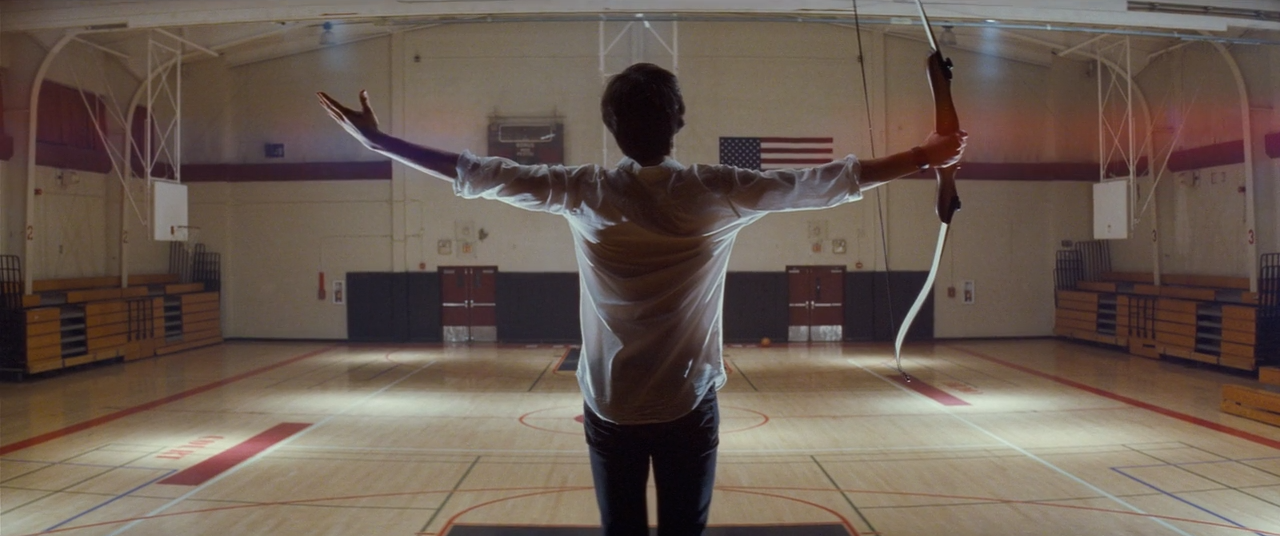
"From the start, we know something's not right and have a pretty good idea exactly what. But the best option is to surrender and let director Lynn Ramsey take us there, which she does, employing seamless transitions between the past and present to show the creation of a monster who eventually evolves into a 15-year-old (deviously played by Ezra Miller) on the cusp of committing an unspeakable crime. But this is no traditional horror movie. It cuts too close to the bone for that, with an eccentric, free-spirited mother named Eva (Tilda Swinton at her iciest) unwittingly setting events in motion by having a child she's neither motivated nor emotionally prepared enough to raise. Swinton knows to play her as terrible mother who isn't a terrible person, just severely lacking in self-awareness. With her milquetoast husband (John C. Reilly) oblivious of the psychological carnage happening right under his nose, mother and child take turns hurting one another, with Kevin always having the upper hand. It all seems so effortless, a muted confluence of scenes and images all leading to one tragically predetermined outcome Eva refuses to entertain. Ramsey dares to show it as it would happen, something that probably wouldn't be tolerated by the PC police just a few years later. Luckily, she pulls it off in time. Of course, we're left with the big question: Who's to blame? While a lesser film would have tried to answer that, this one knows there's more than enough of that to go around. "
7. Margaret

"Multiple storylines and sub-plots are juggled effortlessly, with everything always returning to Lisa and the accident's aftermath for those directly or indirectly involved. But for Lisa, everything is always about her, and it's a credit to the writing and Paquin that we don't judge her for it and at times even empathize with her self-centeredness. She's in over her head and the more she does to make things better, the deeper the hole she digs. Whether it's calling a bad boy classmate (Kieran Culkin) over to lose to her virginity, stringing along her would-be boyfriend (John Gallagher Jr.), hitting on her geometry teacher (Matt Damon), or meddling in the bus driver and victim's lives to absolve her conscience, Paquin makes it all seem somehow refreshingly human and relatable. She's not altogether a detestable character so much as a confused one, making it excusable for us to go from hating to loving Lisa (or vice versa) within the confines of a single scene." - 8/25/12
6. The Descendants

"The Hawaii we're presented with here isn't one we've been made aware of before, at least in movies. The opening voiceover even let's us know that much. It's more depressing than exotic, so unlike the vacation destination we've seen on postcards that it doesn't even register as the same place. If only Hawaiian locals only went to the beach all day, rode waves and had drinks with little umbrellas in them like we we've been told they do for years. This is the first time it hasn't been depicted as pure paradise and in doing so Payne fittingly humanizes this film's setting as much his characters, showing real flaws and imperfections that somehow lead to a greater appreciation of both. While people who live in paradise still have problems, they're hopefully not as big as the ones plaguing real estate lawyer Matt King, played by George Clooney in a dialed down performance sure to net him another Oscar nomination." - 12/11/11
5. The Artist

"The exact moment when The Artist becomes really interesting arrives when silent film star George Valentin (Jean Dujardin) puts down a glass and it actually makes a sound. Until then, it's the first noise we hear other than the film's bouncy musical score. Then his dog Jack (Uggie) barks. Actresses walk by giggling. Valentin screams in frustration but he can't make a sound as the whole sequence plays out like a scene from The Twilight Zone. This nightmare quickly becomes reality for Valentin as Kinograph Studios' boss Al Zimmer (John Goodman) announces that the advent of "talkies" have led to them halting production on silent films and his services are no longer needed. Watching, it's hard not to think of actors being replaced by computer graphics and motion capture in an age of 3D technology, older actresses being marginalized in an industry that worships youth and, of course, the current economic crisis. Despite the old fashioned approach, it's surprising just how fresh and relevant it all seems, and while it's frequently funny, it's also a bit deeper than you'd expect." - 2/23/12
4. The Tree of Life

"Less a film than a symphony, interpretation and analysis is fun, but futile considering each individual will bring however much or little of themselves they want to it. What it all means could be summed up as "everything," but that still doesn't even really touch it. We're born into this world, make connections with different people that can be fleeting or not, and then we leave it, never pausing to consider whether there's a universal scheme in place hurling us toward our inevitable destination. We've seen movies try to tackle the topic but this is the first to make sure it's felt completely. Similar to a collage of dreams or memories, everything is presented in a non-linear format rather than in a traditional narrative structure. Scenes flow freely to form emotions rather than necessarily tell a story, which is sort of a first. Almost embarrassingly messy and over-ambitious, it's a little early to judge its worth as a true masterpiece, but this does feel like something monumentally important that needs to be talked about for a while to come." - 7/5/11
3. Moneyball

"Director Bennett Millers' handling of the material is tremendous in how he visually simplifies what could have been a dense watch for non-sports fans, with the playing scenes only bolstered by Mychael Danna's anthemic score. At 2 hours and 13 minutes the film arguably could have used a snip or trim, but it's difficult to feel that way while watching. If anything, it's so level-headed and straightforward it's biggest problem may be that it's the type of film easier to respect than love. Time will have to tell. When Beane says "it's easy to be romantic about baseball" we expect nothing less than an easy, inspirational conclusion. Instead we get one that leaves you considering what constitutes "winning" and wondering whether Beane could have been toppled by the very approach he helped popularize. When the title card appears on screen revealing what became of him since that '02 season, I heard audible gasps of shock from the audience, perhaps a testament to how few still know what he accomplished in a sport primarily concerned with who won the last game." - 9/26/11
2. Young Adult

"It seems every year people like to say a certain film ' hits the zeitgeist.' The term is so casually thrown around it may as well mean nothing. But here's one that hits dead center, targeting our culture's current obsession with nostalgia and convincing ourselves that things were better back when we thought we were better, whenever that was. Like the celebrities we simultaneously despise and idolize, Mavis functions as the mirror in which we view ourselves at our worst and it isn't pretty. But it's honest. We expect certain things in films and a likable protagonist is one of them. And if they're not, they at least need to experience growth of some sort. While it might be a stretch to say she achieves none, it sure isn't much. Instead she's given a final act "pep talk" that further feeds her narcissistic delusion. It's clear her road to recovery will be a marathon rather than a sprint, if there's even recovery at all. And yet, that's strangely reassuring. This isn't a coming-of-age story but instead a vicious, bracingly blunt character study that goes for the jugular, creating some cringe-worthy moments that only sting that much more because they feel real." - 12/27/11
1. Drive

"This is exactly the kind of movie you can picture Quentin Tarantino kicking himself for not attempting. Could he do it as well? Possibly, but he'd have to curb his penchant for having his characters talk about how cool it is they're in it rather than building tension and suspense. This is the result when the right director, cast and material all come together at once, and it's poor box office performance isn't a huge surprise given the polarizing risks Refn takes. It's just too challenging, representing the type of film mainstream audiences have been programmed to hate after being weened on truckloads of generic Hollywood garbage each year. Now when something's finally done right, it feels wrong, if only for daring to be different. Drawing from a myriad of influences that suggest it was transported from another era, Drive still feels wholly authentic and original, proving that action and violence mean little without an investment in the characters." - 10/5/11
My Top 10 Films of 2011
1. Drive (dir. Nicholas Winding Refn)
2. Young Adult (dir. Jason Reitman)
3. Moneyball (dir. Bennett Miller)
4. The Tree of Life (dir. Terrence Malick)
5. The Artist (dir. Michel Hazanavicius)
6. The Descendants (dir. Alexander Payne)
7. Margaret (dir. Kenneth Lonergan)
8. We Need to Talk About Kevin (dir. Lynn Ramsey)
9. The Ides of March (dir. George Clooney)
10. Contagion (dir. Steven Soderbergh)


 Posts


