Thursday, March 31, 2011

The Next Three Days


Director: Paul Haggis
Starring: Russell Crowe, Elizabeth Banks, Liam Neeson, Brian Dennehy, Olivia Wilde, Jason Beghe
Running Time: 122 min.
Rating: PG-13

★★★ (out of ★★★★)


The Next Three Days is a thriller almost too smart for its own good, but gets away with it by making sense. It's 90 minutes of set-up and 30 of payoff but the suspenseful final half hour makes it all worth it, with a script that succeeds in convincing us what we're watching is plausible, even if it probably isn't. It's refreshing to see smart law enforcement officers unable to catch the protagonist not because they're dumb, but because he's smart, did his research and considered the options. This isn't the "pulse-pounding" popcorn action movie it's been promoted as, but rather all about how a detailed plan materializes and its consequences. It's also about a conviction, but the issue of the guilt or innocence of the convict is mostly left unaddressed. "Restraint" isn't exactly the first word that comes to mind when you see writer/director Paul Haggis' name attached to a project, considering he's responsible for 2005's controversial Best Picture winner Crash. Thankfully this film isn't political, isn't trying to take an obvious stand on any issues and has no real point-of-view. It's a simple story told well as a reminder that Russell Crowe is one of the best actors we have, seemingly incapable of giving anything but his all each time out. Add this to the already long list of quality films he's carried on his back.

The film opens with college professor John Brennan (Crowe) behind the wheel in a frantic race against time. We flash back to find out his wife, Lara (Elizabeth Banks) was arrested and eventually convicted of murdering her boss following an altercation one night at work. Facing life in prison with no possibility of parole or any kind of appeal Lara is visited frequently by John, along with their young son, who refuses to even acknowledge her existence. Fed up, John consults former convict turned best selling author Damon Pennington (Liam Neeson) for ideas on how to break her out and discovers that the actual prison escape is the easiest part. Damon would know, having done it seven times already before turning himself in. The biggest challenge is avoiding capture and making it out of Pittsburgh alive. He finds out time is his worst enemy and he'll only have a very limited amount of it before the call is made to lock-down all the city's exits, preventing any possible route of escape. Most of the film concerns John's preparations and planning, like obtaining fake passports, investigating glitches in prison security and choosing a destination, should they even make it that far. The entire plot is meticulously detailed and methodically paced so those expecting The Great Escape or The Fugitive might be surprised, at least until John finally pulls the trigger on his plan and the chase is underway. But the reason the chase contains all the suspense it does is because of all the effort put into building toward it.

If you actually examined the series of events and tried to hold them up to close scrutiny you'd probably find plot holes big enough to drive a truck through, but within the confines of a movie universe they work because the characters behave intelligently and know what they're doing. We're too absorbed in the details to care whether every piece holds up and Crowe's intense lead performance is why. He specializes at making every action seem purposeful and is one of the few actors capable of playing a normal, everyday schlub thrown into an extraordinary situation and an action hero, a quality that only bolsters the credibility of an already tight script. In a rare, heavily dramatic role for her, Elizabeth Banks has less to do as Lara, if only because she spends most of the film's running time behind bars. The only wrong note Haggis strikes with her is an opening restaurant scene so hilariously overwritten is almost actually does play like an outtake from Crash. Still, her transformation in looks and demeanor from a successful, high powered businesswoman into an defeated convict is noteworthy and she more than holds her own with Crowe when the action picks up later. Olivia Wilde has a small role as a neighborhood mother who befriends John and we're not sure whether she's being set up as a potential love interest, key player in the prison break or something else. The part doesn't really amount to much at all but it's a credit to the script that you're constantly on your toes suspecting it might.

For a change in this genre, there's real legitimate doubt how this whole ordeal will all end and whether or not they'll even survive. You'll also gain a new appreciation for the film's poster, which figures into the plot in a clever, unexpected way. You could equally envision logical, satisfying conclusions where they survive and make it out of the country and another where both are either killed or captured. That the film is uninterested in the relevancy of her guilt or innocence is its most fascinating component, almost undone by a ill-conceived flashback scene in the third act that gives us more info than we want. It's a minor misstep, but anyone interested in a story about someone wrongfully accused might as well just rent Conviction because this is at its best when focusing on the intense mission of a man determined to see his risky plan through to the end. The important thing is that he believes she's innocent, and even if he didn't, you still get the impression his intentions wouldn't change and the unusually logical plot found in The Next Three Days would unfold just the same.

Monday, March 28, 2011

TV on DVD: Parks and Recreation (Seasons 1 and 2)


Creators: Greg Daniels and Michael Schur 
Starring: Amy Poehler, Rashida Jones, Aziz Ansari, Nick Offerman, Aubrey Plaza, Chris Pratt, Adam Scott, Rob Lowe, Jim O' Heir, Paul Schneider 
Original Airdate: 2009-2010 

Season 1: (★★★ out of ★★★★)

Season 2: (★★★★ out of ★★★★)

So, after two years complaining about Netflix, I've finally discovered its biggest benefit. It ties you down and forces you to watch things you either have little interest in or can't motivate yourself into making time for. It's a benefit that's rarely paid off to the extent it has with Parks and Recreation, a show I wouldn't have otherwise watched in its regular Thursday time slot on NBC. It's likely no amount of critical praise or glowing recommendations could have possibly convinced me NBC could actually be airing smart or edgy entertainment, much less what Entertainment Weekly calls the "smartest comedy on TV." The show sharing the same creators and mockumentary style as The Office has caused many to inaccurately label it as a "spin-off" when in it has absolutely nothing in common with that series at at all beyond a mild similarity in presentation. In comedic approach its closer to Arrested Development, and in being the sharpest comedy to air since that ingenious show ended in 2006, it's now filled a giant void . They'll be those who break down and watch, only to get this strange urge to jump ship after the six episode long first season, thinking it just doesn't meet the hype. Don't do it. Throwing in the towel too early is a mistake at the level of abandoning Lost toward the middle of its run. The show builds slowly, with every episode getting a little stronger along the way. That's not to imply there's anything horribly wrong with the first season (other than it being way too short), but it serves mainly as an introduction to the characters and situation, laying the groundwork and planting the seeds for one of the funniest seasons of sitcom comedy in years.

After this methodical start, the writing starts firing on all cylinders in the second season and the show embarks on this creative hot streak, picking up steam with each passing episode, all while hysterically fleshing out every character and finding the perfect tone. If the term "jumping the shark" describes when a show unofficially reaches its expiration date, maybe a new phrase should be instituted to describe when it really finds its groove creatively and there's no looking back. For Parks and Rec it happens toward the end of the first season in an episode entitled "The Banquet." In it, Leslie Knope (Amy Poehler) the Deputy Director of the Pawnee Parks Department in fictional Pawnee, Indiana arrives at a dinner honoring her mother in a suit with a boyish haircut and her embarrassingly overdressed friend Ann (Rashida Jones) while her boss, Parks Director Ron Swanson (Ken Offerman) proceeds to deliver a speech based entirely on fact ("It is true that you have won this award."). From that moment and the next 25 episodes that followed I couldn't stop laughing once, but to explain to someone who hasn't seen Parks and Rec what makes it so great is difficult. There's definitely a "you had to be there" vibe to this kind of humor that, like Arrested Development, won't hit the mark with everyone and the ratings already reflect that. Comedy is probably the most subjective of all genres, but for those who like it really dry, this hits huge.

The first season mainly centers around a pit that upbeat do-gooder Leslie wants to turn into a park after Ann's freeloading boyfriend Andy Dwyer (Chris Pratt) falls into it, breaking both legs and temporarily derailing his aspiring music "career," which he enthusiastically describes as "Matchbox Twenty meets The Fray." If I ever accidentally fall into a pit I can only hope nurse Ann is there to serve my lazy ass pancakes on the couch and I get to write a song about about my experience as memorable as "The Pit," which Andy eventually performs with his band "Mouse Rat," or whatever they're known as that week, since he continuously changes their name. Leslie's unmotivated local government underlings are initially only window dressing in a first season that focuses on Leslie's social ineptness and overall cluelessness, especially when it comes to her dating life or any kind of decision making. Again, not to say the first six episodes are worthless, but they only serve as an introduction to the workplace setting and a surface glimpse into some of the personalities. It's only when the writers figure out how to flesh out the supporting characters' crazy personal lives and humanize Leslie that the show takes off to absurd heights. There's Tom Haverford (Aziz Ansari), wannabe club impresario, self-proclaimed ladies' man and "Miss Pawnee" judge who landed a wife way out of his league because she would be deported back to Canada. He's also discovered the most creative use yet for the Roomba vacuum. Look up "deadpan" in the dictionary you'll find a picture of apathetic, eye-rolling college student April Ludgate (Aubrey Plaza), Ron's eventual assistant who after learning her lesson the hard way now knows to schedule his meetings for "Marchtember Oneteenth." Even seemingly the most minor and hapless of supporting characters, like the clumsy and frequently mocked Jerry Gergich (Jim O' Heir), who's spotlighted in two of the seasons funniest episodes, one involving the design of a new mural (or "murinal" as he mistakenly calls it) and aother centered around his alleged mugging.

Mustachioed legend Ron Swanson is who everyone will justifiably be talking about by the end of the second season, largely because of the performance given by Nick Offerman, who needs an Emmy handed to him right now. To even call this a performance wouldn't do it justice. As the stoic ant-government libertarian he spends most of the first season grimacing behind his desk which happens to be equipped with a loaded rifle. But by the time the second season opens I can't even begin to describe the direction this character takes. Whether he's moonlighting as saxophonist Duke Silver, nursing his unhealthy obsession with breakfast foods, feuding with crazy ex-wife Tammy (guest star Megan Mullally), dressing like Tiger Woods, accepting his "Woman of the Year" award, being aroused by a shoeshine or demonstrating his woodworking skills, Ron Swanson is, quite simply, an American hero. In contrast to his initial appearances as merely a cranky antagonist to Leslie, it's at the start of the second season when Offerman is let loose to lighten up and go in a million different crazy directions with the role, eventually becoming the linchpin of the entire show. And only you see an interview with the actor out of character do you realize how little he resembles the strangely feline-looking man he plays and just how much of a departure it is for this gifted comedian to bring that creation to the screen. 

How registered nurse Ann finds the time to hang out at city hall all the time (even long after the pit is filled in) and becomes Leslie's BFF is kind of a hilarious mystery, but her relationship with city planner Mark Brendanawicz (Paul Schneider) does open the door for the bizarre antics of the now fully recovered Andy Dwyer in season 2, who for my money not only tops Ron as the show's most hilarious character, but qualifies as the funniest character on TV today. If Offerman deserves an Emmy he should cut it in half and split it with Chris Pratt, who some might remember from his stints on Everwood and The O.C. if not for the fact that he's now gained almost as much weight as DeNiro did for Raging Bull. To say he's "let himself go" for this role as 29-year-old with a 5-year-old's brain would be understatement but the transformation isn't just limited to packing the pounds on as he reveals himself to be a brilliant comic actor capable of so much with just a quick physical gesture or expression. Stalking your ex-girlfriend and harassing her current boyfriend should be creepy but Pratt makes Andy seem endearing and almost child-like in his obsession, making all the uncomfortable laughs comfortable. When he actually gets a "real job" as a shoeshinist at city hall in Season 2 it seems like the profession Andy's always been waiting for, second only to his brief stint as FBI agent Bert Macklin.  The romance between he and another character in the second season is brilliant for just how unexpectedly it develops over the course of just a few episodes.

The idea of characters talking to the camera is used much more effectively here than it ever was on The Office, mainly because here it actually seems like they're letting us in on something no one else knows about. Occasionally you'll catch Plaza giving April's "you can't be serious" look of disgust right into the camera while Azari flashes his mischeivous grin that lets you when know Tom is up to no good or hatching a perverted scheme, which is pretty much all the time. It also gives Ron an opportunity to share his anti-government views while delivering some of the show's most quote worthy lines.  Given that there's such a gigantic leap in quality from the first to second season you may wonder what the point is of even watching the first. I don't have an answer for that. No one would be lost with what's happening if they skipped it but for background purposes its advantageous if you're tolerant of giving a show time to grow and come into its own. And truthfully, 6 episodes is quicker than it takes most sitcoms to gain their footing. Most sitcoms never find it. While there isn't an ongoing narrative requiring the level of commitment that was needed for similarly ratings challenged Arrested Development, some of humor does come with the expectation viewers are familiar with previous storylines and inside jokes so I wouldn't recommend just hopping on board mid-run expecting to be blown away. Also like Arrested Development the series thrives on memorable guest stars that actually add something worthwhile and are incorporated seamlessly. In addition to Mullally, just the first two seasons alone have featured appearances from Louis C.K. Fred Armisen, Will Arnett, Andy Samberg, Pamela Reed, Justin Theroux, John Larroquette, Paul Scheer, Michael Gross and most memorable of all, former Indiana Pacer Detlef Schrempf.

If there's one character on the show that always seemed disposable it was Paul Schneider's Mark, so the writers made a reasonable call eliminating him at the end of the second season. That's not a slight on the actor who's laid back coolness provided a nice contrast to the rest of the cast but he really wasn't doing much and could conceivably return in a guest role down the line. The jury's still out on the addition of Rob Lowe and Adam Scott as auditors sent to rescue the Parks department from bankruptcy in the final few episodes and become regular cast members in season 3, but I keep hearing nothing but positives about both of them so it should be interesting to see what they can offer. It's difficult thinking the show could possibly get better than this, its catchy opening theme song can leave my head or I'll eventually be able to adjust to watching it in its regularly scheduled time slot instead of on DVD. That after such an incredibly strong run of episodes it was still almost axed and ordered as a mid-season replacement earlier this year proves just how hard it is to hook viewers and how frustrating it can be for fans trying to spread the word. The "best show you're not watching" is one of those terms that gets thrown around a lot but in the case of Parks and Rec it's actually true.

Sunday, March 20, 2011

The A-Team


Director: Joe Carnahan
Starring: Liam Neeson, Bradley Cooper, Quinton Jackson, Sharlto Copley, Jessica Biel, Patrick Wilson, Brian Bloom
Running Time: 119 min.
Rating: R

★★ ½ (out of ★★★★)

Forget about whether the big screen re-boot of the popular 80's action series The A-Team is faithful to the spirit of the original because even judged solely on its own terms as silly action junk it's still a mess. As one of the more worthwhile remake ideas to come a long recently, there was actually potential to greatly improve the material by shifting it to the present day. With the right direction you could easily envision a modern day update of The A-Team being a huge success but unfortunately for every one thing that does work, about three don't. While certain elements in terms of feel and casting are spot-on, a ridiculously convoluted plot and cringe inducing dialogue make the overlong film somewhat embarrassing to sit through at times. But the biggest problem is tone. No one seems exactly sure what they're trying to make. It's Bad Boys meets The Expendables, though slightly less painful than either. When it was released a few months ago Mr. T. came out criticizing the film for its excessive sex and violence, which is funny considering there isn't much, and even if there was, that would be the least of its troubles.

The film's most clever bit is out of the way early in an entertaining twenty-minute prologue that introduces the four army rangers who together will form the elite Special Forces unit known as The A-Team, led by cranky, cigar chomping Hannibal Smith (Liam Neeson). He's joined by mohawked muscle man B.A. Baracus (Quinton "Rampage" Jackson"), cocky womanizer Templeton "Faceman" Peck (Bradley Cooper) and a mentally unstable, but brilliant helicopter pilot known as H.M. "Howling Mad" Murdoch (Sharlto Copley). Eight Years and "eighty successful missions later" while stationed in Iraq, they're dishonorably discharged and sent to prison after being framed for stealing counterfeit engraving plates. With the help of shady CIA agent Lynch (Patrick Wilson) they escape but must evade capture from Face's former lover, Captain Charissa Sosa (Jessica Biel) and track down a rogue security agent named Pike (Brian Bloom). The rest of the plot, full of double-crosses, illogical turns and centering around some kind massive conspiracy involving the guy who played Major Dad I probably wouldn't be able to pass a quiz on. It's all just an excuse to blow things up and stage giant action sequences that are difficult to follow.

Not to compare, but an advantage the original series will always have over any current big screen adaptation is a lack of technology. It's strange referring to that as an advantage but an overuse of computer generated effects isn't something that necessarily benefits a no nonsense, balls-to-the-wall property like The A-Team. The explosions and action sequences on that show looked real because they actually were and it gave the show a realistic charm. Even when action scenes were sloppy, they were at least believably sloppy, so if any action movie needed to be scaled down on CGI for a reason it was this. Instead, director/co-writer Joe Carnahan bombards us with as much action effects as possible, as well as music video style cutting quick enough to make following anything near impossible. That approach worked for him in Smokin' Aces because you couldn't envision a movie that bombastic being made any other way but here it just doesn't suit the material, with a script alternates randomly between cheesy one-liners and semi-seriousness. It's not necessarily all his fault so much as the wrong take on the material being chosen from the get-go before cameras started rolling. More shameful is composer Alan Silvestri giving only a brief, passing shout-out to the original show's legendary theme music in his score. If you have one of the most recognizable TV themes of all-time at your disposable, wouldn't it make sense to use it?  Then again, when you consider the film made such an effort to stray from what made the the original series successful, that decision comes as little surprise.

The actors' takes on these classic television characters vary in effectiveness with Liam Neeson playing Liam Neeson playing George Peppard playing Hannibal Smith. In the minds of some Neeson's been "selling out" recently with these types of roles but very few have managed to do it with more dignity and he walks away with it still intact after this. While lacking Peppard's gruff ruggedness, he gets the job done in a performance that doesn't mimic the original actor but won't be remembered as anything special. With as much screen time to be considered co-lead, Bradley Cooper goes through the entire film looking like he's still nursing his hangover from The Hangover, merely transporting that character with the macho factor upped slightly. For some reason I found him very irritating, which may have more to do with the corny dialogue he's asked to deliver than any particular problem with the performance. In any event, Face quickly becomes tiresome and unlikable, hitting the same note for two hours straight. Despite really looking the part, Mixed martial artist Quinton "Rampage" Jackson shouldn't quit his day job, failing to come across as even the slightest bit intimidating or charismatic as Baracus. That his character's relegated to the sidelines and basically a non-factor in the action doesn't help much either. Jackson shouldn't be expected to do an imitation of Mr. T (who you may have a new appreciation for after watching this) but he should be expected to do something. Of the four, Sharlto Copley comes closest to capturing the spirit of Murdoch but even that character seems like some kind of crazy parody whether you've seen the show or not. Jessica Biel and Patrick Wilson are more entertaining than all of them, especially Biel who surprisingly gives the best performance in the film, completely believable as an authoritative military captain capable of taking out The A-Team.

Viewing it through the rose-colored glasses of nostalgia, I don't remember the show being this goofy, not that it should matter any because it was probably even goofier. It was never a drama either but the biggest problem with this adaptation is its misguided desire to be both. Action comedies are tough to make well anyway, but when you pile on the added pressure of drawing new fans to a long defunct franchise and attempting to stay true to its original roots, it becomes even harder. This strays too far from the original to entice longtime fans and remains too faithful to attract any new ones, making the common mistake of modernizing too much in an attempt to fix what wasn't broken. To paraphrase Hannibal, this plan doesn't come together like it should. Though fans would also likely consider it a betrayal, a more serious take on the material could have been compelling in the right hands, but that would have been a long shot as well. 2006's polarizing Miami Vice adaptation was a messy misfire but at least Michael Mann had the guts to force us to think of that property in a way we never considered before. Whatever incarnation of The A-Team this was supposed to be it doesn't click, but the most disappointing aspect is how a show that deserved more comes off so closely resembling every other sub-par action movie released these days.

Tuesday, March 15, 2011

Never Let Me Go


Director: Mark Romanek
Starring: Carey Mulligan, Andrew Garfield, Keira Knightley, Isobel Meikle-Small, Charlie Rowe, Ella Purnell, Charlotte Rampling, Sally Hawkins
Running Time: 105 min.
Rating: R

★★★★ (out of ★★★★)
  
MAJOR SPOILERS FOLLOW

In taking a fantastical sci-fi premise that could be ripped from The Twilight Zone and dropping it in a familiar, everyday reality, Never Let Me Go gives us something we've never seen before without flaunting it or obsessing over pointless details. It's a reminder that when executed to its full potential science fiction is the strongest genre out there simply because it's capable of exploring themes, emotions and situations conventional dramatic storytelling constraints would usually prohibit. The world presented to us here seems so frighteningly normal and similar to our own that the phrase "Based on a True Story" could have flashed before the opening credits and we'd believe it. As emotionally devastating as it is realistic it follows three friends who aren't exactly friends but are thrown together by dire circumstances they can't possibly control or possibly comprehend the full impact of. And that they can't understand it despite their best efforts to try just might be the saddest aspect of a story already loaded with sadness and regret.

Childhood memories, first loves, going away to school and everything else we'd usually associate with growing up seem profoundly different when looked at the through the painful prism of these characters' tragic lives. Mismarketed and misunderstood, the film faced an uphill battle from the start in being aimed at two wildly different types of audiences. Commercials and trailers were intentionally vague, leading to confusion and causing the picture to fall by the wayside amidst award competition from other prestigious releases at the end of last year. I've wrestled with whether I should reveal the key plot point (it's not a "twist" since it's revealed early and casually) in this review, and determined it's nearly impossible to discuss what makes the film so unique without doing so. A thesis paper could probably be written on the film's concepts, but what sets this apart is what's done with them, offering up a great case that the best films are capable of being just as intellectually stimulating as the literature they're based on.

The film is narrated by 28-year-old Kathy H., a young woman reflecting back on a childhood spent with friends Ruth and Tommy at Hailsham, a seemingly idyllic English boarding school that fosters creativity and physical health. But things aren't as rosy as they appear as stories and terrifying rumors circulate about what happens when you try to leave the grounds and daily medical check-ups tip off that these children are being groomed carefully for something important. They're scientific clones, being prepped to donate their vital organs to save terminally ill patients when they reach young adulthood. Miss Lucy (Sally Hawkins), the one teacher brave enough to let the children know of their purpose and early fates is fired as the kids continue to await the day they reach their teenage years and are shipped off to cottages before they start their donations. From their very early years at Hailsham young Kathy (Isobel Meikle-Small) begins to fall for the highly emotional, quick-tempered Tommy (Charlie Rowe), but Ruth (Ella Purnell) selfishly sets her sights on him, driving a wedge between the three that will last into the better part of the next decade. Teenagers Ruth and Tommy (Keira Knightly and Andrew Garfield) are still together while heartbroken Kathy (Carey Mulligan) suffers in silence, knowing the time she could have spent with Tommy is whittling away. Reunited a decade later in young adulthood, the stakes become even higher as the three enter the final leg of their tragic journey, preparing to fulfill their ultimate purpose while still holding out hope there's some way out.

What starts looking like it's going to be one of those stuffy, British Oscar contending dramas like The King's Speech evolves into a dystopian nightmare, but slowly and with such clarity and casual confidence you hardly realize it's happening. Merely the existence of the big question as to why they just don't try to escape confirms the film has more on its mind than just its premise and is entirely unconcerned with consequences or a cheap action payoff you'd find in something like Logan's Run or The Island. What sets Alex Garland's script (adapted from Kazuo Ishiguru's bestselling novel) apart is that they wouldn't try to escape because the possibility doesn't exist in their minds that they can (though it's heavily implied certain safeguards are in place to prevent it should they try). This is just the way it is for them and scarier still is the notion that they seem uncertain that they want to and likely wouldn't have a clue what to do once they did. The most terrifying scene in the film comes when as children they're taught something as simple as how to order in a restaurant and the uncomfortable result later when they eventually have to. What motivation do they have to learn anything knowing their days are numbered? Armed with the knowledge they'll die before reaching their full potential informs the story in ways it couldn't if this were just about showing off its premise. Ruth's decades long attempt to come between Kathy and Tommy takes on an almost sadistic quality when you consider how little time is afforded to them.

Since first bursting on the scene a couple of years ago Carey Mulligan has been slowly building toward a performance like this but I didn't think it would happen this soon. She was strong in 2009's An Education (for which she was Oscar nominated) and in last year's Wall Street: Money Never Sleeps, but this a far more challenging role than either, requiring her to tell the entire story of this girl on her face without words and convey the evolution of a character through the stages of her life. Her narration contains a matter-of-fact frankness that subtly adds even more weight to the tragedy. It's also amazing just how well she captures the mannerisms of her childhood counterpart from earlier in the film played by Isobel Meikle-Small (who looks and acts so much like Mulligan it's scary). This is one of those rare instances where the casting and performances are so spot-on that you actually believe the chosen sets of kid and adult actors are the same person.

Andrew Garfield's impact as the shy but sensitive adult Tommy isn't felt in full force until the brutal final hour as he builds on the frightened boy we first met at the start of the picture, now scrambling and seemingly on the verge of a mental meltdown as he attempts to delay the inevitable. Keira Knightley's an ironic choice for the antagonist since she's essentially playing the exact opposite role she did in Atonement where she was the victim in a relationship destroyed by jealous sabotage. This time she's the sabateour, investing Ruth with a detestable arrogance that masks her massive fear and insecurity. While I don't usually count myself as a Knightley fan it's surprising how much she does with what could have been a fairly limiting role, not to mention the physical and emotional transformation she undergoes toward the end of the picture that renders her character unrecognizable from how she began. Giving maybe the most fully realized performance of her career thus far, Knightly can take solace in the fact that she only comes off as the weak link because she's sharing the screen with two actors emerging as the best of their generation.

Thinking of this as Atonement meets Blade Runner in a genre bending mash-up helps in getting a handle on why it had little chance for commercial success. But mentioning Blade Runner in relation to this is slightly unfair in that it implies there's any running going on at all during the film or that the cloning aspect is the driving force in some kind of futuristic narrative. This amounts to much more  than that, using it as only a canvas to tell a deeper story. The film was directed by Mark Romanek who's last outing was 2002's creepy, underrated One Hour Photo and it's easy to see why he waited eight years to direct another movie if he was waiting on a script this strong. What both have in common are premises that could have easily deteriorated into cheap B-level entertainment but instead ended up contemplating actual ideas. Both are also incredibly somber and depressing, this maybe more so, but it's not without a purpose.   

Despite spanning over two decades in telling a story that feels epic in scope, the film's running time still flies by and Romanek creates an intimacy by setting it in a kind of retro alternate reality that closely resembles our own, yet strangely feels like a bygone era as well. We're always aware that the chances of an eleventh hour reprieve for the characters are slim, but not necessarily non-existent, and it's that hope that builds much of the tension, eventually leading to a well earned emotional release. But the most sobering possibility implied in Never Let Me Go is that our lives may differ very little from that of the film's victim donors. If that's not deep enough stuff to think about, I don't know what is.

Monday, March 7, 2011

Let Me In


Director: Matt Reeves
Starring: Kodi Smit-McPhee, Chloe Grace Moretz, Elias Koteas, Richard Jenkins, Cara Buono, Sasha Barrese, Dylan Minnette
Running Time: 116 min.
Rating: R

★★★ ½ (out of ★★★★) 

Let Me In, director Matt Reeves' American remake of the acclaimed 2008 Swedish horror film Let The Right One In is not a movie about vampires. That detail is wisely a backdrop to what's a coming-of-age period film and mood piece featuring a character who happens to be a vampire. It's a means to an end, important in identifying why the film succeeds and how it escapes the pitfalls always accompanying this genre. Having still not seen the original I can't compare, but can still somewhat appreciate the uphill battle Reeves faced in justifying such a project's existence. One group will hate it because they reject the idea of their favorite horror film being remade or just assume any foreign property will have to be dumbed down to appeal to mainstream audiences. Everyone else won't care at all because they've never heard of it. Reeves manages to overcome both those obstacles with an unusually smart, suspenseful film that's beautifully photographed, lushly scored and fully absorbing from start to finish. And that statement comes from someone who usually can't stand anything having to do with vampires and considers it a lazy, overused film topic. If only the final product could turn out like this more often. The few scenes depicting that are handled surprisingly well, but the real horror is found in the emotional pain of growing up.

It's 1983 in Los Alamos, New Mexico and an apparent suicide of a disfigured patient at the local hospital panics the local police detective (Elias Koteas), who finds only a note by his bedside reading: "I'm sory Abby." We flashback two weeks earlier to meet 12-year-old Owen (Kodi Smit McPhee), lonely, depressed boy going through some serious issues with his parents' impending divorce and brutal harassment from bullies at school. With no one to turn to and too afraid to retaliate, he internalizes everything and creates imaginary scenarios of revenge with his pocket knife and a tree. If ever a child were destined for a future filled with trips to the school psychologist's office, it's him. Relief comes in the arrival of Abby (Chloe Grace Moretz), a girl who claims to be his age who moves in next door with a solemn looking middle-aged man (Richard Jenkins) who appears to be her father. After some reluctance on her part to befriend him they start to grow closer and it becomes clear she isn't a twelve year-old girl and that isn't her father. But let's not call her a "vampire," because doing that would be a betrayal of how intelligently the narrative unfolds and the restraint with which her situation is presented. She simply needs to blood to survive. This becomes a problem as she forges a closer relationship with Owen, who inches closer to the truth about her as she teaches him to stand up to his tormentors.

Vampirism always seems to fare best in films when it's treated as an affliction or almost a disease of sorts, as it is here. Abby's condition isn't glamorized in any way, she doesn't think it would be cool to live thousands of years, dress in gothic clothes, sleep all day or hang out with werewolves. Instead, this is a curse ruining her life and preventing her from ever forging a meaningful bond with anyone. That you could probably replace being a vampire with any other physical or psychological affliction and still emerge with a story just as strong proves how much more is going on beneath the surface. It's really about two lonely, troubled kids brought together with their friendship tested by this huge obstacle put in front of them. The question becomes whether Owen can still accept her and whether Abby can withstand the temptation to use him as she does everyone else, including her "father." There are times that this budding childhood romance is handled with such special care that if not for the dark, somber undercurrent, the storyline would recall My Girl before it would a horror film.  What scares there are come not from the few, well-placed and suspenseful vampire attacks from Abby but instead the bullying Owen endures at school by Kenny (an effectively menacing Dylan Minette) and his gang, which is more terrifying than any of the the graphic blood-drenched events that unfold during the picture.

As smart as Reeves' script (based on the novel by John Ajvide Lindqvist in addition to the Swedish film) is in putting the emphasis in the right place and cloaking the vampire elements in a coming-of-age tale, casting was crucial. Thankfully, the young performers are amazing. Kodi Smit-McPhee is subtly devastating as the fearful, lonely Owen so disconnected from everyone else that even his mother (played by Cara Buono) is barely shown on screen at all, her face covered or out of view throughout.  After going two for two in 2010 with this and Kick-Ass, Chloe Moretz is emerging as an actress whose career bares watching in much the same way Natalie Portman's did in its early stages. This is a complex role requiring her to be doomed killing machine in addition to conveying the emotional pain of a lovestruck young girl sentenced to spend her entire life in childhood. This dark, heavy material but these kids get it and rise to the challenge. Just as strong in a small but pivotal role is Richard Jenkins as Abby's guardian, with his sad eyes and morose expression revealing more than any line of dialogue possibly could. And during one memorable stretch of the film, he still somehow does it with a bag over his head. As a character added for this adaptation, Elias Koteas is the eyes and ears for the audience as a nameless local cop, but he gets us to care what happens to him, even if against better judgment we find ourselves in the uncomfortable position of rooting for a vampire to escape.

The early 80's setting present in both the novel and original film was retained and is maximized to great effect through the perfect placement of certain classic rock songs of the era and period details that leave no doubt this takes place in the 80's without ever hammering us over the head with it. The time and setting feel like an natural extension of the plot, like a dream or memory that if updated to modern day could somehow ring false regardless of one's familiarity with the source material.  Only the best period pieces understand it's not so much about the clothes, hairstyles or music (though it's a factor), but capturing a certain mood or spirit of the time that takes you back. The somber tone of the film is spot-on and never waivers, reinforced by Michael Giacchino's creepy, melancholy score and cinematography from Greig Fraser that's soaked in washed-out browns and a yellowish amber tint that creates a visually unsettling atmosphere. That such a methodical, introspective film came from the director of 2008's shaky-cam monster movie Cloverfield is kind of a shock. This is about as far from that as can be while still vaguely straddling a similar genre.

When Stephen King named Let Me In his favorite movie of 2010, calling it the "best American horror film in the last 20 years" I was skeptical knowing his history of overpraising mainstream fluff.  If the statement is a bit of an exaggeration (and as much a testament to all the inferior horror films we've suffered through), it isn't much of one. Nothing about this movie feels mainstream and it's too intelligent to ever be mistaken for the latest Hollywood cash-in slasher remake. If nothing else, it teaches the lesson that the best movies are rarely about what they're actually about and horror can't truly unsettle unless you care about the characters and their situation. Let Me In gets this right, proving all remakes don't have to be pointless and aren't necessarily destined to fail.

Monday, February 28, 2011

Burning Questions From The Oscars


Why does the Red Carpet pre-show seem to feel longer each year? (despite me only catching 10 minutes of it)

Did the opening montage finally confirm it was a good idea to go to 10 nominees?

Or at least that they mostly picked the right movies?

Inception is getting pretty popular to spoof on awards shows isn't it?

Did that opening spoof confirm that this is Franco's show and Hathaway's just along for the ride?

Is there a cooler guy on the planet than James Franco?

Am I the only one relieved that Hathaway and Franco are still considered "young" by today's TV demographic standards?

Was Tom Hanks' Oscar history lesson supposed to be an ugly foreshadowing of what would occur later with The King's Speech?

Did I breath a sigh of relief when Alice in Wonderland took Art Direction instead of The King's Speech?

Did I ever think I'd breath a sigh of relief when Alice Wonderland won anything?

Wally Pfistser for Inception?!

Did anyone see that one coming?

Did you know this makes Pfister the first graduate of my high school to win an Academy Award?

Would you have had to attend my high school to grasp how big an accomplishment that actually is?

How awesome was it that Kirk Douglas milked the announcement of the winner for as long as humanly possible?

Should we insert the obligatory Sally Field "You Like Me, You really like me!" joke in here for Melissa Leo's win?

Should we be thrilled it at least went to someone we know for sure wanted and appreciated it?

Did they regret giving it to her after she dropped the f bomb?

Does this mean we can now officially "CONSIDER" her an Oscar winner?

Will I ever get Animated Short right?

Was there any doubt that Sorkin would (justifiably) win adapted screenplay?

And isn't it the best script to win in a long, long time?

Wasn't it cool he mentioned Network?

Who would have guessed he's a fast talker?

Did anyone else think that Nolan possibly had a shot at Screenplay after Inception shockingly won cinematography? (Yeah, me neither)

Is anyone else tired of hosts singing at the Oscars (no matter how well they do it)?

Didn't Franco look scary as a woman?

Did he look as scary as Russell Brand does clean shaven?

Wasn't Franco's Charlie Sheen joke pretty funny?

Wouldn't any Sheen joke be funny at this point?

Can we give Christian Bale's beard get a separate award for its performance over the past two months?

Wasn't the orchestra's take on The Fighter music kind of catchy?

Doesn't "Academy Award Winner Trent Reznor" sound great?

Have I ever been happier to get a prediction wrong?

Was I wrong in kind of hoping TRON: Legacy would win SOMETHING, even if it's just in sound?

Who would have thought that at any point in the night Inception would be leading in Oscar wins?

Was I thrilled that almost an hour and a half into this that The King's Speech only had one win?

Wasn't it cruel of them to get my hopes up like that?

Shouldn't Kevin Spacey host the Oscars already?

As brief as they were, weren't you glad they went back to performing the Original Song nominees again?

Especially when one of them is performed by Mandy Moore?

And doesn't that beat last year's interpretive dance routine for... The Hurt Locker?

Wasn't that the truth when Gyllenhaal said that shorts were the toughest category to predict on your ballots?

Did you have your fingers crossed for an Exit Through The Gift Shop win like I did?

Seriously, shouldn't it have been nominated for Best Picture? 

Doesn't it suck that we'll never know what Oprah would have done had Banksy showed up?

Where was James Franco the entire show?

Did the Henley rowing sequence alone confirm The Social Network should win Best Editing?

Hasn't Jennifer Hudson lost way too much weight?

Nothing against Florence but why didn't Dido perform "If I Rise?"

Wasn't Paltrow's vocal performance underwhelming?

Didn't Hathwaway sound better?

Isn't it surreal in all the wrong ways having to see Dennis Hopper in the "In Memorium" tribute montage?

Will I be wondering how voters can sleep at night knowing they gave Fincher's Oscar to Tom Hooper?

Seriously, Tom Hooper?

Does this mean Fincher will have to wait decades to be rewarded for a lesser film?


Wasn't it nice that they had Jeff Bridges actually say something about the actress's performances and substantial clips were shown?

Wow, how different does Jennifer Lawrence look from the character she played?

Doesn't Michelle Williams eerily resemble Mia Farrow with that haircut?

Did I just accidentally give Hollywood another remake idea?

Is Williams the only actress in that category you can legitimately say will be back soon as a nominee and mean it?

Safe for me to say it's unlikely Portman will be returning to that podium again as anything other than a presenter?

That said, didn't she still really deserve this?

Should she also receive an honorary Oscar for her work as an uncredited script consultant on The Social Network?

How sad is it that a win for an actress I don't even care for is my favorite of the night?

Now that she's officially won does this mean my complicated, bi-polar love/hate feelings for her come to an end?

Or at least temporarily subside until Your Highness is released?

How great is it that they referenced Franco's General Hospital stint twice during the night?

Wouldn't it have been even greater if they showed clips?

Isn't it ironic that the two big winners from The King's Speech both gave incredibly boring speeches?

Should anyone not named Alanis Morisette ever ask a question that begins with the phrase "Isn't it ironic...?"

Did you recognize the music Spielberg came out to as John Williams' incredible Jurassic Park score?

Can you believe that score wasn't even nominated in '93?!

After this show can we even really be surprised by that?

How great was it for Spielberg to apologize in advance for The King's Speech winning?

But isn't he right that losing just might be the best thing for The Social Network?

Was there a need to play dialogue from The King's Speech over all the other contenders?

Could they have been any more obvious?

Is it fair to say Hathaway and Franco won't be asked back next year?

Didn't Hathaway seem to be trying too hard all night?

Should this be a lesson to producers that doing mean impersonations of actresses on Saturday Night Live doesn't necessarily qualify someone to host the Academy Awards?

Or play Catwoman?

Would my ideal alternate ending of the show be a Social Network Best Picture win followed by that kids' choir covering Radiohead's "Creep?"

Does it even makes sense to hire "younger, hipper" hosts if a film like The King's Speech will just end up dominating?

Wouldn't it make more sense to recruit "younger, hipper" Academy members instead?

All things considered, didn't the show at least move faster than usual?

Don't I say that every year?

Am I kind of glad this whole thing's over?

Friday, February 25, 2011

Oscar Predictions

Let me preface these by saying that I want to be wrong when it comes to the categories of Picture and Actor. With any luck this is just me being overly pessimistic, hoping for the best but planning for the worst. Hopefully I fall to the floor in shock when Tom Hanks or Jack Nicholson or whoever it is this year opens the envelope announcing The Social Network as Best Picture while Fincher, Sorkin, Eisenberg and company storm the stage to collect what's theirs. But as I've previously stated, it's fine if that doesn't occur and for all my complaints about The Academy Awards at least they'll never be The Grammys. Even when the Academy's actual selections are questionable, it's always an intelligent (if sometimes boring) adult-oriented show that at least attempts to nominate and reward quality work. I'd rather they go in this direction and come off as stuffy, pretentious snobs than sell-out and nominate the latest Twilight movie or Justin Beiber's concert film. And consider it a relief the show's producers sensibly reach for ratings with their choices of hosts and presenters, figuring out ways to freshen up the telecast each year, while at least trying to fix what doesn't work. With that in mind...  


Best Picture

"127 Hours"
"Black Swan"
"The Fighter"
"Inception"
"The Kids Are All Right"
"The King's Speech"
"The Social Network"
"Toy Story 3"
"True Grit"
"Winter's Bone"

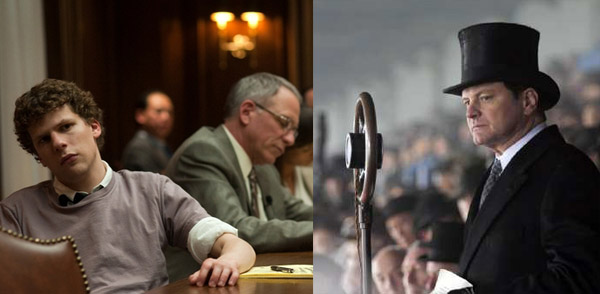
Analysis: The Social Network is inspiring also. When it ended I couldn't wait to overcome the odds and start my own web site, screw my friends out of millions (no, BILLIONS) of dollars, train to compete in rowing races and awkwardly offend every female I come in contact with. In all seriousness, that's exactly what most voters were thinking when they marked their ballots...for The King's Speech. Of course, the big joke there is that The Social Network was never meant to be inspiring, at least in the way that more conventional drama is. And for the record, I didn't think The King's Speech was really that inspiring at all and I was more moved (not superficially inspired) by The Social Network. But hey, that's just me. Should something crazy happen The Fighter and Black Swan would be next in line, and in that order. Outside of that, no other film stands a chance, especially not The Kids Are All Right and Winter's Bone, and not even Inception or True Grit.  It's a two-horse race, with a Social Network victory still very possible, though unlikely. Expect The King's Speech to be joining Dances With Wolves, Crash, Slumdog Millionaire and The Hurt Locker in the $5 DVD bin shortly. None are bad films, only undeserving of going down in the annals of film history as one of the best. The Social Network is. Plus, it's actually fun to watch. What more could you ask for?

Will Win: How Green Was My Valle...I mean, The King's Speech
Should Win: Give me a break. 
Could Win: Please!  
Snubbed: Nothing really. Everyone will always have a different list of what they felt the ten best films of the year were. All things considered, they did a respectable job not leaving anything out.


Best Director

Darren Aronofsky, "Black Swan"
David Fincher, "The Social Network"
Tom Hooper, "The King's Speech"
David O. Russell, "The Fighter"
Joel and Ethan Coen, "True Grit"

Tom Hooper seems like a nice enough guy, which is why it would be a shame if he had to bare the burden of possibly being one of the most undeserving Best Director Oscar recipients in history. It's bad enough he could beat Fincher, but throw in Aronofsky, Russell and the Coens and it almost makes you glad Chistopher Nolan wasn't nominated just so he doesn't have to experience the embarrassment. But I'm cautiously hopeful that won't happen. The King's Speech was well directed for sure but anyone claiming it couldn't have been directed as well (or much better) by Hooper's competitors, or more than a dozen other random filmmakers, need their head examined and I think the Academy will see that. Fincher has a better chance at winning this than his movie does of winning Best Picture, but unfortunately not by much. I think he'll pull it out though. More than any other recent year, this one presents the greatest chance of there being a split between Picture and Director. If that happens I'll take it since anything would be better than The King's Speech dominating every category all night long. One request: If Fincher loses just please let it be to Aronofsky, the only filmmaker close to being in his league and deserving on the grounds of being able to squeeze such a high quality performance out of Portman.

Will Win: FINCHER
Should Win: FINCHER
Could Win: Tom Hopper
Snubbed: Christopher Nolan (Inception)


Best Actor

Javier Bardem, "Biutiful"
Jeff Bridges, "True Grit"
Jesse Eisenberg, "The Social Network"
Colin Firth, "The King's Speech"
James Franco, "127 Hours"

Analysis: I'm not exactly sure what planet we're on where Colin Firth is being trumpeted as being long "overdue" for an Oscar. Firth could probably get in line with about 50 award-less actors and wouldn't be at the front. He's a superb actor, but it's difficult to envision anyone thinking him not possessing a gold statue is a horrifying injustice that needs to be corrected immediately. But this is the Academy and sometimes there's just no rhyme or reason to what they do. You could say his win is really a make-up for an even better performance he gave last year that was snubbed in A Single Man, which not enough people saw for him to be rewarded. So, Eisenberg never really had a chance here as it was decided in voters' minds Firth would win before his film was even released or they saw his performance. The controversy surrounding how "true-to-life" his unlikable Mark Zuckerberg is won't help either. Plus, Firth brilliantly plays a character with a handicap who overcomes the odds. So go ahead and just hand him the Oscar right now. It's a great performance, but Eisenberg's is better, if not so much for what he does chooses to do, but what he doesn't. He'll lose due entirely to politics, as is often the case with these races. Bardem, Bridges and Franco-- thanks for coming. And given how busy Franco's been lately an Oscar would probably just be an unneeded distraction.

Will Win: Colin Firth
Should Win: Jesse Eisenberg
Could win: Jesse Eisenberg
Snubbed: I don't know. DiCaprio maybe? Clooney? Gosling?  Not exactly a banner year in this category.


Best Actress

Annette Bening, "The Kids Are All Right"
Nicole Kidman, "Rabbit Hole"
Jennifer Lawrence, "Winter's Bone"
Natalie Portman, "Black Swan"
Michelle Williams, "Blue Valentine"

So, let's talk about Portman. In my review of Black Swan I was really hard on her. Probably too hard, especially considering I loved the film and her performance, which lived up to all the hype and then some. My criticism of her as actress does actually come from a positive place. I just feel she never fully delivered on the promise she showed as a child in films like The Professional and Beautiful Girls in the early '90s. I expected a great career that never really materialized and its place came Star Wars prequels and other suspect choices with middle-of-the-road performances, so that's probably much of the basis for my disappointment. That said, me basically saying the movie is about her being a bad actress (she isn't) or comparing this to Sandra Bullock's victory last year (which I actually didn't have a huge problem with anyway) was a bit unfair. This work is clearly more substantial and her career trajectory far less embarrassing. And, believe it or not, no complaints from me that she's starring in movies like No Strings Attached and Thor because I always thought her biggest problem was that she needed to loosen up and try different roles like that. There's no question she deserves this, which is really saying something considering her competitors in this category, especially Lawrence who was incredible. Haven't seen Kidman or Williams yet but just knowing their previous work as actresses it wouldn't surprise me if either (or both) gave a better performance than Natalie. But they have no shot. This should be a lock, but prepare yourself just in case. No matter how ridiculous the character she played was, Bening is the only one here capable of matching Portman in a popularity contest, plus she's "overdue" (there's that word again).


Will Win: Natalie Portman
Should Win: Natalie Portman
Could Win: Annette Bening
Snubbed: Emma Stone (Easy A)


Best Supporting Actor

Christian Bale, "The Fighter"
John Hawkes,"Winter's Bone"
Jeremy Renner, "The Town"
Mark Ruffalo, "The Kids Are All Right"
Geoffrey Rush, "The King's Speech"

Analysis: In a category sometimes prone to upsets we have two frontrunners battling it out. The result of this will likely tell the tale of just how much momentum The King's Speech has because if longtime Academy favorite Geoffrey Rush can upset Bale here it could mean very bad news for The Social Network. It would signal early that the film will sweep clean across the board, possibly even adding Supporting Actress to its awards haul for the night. Just the fact that Rush even got in here with a nod and Andrew Garfield didn't is revealing (and alarming) enough in itself so that endorsement has to be factored in when trying to call a winner. But at least Rush is in the right category this time as opposed to 1996 when he won a Lead Actor Oscar for what was arguably a supporting performance in Shine. Now is probably a good time to mention that I haven't seen The Fighter, but we all know anyway the smart money's on Bale who underwent another astonishing physical transformation, this time dropping an alarming amount of weight to play crack addict/former boxer Dicky Eklund. Having won the Globe and the SAG already it's unlikely (though not impossible) that he'd lose. As great as it would be for Dustin from Eastbound and Down and Lennon from Lost to win an Oscar, I don't see it happening (this year at least) for the awesome John Hawkes, who would probably split my vote with Renner, whose performance is actually better than it's been getting credit for. But their nominations are reward enough, especially considering all the deserving actors left out. Someone who is actually overdue, Mark Ruffalo, finally gets nominated for something, but the role's just too lightweight to make an impact in this race.

Will Win: Christian Bale

Should Win: Having not yet seen Bale's performance, and based on what I've seen, I'd probably say Hawkes. 
Could Win: Geoffrey Rush (and it wouldn't be much of an upset either)
Snubbed: ANDREW GARFIELD- How is he not nominated? (The Social Network), Armie Hammer (The Social Network), Justin Timberlake (The Social Network), Vincent Cassel (Black Swan)


Best Supporting Actress

Amy Adams, "The Fighter"
Helena Bonham Carter, "The King's Speech"
Melissa Leo, "The Fighter"
Hailee Steinfeld, "True Grit"
Jacki Weaver, "Animal Kingdom"

The only category where literally ANYONE can win. It's like this every year, or at least since Marisa Tomei's 1991 win for My Cousin Vinny. For whatever reason this race always seems to be full of drama and excitement, usually commencing in gasps of shock and awe in the auditorium when the winning name is read. This year is no exception as Melissa Leo was thought to have this thing all wrapped up until she went rogue, taking out some controversial Oscar campaign ads for herself. Yes they're kind of silly and the timing wasn't the best but if voters actually hold this against her they need a reality check because their job is to judge the performance on screen. Plus, what choice is she left with when the studio refuses to promote her? There aren't exactly lots of golden opportunities out there for character actresses pushing fifty so if anything she should at least be commended for putting herself out there. If this stunt ends up costing her (and it could), Hailee Steinfeld will be the spoiler, but confusion over why a lead performance is being placed in a supporting category could kill her chances outright. Of the nominees, Leo's co-star Amy Adams is an underdog but many still feel she gave the better performance. That the undeserving Bonham-Carter even made it in (and sadly has a great chance of winning) is a credit to only how ridiculously overpraised The King's Speech is. Jacki Weaver was tremendous as a motherly sociopath in the gripping, underseen Australian crime thriller Animal Kingdom, if only enough voters knew about the performance and the film. But even she still has a very good shot here. This one's wide open.

Will Win: Melissa Leo
Should Win: Pass...until I see all the nominees 
Could Win: Hailee Steinfeld 
Snubbed: Rooney Mara (The Social Network), Marion Cotillard (Inception), Mila Kunis (Black Swan) Greta Gerwig (Greenberg), Olivia Williams (The Ghost Writer), Chloe Grace Moretz (Kick-Ass)


OTHER CATEGORIES (WINNERS IN BOLD)

Best Animated Feature

"How to Train Your Dragon"
"The Illusionist"
"Toy Story 3"

Best Foreign-Language Film


"Biutiful" (Mexico)
"Dogtooth" (Greece)
"In a Better World" (Denmark)
"Incendies" (Canada)
"Outside the Law" (Algeria)

Best Original Screenplay

"Another Year," written by Mike Leigh
"The Fighter," written by Scott Silver, Paul Tamasy and Eric Johnson. Story by Keith Dorrington, Paul Tamasy and Eric Johnson
"Inception," written by Christopher Nolan
"The Kids Are All Right," written by Lisa Cholodenko and Stuart Blumberg
"The King's Speech," screenplay by David Seidler

Best Adapted Screenplay

"127 Hours," screenplay by Danny Boyle and Simon Beaufoy
"The Social Network," screenplay by Aaron Sorkin
"Toy Story 3," screenplay by Michael Arndt. Story by John Lasseter, Andrew Stanton and Lee Unkrich
"True Grit," written for the screen by Joel and Ethan Coen
"Winter's Bone," adapted for the screen by Debra Granik and Anne Rosellini

Best Original Score

"How to Train Your Dragon," John Powell
"Inception," Hans Zimmer
"The King's Speech," Alexandre Desplat
"127 Hours," A.R. Rahman
"The Social Network," Trent Reznor and Atticus Ross

Best Original Song

"Coming Home" from "Country Strong," music and lyrics by Tom Douglas, Troy Verges and Hillary Lindsey
"I See the Light" from "Tangled," music by Alan Menken, lyrics by Glenn Slater
"If I Rise" from "127 Hours," music by A.R. Rahman and lyrics by Dido and Rollo Armstrong
"We Belong Together" from "Toy Story 3," music and lyrics by Randy Newman

Art direction

"Alice in Wonderland," production design: Robert Stromberg; set decoration: Karen O'Hara
"Harry Potter and the Deathly Hallows -- Part 1," production design: Stuart Craig; set decoration: Stephenie McMillan
"Inception" production design: Guy Hendrix Dyas; set decoration: Larry Dias and Doug Mowat
"The King's Speech" production design: Eve Stewart; set decoration: Judy Farr
"True Grit" production design: Jess Gonchor; set decoration: Nancy Haigh

Cinematography

"Black Swan," Matthew Libatique
"Inception," Wally Pfister
"The King's Speech," Danny Cohen
"The Social Network," Jeff Cronenweth
"True Grit," Roger Deakins

Costume design

"Alice in Wonderland," Colleen Atwood
"I Am Love," Antonella Cannarozzi
"The King's Speech," Jenny Beavan
"The Tempest," Sandy Powell
"True Grit" Mary Zophres

Best Documentary (feature)


"Exit Through the Gift Shop," Banksy and Jaimie D'Cruz
"Gasland," Josh Fox and Trish Adlesic
"Inside Job," Charles Ferguson and Audrey Marrs
"Restrepo," Tim Hetherington and Sebastian Junger
"Waste Land," Lucy Walker and Angus Aynsley

Best Documentary (short subject)

"Killing in the Name," nominees to be determined
"Poster Girl," nominees to be determined
"Strangers No More," Karen Goodman and Kirk Simon
"Sun Come Up," Jennifer Redfearn and Tim Metzger
"The Warriors of Qiugang," Ruby Yang and Thomas Lennon

Film editing

"Black Swan," Andrew Weisblum
"The Fighter," Pamela Martin
"The King's Speech," Tariq Anwar
"127 Hours," Jon Harris
"The Social Network," Angus Wall and Kirk Baxter

Makeup

"Barney's Version," Adrien Morot
"The Way Back," Edouard F. Henriques, Gregory Funk and Yolanda Toussieng
"The Wolfman," Rick Baker and Dave Elsey

Best short film (animated)


"Day and Night," Teddy Newton
"The Gruffalo," Jakob Schuh and Max Lang
"Let's Pollute," Geefwee Boedoe
"The Lost Thing," Shaun Tan and Andrew Ruhemann
"Madagascar, carnet de voyage," Bastien Dubois

Best short film (live action)

"The Confession," Tanel Toom
"The Crush," Michael Creagh
"God of Love," Luke Matheny
"Na We We," Ivan Goldschmidt
"Wish 143," Ian Barnes and Samantha Waite

Sound editing

"Inception," Richard King
"Toy Story 3," Tom Myers and Michael Silvers
"Tron: Legacy," Gwendolyn Yates Whittle and Addison Teague
"True Grit," Skip Lievsay and Craig Berkey
"Unstoppable," Mark P. Stoeckinger

Sound mixing

"Inception," Lora Hirschberg, Gary A. Rizzo and Ed Novick
"The King's Speech," Paul Hamblin, Martin Jensen and John Midgley
"Salt," Jeffrey J. Haboush, Greg P. Russell, Scott Millan and William Sarokin
"The Social Network," Ren Klyce, David Parker, Michael Semanick and Mark Weingarten
"True Grit," Skip Lievsay, Craig Berkey, Greg Orloff and Peter F. Kurland

Visual effects

"Alice in Wonderland," Ken Ralston, David Schaub, Carey Villegas and Sean Phillips
"Harry Potter and the Deathly Hallows -- Part 1," Tim Burke, John Richardson, Christian Manz and Nicolas Aithadi
"Hereafter," Michael Owens, Bryan Grill, Stephan Trojanski and Joe Farrell
"Inception," Paul Franklin, Chris Corbould, Andrew Lockley and Peter Bebb
"Iron Man 2," Janek Sirrs, Ben Snow, Ged Wright and Daniel Sudick