Creator: Jenji Kohan
Starring: Taylor Schilling, Michael J. Harney, Kate Mulgrew, Jason Biggs, Uzo Aduba, Danielle Brooks, Natasha Lyonne, Taryn Manning, Yael Stone, Samira Wiley, Dascha Polanco, Adrienne C. Moore, Nick Sandow, Lorraine Toussaint, Laura Prepon, Pablo Schreiber, Matt McGorry, Alysia Reiner, Kimiko Glenn
Original Airdate: 2014
★★★★ (out of ★★★★)
With its second season, Netflix's most successful foray into original programming,
Orange is the New Black, breaks through into the upper echelon of great TV drama. Or is that comedy? Probably a bit of both, but genre confusion aside, there's so much to appreciate about their first four-star season, it's hard to know where to start. Showrunner Jenji Kohan takes a big risk in taking the focus off the series' protagonist and turning it on its wild cast of supporting characters we'd only just gotten to know a season earlier. That's a creative gamble when you already have a strong protagonist whose story we were so invested in, and still are. Only now, everything doesn't always revolve around her, which is an irony considering how she seems to think it always does.
This season is really centered around a villain that shakes up the series in a major way, even if calling her a "villain" seems too constricting a term, failing to do justice to the character's complexity in both writing and performance. She brings a sense of legitimate danger and mayhem that was strangely somewhat lacking in a series set in a women's penitentiary, even one that's part-comedy. That a second season this strong is delivered after a somewhat shaky premiere makes it all the more satisfying when it all comes together in the end.
 |
| Piper takes an uncomfortable flight |
Everything seems more purposeful this time around, as the writers brilliantly maneuver around the absence of a major series regular, invisibly weaving it into the narrative to the point that you hardly notice she's gone. The prison politics deeply delved into, with the guards and administrators motivations more fully fleshed out. And with few exceptions, the flashbacks are also more meaningful, carrying greater impact on present events and giving us more insight into the characters, a couple of which pay off in surprising ways. The episodes just keep gathering steam until the last, which puts the perfect exclamation point on a season where we view every character differently than when it began. Despite some concerns at the beginning, there's no sophomore slump here.
In last season's shocking cliffhanger, we saw newbie Litchfield inmate Piper Chapman (Taylor Schilling) deliver a brutal beating to mentally unhinged religious zealot Tiffany "Pennsatucky" Doggett (Taryn Manning) as Counselor Sam Healy (Michael J. Harney) did nothing. As this season begins, there's a lot less fallout from that event than you'd expect, and while we do find out its outcome, the show moves on to other business fairly quickly, with Piper being transferred off the radar to a Chicago prison. It's there where the show attempts to wrap up her storyline with former lover Alex Vause (Laura Prepon), whose drug smuggling landed both in prison, where their reignited affair eventually destroyed Piper's relationship with her now ex-fiancee Larry (Jason Biggs).
In hindsight, it seems ridiculous that we all thought Prepon's departure as a series regular would be some kind of death knell for the show, since the only episode primarily focusing on that arc (as all of last season did) ends up being relatively the weakest of these thirteen. It's unfortunate that it happens to be the Jodie Foster-directed premiere (Ep. 2.1, "Thirsty Bird"), but at least it's out of the way early, and plays much, much better once you've seen the entire season. Needless to say, the Piper/Alex saga still feels far from done since Piper has proven herself to be an co-dependent addict when it comes to this woman, still allowing herself to be manipulated and lied to in order to gain her affection.
 |
| "40 OZ of Furlough" |
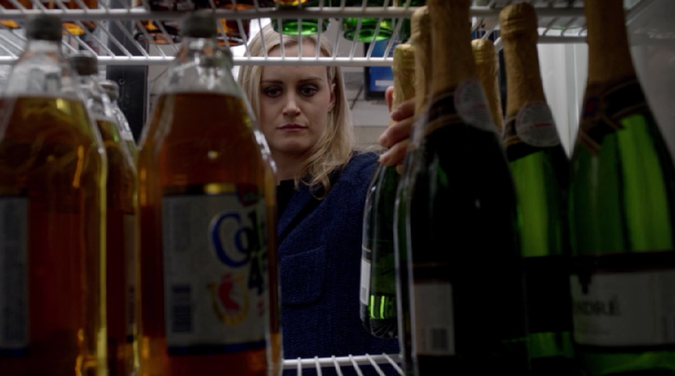
The premiere is the most we get of Piper until she starts a prison newsletter (Ep. 2.7, "Comic Sans") and a family crisis affords her an opportunity to be granted furlough in an episode that examines the change she's undergone behind bars (Ep. 2.9, "40 OZ. of Furlough") and how it's affected her relationships on the outside. She's not the same entitled princess she went in as but the show cleverly posits the theory that this may not be such a great thing. Now she's the one being judged as a failure and there's no turning back or reversing the clock. She's a convict and everyone couldn't be more disappointed, including her own ashamed parents and her jilted, opportunistic ex-fiancee Larry who continues to use her incarceration as a vehicle to further his journalistic career. A strong argument can be made that he's the most selfish character on the show.
This new Piper and Larry very far apart and a development with Larry only serves to separate them even more, and finally giving viewers full permission to hate a guy who's been on a slippery slope since last season. That so many can't stand Biggs in this role is only a credit to just how well he's playing it. Neurotic and disingenuous at every turn, any fans the character may have had vanish by the end of the season. Piper also vanishes for much of the rest of the season too, but that Schilling is still impressive enough to never make the character seem sidelined is noteworthy in itself. In a welcome change, the show's biggest moments involve everyone else.
It's the arrival of drug dealing sociopath Vee Parker (Lorraine Toussaint), foster mother to Taystee (Danielle Brooks) and former nemesis of Red (Kate Mulgrew) that shakes things up at Litchfield. It wouldn't be inaccurate to say she takes over the entire season, making the series considerably darker, dangerous and more unpredictable as a result. She's even at the center of three (!) flashbacks fleshing out her backstory, marking the only time in the show a major flashback player suddenly shows up in the present.
 |
| "Crazy Eyes" finds a mother figure in Vee |
How quickly Vee's able to exert power and control over all the inmates is terrifying, sucking them in like a mother figure before manipulating them to do her dirty work. The most vulnerable are those who don't have anyone, and since it's prison, that would be just about everyone. She runs the guilt trip over Taystee to bring her back into her fold and is even able to drag "Black Cindy" (Adrienne C. Moore) and Watson (Vicky Jeudy) along for the ride with empty promises and more deceit. She's evil, but also incredibly smart, which is a mix we're not used to seeing in this environment, giving her a definitive edge over everyone.
While the wedge Vee drives through Taystee's friendship with Poussey (Samira Wiley) is reprehensible enough, her absolute worst, most bottom of the barrel action is manipulating the mentally unstable "Crazy Eyes" (Uzo Abuda), who's willing to do just about anything to fit in and be loved. Vee casts such a large shadow over the season and Toussaint's work so quietly gripping that at points the series feels like it's channeling Oz or The Wire. And the intensity only keeps escalating to the level where you badly want to see this monster get hers, even if you know the show may suffer without her around. There's no way Toussaint isn't riding this chilling performance to an Emmy nomination next year, as she puts you on pins and needles waiting to see the depths her character sinks to next.
The long awaited backstory of "Crazy Eyes" is given time in Episode 2.3, "Hugs Can Be Deceiving" and it doesn't disappoint, depicting events in her childhood already powerfully hinted at in Uzo Aduba's performance. Always a lonely outcast ridiculed and mocked, the flashback provides an greater context to her current situation with Vee, as well as revealing some surprising details about the struggles her well-meaning parents faced raising her. But the strongest flashback comes in what's possibly the season's best episode (2.6, "You Also Have Pizza"), as we learn the recent history of Samira Wiley's Poussey.
 |
| Poussey gets some awful news in a gripping flashback |
Whereas an argument can be made even the most surprising flashbacks flesh out details already hinted about these women, everything about Poussey's is revelatory, completely changing our perception of the character. I didn't expect her to have the upbringing she did, get caught in the dilemma she was, and her situation elicit nearly this much empathy. It really stands out from the rest not only because of an extremely heated lesbian sex scene (maybe the first of the show's many that actually does feel necessary), but because of Wiley's heartbreaking performance, which insures she leaves this season one of the most beloved characters.
Another fan favorite, Red, struggles after the kitchen (and basically her whole prison identity) was taken from her by the Latinas last season. The return of Vee only causes more problems for her, and as we find out via flashbacks, their history is violent and complicated. New Jersey native Lorna Morello (Yael Stone) also gets one of this season's more revealing flashbacks, dispelling all myths that she's the most normal, well-adjusted inmate at Litchfield when we learn the details of exactly what she's in there for (Ep. 2.4, "A Whole Other Hole"). That this revelation hardly changes our opinion of Morello speaks to how likable Stone (now bumped from recurring to series regular) continues to make the character in the face of some really dark material.
Previously a background player, cancer patient Miss Rosa (Barabara Rosenblat) steps to the forefront as her history as a big time bank robber is unspooled as she currently receives treatment alongside a teen chemo patient in one of the more moving story arcs. At first, you wonder why the show's spending so much time on a bit player, until realizing: A) She's no longer a bit player B) It's a classic case of the writers knowing something we don't. The new face at Litchfield is hippieish inmate Brook Soso (Kimiko Glenn), who besides crying herself to sleep out of fear, not showering and generally annoying everyone, clumsily protests prison conditions with Sister Ingalls (Beth Fowler) in a storyline that dominates the back half of the season. It's clear she'll be around a while so it's a good bet her story will be explored further moving forward. That should be interesting considering that, of everyone, she seems the most out of place in a women's prison. She's practically the new Piper, only weaker and more irritating.
 |
| A low turnout for Healy's "Safe Place" support group. |
This season pulls back the curtain on prison politics amongst the administration, starting with Counselor Healy, who last season went from inmate advocate to sexist, homophobic pig. The more we learned about him, the less there was to like, but he kind of finds some form of redemption in these episodes, starting a prison support group and becoming an unlikely mentor to Pennsatuckey. After years of feeling beat down by the system (and his mail order bride at home) he finally starts taking baby steps toward making a difference for the prisoners and himself.
Similarly, Assistant Warden Joe Caputo (Nick Sandow), who after being portrayed as somewhat of a perverted creep, is revealed to actually care about these prisoners, even if his hands are tied by beaurocracy. They really start to explore his character, revealing personal details (like him moonlighting in a band or his ongoing crush on Officer Fischer) that cause us to look at him in a whole new light, as Sandow shines in a role that's expanded in both depth and screen time. But he's undermined at every turn by corrupt, arrogant Warden Natalie "Fig" Figueroa (Alysia Reiner) who's not only more concerned with the prison's reputation than the health and safety of its inmates, but running an embezzelment sheme in the midst of her husband's political bid.
Litchfield's biggest scandal continues as Officer Bennett (Matt McGorry) and pregnant inmate Daya (Dascha Polanco) attempt to implicate hated guard Pornstache (Pablo Schreiber) as the father of her baby. What's surprising is how far they get with it and the eventual outcome which highlights the price that comes with doing the "right thing," a theme repeated often this season. Thinking along these lines, it wouldn't be a bad idea to add flashbacks for the guards and administrators next season, developing them even more. Healy seems to be the best candidate for this, as his backstory could help shed light on how this formerly idealistic counselor transformed into a woman-hating curmudgeon with no friends or personal life.
 |
| Miss Rosa takes the wheel in the season finale |
Whereas last season's finale ended with a cliffhanger, this nearly feature film length one (Ep. 2.13, "We Have Manners, We're Polite") appears to wraps things up neatly in a bow for the time being. It's telling that that in the sensational final scene, Piper is nowhere to be found. It comes down to a battle of good and evil between the two characters most deserving of appearing in it, bringing their arcs full circle.
For a series not praised enough for its soundtrack selections, they save a couple of the best ones for this episode, including an out of left field use of Deep Blue Something's 1995 pop classic "Breakfast at Tiffany's and a note perfect incorporation of Blue Oyster Cult's "Don't Fear The Reaper." And I'm not ironically using the word "classic" for the former. It's no wonder many have misread its objective in that scene, choosing instead to take more cheap shots at a song that's too earnestly infectious and nostalgia-inducing to ever rag on. It makes perfect sense a character on this show would love it, as most of their musical tastes were left in the past when they entered Litchfield.
Superior in every way to its inaugural season, this one
manages to be much grittier and darker without losing any of the
entertainment value or warmth and humor that initially made it such a
success. And for those already sick of Piper and wanting the supporting
players spotlighted instead, 12 of these 13 episodes surpass those
expectations.When
OITNB first started few could have guessed it would be this insightful about the prison system and how often society can fail those who end up a part of it, whether they're inmates or administration. That story isn't exclusively Piper's. But when you watch the flashbacks of these characters with their current struggles, you realize it almost doesn't matter what crime put them there. Sometimes we see it, but oftentimes not. Most of the damage was done before that, making their eventual incarceration an inevitability. The series can easily go a few more seasons as long as there are still stories to tell, even if we might eventually have to find out just how difficult it'll be for them to adjust once they're out.


 Posts
Posts


