Showing posts with label Ewan McGregor. Show all posts

Thursday, June 30, 2022

Obi-Wan Kenobi

Director: Deborah Chow
Starring: Ewan McGregor, Rupert Friend, Sung Kang, Moses Ingram, Vivien Lyra Blair, Kumail Nanjiani, Hayden Christensen, James Earl Jones, Indira Varma, O'Shea Jackson Jr., Benny Safdie, Joel Edgerton, Bonnie Piesse, Simone Kessell, Flea, Jimmy Smits, Zach Braff, Maya Erskine, Ian McDiarmid, Grant Feely
Original Airdate: 2022
 

**The following review contains major 'Obi-Wan Kenobi' spoilers **

★★★ (out of ★★★★)

How much is too much? That's been the billion dollar question for Disney since their 2012 acquisition of Lucasfilm. Since then, we've seen an entire Star Wars sequel trilogy, a standalone Han Solo film, a much admired big screen A New Hope prequel and an almost equally beloved streaming series thought to have "saved" the franchise. From a commercial standpoint it was all worth it, regardless of how often they hit the creative bull's eye or the amount of vitriol the actor and directors involved seem to receive. But when churning out this much content, we know the real risk comes in trying to fill every story gap in the SW universe with a series or film, leading to potential oversaturation and backlash. In other words, they need to pick their spots.

As one of the few who feel Disney's done better than they've gotten credit for, there's no ignoring the reasons why The Mandalorian worked and The Book of Boba Fett spinoff underperformed until Grogu, Mando and Luke came in for the save. A legendary bit player, Boba's popularity and mystique always revolved around what we thought he could be, but Pedro Pasquel's Mando already had the badass market cornered, leaving a surprisingly restrained Boba without much to do in his own series despite a strong Temuera Morrison performance. So now with viewers still questioning the sustainability of that series comes Obi-Wan Kenobi, which carries an even greater risk.  

Taking place ten years after Revenge of the Sith but a decade prior to A New Hope, Disney's playing with fire in the most literal sense. They've brought out the big guns in not just the title character (whom Ewan McGregor is reprising for the first time since 2005), but Anakin/Darth Vader, Luke and Leia at an unseen stage in their journeys. What's done here can affect perceptions of what happened before and what we know eventually comes. "Continuity" is a loaded word, and as no fan of the prequels, it's come as a bit of a surprise how much nostalgia and affection now suddenly exists for those who grew up on them. The best news is that the series revolves entirely around the long-term aftermath of Episode III, arguably that trilogy's finest hour. 

The show walks a tight rope in trying to get into Kenobi's headspace during this era while not disrupting or diminishing what's already been established, helping make this experiment fascinating to watch unfold. With occasionally scattershot storytelling, some of the six episodes are a mixed bag, but as the finale proves, it gets the big things right and feels like Star Wars, successfully revisiting the complicated bond between Obi-Wan and his former pupil while adding a few wrinkles to their feud.

With more focus, McGregor surpasses what he did in the prequels and channels some of what Alec Guinness brought to A New Hope, as we slowly inch closer to that period. And Disney continues its streak of nailing Vader, actually building on what made him such a terrifying, intimidating force in all his previous incarnations while exploring his fractured psyche. After a somewhat shaky start, it mostly comes together, ensuring that any potential rewatch of the interconnecting big screen sagas could play a lot differently now.

Ten years since Obi-Wan Kenobi (McGregor) survived Order 66 and left a horribly burned and disfigured Anakin Skywalker for dead on Mustafar, he's living as "Ben" on Tatooine, having seemingly abandoned his Jedi ways. Still consumed with guilt over Anakin's turn to the dark side, he resides alone in a cave, working a meat packing job and watching over young Luke Skywalker (Grant Feely) from afar. But Darth Vader's shadow looms large, as vengeful Third Sister and Jedi-hunting Inquisitor, Reva (Moses Ingram) becomes obsessed with finding Kenobi and delivering him to master Vader. 

Reva's ruthless ambition draws the ire of the Grand Inquisitor (Rupert Friend) and Fifth Brother (Sung Kang), who find her rash methods intolerable, even as she sets the ultimate trap, kidnapping 10-year-old Leia Organa (Vivien Lyra Blair) in an effort to lure Kenobi. Unaware of her biological father's identity or his relationship to Obi-Wan, the feisty and brave young Princess of Alderaan must learn to trust this mysterious, bearded Jedi as he prepares for his inevitable confrontation with former Padawan turned Sith Lord, Vader. Haunted and emotionally paralyzed, it's a showdown a weakened Kenobi never expected to occur, and one he may not have the strength to endure.

There were a lot of assumptions made going into these handful of episodes directed by The Mandalorian's Deborah Chow. Would Obi-Wan take a backseat to Reva in his own story? Would his interactions with young Leia and Luke contradict or negatively impact their presumed introduction to him in A New Hope? Would Vader be depicted as the same brutal, intimidating killing machine from the original trilogy? How much, if any, Anakin is left within him? And maybe the most important question is how this all affects Kenobi's fateful encounter with Vader ten years later, which we thought was their only confrontation after Mustafar. 

Kenobi's defeated state of mind during this period makes sense, and while you run the risk of unwanted comparisons to Luke's much maligned exile in The Last Jedi, it is an entirely unrelated situation. It's impossible to believe Obi-Wan wouldn't still be heavily traumatized after leaving Anakin to die, or so he thought, with the big twist being that that he knew nothing of his ex-friend's survival until now. This, along with the revelation that A New Hope didn't mark his first encounter with Luke and Leia, opens up a new can of worms. Though it's not technically cheating from a narrative standpoint, accusations of this being revisionist history will probably persist. But unlike George Lucas' superficially pointless Special Edition changes, this isn't physically altering the actual films, but instead shifting the conversations around them.

The Inquisitors are kind of one-dimensional (especially Sung Kang's grunting and grouchy Fifth Brother), and while Reva 's the notable exception, it even takes her character a little while to get going. Since her rather obvious backstory is easily telegraphed by viewers right away, it becomes a matter of filling in the details and fleshing out why she's so obsessed with bringing Kenobi to Vader at any cost. Having to play everything in a single note until the very end puts Moses Ingram in a tough spot, but she's clearly our main gateway to the two former friends coming face-to-face again. Obviously, we're far more invested in Kenobi, Vader, Leia, and Luke, so it's easy to trust that Chow will eventually get us there.  

As young Leia, the series-stealing Vivien Lyra Blair is sassy and headstrong, while bringing just the right amount of sarcastic precociousness to make it entirely believable she'll emerge as the version Carrie Fisher later portrays. Since we know she'll contact Obi-Wan for help in A New Hope, the writers seem especially careful in developing this temporary bond between the two, borne out of necessity, but primed to be revisited years down the road. 

Kenobi's knowledge of Leia's bloodline and past with Anakin and Padme creates a compelling dynamic while her kidnapping(s) gives the child a closer, harsher look at the Empire that contradicts what she's been fed from adopted parents Senator Bail (Jimmy Smits) and Queen Breha (Simone Kessell). With trusty droid L0-LA in her pocket, little Leia's a handful, as she should be, but Lyra Blair's performance opposite McGregor is perfect in how it plants the seeds for how valuable her rebellious spirit will be. There are also some strong supporting performances from Indira Varma as an Imperial Officer helping Kenobi and Leia, Kumail Nanjiani as a Jedi-posing con artist and O' Shea Jackson Jr. as another Jedi aiding in their escape. But there's only one thing anyone will be talking about after the sixth episode: Kenobi and Vader.  

Voiced again (with some technological enhancement) by the legendary James Earl Jones and getting a physical assist from the returning Hayden Christensen under the armor, this Vader is very much in line with what who we saw in the original trilogy and Rogue One. While not quite at that level of confident brutality yet, this succeeds at showing he's well on his way. Choking villagers and breaking necks left and right on the hunt for Kenobi, it's fitting that Vader's reunion with his mentor should end in Obi-Wan being burned and nearly put in the same state he left Anakin on Mustafar. Obi-Wan's realization that his best friend is still alive as this monster, yet not, becomes nearly impossible for him to reconcile.

Kenobi's guilt makes him incapable of killing Vader no matter how much damage him surviving will cause. This is at the crux of the series, as the finale sees Kenobi recognizing that he doesn't "need" to end Vader, but rather abandon any delusions he had in returning him to the light side of the force. Only Luke can, because unlike Kenobi, he'll see his father and Vader as one, eventually proving Padme's dying declaration that there's "still good in him" to be true. But for all of this to happen and Vader to vanquish Emperor Palpatine (Ian McDiarmid) in Return of the Jedi, Obi-Wan has to let him go. But not until after the epic lightsaber duel that the season's been building toward.

With Chow paying homage to a familiar scene Rebels scene, half of Vader's mask is cut open as his face straddles between lightness and dark, electronically slipping in and out of James Earl Jones and Hayden Christensen's voices. Considering the speculation surrounding just how much the latter would be used with Anakin now fully suited up, a prequel era flashback (minus de-aging effects), hallucinations and that final emotional reveal give us more Hayden than expected. And even his biggest detractors would have to admit his handling of Anakin's turn in Revenge of the Sith was the actor's strongest showing. He delivers again here, being utilized in a way that makes sense, likely satisfying a vast majority of fans that go beyond your usual prequel defenders.  

The question of when Anakin truly becomes Vader will always be mired in debate, with many contending it's when he first dons the suit at the end of Episode III. But this series adds a huge footnote, hinting perhaps that his full evolution into the Sith Lord happened in stages, with this season-closing battle with Kenobi marking a final important step. While Vader takes credit for killing Anakin, strangely absolving his former master and enabling him to let go of the guilt he's carried, it's far from a benevolent gesture. The admission officially confirms that Anakin's gone, with the armored suit now sustaining Vader as much psychologically as physically.  

The creation of this entire Vader persona reveals itself as the only way Anakin can live with guilt of what he did to Padme and the destruction he's caused. His confession that he wished Obi-Wan finished the job on Mustafar is sadly the truth on many levels. After getting demolished in this final duel, Vader crawls away defeated, but lives to fight another day stronger than before, having finally rid himself of this Kenobi obsession. He now has bigger plans on his mind than one mere Jedi, as Palpatine manipulatively reminds him. Having John Williams' iconic Imperial March blasting over the soundtrack in the last episode couldn't be more appropriate. Obi-Wan is no longer an Anakin problem since Anakin now ceases to exist. This is the rise of Darth Vader.

Reva turns out to be both more and less than we thought. As expected, she was secretly plotting against Vader for the Order 66 slaughter but at least the writers were smart enough to keep him more than a few steps ahead. The only thing we may have underestimated was the full range of her anger, not only toward him, but Kenobi, whom she holds almost equally responsible. Reva's sneak attack on Vader had as much chance of succeeding as her being able to move on from the past trauma, but she takes it to a whole new level in targeting young Luke. It's surprisingly satisfying seeing Uncle Owen (Joel Edgerton) and Aunt Beru (Bonnie Piesse) in action combat mode, adding another layer to characters who desperately needed to be remembered as more than the charred skeletons in A New Hope. 

With this comes confirmation of how much the Lars family cared for Luke, while also providing some background on Owen's overprotectiveness. His irritation toward Kenobi for wanting to be a part of Luke's life starts to thaw, indicating that the seasoned Jedi Master is closer to the fully actualized Obi-Wan who later trains Luke, as McGregor's performance expertly conveys it. But for now, we'll settle for a brief tease (along with a "Hello There"), as the wide-eyed youngster greets him with the same look of reverence and astonishment Leia does in their emotional goodbye on Alderaan. 

Finally at peace able to see and communicate with the Force Ghost of Qui-Gon (Liam Neeson), you have to wonder what could possibly be left for a second season, assuming Disney's interested in going there. Attempting to extract even more from Kenobi and Vader probably isn't advisable, but that never stopped them before. And then there's the curious creative decision to leave a now fully redeemed and very injured Reva alive as a dangling story thread, which seems perplexing given how much she knows. 

While still a notch or two below the Mandalorian, Obi-Wan Kenobi keeps with the constantly shifting tone and aesthetic of Star Wars, revealing just enough to keep us intrigued with the past and future of the saga without stepping on too many toes. As an intersecting point between the prequel and original trilogies, it hits the sweet spot, with its best portions recalling a lot of what was done right in Rogue One. If winning over every warring, polarized faction of Star Wars fandom was always an impossibility, this at least does an admirable job in crafting a new adventure worth taking.                

Sunday, June 23, 2013

The Impossible


Director: J.A. Bayona
Starring: Naomi Watts, Ewan McGregor, Tom Holland, Samuel Joshlin, Oakley Pendercast
Running Time: 113 min.
Rating: R

★★★ (out of ★★★★) 

If you could concoct the perfect formula for a harrowing survival film, the results still probably wouldn't come close to matching what you see in The Impossible, which is based on one family's true story of fighting to survive the 2004 Indian Ocean Tsunami. That I use the word "formula" to describe what's actually a dramatization of real events may seem odd, but it's also entirely accurate. It's both the film's biggest strength and weakness because as we're sucked into the human emotion of the story and its unrelenting depiction of a natural disaster, it's hard not to think our strings are being pulled just a little bit. As a result, it at times feels most like an ultimately uplifting disaster movie elevated by a pair of great performances and a frighteningly realistic depiction of a true event. And while adapting from real-life is often tricky, it's especially challenging in this case since knowing how it all turns out does strip the film of a certain degree of suspense. So Spanish director J.A. Bayona piles on the emotion. And it works. Still, I can't help but think the three things everyone will be talking about when it's over are the tsunami scene itself, the graphic injuries and two jaw-dropping performances, one of which was rightfully nominated. But that turns out to be enough.  

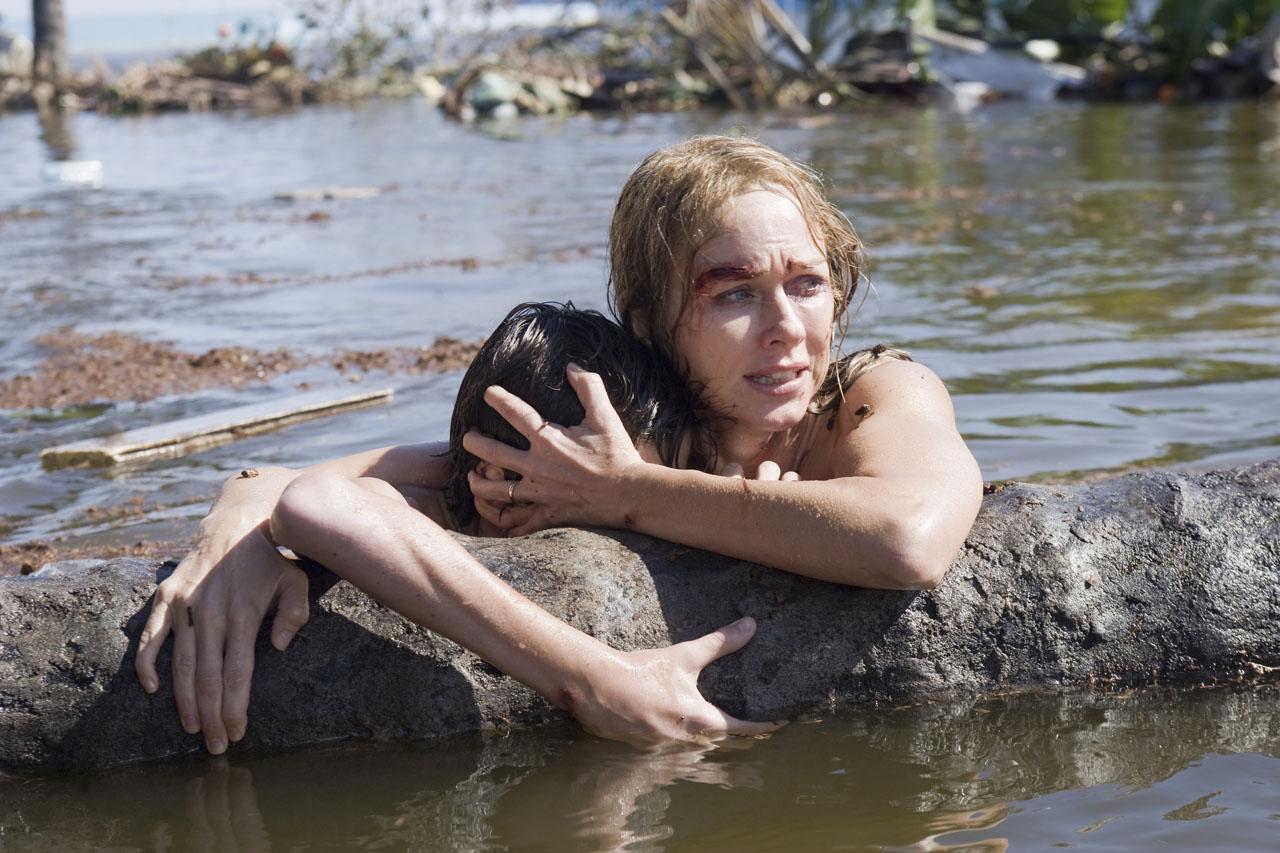
Other than a brief argument on the plane about whether the alarm at home was left on at home, not much time is spent getting to know English physician Maria Bennett (Naomi Watts), her husband, Henry (Ewan McGregor) and their sons, 12 year-old Lucas (Tom Holland), 7 year-old Tomas (Samuel Joslin) and 5 year-old Simon (Oakley Pendergast). But we know enough. They're a seemingly normal, well adjusted family spending their 2004 Christmas vacation in Khao Lak, Thailand. That it could be anyone is exactly the point, and exactly the truth. Maria and Lucas are swept away and separated from the others when the tsunami hits, first struggling to make it to higher ground before searching for medical assistance for a severely injured Maria. Still back at what's left of the hotel, Henry and the little boys must stick together, until he decides to search for his missing wife and son. With Maria fighting for her life and Lucas quickly losing hope, the prospect of a family reunion gets bleaker with each passing day.

The most engaging section of the film is surprisingly not the first forty minutes to an hour when the tsunami hits, but everything that follows it, where we get to see the aftermath of the devastation and everyone scrambling to survive and locate their loved ones. Aside from the unforgettable opening of Clint Eastwood's 2010 film Hereafter, there's never really been a cinematic dramatization chronicling the true events surrounding the Indian Ocean Tsunami, so what we see is revelatory, especially in terms of the type of medical care available and how the locals handle such a crisis. There's a shot of the landscape, or what's left of it, after the storm that's absolutely surreal, calling to mind the wreckage and casualties attached to more recent disasters like Hurricane Sandy. This is that, but times ten.

The biggest surprise is how anyone survives something like this, but Watts is heartbreakingly believable in showing us it's possible in what more closely resembles a physically and emotionally exhausting ordeal than an actual acting performance. Maria has just about one of the most gruesome, graphic injuries you can have while remaining alive, and while I never doubted the character would make it, Bayona has to be commended for not shying away from the gore and showing us everything, as difficult as it is to sometimes watch.  That the character's a doctor herself has much less relevance than you'd imagine, as all the victims seem to be at the mercy of little else but circumstance. And the circumstances are dire. The best scenes occur in the makeshift medical facility where survivors try to locate family members amidst the chaos and a frantic, but strong-willed Lucas attempts to help. As good as powerful as Watts is, young Tom Holland is essentially the beating heart of the movie, holding the majority of screen time while Maria is confined to a hospital bed.

That the story isn't as strong or emotionally involving when shifting focus to the dad and the rest of the boys isn't so much a fault as it is a natural progression of events. As the panicked father and husband, McGregor's solid (great even), but his scenes just don't have the visceral pull of Maria and Lucas'. It's at this point that the movie's last act becomes a foregone conclusion and I started looking at my watch, waiting for the inevitable reunion. If you're a screenwriter, what do you do if the true story you're adapting for a Hollywood feature happens to have a Hollywood ending anyway? I guess in this case, if you're screenwriter Sergio Sanchez, you just wouldn't change it because audiences have to go home happy, but there's still this unavoidable feeling of predictability that hangs over the proceedings and hampers the emotional release felt at the end. Still, it's really well done and if I hadn't been told it was a true story going in, there's probably little chance I'd believe it

The biggest controversy might stem from the casting of white movie stars Watts and McGregor as the "Bennetts," and while it's clearly yet another factually inaccurate Hollywood "whitewashing," the practice is sadly nothing new. As far as allegations that the local Asian's experiences were marginalized into supporting roles, if not flat-out ignored, I don't know what to say other than that's mostly true. But this particular story  being told about this family on screen works, even if it may not be the one everyone wants, or is nearly as universal as the advertising would lead you to believe. Fortunately, films aren't (and shouldn't) be judged on those criteria so it's a moot point from where I sit, hardly hampering my appreciation of the work. The Impossible is ultimately a film about the triumph of the human spirit under the worst possible circumstances, and while feel-good elements and predictability wobbly co-exist alongside a horrifying natural disaster, everything eventually adds up to a well-crafted and frequently inspiring viewing experience.                          

Wednesday, February 1, 2012

Haywire


Director: Steven Soderbergh
Starring: Gina Carano, Michael Fassbender, Ewan McGregor, Bill Paxton, Channing Tatum, Antonio Banderas, Michael Douglas, Michael Angarano
Running Time: 93 min.
Rating: R

★★★ (out of ★★★★)

Steven Soderbergh's Haywire is both more and less than it seems. On one hand, it's an action movie. But on the other, it sort of isn't. It's a conventional spy story that's presented in an unconventional manner, exceeding and subverting expectations while strangely at the same time barely managing to meet them. A second viewing is probably in order, but with only one to go on it's safe to say it distinguishes itself from most other mainstream action movies not so much in terms of plot, but style. It feels like a not-so-distant art house cousin of Drive or The American in the sense that it'll turn off viewers expecting a fast-paced, non-stop mindless action extravaganza (its D+ CinemaScore proves it) and reward those looking for something a little different. But the real story coming out of it is the arrival of a legitimate female action star capable of believably kicking ass. Recently, we've had Angelina Jolie in Salt and Zoe Saldana in Columbiana corner the action market in terms of charisma and willingness to get their hands dirty, but in terms of pure physicality and presence, former MMA fighter and first-time actress Gina Carano puts them both to shame. And her casting that proves just how ingenious Soderbergh is in tailoring his movies to the strengths of his stars.

The film opens in a diner in upstate New York, where we meet Mallory Kane (Carano), a contracted covert operations agent with a private firm employed by the government for missions they'd rather wash their hands of. She sits with a man named Aaron (Channing Tatum) who she thrillingly kicks the crap out of over coffee, breaking his arm and escaping with the help of passing customer Scott (Michael Angarano), who has no idea what he's just gotten himself into to. In flashback, we're told the story of how she was sent by her boss and ex-boyfriend Kenneth (Ewan McGregor) to do a job in Dublin where she'd pose as the wife of a British agent named Paul (Michael Fassbender). But it's all a set-up, putting in motion a chain of events that cause her to go on the run, alternating between being the hunter and the hunted, all while trying to uncover who betrayed her and why.

Initially, the narrative framing device is confusing because it takes a bit to differentiate what's happening in the present from the flashback scenes as the title cards indicate shifts in location (Dublin, Barcelona and New York for anyone keeping track) rather than time. It's worth noting how the picture looks since it doesn't quite visually resemble any other recent action movie. The color looks washed out and the image dim and out of focus, no doubt a deliberate choice by Soderbergh who often works as his own cinematographer in his films and wanted to distinguish this from the slick blockbusters we've grown accustomed to. Once we catch up the plot is pretty basic so most of the thrills come from the style and execution. Otherwise deliberately paced, when the action scenes do arrive they're brutally realistic, especially a hotel room confrontation between Carano and Fassbender that has to rank amongst the most exciting intergender onscreen fights in recent memory. Most of the rest of the action is saved for the final half hour, but it's worth the wait.

What Soderbergh does for Carano is almost exactly what he did for adult film star Sasha Grey in The Girlfriend Experience in taking an untrained actress and placing them in a carefully structured project that plays up their strengths while covering their weaknesses. On a lesser scale it's comparable with what Darren Aronofsky did for Natalie Portman in Black Swan by not only hiding her weaknesses as actress, but actually incorporating them into her character and transforming them into strengths. Soderbergh's careful not to give Carano long monologues and dialogue-heavy scenes that would expose her inexperience, instead playing up her intensity and presence. There's no need for tons of emotion in a movie like this and he's wise to not let Carano attempt to supply any. She's a bad-ass. Plain and simple. But in instances she's called upon to do more in "acting" scenes opposite her seasoned co-stars, she still holds her own, proving she can only improve as a performer moving forward. Pretty and powerful, it's not out of the question she could emerge as a the female equivalent of Jason Statham if she attaches herself to projects that make the best use of her talents. And unlike other action heroines, the ex-American Gladiator doesn't at all look like she can be snapped like a twig.

Soderbergh cleverly plugs in his star-heavy cast in utility supporting roles with Ewan McGregor relishing the rare opportunity to play a sleaze and Michael Douglas slipping into familiar authority figure mode as a powerful government agent. Even Channing Tatum fares really well as Mallory's ex-lover and potential adversary. But the real standout is Fassbender, who in his brief, but extremely memorable turn as a suave, dangerous British agent gives just cause to terminate Daniel Craig's 007 contract after his next outing. As perfect a fit as Carano would seem to be for Wonder Woman, Fassbender is for James Bond. And since the films cover much of the same territory it also wouldn't be off base to claim that the stuck-in-a-rut Bond franchise could stand to look and feel more like this.      

If there's anything holding the film back from greatness it's Lem Dobbs' script, which taken altogether seems very conventional and ordinary despite its sometimes convoluted presentation. It's a simple story told in a complicated way that succeeds in making you fell like you're watching something of considerable substance. Without Soderbergh's stylistic choices and such a believable, intimidating lead it wouldn't work at the level it does. But those elements are there and it does work because of them, making me think that once you have the story all sorted out on the first viewing, everything else will likely improve on subsequent ones. Besides marking the arrival of an exciting new action actress, it also provides a reason to re-examine just how talented a filmmaker Soderbergh is. Unlike any of his peers, he's been able to successfully alternate between low budget indie projects and mainstream blockbusters. Now with Haywire, he's proven himself capable of combining both.

Tuesday, September 21, 2010

The Ghost Writer

Director: Roman Polanski
Starring: Ewan McGregor, Pierce Brosnan, Olivia Williams, Kim Cattrall, Tom Wilkinson, Timothy Hutton, Jim Belushi, Eli Wallach, Robert Pugh
Running Time: 128 min.
Rating: PG-13

★★ 1/2 (out of ★★★★)

The Ghost Writer
is Roman Polanski's Shutter Island, minus the style and even much of the substance. That it was released in theaters at exactly the same time as Scorsese's film is just too ironic to ignore when you consider this really could pass as the poor man's version of it. Both are mystery/suspense thrillers that feature its protagonist trapped on island with untrustworthy and possibly dangerous people and attempt to shock with a surprise "twist ending." They're also both likely to enjoy an inflated reputation because of their directors, although this apparently more so. It just a sprinkling of thrills, mystery and suspense as it meanders for over two hours to a forgone conclusion that isn't worth the time invested from viewers. Maybe that wouldn't be so frustrating if portions of it weren't intelligently written and it contained a few strong performances, as well as some strange casting decisions.

The most surprising thing about the picture isn't the ending (one of the dumbest final scenes all year) but the fact that Polanski wrote and directed it, although he does do as good a job as humanly possible hiding just how ordinary it all is. When you have a film that's all build-up you have to be prepared to really deliver beyond the conventional. The constricting script prevents that, instead serving up another one of those reasonably entertaining government conspiracy cover-ups. There are aspects to admire, but unfortunately none have anything to do with the actual plot.

Ewan McGregor is the unnamed title character hired to ghost write the memoirs of Ex-British Prime Minister Adam Lang (Pierce Brosnan), after the previous man hired for the job mysteriously washed up dead on the beach near Lang's Massachusetts estate. It was ruled a suicide but Ghost (as our protagonist refers to himself) has his suspicions and for good reason since Lang is embroiled in a bitter public feud with former political ally Richard Rycart (Robert Pugh), who's accusing him of war crimes. While that alone would make great material for an autobiography, Lange's personal life is also falling apart as he's been cheating on his cold but loyal wife, Ruth (Olivia Williams) with his assistant, Amelia (Kim Cattrall in an AWFUL performance). With the deadline quickly approaching, Ghost's goal moves from finishing the book to just simply surviving as he inches closer to the truth.

Leisurely paced but never boring, the film takes its time getting to where it needs to go by slowly dropping clues along the way as we discover along with Ghost key pieces of information that are clearly meant to lead to something big and revelatory about Lang. It's fun imagining just how much could have been done with the premise of a ghost writer getting in over his head and there are moments in the second hour when it seems the screenplay will take full advantage of that, but ultimately it just takes the easy way out. Lang is never really an interesting character and is given problems (both personal and political) that literally seem cribbed from the evening news and put to film. There's no effort to make his back story interesting in the slightest to the point where he's a walking political cliche, right down to his extra-marital affair. Brosnan, with his smooth and easygoing charm, is perfect as Lang (many probably imagine him as an ex-British Prime Minister anyway) so this isn't a big stretch for him, but he still brings as much as possible to a limited role. McGregor is a reliable, though not extraordinary actor, so he's in his comfort zone also as an ordinary guy thrust into dangerous circumstances.

The true standout is Olivia Williams who brings a lot to the table as Lang's wronged wife, Ruth than anyone could have reasonably expected from what's usually a thankless part. She suggests an entire history with her performance that's far more compelling than anything we're given, subtly conveying emotional pain and vulnerability that was above and beyond the call of duty for a story this pedestrian. It's a nomination-worthy turn, if only the movie containing it didn't seem so inconsequential. Making almost as much impact in a single scene is the always spot-on Tom Wilkinson whose, brief but memorable appearance as a mysterious college friend of Lang's teases a deeper, more interesting film that never arrives. A bald James Belushi, Timothy Hutton, the former "Mr. Freeze" Eli Wallach round up the curiously mainstream cast, dragged down only by Kim Cattrall, who besides struggling with a British accent, stops every scene she's in dead in its tracks with her capital A "Acting". Why cast a well-known American actress who has to attempt an accent when the role is a glorified cameo and contributes nothing to the story anyway?

With the exception of Alexandre Desplat's appropriately moody and suspenseful score, from a technical standpoint the movie is nothing special, with a generic look and feel that recalls the kind of cable thriller you might land on during a lazy Sunday afternoon. Say what you want about Shutter Island but it it had visual style and atmosphere to spare and Scorsese knew exactly what what he wanted that film to be. Polanski can't seem to decide whether he's making a cheesy B-level potboiler or an intelligent political commentary. As a result, it's neither and I don't even know what to make of him employing a plot point that involves Lang being unable to leave the country because of his crimes. The less said the better I suppose. That and a conclusion that plays as an all-out farce makes me wonder if he was even taking this seriously at all. It's not that the ending was at all predictable or saw it coming, just that I didn't care by the time we got there. The Ghost Writer is a well-meaning but generic thriller, regardless of who directed it, but admittedly a bit more disappointing when you consider who did. It works best for those who set their expectations low and have made it a point to avoid every other film of its type that's out there.