Tuesday, December 29, 2020

The Best (and Worst) Movie Posters of 2020

After begrudgingly accepting that far fewer films would be released in 2020 than anticipated, accompanying it was the bitter reality that there also wouldn't be as many movie posters to admire, or even dislike. With the state of movies on shaky ground all year, the industry was basically forced to adjust its business model on the fly, pushing releases out a year or longer regardless of the advertising. With no concrete idea as to how much it affected the studios' marketing strategies for these titles, we do know it made an impact, causing more films to fall through the cracks than ever before. On the flip side, many were able to reach an untapped audience, giving them attention they may not have otherwise gotten.

This wild year actually made my 15th edition of The Best (and Worst) Movie Posters list one of the more interesting to compile, even while it wasn't the easiest, fraught with more hunting and pecking than usual to make sure nothing was missed. Of course, the big story, already building for years but breaking through in a big way in 2020, was the rise of home viewing, with a Netflix release nabbing top poster honors for the first time. Otherwise, the rules haven't changed all that much.

Complicated or busy just aren't hallmarks of an effective movie poster design. Layouts like that might get a lot of attention, but they're hardly ever capable of holding it. And when you don't see a poster here that was universally praised everywhere for its ingenuity, there's a good chance that's the reason.With only the occasional exception, a poster's main purpose is to cleanly, crisply convey in a single image the idea of the film, giving up just enough, but not too much about what we're in for. 

I'll always contend there's a direct, symbiotic relationship between a movie's marketing and quality. There have been too many posters for great pictures cracking the top 10 each year to think otherwise. And an intriguing enough one-sheet on its own can always make a difference in eventually getting me in front of the screen to watch the film, no matter how little known it may be (case in point--2019's winner, Starfish). While 2020's champ isn't a title in need of such attention, that doesn't make its original, eye-catching poster any less impressive. 

In a distinction suddenly more important than usual this go around, a poster would need to be released during the 2020 calendar year to qualify, regardless of whether the film was. So while any official design that dropped between January 1st and December 31st is eligible, it did lead to one unusual situation where two entirely different posters for the same movie appeared on both last year's and this year's lists. As usual, only "official" movie posters are eligible, as shaky as that definition has become. The runners-up, along with the always popular compilation of the worst, are alphabetically listed below. All images via Impawards.com. Just click to enlarge.


The Best...


10. She Dies Tomorrow

Maybe not the most upbeat title for a horror film, but you don't exactly go into a psychological horror thriller about a woman sure she will perish the next day looking for laughs and giggles. By these standards, Legion Creative Group's design for Amy Seimetz's She Dies Tomorrow is terrifyingly effective and not entirely unfamilar to the genre, as either melting or distorted faces in a state of distress have gotten very popular of late. This unquestionably stands out from the pack, not only because actress Kate Lyn Sheil's haunted face (s) is perfect for this kind of presentation, but those colors. The reds, blues, purples and pinks are literally exploding all over the page in a swirling, mesmerizing pattern that seems to be taking us down the rabbit hole. The red blood effect around her mouth really take it to another level, as does the bright, perfectly centered title. "Your Deepest Fear Is Spreading" is too good a tag line to keep that hidden though, making reference to the parasitic, contagious nature of her condition. Well done.


9. Funny Face

Now this is unique. And no, it's not a poster for that other Funny Face movie, but Tim Sutton's low-budget revenge crime drama about a young man (played by Cosmo Jarvis) who adopts a masked persona after his grandparents' home is destroyed. As you can probably tell, this mask is certifiably creepy, only made more jarring by the manner it's inserted into this one-sheet, presenting a darkly violent social allegory (it's supposedly not a horror film) as a spiritual and religious experience. Consider us disturbed. Great use of the fire engine red against the black background, and the title and credit placement on the top left is a disorienting attention grabber, freeing up all that negative space. Up close, it looks even better, with a weathered, distressed quality that only adds to its appeal. It's surprising this poster hasn't been talked about more, flying so far under the radar I couldn't even uncover the designer.


8. Moving in 2008

Talk about negative space. Taking a cue from that legendary Downhill Racer one-sheet, there's something special about the audacity of this Sister Hyde design, especially considering how the film's subject matter deals with a 2008 recession, "catalyzed by unemployment, personal crisis, and illness." So yeah, not timely at all. Even if brown isn't the most pleasing color, you could argue that's exactly the point considering this isn't an image intended to convey comfort or tranquility. Love the bold title treatment here, both in look and placement, with that "everything just happened so fast" tagline and its microscopic size contrasting nicely with the vast sandy background. Barely keeping her head above ground, those uncertain, sorrowful eyes trail that moving van as it makes it way across the page, delivering a great visual metaphor for an entire life being packed up and driven away.


7. Minor Premise (Both Versions)


More melting and distorted faces, this time in two entirely different one-sheets for Minor Premise, which may not be living up to its title since the plot seems to be anything but. According to imdb, "a reclusive neuroscientist attempting to surpass his father's legacy becomes entangled in his own experiment, pitting ten fragments of his consciousness against each other" in co-writer/director Eric Schultz's sci-fi thriller. It's great when you can read a logline and then literally see the visual manifestation of it in poster form. That top one, designed by Jump Cut and Brandon Schaefer, has the fractured fragments portion of this pretty well covered with that blurry, overlapping imagery conveying a genuine sense of unease and dread. But the face-melting design could be also considered another close relative of last year's aforementioned Daniel Isn't Real design, right down to the color scheme. And you have to love it when a movie's consistently branded across the board, in this case with that slanted "M" in the title treatment.     


6. The Atlantic City Story

What a throwback this is. The watercolor-style design looks like it came straight out the 1970's, causing anyone to do a double take on The Atlantic City Story's release date. But yes, it did come out in 2020 and is about an unhappily married woman who runs away to the title city where she meets a young gambler. There's just something so aesthetically pleasing about this one-sheet that harkens back to a simpler time in movie advertising when photoshopped heads of actors weren't used to sell smaller adult-skewing romantic dramas. Supposedly, this is more of a muted character study, which only makes this off kilter idea work that much better, with great faded use of pinks and purples, a magnificent illustration and some more excellent use of negative space. But it's that retro title font that seals the deal, perfectly complimenting the tone and style of the poster. Haven't seen the film, but will now knowing there's at least a small chance it could live up to the high bar set here.     


5. Promising Young Woman

Yes, yes, and yes. This is how you make an impact with a single, striking image.Writer/director Emerald Fennell's polarizing #MeToo revenge thriller Promising Young Woman dives head first into the controversy surrounding it with a teaser poster that's basically the movie incarnate There's another one-sheet for this below in the runners-up section that's visually clever, but this feels more wholly original and literally dripping with with the toxic venom "promised" from the film's protagonist /antagonist played by Carey Mulligan, who has unusually long arms if this image is to believed. Proportions notwithstanding, it doesn't get much better than her sprawled across hot pink dripping lips, with a wicked tagline ("Take Her Home And Take Your Chances.") and an 80's inspired title font.  Memorable and provocative, it's everything a poster for this kind of movie should be, with an image that already feels iconic.  


4. Color Out Of Space

Just when you thought we couldn't get a crazier Nic Cage poster for director Richard Stanley's 2019 sci-fi adaptation of Color Out of Space, Tom Hodge arrives with a one-sheet that breaks that aforementioned rule that all great one-sheets must be clean, simple and uncomplicated. If ever an exception is to be made, you'd figure it would be for a Cage movie since those adjectives would be among the last to describe the actor's career. While I still prefer last year's trippier, psychedelic design, this one that dropped at the very start of 2020 is a worthy companion that's very Mondo-like in its style, further cementing that company's influence on more mainstream releases, if this could be considered that. Despite seeing chaotically illustrated posters more than ever, this does feel a level above, and definitely in line with Hodge's other work. It's also giving off some major Stranger Things vibes, trading out that series' red color scheme for a very memorable purple.       

3. The Nest

Coming soon to NBC: A Sunday Night Special Feature Presentation of Sean Durkin's The Nest, which is sure to be the top ratings grabber of 1987. Brought to you with limited commercial interruption by   Chevrolet ("The Heartbeat of America") and Pepsi ("The Choice of a New Generation") American entrepreneur Rory O' Hara (Jude Law) and his wife Alison's (Carrie Coon) seemingly happy lives take a sinister turn after relocating their family to an English country manor in this heart-stopping thriller. Okay, it's one thing to pay homage with a retro poster design, but it's legitimately scary how P+A's design exactly resembles a poster or advertisement that would appear in TV Guide in the 1980's, the decade during which the film's events take place. 

This nails everything, from the layout to the title treatment to the washed out color, as well as the lost art of correctly lining up the actors with their names. Even the cracked mirror visual (often overused and poorly presented in other poster designs) works incredibly well, done just subtly enough to throw you off balance while conveying the film's theme of shattered identity. Who cares if Law's reflection looks more like a young Bryan Cranston's or that Coon is completely unrecognizable with longer hair? Staring at this poster out of context I'd believe it's from thirty years go, deserving of prime gallery space right next to this classic,VHS-inspired design for Frost/Nixon. Now there's a double feature.           
 

2. Stardust (U.K. and U.S. Versions)


Ground control to Major Tom. It may not have generated a lot of buzz, but a David Bowie biopic came out in 2020 called Stardust, starring Johnny Flynn as the young singer making his first visit to the U.S. in 1971, inspiring the creation of his Ziggy Stardust persona. That hook alone should solidify the film as a must-see, but these teaser posters, which couldn't be further apart conceptually, are equally effective at conveying the spirit of the artist as he approached his peak. As a fan of stark simplicity and logos, that U.K.teaser is the embodiment of Bowie with the instantly recognizable lightning bolt design seen on his Aladdin Sane album cover. 

In a uniquely advantageous position to use music iconography to sell their movie, it's hard to imagine anything that would have looked or felt as right. Taking a totally different route, P+A strikes again with that wild design directly above, highlighting the outer space theme to maximum effect. The bright pinkish red against the beige and black background really compliments the bold title treatment and teal credits, but the real focal point is that astronaut floating into the abyss. Perfect.


1. Mank

That the winning one-sheet for David Fincher's Mank doesn't even look like anything resembling a traditional movie poster is one of its greatest assets. Much like the film, it's outside the box and requires some effort to absorb all the wonderfully hidden details. Depicting what's arguably the best scene in the entire picture when a drunk Herman J. Mankiewicz crashes a costume party at Hearst's mansion and pitches his Citizen Kane idea right to the publishing kingpin's face. Obviously, the black and white sketch-style illustration is completely unique, superbly capturing the look and atmosphere of this memorable sequence while still managing to go even a few steps further. 

Not only playing with depth in the same way Kane does with some of its most famous shots, it absoutely nails the looks of horror and concern on the faces of these guests, most of whom are artistically rendered as almost exaggerated caricatures of themselves, like something out of The Twilight Zone. That's especially true for our title character, who's never appeared as maniacal or frightening in the film as he does raising his glass like a court jester on this one-sheet, showcasing the enormity of his montrous outburst. Of everyone, he looks the least like the actor playing him, baring virtually no resemblance to Gary Oldman, which had to be intentional. Larger than life and cartoonized, this may as well serve as a dark teaser for Citizen Kane: The Animated Series. And it works. 

With her unmistakably unique look, Amanda Seyfried has rarely been properly captured in illustrative form until now, clad in Marion Davies' unforgettable circus costume from that party. The title typography serves as another neat Kane homage and I like how the credits are arranged almost like a menu or drink list. That makes sense not only considering the protagonist's demons, but because the poster looks like it could be hanging in a pub or tavern in the 1940's. Just imagine this thing on the wall lit up. After waiting fifteen years for my favorite director to have a movie that's poster is the best of the year, this definitely didn't disappoint. 


Runners-Up...


...And The Worst

There are a lot of different poster ideas going on in this single one-sheet for Blindfire and all of them are equally ill-conceived. For all we know, this low-budget cop thriller could actually be of decent quality (Geraghty and Lenz are good actors who deserve a hit), but its 3.9 IMDB score strongly suggests otherwise, as does this visual monstrosity, a mish mash of 90's action cliches gone bad. It's hard not to despise the positioning of its generic title, the tagline and the black and white color scheme, which might go further than being a poor design choice, veering into tastlessness once you read the description of its racially-charged plot. 


These had to be included as a pair since, let's face it, they're the same exact poster with a different title and actors. And judging from the poor photoshopping, they may even be the same actors. Boss Level's title treatment utilizes a font so ugly the marketing department should be forced to write a formal letter of apology to all 80's video game packaging designers. And those pixels and explosions. What a mess. In a rare event, the U.S. version of this poster, while entirely similar and awful, does clean things up a little. Can understand Gibson doing this, but Watts? The one-sheet for Clover (with a shamrock target for the "O"--ugh) doesn't even bother crediting the actors at all. They're all probably grateful. Get ready for a lot of people pointing guns and some big explosions. Let's hope the effects look nothing like whatever that is going on behind Ron Perlman. 


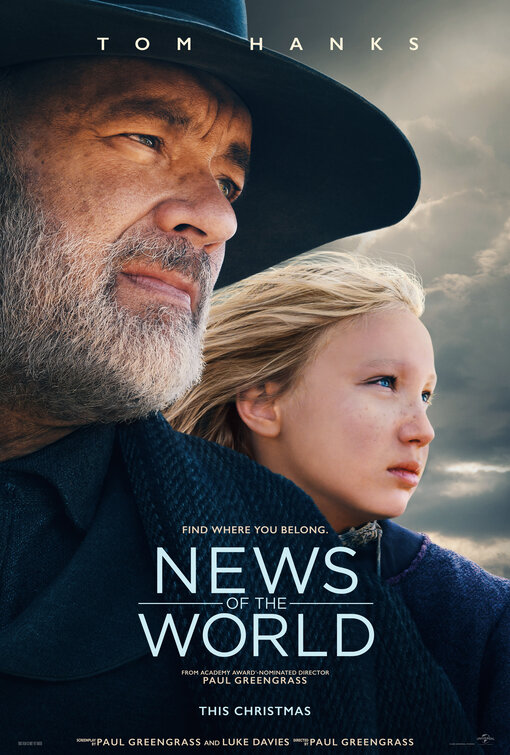
Much like Nic Cage did at one point, Tom Hanks is emerging as a fixture on this list. But it's not because the movies are bad or cheaply made that we so frequently see his visage plastered on some of the worst posters of the year. It's studio laziness. "We've got Hanks. That's it. Just airbrush and photoshop the hell out of it and we're good. Oh, and make his head as big as possible." If forced to pick, version 2 is worse if only because of that horribly rendered ship, but the long and wordy tagline remains equally unreadable on both. By all means, Hanks should be the centerpiece of the movie's promotional efforts. Just not this clumsily. And it's been a noticeable problem for a while now.


Kristen Stewart, Mackenzie Davis, Dan Levy, Aubrey Plaza and Alison Brie are all in a movie together and THIS is the poster for it. Making this approach even more inexcusable, it's actually a really enjoyable film. Outside of a potential sequel, there are no second chances for Hulu as they blew it here, its poor promotional material luckily saved by the actual movie. This poster somehow makes them all interchangeable with a generic Christmas snapshot gimmick that buries everyone's star power. It's quite an accomplishment considering each of them have enough rabid fans to fully populate a new country. They should have instead gone with the illustrated retro greeting card design from the film's opening credits. A far safer route was taken, likely rationalized by the argument that the cast sells itself.  


The chief offense of Netflix's teaser for Ron Howard's Hillbilly Elegy isn't how drab and uninteresting it makes the film look by simply showing an overhead shot of trees and a car, but the needless amount of text overwhelming it. It's almost as if the marketing department knew they didn't have anything so opted to stretch out the credits to hide the lack of any compelling image or message. Kind of like that time in school when you wrote as big as possible on really small paper so the book report would look longer.
 

You just know Fred Goldman and Denise Brown are on the phone with their lawyers right now. And they should be, based on this deplorable one-sheet that finally answers the question of what really happened to...Nick Stahl and Mena Suvari's careers. Aesthetically, the poster isn't any worse than your average VOD stinker, but boy is that tag line scraping the bottom of the barrel, even for a brazenly exploitative thriller "inspired" by true events. Of course, those events seems to involve some cross country serial killer (with the "bloody glove?!") who looks to have either framed or helped O.J., a likely co-producer of this project. The one-sheet's just trashy enough to make The Haunting of Sharon Tate seem like a touching tribute, causing more speculation about the film's legality than its advertising. Assuming there's even a line anymore, it's just been crossed.
Next.

Isn't he holding the phone backwards? Wait, is someone else holding the phone? Whose hand is that? And wasn't this supposed to be a selfie?  I hope they all don't think they're actually in the shot because that's just not possible. So confusing. From a strictly technical standpoint, let's at least hope the film fares better than this.


If anyone still feels brave enough to go for a dip in this water after seeing the look on Luke Wilson's face, let me know.

Monday, December 21, 2020

The Mandalorian (Season 2)

Creator: Jon Favreau
Starring: Pedro Pascal, Giancarlo Esposito, Gina Carano, Carl Weathers, Ming-Na Wen, Temuera Morrison, Katee Sackhoff, Rosario Dawson, Mark Hamill,Timothy Olyphant, Bill Burr, Mercedes Varnado
Original Airdate: 2020

**The Following Review Contains Major Spoilers For The Second Season of 'The Mandalorian' **

★★★★ (out of ★★★★)

While not among those disappointed by the frequently maligned big screen Star Wars sequels, it's still hard to deny Disney was always walking a thin line with them, regardless of the result. It's tricky balancing the needs of a notoriously cranky adult fanbase desperate for their nostalgia fix with the desires of kids and more casual watchers clammoring for fresh content. What we got was a battle of wills, wherein an unspoken compromise had to be reached where there could be certain callbacks and a reliance on classic, iconic characters just so long as it was in service of newer faces and more forward-looking stories. 

Even if Disney fared much better than they've been credited for in their efforts, it can't be ignored that neither contingent of fans walked away completely fulfilled. If returning the franchise to its heyday of the late 70's and early 80's by reigniting the feelings that sorrounded the original trilogy was already a tall order, using it to effectively lay the groundwork for Star Wars' future would be close to impossible.

So how did creator Jon Favreau, with his only mildly anticipated Disney Plus series The Mandalorian, manage to do again for this franchise what J.J. Abrams, Rian Johnson and even George Lucas himself at one point couldn't? You have to think he first probably recognized just how burnt out even the saga's biggest supporters had become after an inundation of big screen content that left everyone wanting a break. If all the sequels and spin-offs were universally beloved that would be one thing, but with wildly mixed notices, something had to change to justify this besides receipts or it wouldn't last.

The best received spin-off, 2016's Rogue One, worked because it felt as if it had temporarily released us from the shackles of this mythology, demonstrating that there's plenty of fringe universe yet to be tapped (through novelizations, games and the animated series), featuring fresh characters and missions unencumbered by baggage or expectations. And to balance things out, the film also marked until now what had been Disney's most successful use of a classic character with Vader's sensational corridor rampage, showcasing him at the peak of his powers in way that completely complimented the plot. 

When the pilot episode of The Mandalorian premiered in November of last year, Favreau revealed the magic ingredient."The Child" (AKA "Baby Yoda") In wisely withholding the reveal in all the show's pre-release promotional advertising, fans were reminded what it's like to be surprised, as lone Mandalorian Bounty Hunter Din Djarin (Pedro Pascal) looks inside the floating carriage to discover the "asset" he's been hired to protect exceeded our highest expectations, causing hearts to grow about ten sizes that day. And that was it. 

Taking place five years after the events of Return of the Jedi, the series debuted as the perfect blend of familiar and new, using the remnants of a beloved but somewhat still mysterious character in Yoda to posit the theory that there could be others like him. And it's accompanied by a lot of possibilities when one of them is a scared, occasionally mischievous, but adorable alien baby of about 50 years-old. Even while partially digitized, the creation harkens a return to the realistic, practical effects and puppetry that defined the original films, while also revisiting one of the series' most prevalent themes of parentage and fatherhood on an even deeper level.

As just the starting point for an initial season that Favreau and producer Dave Filoni spared no creative expense on, Mando begrudgingly protects the Child, who has yet to master his Jedi Force powers, even as his gift could become a curse if exploited by others. That's the intention of a dangerous Moff Gideon (Giancarlo Esposito) who's attempting to restore order to the Galaxy after the fall of the Empire, eyeing this force-wielding baby as his path to do it. 

If the show had been mildly, but unfairly criticized for anything during its first season, it was for settling into a procedural format during which Mando, with Child in tow, would embark on missions of the week with or for various characters. These weekly adventures were frequently transactional, featuring an exchange wherein Mando would reluctantly work with someone who couldn't be completely trusted in order to gain something he needs. 

Some of these forty-minute weekly missions were undeniably better than others, but the world and character building that took place in all of them proved essential in getting to the Season 2 end game, retroactively resulting in an even stronger set of episodes than its inaugural season. And this format comes as a relief for returning the franchise to its roots as a space Western while temporarily shelving that "big picture" blueprint, supressing concerns about how everything and everyone will fit into some larger plan fans will complain about. If a weight was lifted by first making the show good and then taking it from there, it's still kind of astounding all the small and even considerably more substantial details Favreau gets right. Whether that's a soaring Ludwig Göransson score that's up there with anything John Williams has previously done, or the storyboard artwork incorporated into the closing credits.  

What was clear late in the first season, but comes into even sharper focus here, is that Mando's strict, unwavering commitment to upholding a rigid code is cracking as his attachment to the Child grows, now seeking out a Jedi in hopes of returning the little one to his home, wherever that may be. The story heads in the direction we assumed it probably would and while an eventual showdown with Moff Gideon and his Darksaber surely looms, the path there is accompanied by more thrills than expected, along with some unpredictable bumps along the road. After enlisting the help of Mandelorian warriors Bo-Katan (Katee Sackoff, reprising her Star Wars: Clone Wars role) and Koska Reeves (Mercedes "Sasha Banks" Varnado) to locate this Jedi, Mando briefly reunites with Cara Dune (Gina Carano) and Greef Karga (Carl Weathers) before heading forest planet of Corvus in the series' most revealing episode, the Filoni-directed "Chapter 13: The Jedi."

In introducing Ahsoka Tano (a pefectly cast Rosario Dawson) into the live action canon, a bomb is dropped in terms of the Child's background that actually gives at least one of the prequels a reason for existing, while revealing his given name. That Favreau manages to escape disappointing everyone with this reveal is noteworthy since it couldn't have been easy with expectations running so feverishly high. Grogu. Short, simple and sounds very Star Wars-like. That's all you can ask for. It fits him. Supposedly, Favreau already knew it very early on in the first season and it just became a matter of when to pull the trigger, a decision made that much harder when Baby Yoda became a worldwide sensation. But the Band-Aid had to be ripped off at some point and this sure went down a lot easier than anticipated. 

Ahsoka can't train Grogu since he's just too attached to Mando and she senses fear in him, the first hint that his egg eating, cookie stealing shenanigans may not have been as cute and innocent as it appeared, suggesting the possibility we may have another little Anakin on our hands, tempted by the dark side of the Force. But all hope isn't lost since she knows of a Jedi who can train him. Maybe. And with that comes the season's big mystery. Who is it? The possibilities should seem limited, yet are kind of endless when you start running through all the candidates. 

Thanks to Ahsoka, Mando's comes into possesion of a Beskar steel spear we know he'll need, and against whom. The indelible image of a meditative Grogu sorrounded by an energy field reaching out for a connection at Tython's seeing stone eventually makes him a sitting duck for Gideon's Dark Troopers, giant black Transformer-looking droids that make the human-occupied Stormtroopers look like Ewoks. While the undeniable tragedy of the Robert Rodriguez-directed "Chapter 14: The Tragedy" is Grogu's kidnapping, the destruction of the Razor Crest ship at the hands of Gideon could easily compete with it given it's well-earned status as the franchise's most identifiable transport since the Millenium Falcon. 

As far as surprises go, the return of Fennec Shand (Ming-Na Wen) after being left for dead in the desert in last seaon's "Chapter 5: The Gunslinger" an expected, but welcome, especially considering who's with her. In another great example of how Favreau just "gets it," he knows that bringing back Boba Fett (Temuera Morrison) after his sarlacc demise in Return of the Jedi is a no-brainer, because, why not?  If you could bother explaining away Emperor Palpatine's resurrection, this is almost downright logical. And why wouldn't you take the opportunity to do something more substantial with a seemingly minor character who became a major fan favorite by standing silently in a cool uniform for two movies? Now, with a detailed backstory and sense of importance that isn't merely speculative, we get what we always wanted.

Slightly older and more weathered, Boba demands his father and grandfather's armor back from an unwilling Mando, who got it from Mos Pelgo Marshal Cobb Vanth (Timothy Olyphant) in "Chapter 9: The Marshal." And so another one of the series' famous trades leads to Jabba's former bounty hunter once again donning the helmet and armor to help Mando kick some Stormtrooper ass. After being programmed for disappointment for so long, it's almost surreal to see such a bold creative choice pay off this well, both in concept and execution. And it's unlikely anyone could claim they ever expected to see Boba Fett take a tornado DDT from Sasha Banks.

Arriving well-prepared with the help of Boba, Fennec, Dune, Bo-Katan and Koska to save Grogu ("Chapter 16: The Rescue"), Mando's  showdown with Moff Gideon carries an anticipation unmatched by any recent Star Wars battle, largely because of the stakes. Darksaber vs. Beskar Spear. It has to be acknowledged that Giancarlo Esposito's performance during this episode represents his best work of the series, alternating between pure, unadulterated evil and a maniacal glee, gloating at knowing a key detail concerning the power of the Darksaber that will undoubtedly carry into next season.

With an entire fleet of Dark Troopers for the group to fight off, the arrival of that sole X-Wing carries an overwhelming sense of importance the second we see it pull up, signifying the arrival of our mystery Jedi. And it's him. They actually did it. 

Before we even see the hood, the green saber or the glove, we know it's Luke Skywalker because, of course, it had to be. In trying to come up with all the reasons this couldn't work, we ignored the one obvious explanation why it does. Yoda trained Luke and now student must become master and train Grogu, who deserves the most important character in the Star Wars canon clearing his schedule. The kid's earned it.  

Anyone other than Luke would feel second-rate, and however anyone feels about his treatment in The Last Jedi, it takes only a minute or two before it's erased from our minds as he effortlessly slays Dark Troopers left and right in a chills-inducing sequence that brilliantly calls back to his father's aforementioned Rogue One appearance. With his hand on the monitor, Grogu looks on in wonder, as we once did, transfixed with the same sense of childlike amazement experienced during the original trilogy, but rarely felt again since. Until now.

"Open the door." And with those words speculation ends which incarnation of Luke we'd see and, more importantly, how. With Hamill now too old to play the character five years post-ROTJ, would Favreau recast the role with another actor (Sebastian Stan was speculated), or instead go the equally risky route of relying on the same de-aging technology that was used for Carrie Fisher's Princess Leia and Peter Cushing's Grand Moff Tarkin in Rogue One, and briefly for Luke and Leia in The Rise of Skywalker flashbacks? 

In going for the CG option, we're reminded there's still a long way to go before it can be reliably used without issues, but the digitized Hamill is a massive improvement over the the Fisher effort, and about equal to Cushing. But the more noteworthy achievement might be that we hardly care, with the narrative context overshadowing any perceived technological deficiencies. So, even if George Lucas would probably endorse the decision (for all the wrong reasons), this does stand as one of its better uses.

Luke's appearance only enhances the central storyline of Mando having to temporarily part with his son. And, yes, it definitely feels okay to refer to Grogu as his child because he's been that for a while,  and even more so during the course of this season. One of the toughest sells of the show was always going to be having it revolve around a masked protagonist, limiting any actor who would have to convey everything through voice and body language. Not only has Pedro Pascal debunked those fears, he's completely conveyed the bond Mando and Grogu share through this helmet, adjusting accordingly on the very few occasions it's come off and we've seen his face. 

The first removal of Mando's helmet occurred in the Season 1 finale ("Chapter 8: The Redemption") with the IG-11 droid taking it off to treat his injuries, and again this season in "Chapter 15: The Believer" when he and Mayfeld (Bill Burr) go undercover to obtain the coordinates to Gideon's cruiser and a facial scan forces him to remove it. Of course, this is a big deal because if the first time was a necessity, this one's a choice, or rather a sacrifice he makes for the Child. 

At the start of the series we couldn't imagine the inflexible, unemotional Mando doing something like that, but through great storytelling and acting on Pascal's part, we've reached the point where he's now voluntarily removing the helmet so his son can touch his face and say goodbye, if just temporarily. To call it the most powerful moment in this season or even the series as a whole feels like selling it short, as it's tough to recall the franchise coming close to a peak like this within the past thirty years. It also serves a great parallel to Luke removing the helmet off of his injured father at the end of Return of the Jedi. 

Of course any resistance from Grogu to go with Luke is tempered by not just by Mando's blessing, but the presence of R2-D2, joined at the hip with Luke, just as we remembered him at the end of ROTJ. These are how classic characters can be used to service the stories of newer ones without getting it in the way. From a timeline perspective it also perfectly fits, as Luke's exact whereabouts shortly after the conclusion of Episode VI were wide open and largely unestablished.

The big question now is what exactly happens with the future of the series. Will Grogu go on hiatus while he trains with Luke or could we actually see it? The latter seems far-fetched given technological hurdles, so it could be a situation where we have a flash-forward to whenever that's completed, posing another huge creative risk in having to age the Child. But there can be too much of a good thing and overexposing an insanely successful character can be just as damaging, which is why Favreau and Filoni deserve tons of credit for bringing this season's story arc to its logical conclusion, regardless of the creative challenges it'll probably present. 

In successfully shifting the series from becoming the Baby Yoda show into something far more encompassing, there's a good chance Favreau and Filoni are prepared to handle what's next. The show's still titled The Mandalorian so it's a good bet it will continue to follow Mando's adventures and Grogu will return in due time. Aside from the fact he's printing too much money not too, he basically rivals both peak Luke and Yoda in importance at this point.

As the the The Book of Boba Fett post-credit sequence further solidifies, there's going to be an onslaught of new shows, spin-offs and features arriving over the next few years if the franchise can withstand it this time. But even as someone who thinks Disney's done a fantastic job since acquiring the property from Lucas, I'm skeptical of the Marvel-like direction they're taking it, bombarding fans with cross-over content that could be very hit-or-miss. 

If there's a silver lining in this approach, it's that the franchise now has a much stronger foundation on which to build thanks to this series. It may seem hyperbolic to credit one person with "saving" an entire franchise, but that's undeniably what Jon Favreau did with The Mandalorian, giving credence to those suggestions that he and Grogu deserve their own statue beside Walt and Mickey at Disney theme parks. And now we can at least feel safer knowing that any future Star Wars project going through the pipeline will likely have his input or involvement.

Thursday, December 17, 2020

Mank

Director: David Fincher
Starring: Gary Oldman, Amanda Seyfried, Lily Collins, Arliss Howard, Tom Pelphrey, Sam Troughton, Ferdinand Kingsley, Tuppence Middleton, Tom Burke, Joseph Cross, Jamie McShane, Toby Leonard Monika Gossmann, Charles Dance, Bill Nye
Running Time: 131 min.
Rating: R 

★★★ ½ (out of ★★★★)

During David Fincher's Mank, drunk, bedridden screenwriter Herman J. Mankiewicz is told by a producer that the assigned screenplay he's writing for young, hotshot director Orson Welles is "too complicated," confusingly jumping back and forth through time and careening out of control as he approaches an impossible deadline. If the script was just a structural mess maybe that could be fixed, but the bigger complaint is its inaccessibility, sure to drive away mainstream audiences. That working draft, titled "American," would eventually evolve into Citizen Kane, and everything turned out pretty well. Or did they?  Definitely for the film, but not so much for those directly involved. Listening to the criticisms of Mankiewicz's script, you can't help but think that without careful planning it could also apply to the movie that's just been made about it. But we also know this is a director who's nothing if not deliberate.

In adapting his late father Jack Fincher's script to the screen, David Fincher makes a noticeable effort to go beyond taking us on a time travel trip through Hollywood's golden age to deliver an experience that looks and feels as if it could have been released during that era. It attempts to appeal to both diehards who will triple-check its accuracy and more casual viewers unaware of the difference, but respectful of the craftsmanship. And there's plenty to admire in that department, with Fincher expertly channeling this period of filmmaking through dialogue, editing, sound and cinematography that invoke some of Kane's more famous moments.  

The deeper we're submerged into this monochromatic world of shattered dreams, lit cigarettes and broken wine bottles, the clearer it becomes that more bubbles under the surface of Mank as it masquerades as a straight biopic of an immensely successful failure. Movies about movies not only need drama that's worth our attention, but also a unique hook that grabs hold. The creative and personal bloodshed over Citizen Kane should be enough, but in the hands of a master like Fincher, it ends up instead being a thorough psychological dissection of the man who wrote it.  

It's 1940 when Herman J. "Mank" Mankiewicz (Gary Oldman) gets a phone call from Orson Welles (Tom Burke) while recuperating in Victorville, California from a broken leg sustained in a recent car accident. Given complete creative freedom from RKO Pictures for his next project, the upstart Welles recruits an injured Mank to write the screenplay, centering around a wealthy, but morally bankrupt main character who shares more than just passing similarities with newspaper publishing magnate William Randolph Hearst (Charles Dance). 

With Mank dictating the script from bed, his secretary Rita Alexander (Lily Collins) notices this, as well as other parallels to studio executives and people he knew while he and his younger brother, Joseph (Tom Pelphrey) worked at MGM in the 1930's under Louis B. Mayer (Arliss Howard). Flashing back, we see how Mank's friendship with Hearst's lover and beneficiary, actress Marion Davies (Amanda Seyfried) grows, as the writer ingratiates himself and reserved wife Sara (Tuppence Middleton) into the Hollywood elite, entertaining fellow party goers at Hearst's San Simeon estate with his rambunctious personality and outspoken political views. We also see how his alcoholism derailed a successful career, with Welles arriving just in time to offer Mank shot at redemption and a big pay day, if he's still up for it. And doesn't mind forfeiting the credit. 

Those entering this expecting the cold calculation usually associated with Fincher may be surprised to find out that the film's somewhat dark, but not really depressing, moving at a spry, energetic pace that cuts back-and-forth between Mank's latest undertaking and key events in his studio career, most of which are littered with memorable characters and deadpan humor. The familiar device of utilizing screenplay-formatted title cards to indicate the year and location should seem almost too on-the-nose , but it fits exceptionally well here in framing a story about the writer of the most famous non-linear film ever made. 

Considering the feud between Welles and Mankiewicz over credit was historically bitter by even Hollywood standards, this instead mostly focuses on the people and experiences that plant the seeds in Mank to eventually start his greatest creation. In most of his brief appearances, Welles is presented as this deep-voiced, shadowy figure on the other end of the phone, channeling his concerns and demands about the project  through actor-producer John Houseman (Sam Troughton). Because we've had more than enough takes on this side of the Kane fallout before (see 1999's RKO 281 with Liev Schreiber as Welles), this isn't a flaw so much as a choice, and Burke's portrayal of him is sufficient enough given the limited screen time.

The backbone of the film lays in its flashbacks, transporting us into a wild, sepia-tinged world of wealthy, eccentric wheelers and dealers like MGM chief Mayer, who's delightfully played by Arliss Howard as the king of carnival barking studio con-men. He and producer Irving Thalberg (Ferdinand Kingley) tolerate and even like Mank to an extent, until it becomes apparent his best days have passed, and his drunken outbursts threaten the studio's cozy arrangement with Hearst. His eventual script will threaten it more. 

As Hearst, British actor Charles Dance gives the enigmatic publisher the treatment most probably expected would be expected for Welles, conveying a towering but curious presence that in only a few scenes me ets the complicated expectations that drew Mankiewicz and the young, meglomaniacal director to his story, however true or slanderous it ended up being. Mank was 42 when he wrote Kane, and while Oldman is noticeably older, it hardly matters since nearly everyone in this era looked a good fifteen to twenty years past their actual age anyway. Compound that with the fact that Mank was already drowning in the bottle for decades and you could argue the 62 year-old might actually seem too young for the role, especially considering the script's emphasis on him being so far past his prime. 

Anyone who loves that great sub-genre of movies about writers will find a lot to appreciate in Oldman's performance, which severely deviates from the usual trope of introverted writers getting lost inside their own heads. That very well may have been the case if Mank wasn't a self-destructive trainwreck, but he's undeniably the life of the party. And knows it. Two such highfalutin Hearst parties are at the centerpiece of the picture, with the the first memorably deteriorating into a political debate about author and socialist gubernatorial candidate Upton Sinclair (briefly played by Bill Nye the Science Guy). Mank also drunkenly crashes a second one a few years later, leading to an embarrassing display where he basically pitches the Kane story to Hearst's face. 

Self-deprecating enough to be extremely likable, though not entirely oblivious to the damage he leaves in his path, it's hard not to respect the nuance Oldman bring to a real-life figure many know little about aside from his famous writing credit. And some may not even be aware of that since Welles, as director, will always be most closely associated with Kane's success. Keeping Mank in check is his secretary, Lily Collins' Rita, a young woman undeterred by her boss' bluster, or crankiness, steering him on course whether he wants to be or not. Collins leaves a sizable mark, holding together the portion of the film that most centers on his actual writing of the script in between beverages.  

Movie star and Hearst companion Marion Davies is played by an enchanting Amanda Seyfried, who's unquestionably the best thing in this, stealing every scene, nearly all of which are opposite Oldman.  From the moment she appears, Seyfried subverts all expectations of how we'd expect this well known and unfairly maligned celebrity figure to be portrayed. Witty and observant right out of the gate, she plays Davies as a force of nature justifiably tired of being overlooked and underestimated by an "old boys club" that will only ever see her as a ditzy blonde actress. 

Almost instantly on the same wavelength, what's so special and engaging about Mank and Marion's friendship is that it seems real and not put on, breaking that tired cinematic rule that there always has to be romantic strings attached. There are none here and the movie's better for it, regardless of what did or didn't happen in reality. With her expressive eyes and unmistakable facial features Seyfried really looks and talks this part of a classic old Hollywood starlet, nailing a certain rapid-fire style of speech and mannerism that seems pulled out right out of the 30's or 40's. She also gets off one of the film's best lines when trying to convince Mank not to go ahead with a project so obviously taking jabs at her relationship with Hearst. The reasoning behind the objection isn't what you'd think, but perfectly in line with the fair, pragmatic outlook this character demonstrates throughout. 

While it wouldn't exactly be fair to classify this as geared entirely at a niche audience, an argument can be made that Mank isn't the kind of picture that would be considered a huge thrill ride by most, even as some of the best efforts often aren't. But despite the irony of its protagonist having actually won an Academy Award, it definitely isn't calculated enough to be criticized as Oscar bait, mainly because Fincher's incapable of pandering to anyone. For fans of this period and setting there's a lot to revel in with the story of this man's professional and emotional downfall racing by at a almost a breakneck pace, before he's afforded a kind of redemption that ultimately comes too late for him.  

Mankiewicz's standing as a forgotten figure of cinematic history has only increased since this project was first supposed to go in front of the camera for Fincher in the late '90's so its release now feels especially fortuitous. And while any film set in Hollywood during this time would have to address the political backdrop, it holds more relevance now than it otherwise would, made all the more potent by discovering how little has changed beyond the nastiness of the discourse. 

Perceptions have also evolved about the contemporary utilization of black and white photography, as it's been justifiably re-embraced since skepticism surrounded silent throwback The Artist's Best Picture win a decade ago. Those suspecting potential gimmickry should know this looks great and represents one of the better uses of this format, reserved for a story where it feels more like a requirement than a creative choice on Fincher's part. So not only could the timing not be any better for Mank, the movie world seems to have caught up, proving it to be more than worth the wait. 

Thursday, December 10, 2020

Happiest Season


Director: Clea DuVall
Starring: Kristen Stewart, Mackenzie Davis, Alison Brie, Aubrey Plaza, Dan Levy, Mary Holland, Victor Garber, Mary Steenburgen, Ana Gasteyer, Jake McDorman, Sarayu Blue, Timothy Simons, Lauren Lapkus
Running Time: 102 min.
Rating: PG-13 

★★★ (out of ★★★★) 

Going strictly by appearances, Hulu's original holiday feature, Happiest Season, would seem to be the fluffiest of romantic comedies, going down fairly easily while providing little in the way of sustaining value. But what's most surprising about director/co-writer Clea DuVall's semi-autobiographical effort is how in taking what could have easily been a one-joke premise stretched very thin, it actively exposes itself as a smart human drama.With its fair share of laughs sandwiched in between some cringy moments, it tackles a scenario you'd figure happens a lot, though not as deliberately kooky as we see here. How such a dream team of a cast was assembled for this starts to become less of a question the longer it runs, with the material conveying a certain level of self-awareness we're unsure it possesses at the start.

It's easy to initially be taken aback by a premise that takes elements that are questionably funny on paper and blends them together to make a point in a way that is. And it cleverly does so with good writing and worthwhile characters, enabling us to laugh without guilt at how terribly most of them behave. Snickering, eye-rolling and face palms are more common than laugh-out loud moments, but it just keeps picking up steam. And then there's that cast, comprised of fan favorites few expected to be sharing screen time together, much less in a Christmas comedy that appropriately showcases all of their strengths.

Lesbian couple Abby Holland (Kristen Stewart) and Harper Caldwell (Mackenzie Davis) have been dating almost a year when Harper invites her to spend the holidays with her family in their hometown. Still harboring a dislike for Christmas stemming from her parents' deaths, Abby reluctantly agrees to the trip, even planning a marriage proposal on Christmas morning. Unfortunately, Harper failed to clue her in on the detail that she not only hasn't told her image-conscious family about their relationship, but hasn't come out to her parents. 

At Harper's insistence, Abby pretends to be her straight roommate, at least until her father Ted's (Victor Garber) mayoral campaign is over and the holidays pass. But they'll also have to pull one over on Harper's perfectionist mother, Tipper (Mary Steenburgen), eccentric sister Jane (co-writer Mary Holland) and uppity older sister Sloane (Alison Brie). If that's not already an extremely uncomfortable situation, Abby must also contend with the surprise returns of Harper's high school exes Connor (Jake McDorman) and Riley (Aubrey Plaza). Relying on best friend John (Dan Levy) for emotional support, Abby's doubtful she and Harper's relationship can survive this visit, unless the latter decides to tell her family the truth.

This has all the makings of a dumb screwball farce, and while some of that's definitely present, what stands out most is just how terribly the protagonist is treated early on. Abby takes a lot of abuse from Harper and her family, to the point where you really start to question what the movie's up to or how could it possibly land in a place that's comedically satisfying given the assumptions we're left to make about these people. Aside from being labeled an "orphan" (in an admittedly funny bit), framed for shoplifting and facing other humiliating indignities for going along with her girlfriend's charade, Abby's sidelined as Harper spends most of this time with her ex-boyfriend.  

The Caldwells are so hung up on their public image that the characters threaten to veer into outright parody, if not for Garber and Steenburgen's game performances preventing the portrayals from going off the deep end. And that's a very good thing considering it's tough to name a more discomforting set-up right now than wealthy, conservative parents potentially shunning their adult gay daughter. But by honestly owning that premise rather than backing away from it with the low-brow humor expected from such a set-up, we're invested. DuVall and Holland's script is actually interested in the "why?" attached to this idea and from that spawns most of the picture's biggest laughs.          

Stewart seems so much more comfortable and relaxed on screen lately that it's hard to even remember the time when "awkward" was the most popular adjective the media ascribed to her acting style and entire persona. Here, she's actually called upon to deliberately channel that quality in a situation where she's playing the aggrieved party, unintentionally victimized by her girlfriend's inability to break free from her parents' shackles. Stewart has a lot to do, but she's more than up for it, and has a great screen partner in Mackenzie Davis, with their chemistry together providing all the explanation necessary as to why her character's willing to put up with this. 

Davis, who had "future star" written all over when she played rebellious computer programmer Cameron Howe on AMC's criminally underrated Halt and Catch Fire, now gets a somewhat larger platform to impress. Despite some big screen starts and stops since, watching her in this only reaffirms the possibility of her really breaking through is still very much on the table. Harper's treatment of Abby is basically borderline-awful, but Davis still finds a way to find truth in the character, subtly conveying that most of her behavior stems from an almost understandable level of fear and insecurity given the dysfunctional family environment in which she was raised. That they've gone so far out of their way to appear perfectly functional seems to be at the root of Harper's issues, with us rooting for her to literally come out from under them before Abby becomes another romantic casualty. 

Aubrey Plaza fans have good reason to celebrate her smallish, but pivotal role as Harper's ex Riley, as her cool, sarcastic wit is used to maximum effect in a surprisingly compelling sub-plot with Abby that doesn't exactly play out as you'd expect. Anyone checking this out for the actress alone won't be dissappointed as she casually comes in and hits all her marks in that distinctive Aubrey Plaza way, making everything weirder and better. 

While it's also great to see Alison Brie back playing elitist snobs since few do it better, recent Schitt's Creek Emmy winner Dan Levy is cast exactly as you'd hope as Abby's practical and brutally honest friend John, giving Plaza some legitimate competition in the sarcasm department. His part only increases in entertainment value the more immersed he finds himself in this crazy situation, which delightfully flies even further off the rails in the last act. 

If the very release of this has garnered praise for being the rare mainstream Hollywood romantic comedy centered around a same sex couple featuring major stars, DuVall sort of flips that script by incorporating that long-standing institutional prejudice into the story itself in the form of these wealthy, perfectionist parents and adult children too obsessed with image to realize that obsession is the worst look of all. Many might find that the ending wraps things up too tidily, but for a comedy, it's kind of refreshingly messy, getting where it needs to go by taking a circuitous route that works for the story. 

Enjoyable not because of its topic, but how it's handled, we're invited to spend over an hour and half with people who feel authentic, brought to life by actors who make us appreciate their quirks. DuVall juggles a lot of balls in the air as the humorous hijinks and misunderstandings pile up, but most of that pales in comparison to the well-developed characters we begrudgingly grow to care about in wildly different ways. Headlined by two actresses completely at ease in their roles, Happiest Season avoids insulting our intelligence, likely pleasing even those turned off by the very idea of another holiday rom-com.

Friday, November 27, 2020

Starfish

Director: A.T. White
Starring: Virginia Gardner, Christina Masterson, Eric Beecroft, Shannon Hollander, Elias Brett, Tanroh Ishida
Running Time: 100 min
Rating: NR

★★★ ½ (out of ★★★★)

After experiencing 2019's sci-fi cosmic horror fantasy, Starfish, it occurred to me that every filmmaker could do a lot worse than aiming to either succeed or fail in the painfully original way writer, director and composer A.T. White does here, while acknowledging just how difficult that is. But it might be a good thing that few would likely attempt it since that would muddy the waters and make this seem a little less unique. You feel like it should come accompanied with some kind of warning, if not a seatbelt and an airbag, since there's really no way to fully prepare yourself for what's ahead if you're going in cold. 

Attempting to watch it casually is a fool's errand, as the realization hits merely minutes in that it shares more in common with Southland Tales, Under the Skin or last year's equally polarizing but brilliant Under the Silver Lake than the apocalyptic Cloverfield clone some expected going in. You watch it once knowing you won't extract a damn thing, it lingers, then you return for a second viewing that still provides little clarification. Until you discover that's okay. The plot's beside the point because that's not where the movie resides, instead occupying a specific mood, time, and headspace that isn't easily definable.

For many, this will represent the exact type film they detest most, groaning about its deliberate pace or failure to congeal into something that resembles what we'd expect from a traditional narrative. More will complain that it isn't horror, much less sci-fi. All these criticisms, while completely subjective, could just as easily double as compliments, further proving the film's almost aiming too high to warrant classification. It's almost as if White had so much to say that it couldn't be contained and he just started bleeding emotions and images all over the screen. 

Upon an initial viewing, it seems to lose its way a little bit toward the midway point before triumphantly circling back around again at the end for a victory lap. But loses its way from what?  It's sort of difficult to even qualify what that means. In an unbelievable feature debut, White puts himself out there, turning genre conventions on its head with a tone poem that contemplatively explores the grieving process in a manner not quite seen before. Regardless of where you land on it, there's no question we're all better off having been invited in, visually wrestling with concepts and ideas that are still difficult to shake long after the credits roll. 

Aubrey (Virginia Gardner) is reeling from the death of her friend Grace, hauled up in the latter's now vacant apartment with only reminders and memories left of their time together. But when she starts receiving mysterious radio transmissions from an unknown source alerting her of the end of the world, the only clues to unraveling its meaning come from a disembodied voice on a walkie talkie and a single cassette left by Grace labeled, “This Mixtape Will Save The World.” Appearing to be the last person left on earth, Aubrey is sent on a mysterious scavenger hunt to retrieve the rest of the tapes and piece together the signal, all while contending with monstrous, alien-like creatures quickly closing in on her. But to potentially save the world, she'll first need to confront and process her own debilitating grief and guilt.

The business of the tapes, signal and impending destruction of the world could be viewed as entirely metaphorical, or not, if you choose. But it is very much the end of Aubrey's world, at least as she knows it, grappling with not only Grace's death, but a past mistake she'll have to face head-on that caused her whole life to unravel. It's essentially about her depression, even if the other elements can exist on whatever literal or imaginary level the audience wants them to. White mostly keeps the more obvious horror tropes at arm's length with few exceptions, giving us only the briefest glimpse of these creatures, while still managing to wring genuine terror and dread are from Aubrey's situation. 

Cinematographer Alberto Bañares creates this ethereal atmosphere that never really lets up when paired with White's hypnotic, transportive score, invoking a captivating indie music video sensibility often strived for but gone unrealized in lower budget mind-benders. It's distinctive look and style is displayed most prominently during the opening half-hour in arguably the film's strongest section, a nostalgia trip wherein Aubrey explores the contents of her deceased friend's apartment in a sad, soul-crushing stetch of story sure to test some viewers' patience. You'll know immediately whether this is for you, but if it is, it's a lot easier to fall down the rabbit hole, ready to go wherever she's taken next. 

Featured in every scene and carrying the entire movie on her shoulders with hardly a screen partner in sight, Marvel's Runaways and Halloween 2018 star Virginia Gardner is given the ultimate test and pushed past her limits in a role that most actresses on a similar career path wouldn't dare go near, lest their agents drop them for taking it. This performance reveals her hidden depths as an actor, somberly appealing not to others (with the exception of a sensational Christina Masterson as the deceased Grace), but her own character's sense of  hopelessness. Nothing is spelled out for us, as Gardner must subtly and silently provide the pieces that form the puzzle that is, or rather was, Aubrey's existence up until now. 

Clad in an iconic Princess Mononoke-inspired wolf headress, carrying a tape deck around her neck and Grace's pet turtle, it's when Aubrey leaves the apartment that we're immersed into the film's most baffling territory. The nuts and bolts of the plot don't stand up to any kind of scrutiny, but I'm not entirely sure they're supposed to. As she travels to the various locations collecting clues, inventive detours are taken, such as a trippy anime sequence, a face-melting ex-lover and a third-wall breaking moment where she's on the set of this film in a surreal meta scene that would seem outrageous in any other context but this one.

In order to survive, Aubrey will need to process her imense loss, overcoming innner monsters that include a past act of infidelity, heartbreakingly realized and soundtracked in the film's concluding act. Cripplingly sad, visually arresting and impeccably acted with a mesmerizing lead performance, Starfish makes a great case for reading between the lines and just letting go, surrendering yourself to the world the film creates, flaws and all. It's hard to disagree with anyone who thinks there's a masterpiece nestled in there somewhere, frustratingly struggling to break through to the surface. And after a few more viewings, I'm still not discounting the possibility that maybe it will.

Sunday, November 22, 2020

The Way Back

Director: Gavin O'Connor
Starring: Ben Affleck, Al Madrigal, Michaela Watkins, Janina Gavankar, Glynn Turman, Todd Stashwick, Brandon Wilson, Melvin Gregg, Charles Lott Jr., John Aylward, Jeremy Radin
Running Time: 108 min.
Rating: R

★★★ (out of ★★★★) 

If it's pretty much understood that any film centering around an alcoholic will feature a fair amount of on screen drinking, the first few minutes of Gavin O'Connor's sports drama The Way Back really leaves no doubt as to the pitiful, self destructive hole its protagonist's life has fallen into. It starts with some drinks at the bar, moving on to beers in the shower, and a trip to the liquor store before we actually view the full contents of his soon to be emptied fridge. Very early extinguishing any misconceptions this would be an inspirational basketball drama in the vain of Hoosiers, he consumes enough alcohol in just the first half hour alone to drink Leaving Las Vegas' Ben Sanderson under the table. 

Of course, that the central character is played by Ben Affleck brings an obvious duality to the proceedings, opening the door for criticism that he's simply "playing himself" in a biographical account of the actor's well-documented addiction battle. That can't be easy no matter who you are, so if anything, he should probably be praised for taking a role that cuts so close to the bone rather than just taking the first paycheck that came along. And the film benefits from it, as he helps to paint this sad portrait of a man overcome by his own demons for much, if not all, of the running length. That its better, original title was The Has-Been should give you an idea just how uplifting it isn't.

There's never really a breakbrough, which is kind of the point. It's definitely a sports movie, but a melancholy one doubling as a character study where there's no buzzer beater finale or a coach hoisted upon team's shoulders in celebration of their national championship victory. For many who saw the commericals or trailer, this could actually be a dissapointment, especially when they discover how depressingly realistic the story is. But that's what sets this apart, seeming far more interested in intelligently exploring addiction than sending audiences home with smiles on their faces. 

Former star high school basketball player and construction worker Jack Cunningham (Affleck) spends his days and nights drowning his despair in the bottle, as sister Beth (Michaela Watkins) and separated wife Angela (Janina Gavankar) grow increasingly concerned about his isolation from the family. But when Jack receives an offer from Father Devine (John Aylward) to step in and coach basketball at his high school alma mater, Bishop Hayes, after the current coach suffers a heart attack, he's given something to think about. Or rather in this case, drink about. After initially rejecting the idea, Jack reluctantly accepts, even as his life's in shambles, perpetually in need of a lift home from the bar every night. With this job maybe being his last shot at redemption and respectability, he's shown the ropes by assisstant coach and alegebra teacher, Dan (Al Madrigal) and kept in check by team chaplain Father Mark (Jeremy Radin). 

Inheriting a Bad News Bears-level team that hasn't been to the playoffs since he was a student, the quick-tempered, profanity-prone Jack drops a lot of knowledge about the game while giving these kids some much neeeded structure. He bonds with shy, introverted point guard Brandon (Brandon Wilson), the team's best player dealing with issues at home, and attempts to get through to showboating center, Marcus (Melvin Gregg). But while the team does Jack a lot of good, it can't fix his addiction, and until he faces a past trauma head-on, he'll be a ticking time bomb set to detonate, destroying himself and everyone in his path.  

The vivid depiction of Jack's addiction is so raw and depressing it's easy to overlook just how many of the sports elements of the story work far better than they should. A troubled coach guiding a ragtag team isn't exactly fertile creative territory, so O' Connor (adapting Brad Ingelsby's script) doesn't overstay his welcome in any of the well-shot court sequences while giving us just enough of the players' personalities and problems to be invested. There's a certain lived-in quality to the setting and events that if a pre-credit disclaimer appeared informing us this were a true story we wouldn't be at all suprised. Chances are that similar stories unfold at various schools on courts and fields every day and this does about as good a job as any recent sports drama capturing that, uniquely dialed in to the rhythms of life during and after practice. 

While the darker moments of Affleck's performance will justifiably grab the most attention, his portrayal of an exasperated high school coach may be more impressive. We've all known a guy like this, cutting his players no slack, cursing at the ref and rolling his eyes back into his head at as the team continuously makes boneheaded plays. He also looks and acts like a man attempting to cover up his drinking while not quite succceeding, his eyes glazed over and attention diverted. We anxiously await when he'll be ejected from a game and/or show up drunk to practice, and when both do occur, that inevitability does nothing to dilute its impact since Affleck is so adept at playing this volcanic personality on the verge of going off the deep end. 

Jack has a number of little slip-ups that we know will eventually lead to far bigger ones. As for his personal life, we wonder just how long he can continue drowning himself in liquor before he finally hits rock bottom, fearing what that could look like if this was just the warm-up. When the inciting  event from his past is revealed, it doesn't feel like the manipulative machination it could in a lesser picture, but an underlying tragedy that was already present within Affleck's performance. Hearing it spoken out loud serves only as further confirmation of what we already knew. Given the circumstances it's then even more clear how his sister and most especially his estranged wife haven't lost their patience or given up on him yet, try as he might to throw in the towel for them anyway.  

The Way Back earns most of its points for restraint, not to mention Rob Simonsen's elgiac score, which ideally fits such a mood. What victories there are for Jack are tiny ones marked with a lot of pain a long the way. He's a work in progress, and while that may not make for the most exciting of sports dramas, it makes for a more introspective journey that mixes surprisingly well with some more familar sports movie tropes, all of which are well executed. O'Connor finds just the right tone, with Affleck continuing to prove he's an underrated actor whose career choices have too frequently detracted from that. Here, tasked with developing a deeper, more complex character whose struggles had to strike a personal chord, he's back at his best.

Friday, November 13, 2020

Rocketman


Director: Dexter Fletcher
Starring: Taron Egerton, Jamie Bell, Richard Madden, Gemma Jones, Bryce Dallas Howard, Stephen Graham, Steven Mackintosh, Tate Donovan, Matthew Illesley, Kit Connor, Celinde Shoenmaker
Running Time: 121 min.
Rating: R

★★★ ½ (out of ★★★★)  

It was never going to be an easy road for Dexter Fletcher's Elton John musical biopic, Rocketman, especially following Bohemian Rhapsody, for which Rami Malek won the Oscar for inhabiting legendary Queen frontman Freddie Mercury. And when considering the same director actually stepped to finish the latter film, it makes comparisons between the two especially unavoidable. But if all those criticisms that Rhapsody played as a paint-by-numbers biopic seemed unfair, that's because they were, rehashing the same old arguments everyone makes about the genre. 

Ignoring that biopics are supposed to cover the full scope and meaning of a figure's life, the complaints just never seem to cease whenever one is released, regardless of its quality. Whether it's manufactured outrage at a script daring to depict events either in or out of chronological order, including scenes that allegedly never happened, or even worse, ones that did. But what no one seems willing to admit is that the format has been around this long because when it works, it really works, and is usually only as compelling as its subject allows. It's also what the fillmaker chooses to do within that admittedly rigid framework that can make all the difference, with casting a bit more crucial than it would be otherwise.

By these standards, Rocketman, which was widely praised for sidestepping a lot of typical genre tropes, could still be considered a "standard" biopic, with the important caveat that we should probably start reassessing that designation as a compliment. It may finally be time to admit that biopics can be fun and well-made, especially when the very structure of this musical does as good a job as any of conveying the essence of that person. 

Despite some broad similarities in their outsized personalities and career trajectories, Elton John isn't Freddie Mercury and any film covering his life would have to be an entirely different animal. Elton might be harder to tackle since his music's been played to death for decades on end, with few clammoring for the onscreen dramatization of an artist who could be considered overexposed, at least compared to Mercury, who only now seems to be getting his due. If both performers had a flare for flamboyance and theatrics, that's the area where Elton was incomparable, with Fletcher wisely using that as the film's driving engine. 

Elton John might be the only artist where a full-blown, spare no expenses musical about their life scored to all his hits feels completely appropriate. It's what Across The Universe could have been if they didn't try to shoehorn a fictional story into the Beatles' entire song catalogue. This takes the opposite route, as Elton's songs legitimately feel like an organic extension of his life, inseparable from the journey we see unfolding in front of us. 

If it's less dramatically powerful than Rhapsody, that's only because of the tone of Elton as a person and artist, which Taron Egerton magnificently captures in a nomination-worthy performance. A staggering visual achievement loaded with dazzling musical sequences, it digs deeply into his drug use, conflicted sexuality and unhappy childhood, before settling on an ending that feels slightly less than what it deserves. But it's all undeniably in lock-step with Elton's entire persona and career, making it impossible to walk away without a greater appreciation of everything he's brought to the table. 

From an addiction rehab center, Elton John (Egerton) recounts the story of his life via flashbacks, all the way back to his days growing up in 1950's Britain, when the then-Reggie Dwight (Matthew Illesley) grappled with crippling shyness as a child, as well as rocky relationship with his strict, uninterested military father Stanley (Steven Mackintosh). Some relief comes in his bonding with carfree mom Sheila (Bryce Dallas Howard) and even more supportive grandmother, Ivy (Gemma Jones) over his burgeoning musical talent. 

After excelling at piano from an early age, Reggie starts playing pubs as a teen (played by Kit Connor), gravitating toward rock music before eventually landing in a band and getting signed to a label deal by cigar-chomping DJM chief Dick James (Stephen Graham). Re-christened as "Elton John," it's Reggie's  introduction to songwriter and eventual best friend Bernie Taupin (Jamie Bell) that causes his career to soar to unimaginable heights in the 70's, only to come crashing down when he enters a toxic relationship with manipulative and abusive manager John Reid (Richard Madden). Falling into an abyss of wild debauchery fueled by self-destructive drug and alcohol abuse, Elton must face his personal demons head-on in order to save both his life and career, and perhaps finally be at peace with where Reggie Dwight ends and Elton John begins.

Lee Hall's script is meticulously contructed around some of the artist's biggest hits, providing the soundtrack to the scenes and sequences of his life. The concept itself seems hokey on paper and shouldn't work, if not for the fact that the execution is virtually flawless.While it may be initially jarring to see Elton walk into rehab in a flamboyantly bright orange devil costume before we abruptly flash back to the 1950's with characters in the street singing "The Bitch is Back," it's definitely going somewhere. Fletcher really hits the ground running with this structure, which manages to hit on all the key points on Reggie's path toward becoming Elton, with each musical sequence perfectly encapsulating a specific snapshot in time. 

Movie musicals can be off-putting in the sense that they're not stage productions, nor should they be. So when a character spontaneously bursts into song it can fall flat on its face if the story, tone, direction or energy is off. There's a reason the genre isn't for everyone's tastes, and since it's so rarely pulled off successfully, it's easy to be skeptical. But this is one of the few recent ones that really gets it right, as there isn't a single song in here that feels squeezed in because they're due for a big number.

This is who Elton John is, and whether you're a fan or not, it's impossible to deny that this captures that in a bottle. His songs are who he is, making Fletcher's approach work in a way it probably wouldn't for other artists. But we get the impression that he considered himself a performer first, and what Egerton pushes through is that love of showmanship, which practically burns through the screen, making the fact that the actor actually does his own singing (really well) seem almost secondary. 

All this is evident in the film's most memorable musical sequence, when a then low-key Elton first taps into his larger-than-life persona and brings down the Troubadour with "Crocodile Rock," creating an electric atmosphere that just builds and builds, reaching a cresendo that literally lifts him and an enraptured audience off their feet. Brilliantly filmed and staged by Fletcher, it signals from that point on nothing will be the same for the former Reginald Dwight, as does a later underwater scene that visually juxtaposes the movie's title song with his suicide attempt. 

If Elton was the consumate showman, the artist component is best reflected in his friendship with collaborator Taupin, which went well beyond songwriting despite remaining completely platonic. As the only person who saw Elton exactly for who he was, it ends up being the only relationship in the performer's life that doesn't seem entirely transactional. Whether he's pining for love and approval from his parents or an emotionally and physically abusive manager. attempting to downplay his homosexuality in a failed marriage to friend Renate Blauel (Celinde Schoenmaker) Taupin's unwavering committment to this partnership during Elton's darkest days make their union the film's most memorable, if certainly his least toxic. 

Unlike Bohemian Rhapsody or the Brian Wilson biopic, Love and Mercy from a few years back, you don't get too much insight into the "process" of creating because this simply isn't that kind of movie, nor where the bread is buttered when it comes to Elton's career. What we do get are the emotional highs and devastating lows, which strangely seem to exist on the same plane because of Egerton's performance. The framing device of him telling his story from rehab works because the actor does legitimately play him as a spectator to his own life. In even the biggest successes there's this undercurrent of sadness that when combined with his startling resemblance to the real person and painstakingly accurate recreations of key moments (such as the Dodger Stadium performance), make for quite the experience. 

The ending's only flaw is it's one of those familar epilogues that updates you on the singer's life, which seems completely unnecessary unless you've been living under a rock for the past decade. It also looks like something straight out of a cheap TV special, ranking as one of the more forgettable of its kind and almost completely at odds with the visionary sequence preceding it (a mind-blowing recreation of his "I'm Still Standing" video). But this is actually a small complaint since that video will be remembered as the real closer anyway, as well as a reminder that Elton's journey, unlike so many of his contemporaries, will always be more closely associated with triumph than tragedy. But what's so suprising about Rocketman are the wild detours it takes in showing us how close he actually came to burning out his own fuse.