Showing posts with label Emma Watson. Show all posts
Thursday, September 14, 2017
The Circle
Director: James Ponsoldt
Starring: Emma Watson, Tom Hanks, John Boyega, Karen Gillan, Ellar Coltrane, Patton Oswalt, Glenne Headly, Bill Paxton
Running Time:
Rating: PG-13
★★ ½ (out of ★★★★)
Within James Ponsoldt's adaptation of Dave Egger's 2013 dystopian sci-fi novel, The Circle, resides an idea, and sometimes even a reality, so timely and captivating that the film literally forgets to anything with it. Starting strongly, it builds its promising premise one step at a time, methodically mapping out a clear direction the story should take and where everyone wants to see it go. It's one of those rare cases where predictability is desired because the concept is so rich it almost feels as if most of the work is done. Unfortunately for us, as viewers, it's an eye-opening reminder of just how false that assumption is. No concept on its own is ever good enough to carry an entire picture. So just as The Circle seems to get going, it ends. Or rather, it just closes. Complete stoppage. In fact, the film feels so abruptly unresolved, even when the credits started rolling, I was still unsure it concluded. With a certifiable treasure trove of unexplored material left, it may be the cruelest example yet of a movie not being what it's about, but how.
Armed with a talented cast, a superb writer/director, and screenplay co-penned by the author himself, it fails to do something that seems almost ridiculously simple: Raise the stakes. The film's very existence promises that, as we're teased throughout that it'll dive into those deep, dark, morally compromising waters occupied by the likes of 1984 or A Brave New World, its obvious inspirations. And the timing couldn't have possibly been better for it. But instead, we're left nodding our heads in agreement at all the timely, relevant ideas the movie contains, appreciating something that more closely resembles a documentary about what a great movie about those ideas would look and feel like. Two hours of set-up with minimal payoff. Strangely, it might be one of the best recent remake candidates, as it would be tempting to see what the same cast could do with a different script that lets them fully follow through on all the ideas presented, and frustratingly left on the table, relegated to our imaginations.
When struggling customer service rep Mae Holland (Emma Watson) is contacted by her friend Annie (Karen Gillan) about a potential job opening at the enormous, Google-like, California-based tech company she works for called The Circle, it seems to be the perfect opportunity. With her father, Vinnie (Bill Paxton in his final role) suffering from multiple sclerosis as mom Bonnie (Glenn Headly) provides around-the-clock care, Mae's personal life is in a bit of turmoil, tempered somewhat by a recent reunion with ex-boyfriend, Mercer (Boyhood's Ellar Coltrane). After apparently acing what's best described as a bizarre interview, Mae gets a job in The Circle's "Customer Experience" department, where she learns the importance of maintaining a strong and very public social media presence within the company.
The mastermind behind this entire operation is CEO Eamon Bailey (Tom Hanks), who with right-hand man and co-founder Tom Stenton (Patton Oswalt), envisions a world of complete transparency with his introduction of a program called SeeChange, and wants rapidly rising employee Mae to be the face of it. But when co-worker and social networking pioneer Ty Lafitte (John Boyega) keys her in to the company's potentially nefarious motives, she must make a choice that puts her personal beliefs and the privacy rights of citizens directly at odds with an opportunity to be at the forefront of a new digital revolution.
As a reflection of the world in which we currently live and where it seems to be heading, the script hits it right on the head, successfully envisioning a fictional tech company nearly identical to and inspired by both Google and Apple. With a base of operations more closely resembling a laid-back university campus than the headquarters of a Fortune 500 company, Ponsoldt (The Spectacular Now, The End of the Tour) really gets the aesthetic of what this environment would look and feel like, as well as the excitement of being a part of it. That this is happening right now and the film's strongest aspect is that with its emphasis on social media obsession and the elimination of privacy, not a whole lot of what occurs seems even the slightest bit exaggerated. If anything, it could stand to go more over-the-top, which is exactly where we think things are going.
In capturing the wide-eyed exuberance of a reserved girl overwhelmed by her new surroundings, Emma Watson's performance as Mae, while fine, seems to be a bigger achievement in casting than anything else since she (like most everyone else) is never pushed to do the heavy lifting you'd think would accompany a story this ripe with possibility. Of course, Eamon and The Circle have less than philanthropic intentions with the rollout of this new technology, which essentially monitors every individual 24/7 with hidden cameras, and it's to the screenplay's credit that it does at least address the pros and cons of this technology, as well as its moral implications. Unfortunately, it doesn't get around to showing any of them, at least in an impactful enough manner to kick the narrative into the next gear.
When Mae becomes this social media superstar, embracing her role within the company and supporting its mission, the film, and Watson's performance, are its strongest, reflecting Truman Show-like themes that explore the dangers and thrills of living an entirely public life, accompanied by some great on screen visuals. And as she becomes Eamon's pet project, that was absolutely the time to take things to the next sinister level, as you could easily rattle off about four of five steps the writers could have taken to make this company seem like a lethal threat. What they're planning certainly warrants it, posing a big enough threat to be endangering the lives of anyone questioning the organization's purpose, especially Mae, who's ascended into the inner Circle. Why not tamper with her father's medical equipment? Or do something with or to John Boyega's mysterious character, whose dropped just as quickly as he's introduced.
When something does finally occur that could be considered "dangerous," it's essentially an accident involving a character whose relationship to the protagonist was presented in such a muddled, ambiguous way from the moment he first appeared on screen, that it hardly connects. A sub-plot involving dissension between Mae and her friend Annie over the company's agenda isn't developed at all and seems to come out of nowhere.The biggest loss stemming from the script's faults is a failure to properly utilize Tom Hanks, here given the rarest of opportunities to sink his teeth into what could have been one of the actor's most complex roles had the material supported him.
It's almost painful to watch Hanks' scenes since his magnificent channeling of a scheming, Steve Jobs-like CEO, whose greed convinces him he knows what's best for the world, is basically undercut by an uneventful screenplay. Watching him on stage in his corporate presentations, you can only imagine the result had this gone to that dark place, allowing him to really cut loose and get inside the head of a potentially fascinating on screen villain. Instead, he's forced to provide nearly all of this himself, but it's a good bet most will still be thoroughly impressed with how much he does with it. And already well established by now as a surprisingly strong dramatic supporting presence, Patton Oswalt sits it out on the sidelines, mostly forced to stand around giving stern looks. This all leads to a final act let-down, as you could envision something similar to this ending actually working had the groundwork been properly laid leading into it. What we're left with feels more like an extended teaser for a more compelling project.
While assessing the movie you didn't see rather than what's on screen is rarely a good idea, what happens when most of its running time is comprised of reminders of that better, unseen film? It seems as if every scene unintentionally teases us with what we could have been, and despite this being one of my most anticipated releases of the year, it's hard to look at it as anything other than a disappointment, regardless of expectations. That indie-leaning Ponsoldt is such a great director probably accounts for nearly half those expectations, making it easy to assume that the biggest, most mainstream effort of his career was hampered by a studio that lacked the guts to explore the potentially polarizing, but compelling themes Eggers' put forth in his novel. For The Circle to be successful, it had to go dark, and use the platform it was given to intelligently exploit some very real and timely fears. By never fully addressing the ideas at its core, we're left with a final product that feels less like a paranoid thriller than a tame corporate training video.
Wednesday, January 15, 2014
Review Round-up (Part I)
As promised, here are a few shortened reviews of some 2013 releases I've been catching up with in the past couple of weeks. While I'm not thrilled about doing it like this, time constraints and a massive viewing backlog have made it a necessity. More to come soon.
Drinking Buddies (Dir. Joe Swanberg, Running time: 90 min., Rating: R)
★★★ ½ (out of ★★★★)
Give Drinking Buddies credit for this: It's real. Almost uncomfortably, amusingly and sometimes unevenly real. What it isn't is your typical romantic comedy. That alone should be cause for celebration, even if it's a muted one considering how low-key and casual the project feels (a compliment). That much of its script was supposedly improvised isn't much of a surprise. Brewery co-workers and best friends Kate (Olivia Wilde) and Luke (Jake Johnson) have their feelings for each other tested over a long weekend despite both being attached to significant others Chris (Ron Livingston) and Jill (Anna Kendrick). In terms of working and dating life in your thirties, director Joe Swanberg really has it nailed down and kudos to giving the two major characters an occupation that's actually interesting and heavily informs the narrative in an intriguing way.
The two standouts are clearly Wilde and Johnson, both of whom give Indie Spirit worthy performances and come off so naturally endearing together on camera it's impossible not to root for them to cheat (as awful as that sounds). Wilde, especially, has never palyed a character this multi-dimensional before and many will be impressed how easygoing her work is while New Girl star Johnson continues to prove himself underrated as a film actor. Kendrick and Livingston play probably the two most boring people on Earth (intentionally) so that they soldier through this unscathed is a credit to them. Many will probably groan about the non-ending but it's probably one of the more ironic and painfully authentic finishes you'll see for a rom-com, if this can even be considered that. It's more of a low-budget, character driven alternative to the monotony of standard relationship movies. And it works just fine.
Frances Ha (Dir. Noah Baumbach, Running Time: 86 min, Rating: R)
★★★ ½ (out of ★★★★)
"Adorkable" may be the adjective frequently used to describe another current quirky TV character, but it may actually better suit 27-year-old aspiring dancer Frances (Greta Gerwig) who's stumbling and bumbling through her heavily extended post grad-life with an offbeat sense of humor and a giant smile on her face. You can't help but pull for her, even if at times you feel as if you've entered a world not completely comprehensible unless you're on board with Noah Baumbach's black and white universe of mumblecore hipsterdom. I mostly was. It succeeds almost in spite of itself, but most entirely due to Gerwig. When her Brooklynite best friend and roommate Sophie (Mickey Sumner) decides to pick up and move on with her life, the "undateable" Frances must come to terms with the fact that hers is a mess. A broke, somewhat homeless, and minimally talented dancer with few prospects, she soldiers on, crashing at the pad of creative types Lev (Adam Driver) and Benji (Michael Zegan). A visit to her parents in Cali to a trip to Paris to an attempted return to her college days upstate all mostly result in disaster. She's like a female, less talented Llewyn Davis, but lacking the depression.
It's rare to find a film and protagonist that's both so endearing and irritating at the same time. But then again, this is the guy who made The Squid and The Whale and Greenberg. Baumbach's clearly channeling Manhattan-era Woody Allen here but what's funny is how I actually enjoyed this more than anything Allen's done in the past decade (which admittedly isn't saying much). A scene with an elated Frances running down the streets with David Bowie's "Modern Love" blasting over the soundtrack is undeniably joyous. It's the one film on here I'd most quickly revisit despite being nowhere near the strongest and a mixed bag. So that says something. Baumbach's never made anything I didn't care for and this continues the streak.
Blackfish (Dir. Gabriela Cowperthwaite, Running Time: 83 min., Rating: PG-13)
★★★ ½ (out of ★★★★)
There's a scene in the documentary Blackfish that's almost impossible to watch. As baby Orca whale Tilikum is captured by seaman off the coast of Iceland in 1983 with his family crying in the background. A fisherman on the expedition is interviewed, near tears as he regretfully looks back on it as his lowest moment as a human being. It's tough to argue, but he's hardly the only guilty party here. The most fascinating aspect of this doc is what should have been obvious to everyone isn't until now. Of course, keeping killer whales in in captivity and treating them like trained circus animals has to be dangerous, right? And yet we've all been conditioned by SeaWorld since youth to believe it's okay. I'm usually opposed to documentaries that take a stand for "causes" and animal activists certainly haven't been the most level-headed in the past, but this isn't a propaganda piece. The facts speak for themselves.
What we're shown is damning. From the chilling testimonials from former trainers to the horrifying actual footage of whale attacks (one escape by an experienced diver is a heart-stopper), the only question remaining at the end isn't how these whales could do this, but how they couldn't given the treatment they received. The abused Tilikum would go on to kill two trainers, the second of whom was Dawn Brancheau in 2010. SeaWorld caused it. And then they sat on it, before blaming her. At best they're guilty of animal cruelty. At worst, they're murderers. It's a shock they're still in business, even if the release of this film justifiably puts the company's entire future in jeopardy. It's proof that documentaries can cause a serious, seismic shift in how we look at things. As for these SeaWorld executives? They should be tossed in the tank. I was surprised just how emotionally involved and outraged I felt watching it. This is documentary filmmaking in its purest, most powerful form.
The Bling Ring (Dir. Sofia Coppola, Running Time: 90 min., Rating: R)
★★★ (out of ★★★★)
Taking its place alongside Spring Breakers, Pain and Gain and The Wolf of Wall Street, Sofia Coppola's latest is only further proof that 2013 in film will be remembered as the year of materialistic excess and social depravity. Based on real events, The Bling Ring tells the story of a group of celebrity obsessesed California teens who successfully burglarized the homes of Paris Hilton (funny), Audrina Patridge (funny), Megan Fox (still funny) Lindsay Lohan (funnier) and Rachel Bilson (not funny!) And that's pretty much the film, but it's amazing just how much mileage Coppola is able to squeeze out of it. It's supposed to be a satire, but that's not glaringly obvious, which is both its biggest strength and weakness.
There are points when you think it's entirely possible the director is enjoying herself a little too much, feeling almost too comfortable in this setting to really go for the jugular like Harmony Korine did with Spring Breakers. But there is a lot to appreciate here, starting with newcomer Katie Chang's performance as ringleader Rebecca and Israel Brussard's work as Marc, the new student sucked into her vortex and yearning for acceptance. He's really the only character with a conscience about what he's doing or comes close to gaining sympathy while Emma Watson's Nikki is by far the most detestable. It wasn't until I saw actual footage of the real person on which the character was based that I realized Watson didn't take it too far and was creepily spot-on with her vacant, airheaded portrayal.
This is the last film shot by the late, great cinematographer Harris Savides and it presents a California that's washed out, depressed and altogether atypical of how it's usually depicted on screen. You also have to appreciate that Sleigh Bells-backed opening title sequence. While I'd agree that the complaints against the film are valid and there's a certain repetitiveness to the break-ins, the hypnotic way it shines a spotlight on the ugliest side of our celebrity obsessed culture makes it a bit more compelling than its superficiality lets on.
Thursday, October 31, 2013
This is the End
Directors: Seth Rogen and Evan Goldberg
Starring: Seth Rogen, Jay Baruchel, James Franco, Jonah Hill, Danny McBride, Craig Robinson, Michael Cera, Emma Watson, Rihanna, Mindy Kaling, David Krumholtz, Christopher Mintz-Plasse, Aziz Ansari, Kevin Hart, Martin Starr
Running Time: 106 min.
★★ ½ (out of ★★★★)
Sometimes it can be freeing for viewers to be given a break from the rigid constraints of what we've come to expect from comedies. To be filled with the feeling that literally anything can happen at anytime and what we're watching isn't dependent on a specific formula that's been tried before. This is the End provides that tantalizing proposition, as a group of talented, likable actors are given the opportunity to just cut loose and poke fun at their own celebrity by playing versions of "themselves." It's a golden idea from the minds of Superbad co-writers Seth Rogen and Evan Goldberg, even if it looked more enticing on the page than it ends up being on screen. I kept wondering if maybe these guys setting just a few ground rules would have done the film some good, as it starts out promising until devolving into kind of a mess about midway through.
The admittedly inspired central conceit starts running on fumes after a while, with all the actors in on a joke that wears out it's welcome. And it's a shame because what starts so promisingly eventually amounts to a bunch of actors hanging out on set smoking weed and cursing at each other for almost two hours. What nearly rescues this are all these performers since it can't be overstated how big a fan of theirs I am, only making this disappointment sting just a bit more.
When actor Jay Baruchel arrives in L.A. to meet up with his old friend Seth Rogen, he sees it as an opportunity to get high, eat junk food and play video games. But Rogen has other plans, dragging his unwilling and visibly uncomfortable pal to James Franco's debaucherous housewarming party, which includes celebrity attendees such as Jonah Hill, Craig Robinson, Michael Cera, Rihanna, Christopher Mintz-Plasse, Emma Watson, Mindy Kaling, Jason Segel, Aziz Ansari, Kevin Hart, David Krumholtz and Martin Starr. But when Baruchel goes out for cigarettes with Rogen, the two discover mass chaos on the streets, with explosions, fire, and a strange blue light shooting pedestrians up into the sky. It isn't long after they return that a massive crack opens in the earth, swallowing most of Franco's famous partygoers while leaving Baruchel, Rogen, Franco, Hill and Robinson hauled up in his house hoarding supplies and waiting for help. Franco also has an uninvited houseguest in Danny McBride, whose belligerent behavior and glutenous consumption of food and drink is making survival extremely difficult. As tempers flare and tensions escalate at the Franco compound, Jay's bold prediction that the biblical Apocalypse is upon them is looking more more believable by the second.
To call a movie like this "self-indulgent" is not only beside the point, but possibly a high compliment. We wouldn't expect anything else from these guys and would worry if they didn't take every opportunity to lampoon their own images with tongues planted firmly in cheek. That's by far the film's strongest aspect and it's made very clear within the opening minutes with Michael Cera's extended cameo a self-absorbed, drug-addicted celebrity man whore who heinous acts include blinding Christopher Mintz-Plasse with cocaine and sexually harassing Rihanna, The movie never quite repeats it's magic once he departs (in the most spectacularly hilarious way possible). All the dirty, filthy comedy with Cera works because it's truly shocking to see him specifically act like a spoiled Hollywood brat and he just throws himself into it with reckless abandon. And of course there's his unbelievably colorful windbreaker, which should really have its own movie.
When they try to repeat much of Cera's over-the-top hijinx with everyone else it doesn't work as well. We completely expect Rogen, Franco, Hill, McBride, and Robinson to do the craziest things possible, but what's most surprising is just how much of a slog the middle portion of the picture is, with the six of men under lockdown in Franco's house hurling insults at each other and doing drugs for almost an hour straight. While an "end of the world" scenario with these actors should be exciting, the premise actually turns out to be creatively limiting, almost as if Rogen and Goldberg didn't know what to do once the party stopped and they had to switch gears into Apocalyptic action-comedy. There's this nagging feeling that a real-time movie that revolved entirely around this party would probably be superior to much of what follows.
That's not say this still doesn't have its moments, most of them coming in smaller doses when the actors spoof their own reputations. Franco is the pretentious "artiste," with his living room doubling as a gallery adorned with Freaks and Geeks paintings and a basement containing a Spider-Man 3 cardboard standee and an Harvey Milk sign. And that's not even mentioning what happens with his prized pistol from Flyboys. Really clever. Jonah Hill is re-imagined as disinengenous and strangely effeminate, competing with Baruchel for Rogen's attention. Craig Robinson's "Mr. Robinson" hand towel never leaves his shoulder while Danny McBride is, well, Danny McBride. Or more accurately, he's Kenny Powers. He also appears in an epic breakfast montage sure to make Walt Jr. and Ron Swanson jealous, as well as a homemade Pineapple Express sequel trailer with Rogen and Franco you almost wish were real. While it's hard to categorize these as "performances," they really are in every sense. Even that's a joke in itself when in one of the film's first scenes Rogen is harassed at the airport by a papparazzo asking why he always plays the same role over and over. That these guys all definitely seem in on it and clearly don't take themselves seriously in the slightest is at the crux of all the best scenes.
They have the right lead in Baruchel, who's great as a socially awkward hipster struggling to hang on to his friendship with Rogen despite his disdain for L.A. and everyone in it. It was smart making him the only semi-normal character in the movie, giving the audience an eyes and ears, not to mention someone really likable to root for. That everyone now gets to see just how good the former Undeclared star is may end up being this movie's biggest contribution. There's definitely a lack of female presence, with the exception of Emma Watson's extended cameo that puts her at the center of a joke that really isn't funny. While I can't say it directly contradicts with the rest of the film's tone, something about it does seem especially mean and tone-deaf. While it's arguable this joke could have even worked under any circumstances, they're undeniably way off with the execution, revolving the film's cruelest joke around an actress that whose presence instantly makes the situation seem horrifyingly uncomfortable rather than comical.
Very little needs to be said about the apocalyptic aspect of the story because if it were excised entirely I'm not sure you'd be left with something that's all that different. The special effects strike the right balance in that they're cheap enough looking to be funny, yet impressive enough looking to pass off as disaster movie worthy. But the actual apocalypse is the weak link in this, taking a backseat to all the meta references and existing primarily as the creative catalyst to strengthen Rogen and Baruchel's bromance. So by those standards it does undeniably succeed, especially at the finish line.
If I could pick a project from these actors that this most reminds me of in terms of tone it would probably be the Franco-McBride starring lowbrow comedy Your Highness, only with the Apocalypse standing in for a medievel adventure. It's ironic they justifiably trash that during this, and while actually comparing the two may be stretching it, there are definite similarities in terms of the style of humor. This is the End is much smarter and funnier, but gets most of its leverage from extremely likable actors just having a blast together, even as the audience is sometimes left out in the cold.
Saturday, March 23, 2013
The Perks of Being a Wallflower
Director: Stephen Chbosky
Starring: Logan Lerman, Emma Watson, Ezra Miller, Mae Whitman, Nina Dobrev, Johnnny Simmons, Kate Walsh, Dylan McDermott, Melanie Lynskey, Paul Rudd, Joan Cusack, Tom Savini
Running Time: 102 min.
Rating: PG-13
★★★ ½ (out of ★★★★)
While watching The Perks of Being a Wallflower it soon became clear to me why it undeservedly tanked at the box office despite surprisingly strong critical notices across the board. That gap between what's expected going in and what the film ultimately delivers is huge. Trying to market this exclusively as a teen movie is like trying to fit a square peg into a round hole. It just doesn't fit, but not because it isn't a movie for teens. It's just not only for them. There's a universal quality about it that extends further than the age of its characters to reach adults who remember what it was like to be that age at that time, or really, any time. The events take place in a frighteningly accurate and detailed 1991 as the film plays as if it were actually made in that year, then stuffed in a time capsule labeled "2012." Thematically and visually darker than you'd anticipate, it carefully handles some really challenging material like depression, suicide, gay bashing, sexual abuse and domestic violence with uncommon intelligence and restraint, more closely resembling suburban dramas like The Ice Storm or American Beauty than your typical "teen" movie.
This has a lot of ground to cover well and if you told me a novelist and first-time director made it I'd be shocked because it just looks and feels so cinematic. If you told me the director also wrote the book it's based on then you'd have to scrape me off the floor. But that's just what Stephen Chbosky does in successfully adapting his own 1999 cult teen novel to the screen, proving it's possible for a writer to maintain enough creative distance from his own work to effectively shepherd its translation to the screen. Already in college when the book came out, I was a little too old to be in the intended reading audience and therefore slightly too young to be the exact age these characters were in '91. But it's close enough. I definitely recall that bright lime green cover in bookstores all over and thinking how juvenile it looked. Talk about literally judging a book by its cover. Not only is there nothing juvenile about this story, it's sophisticated and mature, never once pandering or talking down to its audience. With its protagonist fresh out of the psychiatric hospital due to past trauma and desperately aching to fit in, it might make for an interesting double feature with Silver Linings Playbook. That there are even similarities in tone at all should give you an idea just how good it is. In a year full of surprises, this is yet another big one.
Shy, introverted Pittsburgh teen Charlie (Logan Lerman) is about to start his freshman year of high school and experience all the adolescent pain and joys that accompany it. Still emotionally reeling from the suicide of a friend, and struggling with his own depression, he does get support from his parents (Kate Walsh and Dylan McDermott) and older sister Candace (Nina Dobrev), but spends most of his time writing letters to an imaginary recipient. As a fact Charlie describes as sad, his only friend the first day of school is his English teacher Mr. Anderson (Paul Rudd), who's at least is someone to talk to and exposes him to literary classics like The Great Gatsby and The Catcher in the Rye. Social refuge comes when he's befriended by seniors Sam (Emma Watson) and her step-brother Patrick (Ezra Miller), who welcome him to their inner circle with open arms and slowly get him to come out of his shell, exposing to a fun side of life he's never experienced. She's kind of a bad girl trying to go good while he's openly gay and carrying on a secret relationship with popular football player Brad (Johnny Simmons). As Charlie's popularity and confidence grows with a new set of friends, so do his feelings for Sam, which in addition to causing some problems amongst them, threatens to reignite the painful memories of a childhood trauma that could send him back into his isolated world.
All the different ways this could have gone wrong are avoided at every turn. This could have easily turned out as an after-school special when you consider the thematic content, but Chbosky clearly had other, grander plans. Not everyone's high school experience was the same but the one thing that seems universally accepted is that each person thought that theirs was the absolute worst. Possibly ten times worse than Charlie's in their own mind. This replicates that feeling and it would be hard for anyone to not at least find one character or situation they relate to in it. Ultimately though, it's a period piece. It's hard to specifically pinpoint exactly what makes the setting feel so much like an embodiment of the early '90's because the details are so numerous that hardly a scene passes where I wasn't subtly taken aback by the accuracy of a particular clothing, music or even vehicle choice. It wraps you in the warm, familiar embrace of nostalgia in a different way than, say, Adventureland, by carefully placing everything in the background rather than foreground. It's 1991 just because it feels like it is without Chbosky ever forcing those details down our throats. The events probably could taken place during any era but that it happened during this one feels especially important beyond the simple reason that its setting was adapted from the novel. With texting and anti-bullying campaigns running rampant there's absolutely no way this story could have taken today and carried the same impact. This is probably it's likely to connect with audiences older than the studio expected. There was very little help for troubled students and stigmas attached to much of it back then, which raises the stakes of Charlie's story and, to an even greater extent, Patrick's.
As played by Percy Jackson's Logan Lerman, a protagonist who could have very easily come across as a whiny cliche of teen angst is so likable it's practically impossible to root against him More often using body language than actual dialogue, Lerman makes Charlie seem incredibly closed off yet strangely open and observant at the same time. He's a total introvert who's not yet discovered how that can work in his favor, but getting there. At first it seems he's just like any shy teen until it becomes obvious his problems run a lot deeper. It wouldn't be fair to call Sam an unrequited crush or necessarily just a friend. The relationship's kind of complicated, but the gist of it is that she's nonetheless such an important person in his life that it almost doesn't matter how it's defined. Having not seen any Harry Potter, this role really stands as my first extended exposure to Emma Watson, and while she sometimes slips in and out of her American accent, it's easy to see why everyone's so high on her. For the most part, she takes a well-traveled character type and makes it seem fresh and original with her poise and charm. The part of Sam also allows her to take something that's in short supply these days for younger actresses. A serious, yet somewhat lighthearted, age-appropriate role that's that's far removed from something like Twilight or The Hunger Games. It also seems Chbosky knew the already strong connection Watson had amongst young audiences who grew up watching her and didn't dare waste the opportunity to exploit that relationship to full effect.
It's Ezra Miller who, walks away with the film as Patrick, delivering a supporting performance that's both outlandishly goofy, funny and heartbreaking. What's amazing is how he so skillfully navigates the problems and pressures of this kid who so often uses a joking mask to hide the absolute hell he's going through as an openly gay teen in the early 90's. A scary scene late in the film exposes just how hard it must have been and how little protection and help there was. Those who were clamoring for a supporting nomination for Miller are justified as its easily the most memorable performance amongst a wide array of strong ones. The adults hardly have anything to do but it was nice for a change to see Charlie's parents depicted as supportive and receptive, if just slightly out of the loop for understandable reasons. It was even nicer to see the relationship between Charlie and her even more supportive sister (who has problems of her own) freed from the manufactured sibling conflict we get in these types of movies. Their few scenes together are kind of touching and if the relationship had been explored further, Nina Dobrev briefly gives the impression she would have been more than up for the task. With the exception of Arrested Development, Mae Whitman's screen presence can be irritating, but as Charlie's first sort-of-girlfriend, she's actually asked to play a character who's irritating, so therefore successfully is. If Paul Rudd spent the entire rest of his career reprising his role as English teacher Mr. Anderson I wouldn't complain since this, not the string of too similar feeling hit-or miss gross-out comedies, represents the kind of meaningful supporting work he should be taking more often. It's unlikely you'll watch without being reminded of your favorite teachers or how likable Rudd is in the right role. Freed from the shackles of having to carry a movie as lead and improve unfunny material, he's as subtly good here as he's been in a long time.
The movie takes a twist in the third act that's not entirely unexpected, but it nonetheless comes off as a gutsy turn into some darker territory for those unfamiliar with the source material. What's surprising is how capably Chbosky handles it since there's a lot going on at once, including a major reveal that could have easily seemed over-the-top or sensationalistic if not presented just right. The film is full of such choices. It doesn't even visually resemble a teen movie, shot by cinematographer Andrew Dunn in a much gloomier color palette than the cheery sitcom look so frequently prevalent in the genre. As expected, the soundtrack is basically a character unto itself with Chbosky making some inspired choices from what was definitely a fruitful period for music. Yes, we could have probably done without the Smiths making what seems like their hundredth soundtrack appearance on a depressed teen's mix tape, but it's tough to argue it doesn't fit in this case or that its placement isn't unusually restrained. The same goes for the interactive Rocky Horror Picture Show screening which, despite being far from restrained, is at least incorporated well into the story.
David Bowie's "Heroes," and the characters' discovery of it, also has a major role in the proceedings. While you could resonably claim these music savvy teens not knowing such a famous song (to the point they can't even name its title or artist), is a writing error on Chbosky's part, it's actually the exact opposite. While it's certainly now a classic rock staple, it wasn't in 1991 and it's not like you could have just "Googled" to find out what it was. As someone who didn't discover classic rock or knew which artists sang anything until college, them not knowing that song isn't far-fetched in the slightest. It's yet another tiny detail that makes perfect sense in a script smart enough to convey that teens sometimes think they know everything, when in fact they have a ridiculously long ways to go. The song's been used countless times in movies but it legitimately feels like we're hearing it for the first time because the characters are, allowing us to join in their excitement.
It's hard enough standing on the sidelines and watching someone else adapt your book or screenplay, making brutal cuts by excising entire scenes and storylines to make it "flow" better or feel more cinematic. Just ask Stephen King, who always seems have complaints whenever one of his novels are adapted for the screen, often blaming filmmakers for deviating from the source material or not being true enough to HIS vision. Maybe he should sit down with Chbosky, who so completely grasps that a book's a book and a movie's a movie. A novel's only job in this process is to provide the starting point or inspiration for the film and by objectively standing back, he was able to determine what would and wouldn't translate effectively to the screen. It's a major accomplishment when you consider he had to take an axe to his own writing while still retaining its essence.
Books and movies are two completely different animals but they join in an inspired way with this adaptation, thanks to its author, screenwriter and director. Never nosediving into easy sentimentality, this is a film that understands growing up and knows that things can get better and also much worse. It's also to imagine the movie without its signature voiceover narration, which here proves the power of that storytelling device if used well. The one used in the final sequence feels just perfect, capturing a time and a place where you just want to grab a fleeting moment and hold onto it as long as possible. But it'll pass. When the film ended, I couldn't stop thinking about what will happen to these characters when it does.
Thursday, April 5, 2012
My Week With Marilyn
Starring: Michelle Williams, Kenneth Branagh, Eddie Redmayne, Emma Watson, Judi Dench, Dominic Cooper, Julia Ormond, Toby Jones, Dougray Scott
Running Time: 99 min.
Rating: R
★★★ (out of ★★★★)
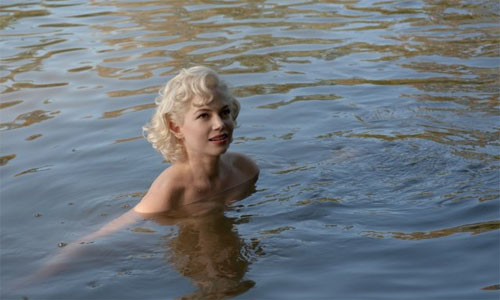
The role of Marilyn Monroe has to be one of the most intimidating and challenging parts an actress can be asked to play, though not for the reasons you'd assume. As far as legendary pop culture icons and celebrities go, there was always a tendency to believe there had to be more to her than what we saw. She really wasn't a good actress. She wasn't incredibly talented. Yet here she is today as this tragic figure and sometimes it's kind of tricky to determine how. That's why casting her is thankless. Do you you cast a movie star who isn't much of an actress for a sensationalized look at "Marilyn?" Or find a great actress who may not necessarily come off as a big movie star for a deeper look at "Norma Jean?" Simon Curtis' pseudo-biopic My Week With Marilyn answers that question by laying claim to the most intriguing casting choice in years and Michelle Williams' Oscar nominated performance delivers on it, even in moments when the rest of the film has trouble keeping up with her.
Foregoing the more traditional biopic route, writer Adrian Hodges (adapting Colin Clark's memoirs) instead takes the Frost/Nixon approach, capturing a brief, but pivotal moment-in-time snapshot in the life of an iconic figure. The story's told through the eyes of Oxford grad and aspiring filmmaker Colin (Eddie Redmayne) who spent a week with Marilyn Monroe (Williams) as third assistant director on Laurence Olivier's (Kenneth Branagh) 1957 film The Prince and the Showgirl (then titled The Sleeping Prince). Olivier, the respected thespian and stage actor, sees casting Marilyn opposite him as a chance for to regain his youth and vitality, finally becoming a full-fledged movie star. For Marilyn-- already the biggest star on the planet-- it's the rare chance to be taken seriously as an actress by holding her own onscreen with one of the best. Of course, the result of this promising collaboration ended up laying somewhere in between a complete disaster and a curious footnote in cinematic history. Over-medicated, showing up late and flubbing lines, the Marilyn who shows up on set with acting coach Paula Strasburg (Zoe Wanamaker) glued to her arm more closely resembles a frightened child in need of constant babysitting than her sexy public persona. After Marilyn's husband, playwright Arthur Miller (Dougray Scott) skips town in the midst of her meltdowns, it becomes Clark's job to look after the star and a semi-romantic friendship develops, awkwardly placing him in the middle of her feud with Olivier. An infatuated Colin falls fast and hard, ignoring warnings from Olivier and her agent Milton Greene (Dominic Cooper) not to buy into the "little girl lost" act they think she's selling.
Outside of Williams' performance and the fascinating on-set clash with Olivier, there isn't a lot here, but there doesn't need to be because those two elements are more than enough. While played well by Redmayne, Colin is kind of a flat character, functioning only as the eyes through which we can observe Marilyn as he attempts to grasp the magnitude of what's happening to him. Whether she's actually interested in him romantically seems almost beside the point. Instead, he represents for her the opportunity to have a real date, act a little crazy and enjoy the normal romantic pleasures that have proved impossible because of her fame. There's a sense all she wants to do is get rid of Marilyn and is unintentionally using Colin to do it, which can only lead to heartache for him. Then again, there are many moments where we sense she doesn't want to get rid of her at all, or simply can't. Her use of the Marilyn "persona" as a security blanket for coping with her own insecurity comes to the forefront when faced with the daunting task of going one-one with the legendary Olivier on set. She can't rely on that persona this time and without so much as a shred of confidence in her own acting abilities, begins to break. Olivier understandably loses his patience and temper, even as his reasoning behind hiring her reveals just as much about his own lack of confidence.
This is some performance from Michelle Williams, justifiably earning every bit of praise it's gotten. She just nails it. The facial expressions. The walk. The voice. Especially the voice. Everything. There's this moment when she's with Colin and they're suddenly mobbed by fans and photographers. She turns to him and asks, "Should I be her?" before slipping into character and becoming Marilyn. Williams seems to turn it on and off at the flip of a switch, alternating between the superstar we thought we knew and a frazzled train wreck of emotional dependency. The question wasn't whether she could play the latter but how well she could capture the former, which is ironic considering her career start as teen sexpot Jen Lindley on Dawson's Creek. It's a testament to how hard she worked since then to move away from that image that seeing her play this now seems like a huge stretch. There's at least a passable physical resemblance to the icon, but what Williams really brings is the depth, making Marilyn the unlikeliest addition to her growing gallery of emotionally tortured heroines.
In his Oscar nominated supporting performance Branagh subtly avoids turning Olivier into an all-out villain, instead showing a gifted actor past his prime who's grasping at straws to turn Marilyn into something she can't possibly be. Her only supporter is actress and co-star Sybil Thorndike (Judi Dench), who realizes her fragile psyche responds better to encouragement than harsh criticism. The rest of the supporting players aren't as well-developed. Dougray Scott is hilariously miscast (then altogether forgotten about) as Arthur Miller, reimagined here as some kind of enigmatic stud. But the film's most thankless role belongs to Emma Watson as a wardrobe girl Lucy, who Colin strings along while he's off frolicking with Marilyn all week. It's one thing to waste a name actress for a useless, underwritten part, but quite another to insultingly pretend in the last act that the part meant anything. While her purpose is clear, it's just isn't followed through enough to have any kind of impact. There's also a scene early on with Oliver's then-wife Vivien Leigh (Julia Ormond) that comes of nowhere, seemingly thrown in only to give Ormond a juicy scene and hammer us too hard with the theme of insecurity.
When Michelle Williams was announced to play Marilyn, Monroe fanatics were predictably up in arms, but the most interesting complaint I heard was that she didn't "deserve" it. She's too short. She's not pretty enough. Not enough charisma. But the real question should have been whether Marilyn "deserves" to be played by Williams. By the end of the film I believed that she did and the choice seems especially inspired when you consider all Marilyn wanted was to be taken seriously as actress. It's likely she would have appreciated the irony. The great thing about biographical dramas is how they bring two figures together from different eras with seemingly nothing in common who must co-exist in a single performance. Using that criteria, it's difficult coming up with a more intriguing pairing than Marilyn Monroe and Michelle Williams. What Norma Jean really wanted was a career like Williams. She got Marilyn Monroe's instead. And it destroyed her. Now with a legitimately great actress playing her, she finally ends up attaining the respectability she never could on her own.
Subscribe to:
Posts (Atom)