Wednesday, December 28, 2022

The Best (and Worst) Movie Posters of 2022

If a single word springs to mind when considering the most memorable movie posters, it's probably "iconic." It may not apply to every one, but chances are if you're able to instantly conjure up a single, striking image in your mind whenever that film's title is mentioned, it applies. Think Jaws, E.T., A Clockwork Orange, The Shining or Vertigo. All top-tier cinematic achievements matched by one-sheets that transcend a poster's purpose, resulting in a beautiful union of marketing and art. 

Those are extreme examples, occupying space in the pop culture lexicon alongside the film itself and emerging as an easily identifiable logo. Occasionally it becomes such a calling card that you could conceivably remove the title treatment (often also memorable) and still identify the film. So even if the theatrical experience has undergone drastic changes over the past few years, movie posters always seems to adapt along with it, their initial intent remaining the same. This idea of iconography isn't gone, just rarer. 

None of 2022's best designs can touch those classics, but that doesn't mean the principles and concepts behind them aren't still in play. Unlike 2021, where I scrounged to fill ten spots, this was a much better year, proving again there's usually a strong correlation between a film's quality and its poster. It's always a toss-up whether the top pick will present itself early and obviously with little competition, or be an unexpected winner that emerges from a crowded field of contenders. This time it's the latter, which I actually prefer, since it speaks to the quantity of exceptional designs over the past 12 months.

Just a reminder that only official, studio approved theatrical and screening posters released during the calendar year 2022 (possibly including upcoming 2023 films) are eligible. Most images via Impawards.com Below are the top ten, along with an alphabetically ranked runners-up list, and of course, the highly anticipated, but always entertaining year's worst. 

The Best...


10. Everything, Everywhere All At Once 

Capturing the polarizing chaos that is Everything, Everywhere All At Once would seem to be an impossible task, but illustrator James Jean nails it, melding all its wackiness onto a kaleidoscopic one-sheet that tells us everything and then some. From the googly eyes, to the hot dog fingers all the way to the two Evelyns framing the top and bottom, there's this strange thematic organization to the insanity that'll likely remind the movie's most ardent defenders why they love it (and prolong the agony of its detractors). Lots of little details here, all converging in Jobu's "everything bagel" black hole. A24 also released a series of parody posters based on the film's many multiverses, but it's this that easily stands as the most inventive and visually appealing of them all.


9. Fall

In the case of the vertigo-inducing, high altitude location thriller Fall, this is exactly how the movie looks, feels and is shot. No false advertising here, as you'll know with one look whether you're up for it. Just glancing at it may make some acrophobiacs nauseous, but there's a brilliant simplicity to Richard Rho's approach that only grows in impressiveness the longer you stare. The awesome use of all that wide open negative space and the breaking ladder captures the film at the apex of it suspense. You also have to love how the blinding sun against the blue skyline is sandwiched in between the top of the tower, nearly kissing its tag line. The functional sans serif title treatment is a perfect choice, with a navy typeface that's bold, impactful and well placed. "Dropping Soon." Clever.  Amidst a myriad of throwback designs, this poster's almost jarringly modern, which was a gutsy choice  Sometimes a teaser doesn't even need to knock your socks off, just convey the film as cleanly and efficiently as possible. Bonus points for playing with perspective and height in an inspired way I can't remember seeing since this.   


8. Spin Me Round

If GrandSon's design for Jeff Baena's romantic comedy Spin Me Round looks slightly familiar that's because it is, strikingly resembling the Criterion Collection cover art for John Waters' Polyester. While there are noticeable differences, the romance novel paperback theme is front-and-center and maybe creatively executed a little better here, going even further with that aesthetic. Drumming up curiosity as to what the film could have up its sleeve, it's busy, but you have to appreciate how the typeface is configured and repurposed to look much more like a trashy airport read than a movie poster. The label on the top left and even that crease going down the "spine" is proof of that attention to detail. With vibrant colors and top notch illustrations (just look at Alison Brie) are topped off by the couple perfectly posed behind that cheesy-looking title treatment. 


7. Butterfly in the Sky

Featuring interviews with host LeVar Burton and the legendary PBS show's creators, to say the 2022 "Reading Rainbow" documentary, Butterfly in the Sky slipped under the radar would be an understatement. But just look at this poster, which is everything the program represented in a single, eye-catching illustration that not only conjures up nostalgic memories of its opening credits, but the iconic theme song itself. It would have been so easy to just photoshop Burton onto the poster, add a title and call it a day. But this avoids replicating the errors of the disappointingly bland 2018 one-sheet for that masterful Mr. Rogers documentary, Won't You Be My Neighbor? You can't look at these images (especially the pages flying out of the TV) and not immediately reflect on everything the show meant to those who grew up on it. And it looks fantastic to boot, with dazzling illustrations and colors, a flawlessly placed brown title and the Tribeca laurel reef, all accompanied by a nice, clean border. Still trying to uncover who designed this.


6. Get Away If You Can

Here's another film that really fell through the cracks. Released back in August on VOD, actors and writer/directors Terrence Marin and Dominique Braun's sailing thriller, Get Away If You Can came and went with little fanfare, but Aleksander Walijewski's poster for it is unforgettable. With a plot revolving around the exploration of a deserted island, the studio at least knew to place the great Ed Harris at the forefront of what can best be described as a highly unusual, but visually captivating one-sheet that isn't overwhelmed by an onslaught of type and credits. The beige border and aqua blue color combo makes for a great contrast, with the two divers descending toward the title below and away from Harris' face on the bottom of the boat. As far as why Harris' face is on the bottom of the boat? Who knows, but it's a great choice. The design takes a page from Jaws, but in reverse. 


5. Armageddon Time
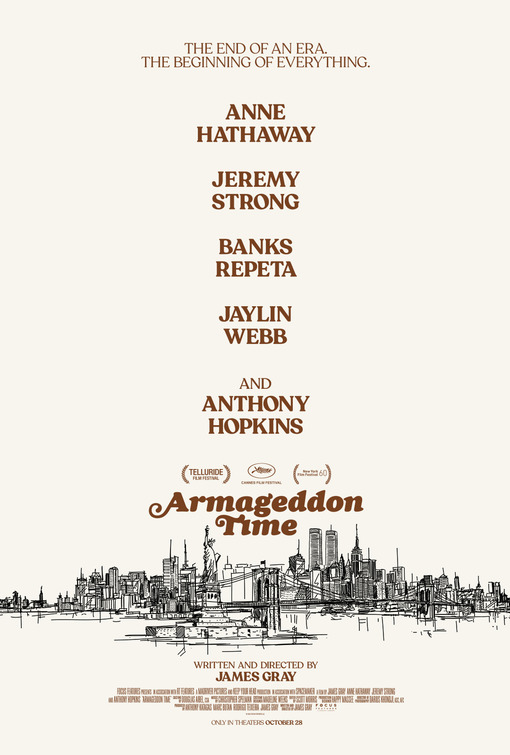
Sending out some classic The Last Picture Show vibes, this elegantly simple throwback for James Gray's autobiographical Armageddon Time demonstrates an understated excellence that's gone missing in modern posters, Successfully channeling the film's New York setting circa 1980, this GrandSon design also manages to replicate the style of poster that would accompany the film's release during that era. It's very deliberately intended to convey the theme and tone of the picture rather than misrepresent or oversell the picture as anything other than an adult prestige drama. And by taking this route, it ends up serving as the best, most honest advertising for this release. Those who want to see it will and that's the audience most likely to appreciate the artistry behind this one-sheet. The brown title treatment against the beige is immaculate and what even needs to be said about that spectacular skyline sketch? Part of me wonders how good this would look if you kept the tag line on top, but removed the vertical cast credits down the middle, freeing up even more negative space. Then again, it does help to know who's in it. Just great work all around.     


4. White Noise

The first official poster for Noah Baumbach's White Noise was surprisingly underwhelming. Then a few character one-sheets followed that weren't much better and we're left wondering...that's it? Yes, it's Netflix, but Don DeLillo's 1985 supposedly unfilmable novel on which this is based should be insane enough on its own to inspire some really wacky designs. And now here it is, as illustrator Marija Tiurina summons her inner Where's Waldo? to give us this gloriously detailed collage of chaos that's bursting through every corner of the page with moments and characters from the film. As fun as it's been seeing Waldo photoshopped into this online, there's actually enough going on that we don't even need him and you could just try spotting Don Cheadle instead. Posters and even t-shirts like this enjoyed spurts of popularity during the 80's and 90's, but this approach is still kind of a deep cut, albeit an entirely welcome one. You just don't see this kind of thing anymore and Tiurina does it about as skillfully as you'll ever see, crafting a worthy homage that reflects the movie's zaniness. 


3. Pearl

While the influence behind MOCEAN's "X-traordinary" design for Ti West's Pearl is clearly Italian horror movie posters of the 70's and 80's, it possesses that rare, attention-getting quality prevalent in those aforementioned classic one-sheets. There is an iconic quality to it, evident by the fact that you really could take away that bloody title treatment (which is outstanding) and credits and still completely know what this is. A lot of that can be attributed Mia Goth, whose performance and look in the film is so immediately recognizable that you could have gone in numerous directions designing the poster, just as long as she's prominently featured. The optimistically wide-eyed "who, me?" look is almost too perfect, complete with the bloody hands covering her cheeks. The black background makes the bright red pop and there's some good manipulation of perspective with a sepia toned Pearl chopping up her victim as the blood flows down the road into that beige background, forming the title. This retro aesthetic is nothing new, but it's still in a class all its own, serving as the ultimate companion piece for West's film. 


 2. Resurrection

P+A's design for the twisty Rebecca Hall thriller Resurrection could on the surface just be described as a grainy, black and white image of her character. But there's a lot more going on, to the point that we really have to question what we're looking at here. Especially the incorporation of those imprisoning orange vertical lines, taking an ordinary head shot into a creepy realm that befits the film's subject. The stark contrast between the black and white and those strong, bold orange bars is what jumps out most here. Pressed up and piercing through it is her eye, resulting in a genuinely unsettling sideways glance that lets us know something's askew. With thick, functionally placed off white title type and a superb border of the same color, notice how those bars feed right into those bold black pull quotes at the bottom and the credits. While undeniably a throwback, it's tough coming up with many past examples it draws from, suggesting maybe this concept is more original than it's gotten credit for. Hall is no stranger to appearing on memorable posters for her films, and here's yet another one, wildly unique enough to lure you into giving it a watch.


1. Tár (All Versions)


If anyone would appreciate the symmetrical composition of these posters, it's the embattled fictional conductor Lydia Tar of Todd Field's Tár. Emerging from the darkness and towering above us all, AV Print's ingenious concept for one of 2022's most acclaimed films lets us know under no uncertain terms that this is Lydia's space and anyone else will be shrunk and overwhelmed by her greatness, much like the characters she's stepped over on her path to dominance. Arms outstretched, it's as if a whole page couldn't even contain the character's wingspan, physicality, ambition and talent. Another great example of cleverly manipulating space and perspective, first two posters still manage to maintain that austere, inaccessible quality that makes the film itself such a challenging mystery box enigma. 

The huge transparent title and credits across Blanchett's torso compliments the image well, but for comparison's sake, look at that second version, which removes everything but the title. A noticeable improvement, only reinforcing the idea that text is often the biggest obstacle to work around. So despite far preferring the simpler version, they did a great job using text in a manner that really fits the overall design's form and function. But better still is Desi Moore's official Cinemark poster (also doubling as the 4K/UHD blu ray cover art), which captures the emotionally detached maestro in all her repetitive obsessiveness with that hypnotizing illustration. All these posters loom as large as the title character herself, which is quite a feat.  


Runners-Up...


 ...And The Worst


Both these films boast impressive casts. So impressive that they should be prominently listed. See, they're big stars. You can read their names here. In text. There are many of them. 


While the idea of Jon Hamm playing Fletch definitely has potential, you'd never know it looking at whatever this is supposed to be. The familiar paperback concept (executed to far greater effect above with Spin Me Round) strangely resembles a Xerox copy of a rejected art assignment. Besides Hamm not looking quite like himself at all, everything just seems off, not to mention surprisingly unpleasant to look at.  


Despite being photoshopped beyond all recognition, it's hard to not to be mildly impressed that Tomlin, Fonda, Moreno and Field will all be sharing the screen together for the first time (bonus points for matching the correct names to the actresses). And yet it's still cringeworthy, managing to meet all the middle of the road expectations you'd expect from a comedy depicting four senior friends' trip to Super Bowl LI to watch their hero. Tom Brady doesn't need to be on the poster, but you wonder how much goofier this could have been if he was.  


Coming soon to your local public library...Steven Spielberg's The Fabelmans. That Toronto Film Festival poster really does look like something you'd see on the bulletin board next to a missing pet flyer or babysitting inquiry in the lobby while returning your overdue book. But even that can be forgiven, until you realize the borderless theatrical version is identical, yet somehow drabber. And all these sentimental images do little beyond reinforce everyone's biggest Spielberg misgivings going in. Supposedly, the film's much better than this, but young Sammy Fabelman walking toward projected images of his life on a studio backlot only heighten any concerns of syrupy content. At least they were smart enough to put Michelle Williams front and center, but that's about it. Maks Bereski's unofficial poster shows how this could have been done well.


Poor Andy Garcia, who looks legitimately perplexed at either how he ended up in HBO Max's Father of the Bride remake or got digitally manipulated onto its poster. Maybe both. Can't say I blame him. As far as no one knowing the film exists, generic advertising like this helps explain why.


Even by Netflix standards, this is pretty uninspired. And very, very blue. And that they simply repeated the same formula for the individual character and ensemble cast versions makes it clear what the game plan was all along. Just throw stars on the posters. They'll watch anyway. It doesn't matter.


To Jeff Goldblum's credit, he has his trademark bemused look suggesting he'd rather be anywhere than on a character poster for Jurassic World: Dominion. And it's hard to disagree. But I feel worse for that unidentifiable actress below who's baring only a vague resemblance to someone who looks like Laura Dern.  


Just a guess that this is supposed to be one of those body swap comedies, but Diane Keaton actually looks de-aged here (defeating the conceit of a younger person trapped in a senior citizen) and the others just look superimposed into a background containing the tidiest, most carefully placed pool party mess you've ever seen.


Tom Hanks is a lot of things, but "Grumpiest Man in America" doesn't exactly feel like the most accurate descriptor. But putting that, his menacing scowl and a fake cat aside, this does seem to represent a trend for the actor of late. They've basically just stopped designing posters for his films, opting instead to just paste the actor on a one-sheet with some text. If anyone deserves better, it's him. 


It's not a list without our requisite Cage entry and this one doesn't disappointment. It seems like they've ironically gone to great lengths to age him in this poster for The Old Way. But his name sure is perfectly centered on that hat, depriving us the knowledge of what crazy hair he'll be sporting this time.


The most dramatic rose ceremony ever.


The Son blah blah blah blah Florian Zeller blah blah blah Hugh Jackman blah blah blah blah. When pull quote posters are done well, there's nothing better, but this is just an mountain of small, unreadable italicized text. On the bright side, this does look like Laura Dern.  


Forget about appearing on the same poster, Eva Longoria and Matt Walsh don't look like they're even sharing the same country, state or zip code here.


What a disappointment. The Whale should have been the movie poster of the year. Just an illustration of Brendan Fraser's head on a whale's body. Someone needs to get on that. Instead, we get the now ubiquitous screenshot cleaned up and photoshopped to such an extent that it actually undermines the dramatic subject matter. The bright aqua title type is an interesting choice, but with this uninspired approach A24 has again revealed their discomfort promoting the film due to the fat suit "controversy." The hesitancy isn't doing the film or Fraser any favors.

Saturday, December 10, 2022

Tár

Director: Todd Field
Starring: Cate Blanchett, Noémie Merlant, Nina Hoss, Sophie Kauer, Julian Glover, Allan Corduner, Mark Strong, Sylvia Flote, Adam Gopnik, Mila Bogojevic, Zethphan Smith-Gneist
Running Time: 158 min.
Rating: R

**The Following Review Contains Major Plot Spoilers For Tár **

★★★★ (out of ★★★★)

You could call renowned conductor Lydia Tár the Cate Blanchett of her field, or maybe even categorize Blanchett as the Tár of hers. Of course it'll have to be a strictly professional comparison, based entirely on their statuses as the greatest working in their respective fields. And isn't that all we ever have to go on? In his first film since writing and directing Little Children 16 years ago, Todd Field explores that very question, asking whether art can truly be separated from the artist, digging into this embattled title character with all the depth and precision we remember expecting from a filmmaker of his caliber. 

While impossible to know everything that drew Blanchett to the role, it's likely she and Field recognized the creative possibilities in showing that people, even the worst ones, are rarely just one thing. And highly successful, driven geniuses at the top of their craft are often much more complicated than that. Both literally and figuratively, Blanchett makes sure all those notes are hit, giving us a multi-layered examination of a woman who's capable of being likable and engaging, until you dare stick around a little longer. 

Labeling Lydia a monster would sell this nuanced portrayal short, but she's still a self absorbed egomaniac who basks in all the adulation and attention being the best brings. Among her many flaws is a fatal one that leads to complete career implosion, or cancellation, depending upon your perspective. There's good reason to believe the accusations have at least some legal merit, even if we don't really have enough to go on. But Field's not interested in guilt, innocence or "picking a side." It's a character study through and through, enabling viewers to draw their own conclusions based on the available information. And the closer you look, there's a lot to find.

World famous Lydia Tár (Blanchett) is the first female chief conductor of the Berlin Philharmonic, talking up a number of upcoming projects in an interview with The New Yorker's Adam Gopnik, including her live recording of Mahler's 5th Symphony, a new book (Tár on Tár) and the fellowship program she founded. Supported by her highly disciplined personal assistant Francesca (Noémie Merlant), violinist wife Sharon (Nina Hoss) and their young adopted daughter Petra (Mila Bogojevic), she also guest teaches at Julliard, encouraging students to look beyond issues of identity politics and focus on the music. 

When Lydia confides in fellowship manager Eliot Kaplan (Mark Strong) about her plans to replace assistant conductor Sebastian (Allan Corduner), a young Russian cellist Olga (actual cellist Sophie Kauer) arrives on the scene for a blind audition. Immediately attracted to her, Lydia pulls out all the stops to secure the Olga a seat, raising suspicions. This is while emails surface from a former student, Krista Taylor (Sylvia Flote), suggesting she was groomed into a sexual relationship by Lydia, which resulted in her dismissal from the program and a shattered reputation. Haunted by the escalating allegations, Lydia plows forward, but this might be the one situation she can't so easily control. And it very well could destroy her.          

Rather than speculate how or why Lydia would abuse her power, the more pertinent issue becomes...why not? With no one willing to hold her accountable for anything, she can. It's a perk of being a revered musical genius, which isn't to say she got there by accident. That's what makes this so compelling, as Field immerses us in her world for over two and a half hours, giving the potential wrongdoings room to marinate around this seemingly untouchable figure who's reputation will soon come crashing down to Earth.

The now infamous Julliard lecture scene is a microcosm for the entire film, as one of Lydia's students, Max (Zethphan Smith-Gneist), makes it known that as a BIPOC pangender they're no fan of Bach. And is Lydia ever the wrong person to tell that, as they argue before the humiliated student storms out of class. What's so fascinatingly uncomfortable about this episode is that she brings up a completely valid point about the dangers of dismissing art or music on the basis of the personal life of its creator. But in trying to convey that confronting the work head-on can often lead to a greater understanding, she gets lost in the throes of her performative narcissism. 

In taking a reasonable position she's more than entitled to, Lydia confidently owns the room, and while this kid clearly never stood a chance, it sends up the first red flag about her personality and how she handles those who disagree. It's a pattern that repeats itself and in hindsight can be looked at through another lens once those allegations hit. 

It's Lydia's behavior that triggers our doubts, along with what appears to be a predilection for younger women that everyone in her orbit seems fully aware of, especially her sickly wife Sharon, and more quietly concerned assistant Francesca. She shares genuine moments with both, but they know what she's all about, and the lengths she'll go to manipulate the power structure to fit her needs. Even the vulnerable Sebastian, a conductor on the chopping block, knows, and we see how quickly she weaponizes that against him. Lydia's only real, non-transactional connection is with her daughter and  that's overshadowed by a chilly schoolyard encounter with one of her classmates.

There are no accidents in a film this meticulously constructed so Field's decision to have an alleged sexual predator be a gay woman rather than your typical straight white male isn't irrelevant. The decision definitely splits the deck in a way, pushing gender politics aside while also taking pains not to prejudice us either way in regards to her potential guilt. In telling so much of her story without words, he uses music, sounds, gestures and visuals to get inside a certain life and routine, baring witness to a career slowly crumbling, piece by piece. 

Going far enough in depicting the minutiae of her everyday that you'd be forgiven for thinking it's a biopic of a real person, Blanchett believably captures how exalted individuals like this can find ways to constantly compartmentalize their actions. It's long, but there isn't a moment wasted as you're hypnotized by the details and clues, realizing there's a lot more to this than what appears on the surface, with the film even flirting in supernatural thriller territory. And none of this necessarily confirms Lydia's guilt, leaving us to imagine what else could have been found, or even consider it really is the case of a troubled girl targeting her. 

Krista's suicide marks the no point of return, but how it's handled is the film's masterstroke, offering another unique perspective on Lydia that invites extra consideration. More than one thing can be true at once, as coming from very little to scratch and claw her way to the top seems to have defined all her later actions. And while she's relatively dismissive about how being a woman affected this path, it's fair to assume it had an impact.

Field gives us numerous opportunities to figure Lydia out, as if such a maddening puzzle could ever be completely solved. But we get to know the woman so well that it's easy to guess what she had for breakfast yesterday, the type of wine she'll send back in a restaurant, or her Sight and Sound film ballot. Blanchett brilliantly embodies all these contradictions and conundrums, providing good reason to tout this as one of her finest performances, if not most compulsively watchable. And given who we're talking about, that's not small praise.

Lydia physically attacking her replacement for Mahler's 5th is shocking enough, but the killer ending reveal is both pitifully depressing and outright hilarious, leaving little doubt as to the depths she's sunk, while reopening the floodgates for further debate. If conducting the Monster Hunter video game score in an auditorium full of cosplayers is a jarring surprise, it's one contrasted by how seriously she still manages to take the work. 

Considering her enormous ego, this new job should be a fate worse than death, cruel karmic comeuppance on par with that guest conductor role, or more insultingly, a human metronome. But she outwardly treats this humiliation as if it were no different from the Berlin Philharmonic, accessing that childhood love of music we glimpsed when she tearfully watched Bernstein's VHS tapes in her old home. 

Whether she's Linda or Lydia, it hardly matters anymore, as even her estranged brother acknowledges how she never quite figured that out. But seeing her conduct for an audience you could easily picture her mocking, the realization sets in that Lydia's arrogant and determined enough to believe she'll come back from this. And knowing what we do, it's entirely possible she's right. 

Tuesday, December 6, 2022

Smile


Director: Parker Finn
Starring: Sosie Bacon, Jessie T. Usher, Kyle Gallner, Robin Weigert, Caitlin Stasey, Kal Penn, Rob Morgan, Judy Reyes, Gillian Zinser
Running Time: 115 min.
Rating: R

★★★ (out of ★★★★)

Playing fairly within the rules of its own horror universe, writer/director Parker Finn's debut feature, Smile, won't be accused of trailblazing originality, but it knows what it is and avoids insulting the audience's intelligence by aiming higher than it should. Recalling efficiently made 90's thrillers, it's moody, atmospheric and carefully paces out the steps of what's actually a pretty tight plot despite some occasional absurdity. In adapting his own 2020 short film, Laura Hasn't Slept, Finn takes a familiar concept in the genre and does right by it, stringing us along just enough to generate curiosity in the resolution without overstaying its welcome. 

Working with a premise not entirely different from that tackled in It Follows, The Ring and the Final Destination series, this manages to do enough in distinguishing itself that we're not distracted by those obvious similarities. Part of why is a lead performance that carries the story in every way, absorbing its baggage and emotionally grounding it with an authenticity that sometimes exceeds the film's quality. And while focusing on an already fragile character brought to the brink of insanity by something she can't understand or control, it's a credit to Finn's script that those around her react how you'd imagine they would under those circumstances. It's all neatly mapped out, leaving little room for surprises, but nonetheless following a reasonable trajectory to the somewhat predictable, though entirely satisfying conclusion.

Stressed out and overworked, psychiatrist Dr. Rose Cotter (Sosie Bacon) meets with a troubled patient, PhD student, Laura Weaver (Caitlin Stasey) who, traumatized by watching the suicide of her art history professor days earlier, screams to Rose about being stalked by smiling people telling her she's going to die. After grinning uncontrollably, Laura slits her own throat and commits suicide during the session.  Horrified by what she witnessed, Rose's behavior at work becomes increasingly erratic, forcing her concerned boss, Dr. Morgan Desai (Kal Penn) to become involved.

With Rose's hallucinations and wildly unhinged episodes worsening, fiancé Trevor (Jessie T. Usher) and sister Holly (Gillian Zinser) are seriously worried while Rose's former therapist, Dr. Northcott (Robin Weigert) attempts to draw a line back to the death of her mentally ill mother.  Soon, it's clear something far more sinister is happening, as she's seemingly afflicted with the same supernatural parasite that plagued Laura and those before her. Leaning on ex-boyfriend and police detective Joel (Kyle Gallner) for help, Rose needs answers and must prove to her family and friends she isn't crazy to avoid suffering the same fate as Laura. But with her days seemingly numbered, she's discovering just how hard it is to escape your own mind.   

One of the simpler, smarter aspects to the screenplay is that those who know Rose justifiably believe she's having a mental breakdown, as there's no reason to assume otherwise given her behavior. In this sense, much of the film's tension comes from Rose's fight to prove it isn't "all in her head," even while acting out and exhibiting psychotic tendencies. Initially, those closest express all the concern you'd expect, at least until it gets so bad that their worries become entangled in judgment and assumptions, with Rose hearing similar doubts from them that she expressed to Laura before the suicide. It doesn't take long for Rose to realize this is all going down the exact same road, as her visions of grinning, cackling people increase in frequency and intensity. 

Given Rose's already strained relationship with her older sister dating back to childhood, she's not much help, nor is fiancé Trevor, who tries to pass her off to the therapist. Since everyone's on the sidelines ogling in horror as she loses her mind, the film's heavy lifting falls on Sosie Bacon, who definitely doesn't disappoint in her first starring role. With a strong presence that may remind some of a younger Hilary Swank, she elevates what should be ridiculous jump scare scenes into deeper psychological territory as a woman victimized by both her own past and and this unknown curse. 

While essentially a plot function, Gallner's cop Joel is at least noteworthy compared to the rest, tuned in enough see the evidence for what it is and help her follow the trail backwards. The film milks a considerable amount of suspense from the metaphorical clock rapidly running down on Rose's life, and the more she fights, tries to solve the mystery, or even attempts to run, the closer she hurls toward the climactic showdown between her and this inexplicable demon force.  

It's tempting to label Smile as gimmicky or derivative, but it pulls off its tricks more skillfully than most, aided in no small part by Bacon's affecting turn. And Finn actually picks the right time to cut bait and get out, emblematic of the tricky line this manages to toe throughout, successfully juxtaposing the protagonist's mental trauma against some of the more visceral supernatural elements. This could have easily been laughable, but it holds steady, building tension and delivering an uncomfortably creepy trip that gives us some genuinely unsettling imagery and an emerging acting talent to keep a closer eye on.      

Friday, December 2, 2022

Everything Everywhere All At Once

Directors: Daniel Kwan and Daniel Scheinert
Starring: Michelle Yeoh, Stephanie Hsu, Ke Huy Quan, James Hong, Jamie Lee Curtis, Jenny Slate, Harry Shum Jr., Tallie Medel
Running Time: 140 min.
Rating: R  
 

★★★ ½ (out of ★★★★)

With a still growing reputation that precedes it, such a deafening buzz surrounds Everything Everywhere All at Once that by the time you get around to watching it, it's easy to be intimidated by all the build up. Starting conventionally enough, we're introduced to the Chinese American immigrant family the story revolves around, accompanied by a certain amount of relief that this may not be as insane or unintelligible as everyone's saying. Then it happens. There's an early moment that forces us to reevaluate that notion, as there's barely enough time to process our thoughts before the ride actually starts, careening off the rails with reckless abandon. 

The story goes in a number of crazy directions, dipping in and out of dimensions, parallel universes and multiverses while crossing over various genres not strictly limited to sci-fi or fantasy. But the most shocking thing is that despite pummeling our senses with a frenetic onslaught of dark comedy, domestic drama and martial arts for nearly two and a half hours, there's a method to the madness. It somehow makes sense because the film remains at its core about a family's relatable struggles, no matter how that happens to manifest itself at any rapidly changing instant. 

Much like the many universes and choices not taken by the protagonist, you could envision an another take on this story that would function as a straightforward character drama examining the Asian immigrant experience. It would still probably be a great achievement, but unnecessary considering we get that anyway, on top of everything else. Writer/directors Daniel Kwan and Daniel Scheinert (known collectively as "Daniels") take a huge, ambitious swing for the fences that pretty much guarantees it won't all work, which is okay. Then again, it's hard to expect anything less from the team who concocted 2016's bizarre, far from forgettable Swiss Army Man, of which this shares similar, yet entirely different DNA.   

Years ago in China, Evelyn Quan Wang (Michelle Yeoh) fell in love with Waymond Wang (Ke Huy Quan), eventually eloping to the United States against her strict, traditional father Gong Gong's (James Hong) wishes. Now running a family laundromat that's currently being audited, they're struggling to make ends meet, as Waymond plans to serve Evelyn with divorce papers. With her dad wheelchair bound and living with them, she has also a seriously strained relationship with gay daughter Joy (Stephanie Hsu), who wants her mother to accept her relationship with non-Chinese girlfriend Becky (Tallie Medel), a detail Evelyn hides from Gong Gong. 

Following a disastrous meeting with sullen IRS auditor Deirdre Beaubeirdre (Jamie Lee Curtis), Waymond's suddenly overtaken by an another version of himself from an alternate universe (the "Alphaverse"). This "Alpha-Waymond" must recruit this Evelyn to use "verse-jumping" technology to access skills and memories of her parallel selves to defeat the villainous Jobu Tupaki, who's created a black (bagel) hole that threatens the multiverse.  As Evelyn uses her newly acquired powers to fight Jobu and an army of followers, her consciousness spans across wildly different universes, as she's given glimpses of into what could have been. In coming face-to-face with Jobu she soon realizes the enemy she was battling wasn't who or what she thought, and it might not be too late to save her family from surrendering to a nihilistic, self-destructive existence.

Any description will make the film sound substantially more convoluted and inaccessible than it actually is, but that fact still doesn't make this any less of a challenge for viewers, from which a lot is demanded. Practically from the jump, the story moves at a breakneck, unrelenting pace before the actual craziness really kicks in. Part of why most of this works is because the Daniels seamlessly introduce this family's dynamic and set the table well enough that you're invested in their plight right away, especially Evelyn's. From that point on, you're willing to follow them through whatever rabbit hole they're dragged down. And there's many of them.

Buried in piles of receipts and completely oblivious to the kind but meek Waymond's half-hearted attempt at initiating a divorce, Evelyn's life is a mess, made no better by a difficult relationship with her father that's now repeating itself with daughter Joy. It's all prologue to what unfolds in that IRS office, when her existence is turned upside down with the arrival of Alpha-Waymond, briefly entering an awkward period where we're trying to figure out if sensational kung fu fights, fanny pack attacks and a villainous auditor of the month stalking the Wangs like Godzilla are meant to be taken literally. It turns out they are. 

Once that's established, what follows becomes a bit easier to take in, with characters popping in and out as actors take on different roles and the multiverse concept provides endless opportunities for a dizzying amount of callbacks and gags. These range from hilarious (A Ratatouille parody with a raccoon, rocks with googly eyes), to intentionally repetitive (hot dog hands), or sometimes just plain disgusting (you know the ones), but there's a usually a narrative reasoning behind them that exceeds mere shock value. 

The martial arts fight scenes are mind blowing in how even some of the cheaper CGI works to further enhance and reflect the film's tone and style, almost as if anything that looked better would only defeat the purpose. Kwan and Scheinert definitely make the most of what they have, and considering the budget, much of what we see on screen does looks very good, with all the dimension hopping containing moments of recognition and joy that will have you leaning forward in your seat. 

The biggest beneficiary is Yeoh, who not only gets to use all the skills that's made her a top action star, but gets to flex certain dramatic and comedic muscles that have gone completely unexplored in any previous role. Struggling with her own shortcomings and disappointment in fully connecting with her family, Evelyn even has a timeline wherein she's a movie star not unlike the actress playing her, as actual red carpet footage and clips of Yeoh are briefly but smoothly inserted in.

Sometimes when an actor makes a big return after a long layoff it can result in disappointment, competing with audiences' memories of how they were once perceived. And if they were a child, it's only further compounded by that seemingly insurmountable nostalgia factor. These unfair expectations are moot in the case of Ke Huy Quan, or as he's best known, Short Round from Indiana Jones and the Temple of Doom and Data from The Goonies. What's so wonderful about his performance is that all the enthusiasm and comedic likability he brought to those roles has not only been entirely retained as an actor over fifty, but fully woven into the fabric of Waymond's character.

That Quan worked as a stunt choreographer had to help in the many action scenes but it's how he manages to balance these different versions of the character from scene-to-scene that leaves the most lasting impression. Whether he's Beta-Wayond goofing off in the laundromat to make his wife's day brighter or Alpha-Waymond guiding Evelyn toward unlocking her full potential, we're buying every second of it. And as an alternate, more debonair Waymond, he delivers the film's most powerful line as both he and Evelyn attempt to make sense of their unmarried existence in a scene reminiscent of a Wong Kar-wai film. At first, 93-year-old legend James Hong initially seems as if he'll be relegated to the sidelines until his Gong Gong emerges as a key antagonist, enabling the veteran actor to also cleverly send up up his most famous role in Big Trouble in Little China

Stephanie Hsu is the big breakout, albeit in a far different capacity than Yeoh. The antithesis of her name, Joy's given up all hope and believes nothing matters in the face of her mother's constant criticisms and disapproval. Playing dual roles, Hsu gets to do more than wear crazy costumes and kick ass, somehow merging two seemingly disparate personalities into one, often heartbreakingly. It's only as the film wears on that we realize how important Hsu's performance is to the movie's themes as a whole, which in between its laughs goes dark enough to earn serious consideration as a timely metaphor for suicidal depression. And deftly handling a supporting part unlike anything we've seen her in, Jamie Lee Curtis figures into the equation in constantly surprising ways, delivering a delightfully odd turn. 

You have to wonder what directors like Richard Kelly, David Robert Mitchell, Edgar Wright and Darren Aronofsky must be thinking right now, having each gone down a similarly ambitious route with follow-up projects just as visionary and off-putting, only to be met with varying degrees of ridicule that impacted their careers. But if it's any conciliation, without those titles there's a decent chance we wouldn't have gotten this, or at least the uncompromising version of it that A24 released. That it's broken through like this probably has a lot to do with the universal themes of humanity and culture it hits on, as well as the complicated relationship between mothers and daughters. hammered home with an ending (or two or three) that feels earned for the characters.

Undeniably lengthy and sometimes overly reliant on gross-out toilet humor, Everything still manages to come together beautifully, subverting the tropes currently associated with overblown superhero spectacles. It also provides an enduring lead showcase for a long overdue talent while featuring one of the most welcome acting comebacks in years. This won't be for everyone, as the rest test comes in repeated viewings when we discover whether it really is too much and could have used a more focused, disciplined approach. That's possible, but the entire experience just wouldn't be nearly as much fun without all the chaos.