Showing posts with label Sam Rockwell. Show all posts

Saturday, March 28, 2020

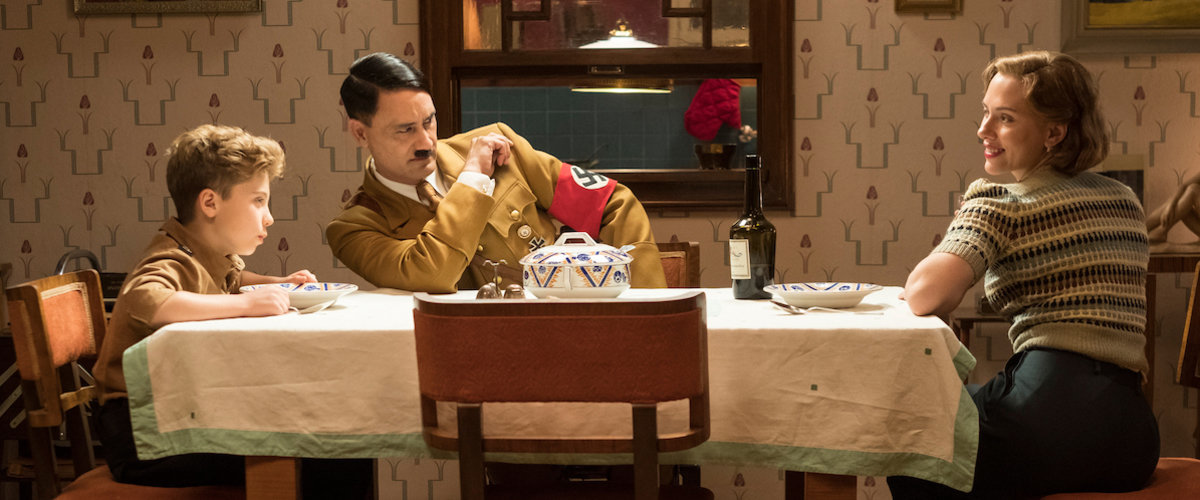
Jojo Rabbit


Director: Taika Waititi
Starring: Roman Griffin Davis, Thomasin McKenzie, Taika Waititi, Rebel Wilson, Stephen Merchant, Alfie Allen, Sam Rockwell, Scarlett Johansson, Archie Yates
Running Time: 108 min.
Rating: PG-13

★★★ ½ (out of ★★★★)

You can almost feel audiences and critics collectively cringe whenever a comedic film is released that tackles anything related to Hitler, World War II or the Holocaust. And understandably so, as these aren't exactly topics brimming with cinematic possibilities for parody and satire. It could also be the reason we've seen so few of them, with most confirming those fears in the worst possible way. It's one thing to fall flat on your face, but it's another entirely to miss the mark while managing to offend everyone in the process. And lately, doing that seems easier than ever. It took all of thirty seconds into Taika Waititi's Jojo Rabbit to realize it would be different, and maybe even a shorter time for me to know I'd love it.

The opening scene so perfectly lays the groundwork for what's to come, taking a tone and approach that immediately disarms the potential viciousness of the material without defanging it, letting us know we're in good hands. And how could we not be when sais scene involves a little boy getting some motivational coaching from his idiotic imaginary friend, Adolf, before segueing into an opening credit sequence set to the German version of the Beatles' "I Want To Hold Your Hand."

Accomplishing even more than being awkwardly hilarious in the face of a seriously shameful piece of history, the film somehow effectively conveys a genuinely touching and light-hearted tale about friendship and tolerance in the face of pure evil. That it doesn't run from nor make light of these weighty issues in delivering this uniquely touching coming-of-age tale is what makes the end result so memorable.

Ten-year-old Johannes "Jojo" Betzler (Roman Griffin Davis) lives with his mother, Rosie (Scarlett Johansson) in Nazi Germany during World War II. With his father serving abroad and his older sister having passed away from influenza, Jojo regularly coverses with an imaginary version of Adolf Hitler (Waititi), who provides him with encouragement and support, but mostly acts like a buffoon most of the time. But much to Adolf's pleasure, Jojo and his best friend, Yorki (Archie Yates) enroll in and attend the "Deutsches Jungvolk," a training camp for aspiring Nazi youths run by the one-eyed Captain Klenzendorf (Sam Rockwell) and his no-nonsense instructor, Fräulein Rahm (Rebel Wilson).

After an unfortunate accident involving a hand grenade leaves Jojo badly injured with a limp and facial scarring, he's bedridden, aside from getting out to spread Nazi propoganda pamphlets around town. But while home, he makes a shocking discovery upstairs, finding a Jewish classmate of her late sister's, Elsa Koor (Thomasin McKenzie), hiding out. Jojo immediately threatens to turn her over to the Gestapo, until she warns him that his mother could be killed for hiding her. Frustrated, he then demands that she spill her "Jew Secrets," which he plans on compiling in a book to give Klenzendorf. With the war raging on, secretly housing a Jew becomes a major safety risk for Jojo and his mom, even as he starts to look beyond who he heard Elsa should be is to form a genuine friendship with their new houseguest, challenging every belief he thought hw had. 

Of the many obstacles the script (based upon Christine Leunens' bestselling novel, Caging Skies) would have in making it to the screen, you'd figure a big one would be getting audiences on the side of a ten-year-old, Hitler-worshipping aspiring Nazi. The young protagonist has to be presented and performed just right for all of this to work, and luckily, Roman Griffin Davis brings just the right mix of bewildered innocence and comedic flare to JoJo, playing him not unlike any other kid who clinges onto and absorbs whatever is put in front of him.

Growing up in Nazi Germany, it's essentially been drilled into JoJo's brain that the sun rises and sets on his hero Hitler, without ever a pause to consider why. The arrival of Elsa into his life gives him that pause, even as he initially has trouble recognizing it. And being ten, he can't be expected to know otherwise until shown, despite having a really positive role model in his feisty, free-spirited mother, Rosie. But at this point, under such an oppressive regime, there's only so much she can do to instill in him the diffrences between right and wrong without facing serious consequences. But hiding this Jewish girl in the house accomplishes that, even as she hopes Jojo won't discover it.

It might be possible to come up with a performance in Scarlett Johansson's career you feel is "better" than the work she does here as Rosie, but good luck naming one that leaves as much of an impact in as short a time. It's very much a supporting role, but she exhibits a comic timing and playfulness we're not accostomed to while still remaining completely in line with the darker edges of the material. And it's testament to how much she brings that when she eventually leaves the screen, her presence doesn't.

It's really the relationship between Jojo and his unexpected houseguest Elsa that gives the film its firepower, with the boy at first intimidated and even afraid of the older girl, if only on the basis of the awful things he's been taught about Jews. And she happily decides to play into it and mess with him a little until he's massively confused by the idea that she may not be so bad after all, flipping his previously limited worldview upside down.

When forced to see Elsa as an actual person rather than a label, Jojo likes her and feels obligated to protect her, leading to the film's most suspenseful scene, when the Gestapo, led by Captain Deertz (Stephen Mercahnt) arrive at the house, questioning Elsa's identity. It's moments like this where we're reminded just how serious this is and how high the stakes, with Thomasin McKenzie's performance during this extended sequence brilliant in how she must somehow create the illusion of maintaining composure while very subtly appearing ready to crack out from unimaginable dread and fear.

The narrative does take a turn, but other than to say we all know the outcome of the war and its ramifications, to give way how profoundly it impacts each of the characters is spoiling too much. But how Waititi's script manages to maintain its wicked sense of humor during the most dire of cirmcumstances continues to seep through even the most minor of details. Upending expectations mid-way through in such a way that it almost feels like a surrealistic fantasy, the story brings a whole new meaning to the notion of being "on the right side of history."

As with any art dealing with this subject, Jojo Rabbit still won't be for all tastes, but it probably comes closest to appealing to the mainstream that any movie broaching this controversial topic has. It's easy to understand its popularity, but the real thrill could be in putting someone with no preconceived notions in front of it and watching them gasp at amazement at what Waititi manages to pull off in the face of seemingly insurmountable material. 

Monday, February 3, 2020

Richard Jewell


Director: Clint Eastwood
Starring: Paul Walter Hauser, Sam Rockwell, Kathy Bates, Jon Hamm, Olivia Wilde
Running Time: 129 min.
Rating: R

★★★ ½ (out of ★★★★) 

Early in Clint Eastwood's Richard Jewell, we're introduced to a man who behaves with absolute purpose and certainty. Someone so sure of what he's doing that nothing could possibly get in the way. Despite being mocked for his weight, called a "rent-a-cop," and generally laughed at and disrespected by everyone with whom he comes in contact, he just plows forward like it doesn't bother him at all. Of course, we later find out it very much hurts him, as it would anyone, but his loyalty to upholding the law takes precedence. In other words, Richard Jewell saved many lives in Atlanta's Centennial Park at the 1996 Olympics by doing what's he's always done: pay attention.

Despite the fact Jewell was railroaded and vilified by both law enforcement and the media to no end, there will be those accusing Eastwood of pedaling a right-wing agenda with his heroic depiction of this protagonist. And that's mainly because he fits the profile of an eccentric white male loner, as much now as even then. But if viewing the film through a political lens is eerily reminiscent of assumptions made about Jewell at the time, here's something scarier: Everyone still thinks he's the Olympic Park bomber. To this day. Well over a decade past his death. That fact alone should grant Eastwood as much creative freedom as he wishes.

Legally exonerated, but never acquitted in the public's eyes, Jewell's somehow taken this crime to his grave as its perceived perpetrator. There's a reason this movie isn't called Eric Rudolph. That eventually revealed bomber wasn't an exciting enough suspect for the media, nor was he an easy layup for the FBI. But disregarding the physical impossibility of Jewell having committed the crime and producing no forensic evidence linking him, they pushed forward anyway. So while the media and law enforcement get some rough treatment from Eastwood, it definitely isn't unwarranted. It's the director's best film in ages, but also a brilliantly told story made all the more remarkable for happening, its effects still rippling through our culture to this day.

It's summer 1996 when 33 year-old aspiring law enforcement officer, Richard Jewell (Hauser) moves in with his mother, Bobi (Kathy Bates) in Atlanta after a decade of bouncing around in various jobs such as a law office supply clerk and campus security guard. Given the chance to work security detail at Centennial Park on the eve of the Olympics, Jewell signs on, figuring that at least his mom will get a front-row seat to see her favorite singer, Kenny Rogers. Despite feeling ill the night of July 27th, Jewell reports for duty, and while chasing off some drunk teens, discovers a suspicious-looking backpack under a bench he suggests be investigated. After initially dismissing his serious concerns as nonsense, an explosives expert confirms the presence of a bomb before it detonates, injuring many and killing one.

By finding the device and helping to clear the area, Jewell is understandably celebrated by the media, his face plastered on every news program and a book deal being fast tracked. But when FBI agent Tom Shaw (Jon Hamm) suspects Jewell as the possible bomber with a "hero complex," his leaking of that info to fiesty Atlanta Journal Constitution reporter, Kathy Scruggs (Olivia Wilde) causes the security guard's life to unravel. With the FBI attempting to manipulate Jewell into confessing, he turns to an old friend to represent him, lawyer Watson Bryant (Sam Rockwell), the only person at his old supply clerk job who treated him, as Richard calls it, like a "human being". Both have their work cut out for them, as Jewell's name is dragged through the mud, devastating his mother, who still couldn't be prouder of her only son.

Adapted from Marie Brenner's 1997 Vanity Fair article,"American Nightmare: The Ballad of Richard Jewell," (a far better title by the way) Eastwood and screenwriter Billy Ray do a masterful job making a very clear distinction. This may be a simple man, but he's not simple-minded, as demonstrated in his ability to spot a threat that law enforcement officials with far more experience couldn't. And that might be the story of this guy's life, as he's constantly been overlooked and underestimated due to his appearance, weight, eccentric demeanor or the fact he lives with his mother. But for Hamm's rigid agent Shaw, those traits read as the criminal profile for a serial bomber.

Similar to the feeling of certainty Jewell exhibited in his investigation of the mysterious bag that night, Shaw's equally sure he found his man. But it's different, driven by a preconceived hypothesis about Richard that he's desperate to prove correct. It's a fascinating study in how people are falsely accused of crimes, with Shaw arranging and rearranging details in the investigation so it fits, as if he's trying to convince himself. While as confident he's doing the right thing as Jewell was, the key difference is that he's dead wrong.

Paul Walter Hauser was the ideal selection to play Richard Jewell and one of those rare, magical choices for a reality-based role that make the best case possible for why Oscars should be given out for casting as well as performances. Despite recent high-profile work as Harding bodyguard Shawn Eckhardt in I, Tonya and adult recruit "Stingray in YouTube's Cobra Kai, there's still an anonymity associated with him you just wouldn't get with any supposedly bigger name. And because Jewell's story revolves so much around us discovering this regular guy unwillingly shoved into the spotlight, anyone else would have seemed like a distraction. Aside from a considerable physical resemblance, Hauser completely disappears into Jewell as if the infamous security guard's been exhumed from a 1996 newscast. But the brilliance in his work comes when Richard calls upon the same strength he exhibited in the park scenes to hold himself (and his mom) together as public humiliation begins chipping away at his loyalty to the justice system.

Much of the action takes place in only two locations, with Eastwood first transporting us into the mileu of Centennial Park that night in July, with all the excitement and nervous energy surrounding the city on the cusp of the XXVI Olympic Games. We trail Jewell throughout, leading right up to and including the tragic event, witnessing his warnings of danger falling on deaf ears until action's eventually taken. And you could just as easily imagine brushing this guy off given that he's playing a hunch (albeit one based on knowledge and experience) that happens to end up being correct.

The rest of the action essentially takes place in his mom Bobi's apartment, which becomes Richard's own personal prison, as the pitchfork-wielding media descend upon their residence. As attorney Watson Bryant, Sam Rockwell reliably provides whatever comic relief exists in this re-telling, while also making you empathize with his blunt, straightforward character's exasperation with Jewell as a client. The honest, transparent qualities he admires in his friend are exactly what make him so difficult to represent, opening his mouth at the most incriminating times to state personal details better left unsaid. Soon, his job becomes to just simply shut Richard up before he serves himself up to the FBI on a platter.

For as much pain as Richard endures, it's his mother Bobi who seems to suffer most, earning her eventual designation by Watson as the 113th victim of the Olympic Park bombing. There are so many great, little details in Kathy Bates' performance as this proud mother whose entire reality is upended over two days. There was hardly enough time to process her son becoming a hero known around the world, fulfilling every dream she had for him in law enforcement, before he's scapegoated by the media and FBI as their lead suspect.

There's this indelible moment when Bobi's watching Tom Brokaw report on the story and asks why HE'S saying these terrible things about her son. And she means that literally, expressed with the utmost sincerity and confusion. It's as if Brokaw saying it has just made things more painfully real for her. And with just that short line, Bates conveys that Bobi is very much her son's mother, trusting and holding dear those who earn her respect and loyalty. Even if it's a TV personality. In many ways it represents the ultimate betrayal, as if this case has now officially infiltrated everything in their lives, including the trusted Tom Brokaw. If he's turning against Richard, the situation must truly be hopeless.

The Atlanta Journal Constitution's Kathy Scruggs was a real person and apparently well-respected journalist who's depicted here as sleeping with FBI agent Shaw in exchange for the info that Richard Jewell is their prime suspect. Hamm's Shaw is supposedly a composite of numerous federal agents working on the case so his character's let off the hook, while Scruggs, who passed away in 2001, is a little different in that she's an actual reporter referred to by name and shown having traded sex for tips on a story. Or did she? Whether this was some kind of exchange or they were in a relationship could have been easily distinguished by giving her more screen time that further fleshed out the character. Instead, we get a snapshot that doesn't provide a clear indication either way. And since she doesn't really warrant an expanded role in the context of the story Eastwood'strying to tell about the media, the better answer was probably just not using her name at all. It makes very little creative difference, but it sure did garner a great film the wrong kind of publicity, which is cruelly ironic in itself.

 Eastwood clearly cares very little about sugar-coating anything, and like Jewell himself, will forge ahead and do what he wants, regardless of whatever the current cultural climate dictates he should. It's hard not to respect that when the results are this good, while still recognizing why Scrugg's family would have a big problem with it. For what it's worth, Wilde plays Kathy well enough, which in this case means that she's a nasty, brash reporter who will do anything for a lead. And yet for all the controversy surrounding this real-life reporter's somewhat monstrous depiction, she went with a story from a valid source that she had every reason to believe was true, regardless of her methods in obtaining it. Eastwood never holds her to the same standard as an FBI agent who leaks classified information related to a bombing.

Jewell's only crime was misplaced faith, perhaps guilty of being too trusting, naive and compliant. In the film's most gut-wrenching scene, we find out that his biggest fear actually wasn't what would become of him, or even his mother, but those in law enforcement who could eventually find themselves in a position similar to his on that night. And because of this debacle, opt to say and do nothing. Then 9/11 happened. As it turns out, Richard Jewell may have been on the right side of history all along, patiently waiting for the rest of us to catch up with him.

Sunday, May 12, 2019

Vice


Director: Adam McKay
Starring: Christian Bale, Amy Adams, Steve Carell, Sam Rockwell, Tyler Perry, Alison Pill, Lily Rabe, Jesse Plemons, Justin Kirk, Shea Whigham
Running Time: 132 min.
Rating: R

★★★ (out of ★★★★)

Whenever a biopic is released on a controversial public figure from either past or present, our favorite conversation is restarted about how fair and accurate the treatment of said subject will be. Strangely enough, the more polarizing they are, the higher standard the filmmakers seem to be held to. Will it be a hatchet job or an overly sympathetic portrayal that humanizes their irredeemable actions? Maybe a balanced mix of both? Depending upon who you ask, Steve Jobs was either vilified as a soulless monster in Danny Boyle's Jobs or was let off the hook too easily. Mark Zuckerberg was a meglomaniacal antisocial parasite in The Social Network, or if you prefer, simply a shy, ambitious genius who developed a web site to impress a girl. Oliver Stone's W., signaled what many believed was the neutering of a once great filmmaker who failed to go for the jugular in depicting a ripe for skewering Bush 43 as he exited office. Now, writer/director Adam McKay makes up for that with Vice, a movie unlikely to spark any of those conversations since he leaves so little room for debate about how Bush's V.P., Dick Cheney, should be viewed.

On an evilness scale, Vice's rendering of Cheney lands somewhere between Hitler and Darth Vader, with a little Grinch thrown in for good measure. Without holding back, McKay unloads on his target with a contempt only momentarily tempered by his excursions into satiric silliness that end up making Cheney look that much worse by mocking him. And like his simarly topical The Big Short, it's done in trademark McKay style, jumping back and forth through time, breaking the third wall, and telling as much as it's showing. From a cinematic standpoint, it's a total mess, with a few endings too many and a tendency to treat its audience like simpletons.

For those who already despise Cheney, this preaches to the choir, even if those on the fence will gladly jump on the bandwagon once they get the film's take on what he's done. His supporters will be fuming, citing it as the latest example of the Hollywood liberal elite run amok. And they're not necessarily wrong, since this is about as one-sided an attack as it gets. But boy is it entertaining, taking risks few political dramas or comedies have attempted, much less gotten away with. It doesn't all connect, but when it does, it's pretty vicious. 

Pinning down exactly when the story of Dick Cheney (Christian Bale) begins and ends is no easy task, but it speaks volumes that one of the the first glimpses we get of the future Vice President is as a young man drunkenly stumbling out of his car after being pulled over by Wyoming police in 1963. The journey that takes him from that moment to the brief opening scene of him responding to the 9/11 attacks can be traced back to his relationship with power-hungry wife, Lynn (Amy Adams), the mastermind behind his eventual ascent.

It's Lynn's ultimatum toYale dropout Dick to shape up or get out that leads him to D.C.,working as an intern for outspoken economic advisor Donald Rumsfeld (Steve Carrell) in the Nixon administration. After Watergate and Nixon's resignation, Cheney rises to the position of Chief of Staff under President Ford, then as Secretary of Defense under Bush 41. Heart problems and a stint as Halliburton C.E.O. come after, and while the movie makes it very clear that his story could have easily ended there, it doesn't. His most infamous chapter follows with a stint as Vice President to George W. Bush (Sam Rockwell), leading to Cheney's emergence as a manipulative Washington puppet master. With his tentacles extending to even the most controversial foreign policy decisions and in worsening health, he covertly spearheads an administration many believe left a trail of death and destruction in its wake.   

While it's all a bit too much to take in with McKay rarely bothering to even feign any sense of objectivity in delivering what often plays as Oliver Stone and Michael Moore's cinematic love child, it's at least tied together by an undeniably fascinating and controversial idea. The Unitary Executive Theory is the principle by which Cheney seems to live and breathe, and is firmly rooted in the belief that the President is invested with the power to control the entire executive branch. If some believe should be a limit or check on the extent of it, Cheney's not one of them, and in carrying out the duties of the Vice Presidency, he demonstrates what can happen when you extend that constitutional theory as far as possible, then wield it like a club. After stretches of cloaking every event of the script in this power-hungry outlook, it becomes clear that McKay wants you to believe Cheney's tenure as Vice, his marriage, ambitions, relationship with his daughters, and ultimately, his life, are all driven by this conceit.

McKay unequivocally succeeds at depicting this worldview, while also making excellent use of an unknown narrator named Kurt (Jesse Plemons), who we're told has some kind of relationship to Cheney that's cleverly kept under wraps until the film's final minutes, paying off in a major way. Some may find that to be the story's real hook, if not for Bale's rightfully heralded performance, which manages to do something the film itself only rarely manages to: humanize him. And simultaneously demonize him. With a massive weight gain and prosthetics, he not only looks the part (complete with a scary facial resemblance), but really understands it, even in places where the screenplay seems to be mocking every facet of his ideology.

Bale conveys this urgency in the man to plow forward because somewhere along the way, be it from Rumsfeld or his wife, it was drilled into him that history is written by the winners. This path replaces alcohol as his addiction, but like most, he's only as good or bad as who's surrounding him. While it's become sort of a running joke to guess which supporting role Amy Adams will be annually nominated for and lose, her work as Lynn Cheney ranks amongst the strongest in that regard, kind of an expanded version of the ice cold character she played opposite Philip Seymour Hoffman in The Master, albeit even more outrightly devious and controlling. In other words, she's living proof that behind every successful man is a woman. And the (fantasy?) scene where they recite Shakespeare to each other is really a keeper.

Despite earning a nomination himself for this, Sam Rockwell provides what essentially amounts to amounts to an SNL characterization of George W. Bush. Whether or not that's McKay's intention (and it's easy to believe so), it might be the only element in the film that plays as an all-out comedic farce. Depicting Bush 43 a moronic bumbling drunk who can't spell his own name or tie his shoes is undeniably low-hanging fruit, but it also seems very dated, more in line with something we'd see on some sketch show a decade prior. Is that the point? Either way, it begs the question of what time and distance has done to our percetion of his Presidency. Often, it's tough to tell if the movie's in on its own jokes or not, as Rockwell's portrayal is basically everything Josh Brolin resisted doing in W. 

Less broadly comedic is Carell's performance as Donald Rumsfeld, who ends up as kind of a tragic figure of sorts after his maniacal mentoring of Cheney. A little goofy, but smart and impulsive, Carell strikes just the right chord, making you wish he had an even more screen time. Tyler Perry shows up as Colin Powell, an uncredited Naomi Watts cameos as a FOX News-like anchor, along with nearly half a dozen "blink and you'll miss it" appearances from various actors as figures like Gerald Ford, Condoleezza Rice, Henry Kissinger and Roger Ailes.

If there were any lingering doubts as to how you're supposed to feel about Dick Cheney, McKay very proudly posts his reminders at every turn that you better hate him! And if you don't, he'll make sure you will by the time Vice ends. Unfortunately, that end point isn't exactly clear since a moment arrives late in the third act that seems to signal a perfectly logical conclusion, yet he keeps going, missing the opportunity to close on a single, powerful image that perfectly encapsulates his subject's life.

Even after an ailing Cheney is fighting to take his last breath due to heart problems and waiting on an eleventh hour miracle, the movie manages to get more shots in. Is this supposed to be the most one-sided of poltical takedowns? Or is it a spoof of one-sided political takdowns? We may never know, but with Cheney's legacy sealed, he gets a film as messy, muddled and confounding as he is, succeeding most at turning him into a bigger showman than he could have ever hoped to be.

Saturday, October 2, 2010

Iron Man 2


Director: Jon Favreau
Starring: Robert Downey, Jr., Gwyneth Paltrow, Don Cheadle, Scarlett Johansson, Mickey Rourke, Sam Rockwell
Running Time: 125 min.
Rating: PG-13

★★ 1/2 (out of ★★★★)

While it seems like faint praise, Iron Man 2 really isn't all THAT much worse than its predecessor. What complicates the issue is that the first film was massively overpraised, accumulating truckloads of accolades for just simply being a fun, competent summer diversion. So we all knew, if only for monetary purposes, we'd see a sequel, no matter how unnecessary. As the continuation of the groundwork laid in the original, this film works as a logical progression, except for the fact that it's a discombobulated, annoying next chapter of a story that didn't need to be told to begin with. I'll give it this though: At least it lets go and tries to have fun, and doesn't attempt at any point to try and get us to take the material seriously, which was a sore spot with me in the original. Unfortunately, there are enough other problems to go around. And how couldn't there be with so many plotlines and characters fighting for attention? Packed with non-stop action, celebrity cameos and quick one-liners, the movie never bores. It advertises instead, delivering what amounts to a mildly enjoyable two-hour Marvel Studios trailer.

For at least the first hour, it appears director Jon Favreau had the ingredients for a successful sequel, until losing his way in the second act. It's at it's best early on when focusing exclusively on Stark Industries CEO, Tony Stark (Downey), who's now living the life of a rock star after revealing his identity as Iron Man to the world. The government doesn't quite see things his way as senate hearings are called in an effort to get Stark to turn over the Iron Man technology. Meanwhile, mad Russian physicist Ivan Vanko (Mickey Rourke) aims to settle a long-standing family grudge by constructing a reactor-powered suit to take Stark down and finds a generous supporter in rival defense coordinator, Justin Hammer (Sam Rockwell). With the reactor in his chest slowly releasing toxins that are killing him, Stark appoints his loyal assistant Pepper Potts (Gwyneth Paltrow) new CEO.  He must also deal with the mysterious arrival of S.H.I.E.L.D. organization director, Nick Fury (Samuel L. Jackson) who's undercover agent, Natalie Rushman, (Scarlett Johansson) has infiltrated his company.

The set-up for all of this is actually quite good with Favreau doing an admirable job handling an overstuffed Justin Theurox script that tries to find room for every character, without giving enough of them something to do, or us a reason to care. For a little while at least he effectively balances all the sub-plots and it was the right way to go focusing on the hard-partying Stark's struggle to deal with increased with his new found celebrity. Then at about the hour mark Samuel L. Jackson appears as Nick Fury and this becomes a paint-by-the-numbers superhero movie doubling as an infomercial for whatever sequel or franchise Marvel studios is planning to take our dollars with next. In this case, it's The Avengers and while comic fans may be drooling over it (assuming it's ever even released), that's not an excuse to sidetrack the story being told NOW. You know, the one with Iron Man in it. For all I know it could fit perfectly into the Marvel "Universe" but in this film it doesn't and in a deck already stacked too high with sub-plots and characters, it's an unnecessary addition. Not quite as worthless as the throwaway Tony Stark cameo at the end of The Incredible Hulk, but close. The rest of the film suffers along with it as Stark's best friend Lt. Jim Rhodes' (Don Cheadle taking over for Terrence Howard) transformation into War Machine feels too rushed, the Natalie Rushman character loses her mystique the more we learn about her and the promising storyline involving the alliance between Hammer and Vanko turns into a bit of a mess. The remaining run time is a big blur, lost in a sea of noises and explosions before arriving at the final credits.

The performances are mostly solid all-around but let's be honest in admitting that as well as he plays it, the role is clearly beneath an actor as talented as Robert Downey, Jr. who could be spending his time on more meaningful projects that better utilize his skills. There's nothing wrong with taking on fun, escapist entertainment but this is essentially a repeat of his work in the last, with the cockiness amped up. It's to his credit that he makes Stark's struggles interesting at all but praising him for this role is starting to feel like congratulating The Rolling Stones for covering Katy Perry songs. Well done, but a waste. The biggest letdown is how little is done with Gwyneth Paltrow, with Pepper going from being the rarest of well-written female love interests in the first film to merely an afterthought. You know it's bad for her when even a bloated Garry Shandling (who now strangely resembles Jiminy Glick) gets just as much screen time as a crooked senator. Still, even a little Gwyneth goes a long way. Johansson really isn't done any favors either with an underwritten role, which is a shame because her character had potential. Rourke looks to be having almost too much fun as Vanko/Whiplash, letting his inner goofy flag fly with a pet parakeet and a hilarious take on a Russian accent while Cheadle is actually a downgrade from Terrence Howard as Rhodes, possessing a more calming, laid back presence that conflicts with the commanding one we previously associated with the role. That it was recast so haphazardly by the filmmakers demonstrates how little regard they have for a character that could have easily been excised from the film altogether without anyone noticing. Aside from Downey, the best performance comes from Sam Rockwell, who steals every scene he's in as Stark nemesis Justin Hammer. If the series must continue (and you know it will) his return would at least be a suitable consolation prize.  

If I'm making it all seem slightly worse than it is it's only because this franchise wore out its welcome after the first film and there's no reason to keep going other than the almighty dollar, which the filmmakers make abundantly clear with their cross-promotional tie-ins. They should concern themselves with making one really good film first before thinking ahead to other ones. Part of the problem may be that after The Dark Knight the bar has been raised to the point where all these superhero movies can't help but come off as child's play, with this being no exception. But at least it moves at a brisk pace, the action sequences impress (the race track scene is something else) and unlike last year's big summer release, Transformers: Revenge of the Fallen, it has its fun moments, most of them again provided by Robert Downey, Jr. Calling Iron Man 2 disappointment wouldn't be fair, if only because it assigns the sequel expectations it couldn't have met to begin with.

Sunday, February 7, 2010

Moon

Director: Duncan Jones
Starring: Sam Rockwell, Kevin Spacey, Dominique McElligott, Kaya Scodelario
Rating: R
Running Time: 97 min.

★★★★ (out of ★★★★)

Immediately after experiencing the impenetrable sci-fi thriller Moon, I did something I don't remember ever doing before...at least not so quickly. I watched it again. I'd have to re-watch it eventually so I figured I may as well just get it out of the way right then and there. Three or four viewings would have probably been more helpful. It isn't exactly an easy film to follow, not does it feel like the type of entertainment we're used to getting, especially in this era of CGI, 3-D and overblown special effects. Anyone who thinks 2009 wasn't a good year for movies is entitled to their opinion....even if they happen to be completely wrong. It's just that very few of these great films are the ones being rolled out for Academy Award consideration these past few months. This joins those that were unfairly ignored and it contains more emotion and ideas than any of those Oscar friendly efforts dealing with "important" topics.

It joins The Box as one of two releases this year that could be classified as hard Sci-fi. Very hard. It deals only in complex concepts and huge ideas and fans of this particular type of film (the number of which seem to be shrinking by the day) will have to pinch themselves that something like this was even released at all. The most obvious aesthetic influence on the film is 2001: A Space Odyssey, even if its theme and consequences more closely parallel Solaris. But in reality it's nothing like either, sucking the viewer into a hypnotic vortex of confusion that mirrors the plight of the main character(s). It's appropriate I re-watched the film right after it ended because the entire experience of watching the film is re-watching it as the narrative travels in circles before shocking us, then arriving at its mind numbing conclusion. Many won't care for it, but the kind of cerebral filmmaking on display here is something we rarely see anymore, as deserving of recognition as the compelling, career defining performance that carries it.

Astronaut Sam Bell (Sam Rockwell) is just two weeks away from completing his three-year contract to a company that hired him to serve as the sole crew member in extracting helium-3 from the lunar surface needed to provide clean energy back on Earth. His only companion on the journey is a robot named GERTY (voiced by Kevin Spacey) and the limited communication he has with his family come via recorded video transmissions that rarely work because of satellite failure. While looking forward to returning home soon, he's so mentally spent that he begins suffering from hallucinations, one of which leads to him accidentally crashing his rover during an excursion and landing in the infirmary. Against GERTY's wishes he goes back out to investigate and discovers another astronaut barely alive in the rover. Himself. Then things start to get really crazy. Revealing anymore would reveal too much.

I had a few reasonable theories in my mind as to how there could possibly be two Sams on the station. All of them were wrong. The majority of the film concerns Sam dealing with and trying to co-exist with this visitor who is him...but isn't. This is a challenging dual role for Rockwell and could be considered dramatically comparable to Nicolas Cage's twin turn in Adaptation (albeit more physically and emotionally taxing) because both Sams have very different and distinct personalities that are constantly clashing. One Sam's grip on reality is slipping while the other seems to be playing with a full deck, but is arrogant and has a short fuse. They'll have to learn to work with one another whether they want to or not. I've heard a lot about Rockwell's performance going in but nothing could have prepared me for what he pulls off. He literally has to act alone for the entire 97 minute running time of the picture, reacting only to a computer and the other performance he's giving as a bizarro version of the protagonist.

Rockwell is one of those frequently recognizable actors who despite showing up in smaller supporting roles in big budget blockbusters like Galaxy Quest and Charlie's Angels and giving a series of brilliant lead performances in little seen independent films like Confessions of a Dangerous Mind, Choke and Snow Angels is still generally unknown to most of the moviegoing public. It's his ability to so fully and unrecognizably disappear into a role that can partially account for why he's still considered more of a character actor than a movie star, which isn't necessarily a bad thing. But this should have changed all that and it's a shame that a grassroots internet campaign had to be launched in attempt to convince the Academy to nominate a performance they should need no needling to see is among the best of this or any recent year. Rockwell is once again a victim of being almost too invisibly good and subtly complex that his work in eccentric films that fly under the radar is taken for granted. It's easy to understand why this movie didn't connect with a mass audience but it's a lot more difficult to come to terms with the fact that his performance went unrecognized.

In a shout out to 2001, the computer GERTY (whose display screen is an emoticon conveying shifting moods) has information that Sam doesn't and one of Rockwell's most poignant scene comes when he's given the shocking explanation for why all this is happening. Sam may only have a three-year contract but someone didn't read the fine print. The choice of Kevin Spacey as the voice of GERTY is a curious one since he's a relatively big name actor with a recognizable voice. That shouldn't work but it does because it's exactly the right voice for this part--calm and objective. Would it be wrong to say that this the best role Spacey has had in years even though he never appears? Like HAL 9000 in 2001, the computer's motives are in question with the idea that it can possibly think and feel being front and center throughout and his relationship with Sam serving as the story's most important component. It's a relief that the action doesn't take a detour into space horror like Event Horizon or Alien as I feared it was headed in that direction. I have nothing against those films because that approach worked for them but it would be a disappointment for this one which proves to be more interested in dealing with more philosophical issues like the nature of human existence and family.

This marks the feature directorial debut of Duncan Jones, who's David Bowie's son, a detail that's either widely publicized or little known depending on the sources you read. It's also not very relevant until you consider Bowie's biggest hit and the fact that he probably grew up watching many of the science fiction films of the '60's, '70's and '80's that seem to have heavily influenced this one. It doesn't feel like an imitation as much as an homage or a throwback, right down to Clint Mansell's sinister musical score and the very welcome return of models and replicas rather than computer effects to create this claustrophobic space environment. Needless to say, it puts most CGI to shame because it actually looks and feels REAL.

Going in it helps to know that this is a movie driven by the psychology of human behavior, not special effects. It's slow moving but suspenseful, requiring a lot from audiences who choose to watch it. Moon isn't for everyone but contains enough mystery and action that those outside the regular hardcore sci-fi fan base could find a lot to appreciate in it if they're willing to surrender to its trippy narrative. And for those longtime fans of the genre like myself, this is the film we've been waiting for but didn't think we'd be lucky enough to get.

Tuesday, February 3, 2009

Snow Angels

Director: David Gordon Green
Starring: Sam Rockwell, Kate Beckinsale, Michael Angarano, Olivia Thirlby, Amy Sedaris, Nicky Katt, Griffin Dunne

Running Time: 107 min.

Rating: R


*** (out of ****)

Was it unfair of me, given the director and subject matter, to go into Snow Angels expecting it to be nothing short of a masterpiece? Maybe, but when you have a filmmaker like David Gordon Green tackling suburban dysfunction and moral depravity, expectations of greatness are bound to accompany it. Don’t get me wrong, this is a good film, but I just anticipated a little more. It’s frustrating because so much of the film is beautiful and glimpses of what could have been are visible at every turn, yet after it concludes there isn’t a lot to extract or think about.

The story Green tells is basic and that may have been the problem. He’s a filmmaker who operates with a minimalist approach that deals primarily in capturing feelings and moods. It works for films like George Washington and All The Real Girls (and believe it or not Pineapple Express). This is the first time he’s adapting a novel (in this case Stewart O’Nan’s) to the screen and it’s easy to see how maybe the obligation of faithfulness to the source material could have limited him some.

What Green and his cinematographer Tim Orr can accomplish visually are limitless but there’s only so much that can be done with the story. It really needs to crackle with force and energy and Green’s laid back “slice-of-life” approach may not be the best match for material this weighty. The actors really had to be up for the task and most of them are, with one notable exception. Unfortunately, she plays the most important role in the film and the entire emotional impact of the story rests on her shoulders. This performance isn’t distractingly awful or anything, but in a way it’s worse in that it’s just plain bland.

Movies that cover similar territory like The Ice Storm, American Beauty and Little Children depend on us not necessarily sympathizing with deeply flawed characters but understanding them. If we can’t see at least a little of us in them it doesn’t work. Snow Angels works about halfway in that regard as I could get a handle on the motivations of most of the characters, except for the most important one. I actually kind of despised her and considering the film's bleak, tragic events that’s a serious problem. And because everything else is handled so well by Green the actress has to take the lion’s share of the blame for the false notes that are hit. She’s just wrong for the role and if another actress had played it the film would have likely been improved ten-fold. There are also other smaller issues at work, but that's the major one .

During the film's opening minutes a teacher’s impassioned pep talk during a high school marching band practice is interrupted by the sound of two gunshots in the cold, snowy air. We flash back to weeks earlier and are given glimpses into this small Pennsylvania town and the events that led up to that moment. All of them seem somehow connected to trombone player Arthur (Michael Angarano), whose parents are separating as he embarks on a relationship with the new girl at school, Lila (Juno’s Olivia Thirlby). On weekends he works at the local Chinese restaurant with waitress Annie (Kate Beckinsale), who babysat him in his youth.

Annie’s currently separated from her alcoholic, suicidal husband Glenn (Sam Rockwell). He’s recently found Jesus (and a new job) but it’s done little to curb his violent outbursts as the two spouses argue constantly over their young daughter. Annie seeks solace by having an affair with slimeball Nate (Nicky Katt), the husband of her co-worker and best friend Barb (Amy Sedaris in a rare dramatic turn). All these characters lives are about to be seriously altered by the tragic events that will unfold, or so we’re led to believe. It isn’t trying to be a mystery so much as deeply involved character study, but the film curiously only scratches the surface of what it could.

No filmmaker is more in tune with the rhythms of everyday life than Green and that’s where most of this movie’s power comes from, even when the story doesn’t seem particularly inspired. The developing romantic bond between classmates Arthur and Lila is one of the more authentic depictions of a teen relationship on film you’ll see. Nothing about it is forced and every moment Angarano (best known for playing the younger version of William Miller in Almost Famous) and Thirlbly share onscreen together is really something special. I kept waiting for them to become more than just periphery characters standing on the sidelines as the adults wreck their lives, but that never came to pass.

Arthur’s crush on Annie also didn’t go where I expected. Problematically, it didn’t go anywhere at all. The details of Arthur’s parents’ fractured relationship is as well observed as their younger counterparts, but with far less screen time. It seemed the whole film is meant to have the characters represent various stages of a relationship, from puppy love (Arthur/Lila) to complete destruction (Glenn/Annie). That's great, but you can get that insight in a therapist’s office or psychology class.

The central story is Annie’s fractured relationship with the screw-up Glenn, which is where most of the film's problems lay. First of which is a performance from Beckinsale that can best be described as “blah.” I’ve never seen a movie of hers where she registered onscreen at all or conveyed any presence so it’s odd Green would think she’s capable of lifting material this heavy. Nothing on her résumé suggested she could. It’s kind of hard to believe a filmmaker as gifted as Green didn’t have more talented actresses knocking his door down to get this part. As I watched I couldn’t help but think what Nicole Kidman or Kate Winslet (who played a similar character in Little Children) could have done with it.

Beckinsale must play an irresponsible mother cheating with her best friend’s husband. And she plays it just like that and nothing more, sleepwalking her way through the whole thing. It isn’t a bad performance, just merely serviceable and for this type of a film you need a lot more than that. As a result, Annie comes off as an uncaring bitch and when the cataclysmic event occurs about an hour in and she’s blamed for it I couldn’t disagree. It is mostly her fault. The sad part is I don’t think Green’s screenplay intended it to come off that way.

Rockwell’s layered portrayal of a man driven to the brink is much more rewarding. He plays him as a decent guy trying desperately to do good for his daughter but continuously messing up at every turn because he just can’t get a hold of his demons. We can actually see and understand how things get to the point they do with him and that’s no small feat. Here’s hoping that Beckinsale comes off so bad because Rockwell is that great. What’s worse though is that this represents her best work, which means if Green can’t coax a great performance out of her then no filmmaker can.

There’s a lot going on but the separate characters’ lives rarely intersect and the story never really comes together as a cohesive whole, which you could argue fits the realistic minimalism Green pictures usually bask in. But that doesn’t mean it helps the film. That style is fine for a meditative tone poem like All The Real Girls that explores the heartbreak of relationships but this sets itself up to be more than that and doesn’t completely deliver. It actually could even be described as almost too restrained. The result is a depressing viewing experience that’s intelligently written, beautifully shot and features a couple of very good performances. And that’s pretty much it. More gasoline needed to be added to the narrative fire.

There’s been some debate as to when the film’s events actually take place. The novel was set in the 1970’s, but contrary to Netflix’s erroneous packaging information Green did adapt the film to present day. That you really can’t tell the time period is a high compliment that represents one of his many great attributes: they exist in a timeless vacuum that doesn’t age. His control of mood and atmosphere is such that it may be intriguing to see him attempt a horror film. This could almost be considered one. Unfairly or not, some directors are just held to a higher standard than others because we expect so much. David Gordon Green tops that list. While Snow Angels is his first film with some holes in it, one of his merely good pictures will always be ten times more interesting than most filmmakers’ finest.