Showing posts with label Shailene Woodley. Show all posts

Tuesday, November 21, 2023

Dumb Money

Director: Craig Gillespie
Starring: Paul Dano, Pete Davidson, Vincent D'Onofrio, America Ferrera, Myha'la Herrold, Nick Offerman, Anthony Ramos, Seth Rogen, Talia Ryder, Sebastian Stan, Shailene Woodley, Kate Burton, Clancy Brown, Dane DeHaan, Olivia Thirlby, Deniz Akdeniz
Running Time: 104 min.
Rating: R

★★★ ½ (out of ★★★★) 

If The Social Network and The Big Short had a baby, you'd think it would probably resemble Craig Gillespie's Dumb Money, which begins hecticly, with numerous characters, real news footage, viral videos and a plot that seems destined to be more convoluted than necessary. But this adaptation of Ben Mezrich's bestseller detailing the infamous GameStop stock squeeze has a method of delivery we haven't exactly seen yet. A full-blown 2021 period piece, it succeeds by immersing viewers in the chaotic headspace of its players during that challenging year. It's the film's ace in the hole, dropping us in an easily recognizable universe that still feels jarring despite its recency.

Gillespie and writers Lauren Schuker Blum and Rebecca Angelo clear a high creative hurdle by framing this very specific event in a larger context, with those involved becoming inseparable from the madness surrounding them. Even when taking wild detours, it really grows on you, picking up steam by balancing some clever laughs with dramatic heart. But unlike the aforementioned Big Short, this doesn't assume audiences won't get it, instead telling an easily digestible story that works regardless of how familiar you are with the intricacies of what actually happened. And at its center is a likably eccentric Paul Dano performance that earns respect and sympathy for the brainy instigator behind this financial hysteria.

It's June 2020 at the height of the COVID-19 pandemic when Massachusetts-based financial analyst Keith Gill (Dano) streams his stock market picks on YouTube under the name "Roaring Kitty" and posts on the WallStreetBets subreddit. After noticing the drop in fledgling video game retailer GameStop's stock, Keith pours all his savings into it, drawing eye rolls from his underachieving brother Kevin (Pete Davidson) and colleague Briggsy (Deniz Akdeniz). But assuming the chain will close, hedge fund firms like Gabe Plotkin's (Seth Rogen) have been short selling the stock, causing a price increase, as Keith's online followers pounce and start buying. 

Those buyers include financially struggling nurse Jennifer (America Ferrera), lesbian college couple Riri (Myha'la Herrold) and Harmony (Talia Ryder) and GameStop employee Marcos (Anthony Ramos). With the stock continuing to rise and investment CEOs losing millions by the day, Wall Street and the entire country take notice, with Keith emerging as a middle class hero to the masses. Scraping by to help provide for his wife Caroline (Shailene Woodley) and newborn baby, selling at the right time could make him a millionaire, but that becomes complicated when influential financial firms and the government start to catch on.

The film opens with a bang before going backwards, showing how this cat-obsessed vlogger rides a hunch based on experience and knowledge, in the process accomplishing what no one else was crazy enough to try. While you can quibble with how the script depicts him as a clueless nerd who stumbles onto a plan that was probably more calculated in reality, Dano's so engaging in the role it hardly matters. Once he was cast, it had to go in this direction, as the actor so accurately channels the type of quirky, painfully honest personality that catches fire on social media. 

Gillespsie's recreations of the headband, tie dye wearing Keith's videos are rivaled only by his take on the guru's loyal subscribers, who we follow through a series of individual side stories, none of which get the short shrift. They're all either financially struggling, excited about the risk or looking to screw over these greedy CEOs. Once this crack in the system is exploited, legal questions arise, as do ethical ones related to the tactics of Rogen, Nick Offerman and Vincent D'Onofrio's billionaires. They arguably opened the door for this and the eventual damage inflicted by Robinhood's shady chairman Vlad Tenev (Sebastian Stan), whose attempts to stop the bleeding land him in the government's crosshairs.

Much of the film's immediacy stems from its pandemic timeline, allowing the opportunity to capture these working people struggling in a stressed economy they're on the bottom rung of. But unlike other projects that very reluctantly covered the era with kid gloves, this has the conviction to visualize its effect on everyday life, masks and all. Scenes with the buyers play almost as episodic vignettes with Gillespie jumping from one character to the next, each bringing a different energy that helps unify the plot. 

As an essential worker at the end of her rope, America Ferrera might be even better here than in Barbie while Anthony Ramos' GameStop employee brings the laughs in a hilarious ongoing feud with his passive aggressive supervisor played by Dane DeHaan. Pete Davidson also knows exactly what to do, when, and how much as Keith's loud, irritating freeloader of a brother. At the other end of the spectrum is the latter's supportive but realistic wife Caroline, who Shailene Woodley plays with pragmatic perfection, offering up a necessary dose of reasonableness.  

There's a big speech lifted from Keith's actual hearing testimony that hits its mark in the final act and Dano's delivery makes it soar, driving home the point they were all cheating a rigged a game. Incorporating actual news footage, real message board posts and memes throughout, it's fun anticipating what happens to everyone involved, mainly because they all have such different endings, a few more favorable than others.

Those completely unaware or uninterested in the stock market can not only follow this, but should be hooked, knowing it touches on something bigger and more relatable than dollars and cents. Investment firms may have considered the general public "dumb money," but Gillespie's film is anything but, proving that whatever creative liberties taken resulted in a more entertaining version of actual events.    

Saturday, October 6, 2018

Adrift


Director: Baltasar Kormákur
Starring: Shailene Woodley, Sam Claflin
Running Time: 96 min.
Rating: PG-13

★★ ½ (out of ★★★★)

As a reality-inspired single location survival story, Adrift makes its biggest mistake in wanting to have its cake and eat it too, jumping between a young romance and harrowing disaster tale, all while making it glaringly obvious which it prefers focusing on. A lot of scenes work when taken separately and each would have made a fine film on its own, but taken together, it comes off as somewhat of a mess.

Hardly helping matters is a plot twist we've seen at least six or seven times before in this genre that sucks out whatever remaining suspense could have been generated from the set-up. But labeling this development "manipulative" almost feels inaccurate, naively implying it comes as any surprise at all. The device has been repeated so frequently we're almost past the point of complaining, and despite a true story at least supporting its inclusion this time, common sense still doesn't.

Even with relatively strong performances from co-leads Shailene Woodley and Sam Claflin, much of the picture can't help but give off a YA All is Lost vibe, using the same initial premise behind that greatly superior Robert Redford 2013 survival at sea drama to craft a picture that instead shares more similarities with Woodley's own The Fault in our Stars. All is Lost was a movie that was about what it was singularly about and all the more affecting because of it, leading to a open-ended conclusion  that showed respect for its audience and encouraged contemplation.

This treats its survival story as almost window dressing, or a narrative roadblock in the way of the studio reaching their ultimate goal of selling tickets to teens and tweens interested in two attractive young leads staring longingly into each others' eyes. It's not spoiling anything to reveal a rescue eventually comes, or that by the time it arrives the script gets so caught up in the love story that you forget there needs to be one.

It's 1983 when Tami Oldham (Woodley) and Richard Sharp (Claflin) embark on a 6,500 km journey on the yacht "Hazana" from Tahiti to San Diego, sailing directly into the path of Hurricane Raymond. With their boat destroyed and Richard missing, Tami must use her ingenuity and survival instincts to fight off the elements, as well as inevitable starvation and dehydration, while stranded at sea for 41 days. With little hope for rescue, she survives on canned food, builds a makeshift sail and attempts to navigate her way to Hawaii. This ordeal is intercut with flashbacks to her initial meeting with Richard and their developing realtionship, tracing the steps they took that eventually lead to them boarding that boat, a fateful decision that would forever alter both their lives.

Based upon Tami Olham's own autobiographical account of events, "Red Sky in Mourning: A True Story of Love, Loss, and Survival at Sea," the film's skillfully edited in hopping between the two timelines in a manner that rarely feels jarring or confusing. Still, you can't help but wonder how this would register if instead of jumping between the disaster and meet cute flashbacks, we were given the linear story told to its conclusion. And that's not because the scenes involving Tami and Richard's relationship are poorly conceived, as many are quietly affecting and even occasionally moving, at least as far as screen romances go. But with time being split with the far more engaging survival-at-sea sequences, everything kind of settles into a predictable rythym, the narrative ambling along with no real forward momentum or tension. It's no sooner than when Tami's fighting to stay alive on the damaged vessel, that we're taken back a few months to Richard serenading her in a resturant. And transitions like those happen a lot. 

While it's easy to appreciate what director Baltasar Kormákur was going for in getting us to care about Tami and Richard's bond (and largely succeeding to an extent), the survival aspect of the film isn't given the breathing room it needs to leave its necessary impact. Part of this could be attributed to the PG-13 rating, which really does feel like a concession in that there's a nagging sense that the studio or filmmakers were holding back in some way, at least compared to other more brutal, harrowing on screen depictions of nautical disaster. It isn't lacking in realism so much as pure intensity, most of which is made up for by Woodley's performance.

As the firecely independent, free-spirited, relentlessly creative protagonist, Woodley's depiction of Tami is what the film really has going for it, her authenticity helping to cover that aforementioned imblance and fluff that exists within the narrative. Claflin's a natural too, but most of the workload falls on her in terms of carrying this through. Woodley's put through the emotional ringer and believable enough that her work walks right up to that line of award-level greatness without ever truly crossing it, if only due to the inherent limitations of a script that's frequently undercutting it.

That Tami's survival instincts almost completely hinging on the affections and support of a man results in an experience that couldn't feel less timely or more regressive given the curent cultural climate. If they goal was to make Adrift a full-fledged love story, maybe they just should have done that since it's nothing incredibly special otherwise. Instead, we're left with two halves of what could have been, struggling to form a cohesive whole.      

Sunday, April 16, 2017

Snowden


Director: Oliver Stone
Starring: Joseph Gordon-Levitt, Shailene Woodley, Melissa Leo, Zachary Quinto, Tom Wilkinson, Scott Eastwood, Logan Marshall-Green, Timothy Olyphant, Ben Schnetzer, LaKeith Lee Stanfield,
Rhys Ifans, Nicolas Cage
Running Time: 134 min.
Rating: R

★★★ (out of ★★★★)

At what cost? That question runs through Oliver Stone's Snowden, and the controversial figure around which his film revolves, government whistleblower Edward Snowden, who in 2013 infamously leaked to the media classified information on mass surveillance being conducted by the National Security Agency. Such a hot-button topic would seem ideal for Stone, the maverick director and Vietnam vet who's made a career of tackling socially and politically charged material with an "in your face" style in films like JFK, Natural Born Killers and Nixon. But that Oliver Stone is gone. Already showing signs of it with his relatively fair, if even somewhat sympathetic, treatment of President George W. Bush in 2008's underrated W., Stone's interest in pushing buttons has diminished considerably in recent years. On one hand, it's a shame since it's never been more necessary, but on another, it's easy to argue he's earned the right and can't be expected to keep repeating himself. A straightforward but exceptionally well made biopic, Snowden represents more of this new, slicker, mainstream Stone uninterested in courting "controversy."

What this does contain is ideas and a sense of urgency surrounding an issue that shouldn't really be all that controversial on paper. It's pretty simple and boils down to whether you feel the moral price of our security is worth the cost of giving up a certain amount of our constitutional freedom. But where you stand on that issue may determine not only to your personal feelings on Snowden and his actions, but perhaps even which side of the political fence you fall. In that sense, it's touchy, and the film does a compelling job dramatizing both sides of that ethical dilemma, even in scenes you wouldn't expect. It also contains a romantic subplot that doesn't feel like one, less a throwaway than a natural and pertinent extension of the main plot, featuring characters whose futures we care about despite our familiarity with the outcome.

As tame as Stone's become, anyone expecting complete impartiality won't get it, with the screenplay clearly showing an allegiance to Snowden, played by a scarily well cast Joseph Gordon-Levitt as kind of a tragic antihero to be revered and celebrated for his sacrifices. Make of Stone's stance what you will, but anyone that shocked or even offended the government has these capabilities probably have their heads buried in the sand. Snowden wasn't telling us anything we really shouldn't have assumed already. The real question was whether he had the right to do it and the potentially dangerous precedent that's set when someone does.

Based on two non-fiction books covering the events, the film picks up in 2013, with Ed Snowden (Gordon-Levitt) hauled up in a Hong Kong hotel room secretly meeting with documentarian and Citizenfour director Laura Poitras (Melissa Leo) and journalists Glen Greenwald (Zachary Quinto) and Ewen MacAskell (Tom Wilkinson). Preparing to spill his guts to them while simultaneously releasing of the NSA's top secret surveillance data to the media, flashbacks paint a complicated picture of Snowden, an antisocial conservative who finds himself working for the cyberwarfare arm of the CIA after being discharged from the Army.

Snowden picks up the intricacies quickly, becoming a star student of  Deputy Director Corbin O'Brian (Rhys Ifans) before moving on to the NSA and making some disturbing discoveries about how the government is acquiring data and potentially violating citizens' rights. As his disillusionment grows, the only constant is free-spirited girlfriend Lindsay Mills (Shailene Woodley), an Obama-supporting liberal who tolerates his opposing political beliefs up to the point where even he starts to doubt them, the stress of his job eventually threatening his health and that of their relationship. Armed with incriminating evidence that can shake the U.S. government to its core, Snowden makes a fateful decision, insuring that his life will never be the same again.

A lot of information is dispensed about Snowden's background and what there is to glean of his personality, which can best be described as "robotic." It's an adjective he's even assigned to himself, as he often comes across as someone suffering from some kind of anti-social disorder, demonstrating behaviors that don't seem all that dissimilar from Mark Zuckerberg in The Social Network. While lacking that character's worst narcissistic tendencies, Snowden's intelligence is undeniably his worst enemy at times, as well as his most dangerous weapon. Holding political beliefs in direct opposition to what he eventually does, his time in the CIA and NSA trenches establish him as an important cog in the government's machine, his cyber skills essential in their burgeoning electronic surveillance program. But as his climbs the ranks, the more he sees, and the more his anxiety and guilt grow.

This isn't an easy role to play as far as real-life public figures go, or even otherwise, as in the place of a distinctive personality, Snowden is imbued with a rote, mechanical sense of duty that's eventually shaken. Lowering an already deep voice a few octaves lower, JGL has the flat affect and emotionless verbal delivery down pat and looks enough like his subject, but where he really excels in capturing Snowden's inner struggle. The government's actions contradict everything he signed on for but risking the comfort and security his occupation provides Lindsay and himself in the name of "doing what's right" may not be worth the price.

It's a credit to Stone and Kieran Fitzgerld's screenplay that Edward's relationship with Lindsay isn't treated as an afterthought with the latter having thoughts, complaints and opinions worth listening to and fighting about, as an impressive Woodley confidently sidesteps the trap that too often marginalizes girlfriend characters in male-driven biopics. Strong in a role she seems ideal for, audiences will undoubtedly draw parallels between the actress and the idealistic hippie she portrays. The presentation of Snowden as a selfish, thoughtless boyfriend consumed by his job could be viewed as the director's conscious effort to pacify potential critics of the character's fairly reverent treatment throughout. Or it could just simply be true.       

The action doesn't necessarily move at a breakneck pace and we aren't marveling at the editing as we would with Stone's classic 80's and 90's offerings. And while crisply photographed by Academy Award-winning cinematographer Anthony Dod Mantle, you'd be hard-pressed to find supporters championing it for a spot in the top tier of the director's best looking films. It speaks volumes that even Nicolas Cage's virtual cameo (as a U.S. Intelligence official) isn't crazy at all, perfectly serving its function like most of the other moving parts in the story. And that's completely fine. Stone trusts the extraordinary subject do most of the work, recounting events presumably as they happened with little space for editorializing.

Toward its third act, it fully evolves into this gripping thriller, culminating in a jarring transition that melds real life and movies in a way you've never quite seen before in a biopic, making you appreciate the lead performance that much more. Controversy isn't everything when it can be just as effective taking a logically straightforward approach to telling an exceptional story. With Snowden it rings especially true, as the scariest part of it all is just how flawed and relatable the protagonist is, offering up the very real possibility that anyone placed into similar circumstances are capable of making the choices he did.
                   

Sunday, September 7, 2014

The Fault in Our Stars


Director: Josh Boone
Starring: Shailene Woodley, Ansel Elgort, Nat Wolff, Laura Dern, Sam Trammell, Willem Dafoe, Lotte Verbeek, Mike Bibiglia
Running Time: 126 min.
PG-13

★★★ (out of ★★★★)

There's an affliction that exists in movies often mockingly referred to as "Beautiful Girl Doomed with Cancer" Syndrome. We've seen it enough over the years that it's almost become a running gag. In The Fault in Our Stars, adapted from John Green's bestselling YA novel, Shailene Woodley gives what just might be the best "Beautiful Girl Doomed With Cancer" performance of all-time. And that's not meant sarcastically or as some kind of backhanded compliment. She's wonderful precisely because she so naturally makes us feels like we're never watching one of those. And yet it delivers exactly what the trailers and commercials promised and its book's tween girl fanbase were clamoring for. It's definitely a teen romance through and through. But what's shocking is how this isn't a deal-breaker or even necessarily bad news since it proudly owns that designation while reaching for something more. The movie honestly wears its heart on its sleeve, completely committing to what it wants to do without any fear of coming off sappy or ridiculous.

According to doctors, 16 year-old Hazel Grace Lancaster (Woodley) is on borrowed time. She has been for a while now, suffering from Stage 4 thyroid cancer that's spread to her lungs. While an experimental drug has temporarily improved her quality of life, the simplest of daily activities are difficult. But with a sarcastic sense of humor and a realistic outlook on her condition, she sees herself as anything but a victim. When her mother Frannie (Laura Dern) suggests she attends a cancer patient's support group at a local church to make friends, she meets the charismatic Augustus Waters (Ansel Elgort) a former high school jock whose ongoing battle with osteosarcoma resulted in the loss of his leg.

The two start spending a lot of time together bonding over their favorite books, but despite Augustus' persistence and charms, it's a relationship she insists on keeping platonic, describing herself as a "grenade" ready to go off and destroy anyone who gets too close. But that stance is seriously tested when he provides her with the opportunity to fly to Amsterdam to meet reclusive author Peter van Houten (Willem Dafoe), who wrote her favorite novel, An Imperial Affliction, which centers around a young girl battling cancer. Whether she'll be well enough to even survive the trip and what eventually happens during it defines the relationship between Hazel and Augustus, which is rapidly evolving in ways neither expected.

For much of its first half the film follows a trajectory that would probably be familiar to not just anyone who read the book, but those who have seen any movie about a young person in love battling a terminal illness. But the difference here is that Hazel is unusually well-written and intelligent for a character of this type. She talks openly, humorously and sometimes even sarcastically about how horrible her condition is while maintaining a positive enough outlook that falls on the side of realistic rather than saintly. That's all Woodley's performance. Augustus isn't quite as deeply drawn and could easily be considered a "Manic Pixie Dream Boy," showing up seemingly out of nowhere to sweep Hazel off her feet by saying all the impossibly right things. But Elgort's so likable and the two actors share such incredible chemistry it's difficult for even that to be bothersome.

Their initial courtship is the film's strongest claim to "chick flick" territory with scenes that come off as somewhat cutesy in the moment until the full story later comes into view and they feel completely earned. The turning point is the Amsterdam trip and even some of the events leading up to that regarding Hazel's health. A lesser film would have just glided over the dangers and pitfalls of flying a Stage 4 terminal cancer patient on oxygen overseas. But the screenplay actually spends some time with her parents and doctors examining all the drawbacks, before coming to a reasonable resolution. We know the trip is technically a bad idea and likely impossible, but at least the characters are smart enough to understand that also.

Revealing anything about the jaw-dropping encounter Hazel and Augustus eventually have with her literary hero is giving away too much, but when a successful author's a recluse there's usually a reason why. And most of the time it's bad. Paraphrasing Hazel, Willem Dafoe ends up being the real "grenade" of the story, shifting things in an entirely different direction. The whole van Houten sequence is a legitimate shocker in how uncomfortable and angry it makes the viewer. I was literally squirming in my seat. If that's not enough, it's followed by another surprise that proves to be just as emotionally devastating, but equally well handled. In a rarity, the over two hour run time adds a bit of weight and heft to what could have seemed like a less substantial effort without the breathing room, even if it probably has one more ending than it should.

Woodley's simply a revelation in the role and try as the script might to sometimes take her into syrupy territory, she's having none of it, bringing a realistic vulnerability and toughness to Hazel that sidesteps as many cancer patient movie cliches as it can. With each passing scene she only pulls us in further, likely winning over any cynics who thought she was possibly too old for the role or didn't have the moxy to pull it off. She deserves much more than an MTV Award. Elgort is almost equally strong and in a way he had to overcome more in being thrust into the more obviously "written" part. He not only overcomes it, but creates doubt that Woodley couldn't have done this opposite just anyone else, effectively portraying this young man who isn't as sure of himself as he'd have everyone believe. An actor playing an actor, the only thing we know for sure is that his feelings for Hazel are very real.

It's easy to complain Laura Dern is being relegated to the mother role, but at least it's written and performed in such a way that it never feels like are noses are being rubbed in it. Walking the line between wanting Hazel to have a life and friends but aware of the precautions that need to be taken with her daughter's health, Dern makes her almost impossibly cool and normal without ignoring the emotional pain of the situation. Sam Trammell gets less time in as her dad, Michael, but he's portrayed and performed just as believably. Nat Wolff kind of feels hung out to dry as Augustus' blind best friend, more there as a wisecracking sidekick to provide comic relief amidst the gloom and doom. And it's already established that Dafoe steals the movie in his few, but monumentally pivotal scenes, bringing his trademark creepiness to the last movie you'd expect to find it in.

Indistinctly but efficiently adapted to the screen by relative newcomer Josh Boone, he may have just cashed in his directorial lottery ticket by simply not screwing this up. It's a victory that shouldn't be undersold since the number of ways a disease melodrama can go wrong are endless. Written by the duo of Scott Neustader and Michael H.Weber, this effort comes in a distant third behind their work in (500) Days of Summer and The Spectacular Now, but there's little shame in that considering those were two of the best scripts written about young love while this is somewhat handcuffed by the trappings of a super-popular YA adaptation. But remarkably, that same observational quality about relationships from those films is still very present.     
  
The Fault in Our Stars doesn't exactly go where you'd expect, or at least in the way you'd suspect it to. But it also kind of does. And still, nothing about it really seems juvenile or cloying, even if by every right it should. With a somewhat bizarre structure and a wordless scene near the end that will have you choking back tears, it still has its faults, but even a few of those are converted to strengths thanks to some smart choices and two performers that make everything feel real. They're worth every penny the studio paid them, as it's impossible imagining a similarly successful result with different actors in the roles.

Monday, March 31, 2014

The Spectacular Now, Fruitvale Station


The Spectactular Now  
Director: James Ponsoldt 
Starring: Miles Teller, Shailene Woodley, Brie Larson, Jennifer Jason Leigh, Kyle Chandler
Running Time: 95 min.
Rating: R

★★★ ½ (out of ★★★★)

High school coming-of-age movies have fallen a considerable height from the glory days of John Hughes, where teens were treated as three-dimensional people viewers of any age could root for and care about. A brief description of The Spectacular Now would easily fool anyone into thinking it's joining the recent scrap pile. Bad boy meets good girl and she has to redeem him. But director James Ponsoldt and (500) Days of Summer screenwriters Scott Neustadter and Michael H. Weber flip that premise on its head, delivering a smart, sensitive drama that doesn't pander to its audience, while insightfully observing real life problems without a hint of manipulation or contrivance. Each decision feels carefully considered, with so much resting on the standout performances of the two leads, who are given the opportunity to play flawed, likable characters we want to see happy, independent of whether they end up together or not.

Miles Teller plays popular, but unambitious high school senior Sutter Keely, whose daily life consists of an endless stream of drinking and partying, with little thought given to his future. In a rare touch for the genre, Sutter's vices don't look fun in the least, depicted instead as a serious addiction that's taking over. He's basically a teenage alcoholic. His equally popular girlfriend (Brie Larson) dumps him and it's gotten to the point that even his mother (Jennifer Jason Leigh) can't put up with it anymore.

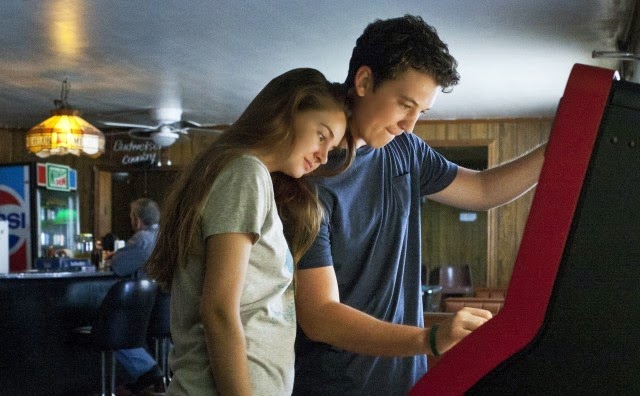
After a late-night partying binge he wakes up on the lawn of classmate Aimee Finnicky (Shailene Woodley), a pretty but socially invisible "girl next door" who reads manga and has a paper route. They start seeing each other. Sort of. That their relationship can't easily be classified because of how different they are is one of the film's biggest strengths and what follows is complicated, but in an authentic, messy kind of way.

Upon Sutter realizing he's actually falling hard for this girl, his thoughts shift to him not being deserving of her and there's this intriguing mystery that develops involving Sutter's long-absent dad (a brilliant Kyle Chandler). It's a supporting performance perfectly calibrated to subvert and challenge expectations of not only the character and story, but the actor playing him. Even seemingly minor players like Sutter's boss, Dan (Bob Odenkirk) are so richly drawn in their brief appearances you'd imagine a film focusing on them would be just as rewarding. As Sutter's older sister Holly, Mary Elizabeth Winstead conveys that there's even more to her than originally thought, the character's snobby demeanor merely a defense mechanism masking the emotional pain of their upbringing.    

Ponsoldt knows not to try too hard and at a turning point where everything could have flown off the rails, he resists the temptation, choosing even more honesty. That this takes place in unnamed "Smalltown, U.S.A" in an unidentifiable era brings a universality to the story, allowing it to exist in a timeless vaccum. No one will be laughing at the music and clothes years down the line, as is usually the case with most other high school movies. What will be remembered is how Teller and Woodley take familiar character types and make them feel completely fresh, him with offbeat goofy charm and her with a realness and authenticity that never come off as "acting." And just watch what she does in that killer final scene. She's too good to be toiling away in YA franchises, even if this was ironically adapted from a young adult novel. Let's just pretend the giant check she's cashing for Divergent is really for this.


Fruitvale Station
Director: Ryan Coogler
Starring: Michael B. Jordan, Melonie Diaz, Octavia Spencer
Running Time: 85 min.
Rating: R

★★ ½ (out of ★★★★)

Despite certain misgivings I have about about the film itself, none of them affect my feelings about Michael B. Jordan's performance as Oscar Grant, the young man shot and killed by a Bay Area Rapid Transit police at Oakland's Fruitvale Station on New Year's 2009. If anything, I wish that first-time writer/director Ryan Coogler's effort had the subtly and nuance of Jordan's performance, which sets a high bar the picture can't quite reach. There's little doubt that Oscar Grant was far from perfect. He was only human. And there's also little doubt what happened on that train platform was an avoidable tragedy with more than enough blame to go around, along with some unfortunate coincidences and bad luck. To say the transit cops handled the situation poorly would be a gross understatement, but it's hard not to feel Coogler's trying to unnecessarily stack the deck. The facts tell the story, yet he insists on going beyond that, to the point that by the film's finish it almost feels like we've gotten a public service announcement.

The film follows the last day of the 22-year-old Californian's life before being fatally shot on that train platform, circumventing the rocky relationship he has with his girlfriend and the mother of their infant daughter, Sophina (Melonie Diaz, really strong), and his own mother, Wanda (Octavia Spencer). It paints a picture of an ex-con trying to do right and get on the straight and narrow for his family. For all we know much of it may have gone down as depicted. But certain details feel too convenient, with Coogler going so far out of his way to avoid portraying his subject as a saint that he ends up doing exactly that.

There's an early scene in which Oscar tries to save a dying dog hit by a car. Besides the incident being drenched in heavy-handed symbolism and blatant foreshadowing, I could have done without animal cruelty (real or simulated) to show us Oscar's a good guy. And just to level things out we also get a scene where he threatens his boss. No one thinks this young man "deserved" what eventually happens so it's perplexing that we're being lectured on his morality with contrived situations. Maybe they happened. Maybe not. But it rings false in the context of this film.

It's when we finally get to that train platform that things start to feel real. How the situation escalates to the point it does is so fascinating and disturbing that you almost wish the whole movie was this incident in real time, if it wasn't so difficult to watch. Coogler's clearly a skilled director, making excellent use of shaky cam to give us a found footage feel and show various points of view from different witnesses. Certain details from earlier pay off in surprising ways, creating a storm of events that tragically converge at the station. The last half hour earns its emotional response by doing away with the editorializing and grandstanding and just showing what happened .

Anyone who's seen Friday Night Lights knows how great an actor Michael B. Jordan is and so much of that natural charisma and quiet intensity is on display here. We care about Oscar because of his performance, one that too often must battle to overcome the script's flaws. It's a problem when a film is based on true events and you can't believe much of what happened even it it's completely true. The last shot reveals the film's true intentions. And that's the roadblock when tackling a controversial real life issue. Judgments and intentions are best checked at the door.

Sunday, December 11, 2011

The Descendants


Director: Alexander Payne
Starring: George Clooney, Shailene Woodley, Judy Greer, Beau Bridges, Matthew Lillard, Robert Forster, Nick Krause, Amara Miller 
Running Time: 115 min.
Rating: R

★★★ ½ (out of ★★★★)

It's rare to see a movie as informed by its setting as Alexander Payne's The Descendants. Watching, you get the impression the story couldn't have taken place at all if it didn't take place in Hawaii. The characters wouldn't feel what they feel, do what they do and the entire mood, atmosphere and pacing would seem off. The Hawaii we're presented with here isn't one we've been made aware of before, at least in movies. The opening voiceover even let's us know that much. It's more depressing than exotic, so unlike the vacation destination we've seen on postcards that it doesn't even register as the same place. If only Hawaiian locals only went to the beach all day, rode waves and had drinks with little umbrellas in them like we we've been told they do for years. This is the first time it hasn't been depicted as pure paradise and in doing so Payne fittingly humanizes this film's setting as much his characters, showing real flaws and imperfections that somehow lead to a greater appreciation of both.

While people who live in paradise still have problems, they're hopefully not as big as the ones plaguing real estate lawyer Matt King, played by George Clooney in a dialed down performance sure to net him another Oscar nomination. With his wife Elizabeth (Patricia Hastie) laying in a coma after a boating accident, the wealthy lawyer has been entrusted to a large, lucrative piece of land passed down from his ancestors. With the state and his family waiting on pins and needles he must decide as sole trustee whether the family should sell to cash in or hold on to the property. Coming off the bench as the "back-up parent" he has to deal with his two daughters. 10-year-old foul-mouthed Scottie (Amara Miller) is acting out at school and at home while her angry, rebellious 17-year-old sister Alex (Shailene Woodley) returns from boarding school, giving Matt the shocking news that their mom was cheating on him.

Moving at a methodical, appropriately laid-back pace for most of its running time the story really starts finding its rhythm when the big revelation about Elizabeth's infidelity arrives. That's the turning point. From then on the story takes some twists and turns with the land sale figuring into the personal story in a way that's unanticipated without feeling forced. What's interesting is that despite being on life support in a hospital bed the entire and never even being seen in flashback the narrative forces the viewer to form strong feelings about Elizabeth as we watch those closest to her react to the news of her betrayal. It wouldn't be off base to say that the more we learn about her the less we like, to the point I could honestly say I hated her. That's a strange declaration to make when the offender in question is already laying in a coma but that feeling seems to be exactly what Payne is going for since the characters struggle with that as well. Matt is in shock, plagued by the insatiable urge to track down the man she was cheating with, a sleazy island realtor named Brian Speer (Matthew Lillard, a long way from Scream). Or rather it's assumed he's sleazy from a single fact and it's kind of funny how it seems we know everything about him before the actual introduction, or want to believe we do.

The quest to find Speer turns the movie into a road trip with Matt, Scottie, Alex and her dim-witted boyfriend Sid (Nick Krause), who shoots off wildly inappropriate comments at the worst moments. They have to contend with Matt's grumpy father-in-law Scott (Robert Forster) who blames him for his daughter's accident just as he faces increasing pressure from cousin Hugh (Beau Bridges) and his extended family about the land sale.  Anticipation builds for the family's eventual encounter with Speer, a meeting that somehow surpasses expectations. That's when things really get crazy. And I haven't given anything away. It all could have easily played like a soap opera (which it kind of is) but there's a brutal honesty and truthfulness to the scenes that keep it from going into shallow territory. It's a thin line to walk but Payne never crosses it, nor do his actors.

Sad and weary-eyed, wearing old man khakis and flowery shirts, Clooney downplays the movie star charisma he's famous for, just as he did in last year's The American. As a parent completely defeated by life, he brings a depressed vulnerability and hangdog physical presence to Matt we're not used to seeing from the actor. If it's not his best performance, it's sure way up there and will easily net him another Oscar nomination. And if he wins I can't say I'd have a problem with it. For all the jokes about his popularity and "Mr. Hollywood" persona these past few years, he's been taking on more meaningful projects and pushing himself in different directions as an actor, refusing to ever take the quick payday when he very easily could.

If Clooney does win, he can probably give cut the statue at its waist and give half to Shailene Woodley, who rises to the near impossible task of making us not only understand Alex, but see how her actions could actually be justified under the circumstances. Saddled with the film's most emotional scenes, she slowly peels the layers away to reveal Alex is far from just the spoiled brat we'd assume from her initial introduction. Equally strong and vulnerable, she gives a beyond her years performance that never tells the audience what to think or feel and seems in perfect harmony with the script. That she's only been known until now for starring in ABC Family's The Secret Life of The American Teenager, of all things, stands as proof that undiscovered talent can come from anywhere at any time, and all it takes is one performance in the right project.

Lillard's cheating Brian Speer doesn't build up as much disdain as comatose Elizabeth, at least until we meet his wife. Then viewers will want to wring his neck. That's because she's played by Judy Greer. Unarguably the most underrated, instantly recognizable actress working today, she's finally freed here from the shackles of the "best friend" in romantic comedies as she steps up to the plate in a third act dramatic role that isn't necessarily any larger than those those, but ten times more complex. It's difficult to get into without spoilers but you can argue the story doesn't fully register until Greer arrives, going toe-to-toe with Clooney and turning what could have been a cliche of the scorned wife into the character I walked away caring what happened to most. Here's hoping this part helps break her through into the leading lady ranks where she's belonged for a long time.  I'd say I wished the entire movie were about her, but it in many ways it actually is. Or rather it's about how sometimes a life situation gets so bad you're left with no choice but to let go, rather than risk the anger completely consuming and destroying you.

It's becoming increasingly difficult going into a movie knowing it's a big awards contender and hearing about Oscars even before seeing the results on screen. While the problem should be that it puts more pressure on the film and sets unreasonable expectations I instead frustratingly find that the opposite is true. These movies almost seem to have an unfair advantage from the start since it's common knowledge that the best films are usually reserved for the final two months of the year. This makes it easier for the movie but a bigger challenge for the critic who has to throw out all that other information out the window strengths and weaknesses.

The Descendants isn't perfect, but it's close. Coming from someone who thinks voiceovers often get a bad rap, I still have done without Clooney's over-explanantory narration since it just doesn't point out anything we can't see for ourselves. Also, a noble attempt to develop the Sid character doesn't seem to register like it should. This is the first film to use exclusively authentic Hawaiian music in lieu of a traditional movie score and it makes a big difference in terms of conveying mood and atmosphere, even if there's this small part of me that wanted one huge music moment. For some reason it seemed like a classic Cat Stevens song would have fit in perfectly. It's just that kind of movie.

It's still unclear how it ranks against Payne's previous efforts like Sideways, Election and About Schmidt but it already feels weightier than those and more substantial. There's something about it's style and approach that stays with you even though the story, with a few surprise exceptions, is fairly universal and basic. Given it's been 7 years since his last film, it's a credit to how skilled he is at telling human, truthful stories that the wait felt even longer than that. In a way this is my favorite type of film: an intimate writer-driven piece interested in exploring real people dealing with actual problems. It sounds like a cliche, but in the right hands it can be the most satisfying form of entertainment because it tends to stick around after you've left the theater. It's easy to see what all the fuss is about since The Descendants is the kind of intelligent adult drama that's increasingly hard to come by.