Showing posts with label Kyle Chandler. Show all posts

Tuesday, May 12, 2026

Anniversary

Director: Jan Komasa
Starring: Diane Lane, Kyle Chandler, Zoey Deutch, Mckenna Grace, Dylan O' Brien, Daryl McCormack, Madeline Brewer, Phoebe Dynevor, Sky Yang, Rebecca O' Mara
Running Time: 111 min.
Rating: R

★★★★ (out of ★★★★)  

Director Jan Komasa's Anniversary asks what happens when the actions of those surrounding you can longer be explained away as politics. It theorizes where that line is and how it gets crossed, bleeding over into legal and ethical waters that have less to do with party affiliation than an emerging ideological battle between "us" and "them." Scarier still is how many won't realize this until it's too late, their moral compasses malfunctioning when needed most.  

If that sounds like an episode of The Twilight Zone, it easily could be, if only the film's events weren't so believably grounded in reality, even by Rod Serling's standards. With that comes the tendency to label this as a mirror reflection of current events or complain how it isn't taking enough of a "stance." Of course, that's precisely the kind of thinking this film rallies against and why it rises so far above similarly themed projects attempting to tackle such issues. It's about the story, leaving it all up on the screen for us to reach our own conclusions. 

Georgetown University professor Ellen Taylor (Diane Lane) and restaurateur husband Paul (Kyle Chandler) are celebrating their 25th wedding anniversary with their adult children at the affluent family's sprawling estate. Attending are depressed environmental lawyer Cynthia (Zoey Deutch) along with her husband/fellow attorney Rob (Daryl McCormack), rebellious lesbian stand-up comic Anna (Madeline Brewer), aspiring teenage wildlife scientist Birdy (Mckenna Grace) and struggling novelist son Rob (Dylan O' Brien), who's accompanied by new fiancée Liz Nettles (Phoebe Dynevor). Polite and complimentary, Liz hopes to make a positive first impression on his parents, but Ellen eventually recognizes her as a former student who left Georgetown after the professor she pushed back on her controversial ideas advocating for a totalitarian government. 

As Paul attempts to convince his wife that everyone deserves another chance, Liz gifts Ellen a copy of her latest book, The Change: The New Social Contract. Co-written with Rob, its contents sicken Ellen, who immediately realizes it's just an expanded, updated version of Liz's dangerous worldview. But by the time  everyone next gathers, the book's already incited a full-fledged political movement that's sweeping the nation. And even while many of the Taylors remain vehemently anti-Change, Liz and Josh's power grows, as does their expanding influence, ripping the country and this family apart, just as Ellen warned.

Despite her employment at an academic institution under fire for its liberal leanings, Ellen categorizes herself as "non-political," believing such labels cause people to see only the truth they've conditioned themselves to accept. But what's more interesting is writer Lori Rosene-Gambino's choice to withhold the specifics of Liz's hugely influential novel beyond a brief excerpt and Ellen's descriptions of it as "anti-democratic" and "fascist." The film's actually less concerned with outlining what's in the book than showing us its subsequent impact, all while Ellen remains ahead of the curve, her premonitions about Liz's true intent initially falling on deaf ears. 

Ellen knows Liz's incapability for growth, but any suspicions that a vengeful former student is back to infiltrate this family eight years later are dismissed by husband Paul as paranoia. And Lane gives one of her strongest performances in years as a wife and mother whose mannerisms can barely suppress the frustration that no one's seeing what she is, especially Paul, who's more interested in keeping the peace. But when Ellen gets an early glimpse of Liz's soon-to-be bestseller, she completely snaps, unable to contain herself any longer as the Change starts catching on.  

We easily understand how everyone else would accept the self-assured Liz at face value, or at least assume she doesn't pose the massive threat Ellen speaks of. Coming across as friendly, intelligent and put together in every way, there's no reason to suspect the worst, aside from maybe wondering what she sees in a floundering Rob. But Dynevor's sneaky performance hints that something's off as Liz maintains this blank, almost coldly emotionless poker face the entire time. After a while we'll realize she's there with a single-minded purpose, even while continuing to question whether she's really capable of all Ellen alleges. 

Much to Paul's displeasure, an explosive Thanksgiving family dinner erupts when the action leaps forward two years and it's increasingly hard to ignore for him to keep ignoring politics at the table. It's also difficult not to notice an unrecognizable Rob's transformation from geeky, self-loathing journalist into cocky, belligerent control freak. And few feel the wrath of that quite like outspoken sister Anna, who uses using her public platform to condemn the Change before facing disastrous consequences when more than just her first amendment rights are stripped away. Cynthia isn't thrilled about any of this either, with her depression and marital problems with Rob compounding an already dire situation. 

The wild card is an introspective Birdy, who's played by an impressive McKenna Grace, whose quietly heavy lifting leaves her character's intentions up in the air. A confused, curious teen still figuring things out, we read the teen's expressions and mannerisms looking for hints, until realizing she may not know herself. Torn between an intense, anti-Change activist boyfriend Moses (Sky Yang) and a brother and sister-in-law looking to exploit her perceived vulnerability to their advantage, Birdy's allegiance is unclear. And yet she's stronger than they think, but also somehow weaker, with nothing fully preparing us for how important to the story she'll become.   

With its stars centered in the middle, The Change regime's American flag is a clever, distorted perversion meant to symbolize the country joining in the middle, supposedly free from political parties and division. Of course, what that really means is an oppressive single party system that foists its beliefs on the nation with force. The distressing sight of it shakes Ellen to her core, causing her to do something she'll regret, or maybe not, since the character's defining trait is her unwavering commitment to standing up for what she believes. But whether a single book can carry this level of cultural currency and influence might be the wrong question to ask when sometimes all it takes is a small spark to set social media ablaze, allowing the public to take care of the rest. 

The film's masterful in its escalation as Lane and Chandler's stressed characters subtly age a lifetime, deteriorating before our very eyes as they wonder how things went so spectacularly wrong, especially in raising son Rob, who Liz easily molds and manipulates into the person he thinks he wants to be. O' Brien's metamorphosis as Rob is the stuff of nightmares, particularly during his tense sit-down with Paul in the film's second half, as the latter now grasps the enormity of his own son's actions, finally drawing a line in the sand. 

The always underappreciated Chandler plays Paul as a hardworking, salt of the earth everyman who isn't exactly naive, but chooses to see the best in people, especially his own family. He sees this as a problem that can be temporarily ignored, if not fixed, with small talk and a some burgers. Unfortunately, by the time he heeds his wife's warnings and hunkers down for an ugly fight, the country's careened into an Orwellian surveillance state, reinforced by a chilling third act census visit. But when any political movement gets too big and dangerous to control, no one's immune from the consequences, including those supposedly in charge. 

What starts as a dysfunctional family drama morphs into an American tragedy before emerging as a full blown suburban nightmare that hits too close to home. It also boasts a loaded dream cast where each member stands on equal footing, their respective performances peaking at various points to cohesively form pieces of a much larger puzzle. Starting with an anniversary party and ending with a far different one, its incisive, unsettling script comes full circle with mind blowing developments and a guarantee you'll never hear Crowded House's "Don't Dream It's Over" the same way again. 

In a less fragmented viewing landscape and with proper studio support, you can envision a scenario where Anniversary becomes one of the more hotly debated and discussed releases of the past year. Instead, Lionsgate seemingly buried it with a generically inoffensive title that hints at them not knowing what they had or maybe even being scared to promote it. Simply calling this The Change would have been a better call, at least drawing attention to the controversial uprising at the story's core. But audiences willing to put preconceptions aside and embrace this at face value can prepare for a thriller as terrifying as it is thought provoking.                                                                                     

Saturday, July 7, 2018

Game Night


Directors: John Francis Daley and Jonathan Goldstein
Starring: Jason Bateman, Rachel McAdams, Kyle Chandler, Billy Magnussen, Sharon Horgan, Lamorne Morris, Kylie Bunbury, Jesse Plemons, Michael C. Hall, Danny Huston, Chelsea Peretti
Running Time: 100 min.
Rating: R

★★★ (out of ★★★★)

Getting a big boost from a clever script that takes some unexpectedly twisted and darkly inspired turns, it's unlikely anyone would walk away from Game Night dissatisfied. And that's exactly how it should be. While this doesn't reinvent the comedy wheel, it  accomplishes what few recent comedies have in delivering a fun time without being burdened by qualifiers that it's overlong or makes boneheaded decisions along the way. Carried by a ridiculously talented cast, it takes a reasonably high concept comedic premise and just runs with it, offering the reassurance that everyone involved knows exactly what they're doing. As it turns out, they do.

When super-competitive gamers Max (Bateman) and Annie (Rachel McAdams) meet during trivia night at a bar, it's love at first sight, as the two begin dating and then marry, bonding over their shared obsession with winning. This is exemplified by their traditional weekend "game night" with friend Ryan (Billy Magnussen) and spouses Kevin (Lamorne Morris) and Michelle (Kylie Bunbury). Excluded is creepy, socially awkward cop next door, Gary (Jesse Plemons), who's been uninvited from the festivities ever since his wife left him and is desperately looking to get back in. But when Max's extremely successful and charming brother Brooks (Kyle Chandler) reappears on the scene, it causes his lifelong feelings of inadequacy (as well as his inability to conceive a child with Annie) to bubble to the surface.

Looking to once again show up Max, Brooks plans to take game night to a whole new level, staging an elaborate interactive role-playing mystery at his new pad that the participants won't soon forget. The winning prize: His Corvette Stingray. But when things get out of hand, and the line separating what's a game and an actual kidnapping starts to blur, the players must band together to save Brooks and somehow find a way to escape with their lives intact.

What makes all of this work is its premise, or rather co-directors John Francis Daley (best known for playing Sam on Freaks and Geeks) and Jonathan Goldstein's commitment to keeping the characters and viewers in the dark about what's happening. There are moments in the script where you confidently assume the unfolding events have to be "part of the game," yet you're still not completely sure. The uneasiness surrounding that, and each of the major players' reactions to the escalating crisis, permeate every scene, making for some great comedic exchanges.

Each character seems to have a relatable quirk that's exploited with every catastrophe, allowing the night's "mystery" to act as the perfect platform for their faults. The movie wastes no time, from an ingenious board game-style opening credit sequence that lets us know everything about Max and Annie within minutes, leading right into the "game night" concept. He's insecure. She's hyper-competitive. Brooks is an attention whore so in love with himself that this interactive mystery theater could only be his idea. And with the arrival an "FBI Agent" at the door, we're off to the races.

If you're searching for a comedic or dramatic actor who makes everything around him better by simply being there and logically, matter-of-factly existing as a surrogate voice for the audience, few are better than the largely unheralded Jason Bateman. And you could argue none are as reliable, knowing when you see his name atop the credits he'll deliver exactly what you want and expect, regardless of whether the project itself happens to disappoint. And it definitely doesn't here. Of course, the argument against him is that he always plays the same put-upon straight man. Aside from that being entirely disproven with darker turns in The Gift, Disconnect and his recent best ever work in Netflix's Ozark, I'd still argue variations of that lane is all he needs since it's such an easily adaptable one across all genres.

Bateman's normalcy makes those around him seem scarier, funnier and more entertaining than they would have otherwise been opposite someone else. Ceding the spotlight so co-stars can reap the rewards, no one can look as befuddled, grimace in disgust or dryly deliver a sarcastic dig quite like he can. If the quintessential small screen example of his comedic skills are are found in Arrested Development, then Game Night might stand as his best recent big screen offering of it.

Nearly every sub-plot and one-liner lands, logically furthering a plot that's probably better mapped out that it had any right being. While it's arguable the mere casting of Bateman and Chandler as feuding brothers is enough to carry this, it's surprising how many other elements click into place and manage to play just as well. If only occasionally given the chance to show it in other projects, Rachel McAdams can be devastatingly funny when she needs to be and here she's given the opportunity opposite Bateman to utilize that timing. They bounce off each other so well that they're the rare screen couple that are even funnier when they're in total agreement because their personalities are so competitively obnoxious, yet strangely compatible. They play the whole thing straight, forging forward to win despite obvious signs this isn't a game. Or is it? To these two everything may as well be, which make them the perfect victims/players.   

Even running, throwaway gags like Kevin's unhealthy obsession with guessing the identity of Michelle's secret celebrity hookup and the airheaded Ryan wising up and bringing his super-intelligent ringer date, Sarah (Sharon Horgan) into the game, not only provide a decent amount of laughs, but result in extremely satisfying payoffs that enhance the characters. But the character who makes the most impact and sends the the film's entertainment quotient through the roof is Jesse Plemons' creep cop neighbor, Gary, whose obsession with his ex-wife and her "game night" friends make everyone within his vicinity deeply uncomfortable.

Plemons plays this perfectly, which is to say deadly serious, as if he's Hannibal Lecter wondering why no one's invited him to dinner. Just watching the other actors' react to this is a treat in itself, as everything from his stilted body language to monotone delivery imply a complete sociopath. He completely and unflinchingly commits to it, and the film is all the better as a result. While for many there's a certain level of anticipation in seeing Friday Night Lights alum Plemons reunited with Coach Taylor, he and Chandler share maybe about two scenes together. But it's the latter scene in the third act that will grab the most attention because it's just so completely insane. It isn't often you can say you've seen Chandler, Plemons, Bateman and Michael C. Hall all share the screen together at one time and have it exceed even the wildest of expectations.

It's nice to see a comedy that's as smart as the actors appearing in it since the last one to reach that lofty goal was Shane Black's criminally overlooked The Nice Guys. This isn't quite as laugh-out-loud hilarious and subversively clever as that effort, but it succeeds just the same for what it's aiming for. While there likely will be a sequel looming on the horizon, the idea of this concept being expanded isn't something I'd necessarily roll my eyes at provided it's done right and reunites the cast and creative forces that made this work so well. It isn't often you can say a big, mainstream comedy is even worth the trouble of revisiting, but another Game Night actually doesn't seem like such a bad idea.

Sunday, March 5, 2017

Manchester By The Sea


Director: Kenneth Lonergan
Starring: Casey Affleck, Michelle Williams, Kyle Chandler, Lucas Hedges, Gretchen Mol, C.J. Wilson, Tate Donovan, Kara Hayward, Anna Baryshnikov, Heather Burns, Matthew Broderick
Running Time: 137 min.
Rating: R

★★★ ½ (out of ★★★★)

Bleak and almost relentlessly dour, Kenneth Lonergan's Manchester by the Sea will undoubtedly be a trying watch for anyone with an aversion to large helpings of depression and hopelessness in their cinematic diet. At over two hours and two tragedies later, you'll be reminded it's Oscar season again, if it wasn't already obvious. It's about real people struggling with real problems, but the plot doesn't always take the easy way out by connecting the dots between point A and point B or offering up a pat resolution. For the character Casey Affleck inhabits, there's no possible resolution available that could redeem him or allow him to look in the mirror in the morning without hating the man he sees. It's clear early on that he was involved in something, but even before we're filled in entirely, it's a given it was catastrophic, not only changing the course of his life, but everyone around him. At first he's quite and unassuming, prone to occasional bouts of rage that only intensify upon discovering the amount of responsibility he'll soon take on. He's not ready for it and may never be, but he's the only option left in a sea of bad choices.

While there's no mistaking that Affleck's lead turn is the big draw here, everyone else isn't just merely tagging along for a ride that can best be described as melancholy. Like the tortured protagonist at its center, it's introspective in a way likely to turn off mainstream audiences looking to escape to the movies for a good time. Usually, I'd scoff at the categorization of any film as being "for critics" but this comes closest to fitting the bill with a loose, free-flowing narrative sure to frustrate some. But unrelenting in its fleshing out of emotional pain, it's also intelligent and observant, taking its time telling a story about grief sure to touch, and possibly disturb, anyone forced to go through something even remotely similar, and the many more who haven't.    

Withdrawn, reserved handyman Lee Chandler (Affleck) is working in Quincy, Massachusetts, arguing with tenants by day while drinking and starting bar fights at night. But when Lee gets word from family friend, George (C.J. Wilson) that his brother Joe (Kyle Chandler) suffered a heart attack, he rushes up to his hometown of Manchester, only to discover he's passed away. Staying a few days to handle funeral arrangements and break the news to Joe's teen son, Patrick (Lucas Hedges), Lee's informed by a lawyer that he's been named by Joe as the boy's guardian.

Unwilling to move back to Manchester and refusing to let Patrick stay with his estranged alcoholic mother, Elise (Gretchen Mol), Lee's insistence on uprooting the teen from his current life and dragging him back to Boston with him causes a contentious rift between the two. Making matters worse is Lee's penchant for acting out and starting trouble, frequently revealing a violent side that clashes with his outwardly quiet nature. Flashbacks to his once happy life with ex-wife Randi (Michelle Williams) and their three children in Manchester reveal a horrifying tragedy that both explains his refusal to return and the sad, bitter man he's now become. Through Patrick comes the opportunity to reconnect with someone who could use a friend and an uncle, as well as possibly reclaim at least a small piece of himself he lost years ago.

Reading only a description of the two main characters, it would probably be difficult to tell the adult from the child in the picture, at least when based exclusively on their behavior. Taking a somewhat different turn from what's expected, Patrick isn't an angry, rebellious kid acting out in the wake of his father's death. If anything, it's the exact opposite, as he's a really good kid who's surprisingly well adjusted and takes the news of his dad's passing as you'd imagine an understandably devastated but mature person would. Most people would probably be lining up to be this kid's guardian, realizing they could easily do far worse. Unfortunately, Lee's a complete wreck and the thought of him raising any child, even if it's just until he turns 18 in couple of years, is scary proposition given his current emotional state.

Lonergan builds up a good deal of suspense by slowly revealing through flashbacks drips and drabs of Lee's previous, more fulfilling life, all leading up to the incident that destroys everything.  Initially, we're given a peek into his relationship with his brother and nephew during happier times, perhaps providing evidence that he was at one point the ideal choice to look after Patrick should something happen to the long ailing Joe. But then it happens. The accident. Without giving too much away, it's just about the worst possible tragedy that could happen, with responsibility for it laying squarely at Lee's feet.

We already have a general idea what the event is, but once we actually find out, everything about his behavior starts more clearly coming into focus. It's a miracle he can even get up in the morning, much less function at all. And often he can't. Every interaction he has with another human being is strained in some way, with the possibility hovering that he could explode at any moment. There's a flashback scene at the police station following the event that's so difficult to get through it's almost unreal, as Affleck plays Lee as being in such a shocked trance that he's barely present. That is until he gets one piece of information that sends him flying off the deep end, as the realization hits that they'll be no one to punish him for his horrifying mistake but him. And if need be, he'll spend the rest of his sad, miserable days doing so. Calling what Affleck does in the film a "performance" nearly fails to do it justice, as this could more accurately be described as a compulsive study of human behavior in the throes of extreme grief.

With a hangdog expression permanently etched on his face, you can literally sense and feel Lee's pain with each exasperated line of dialogue. You're on edge the whole time, wondering when he'll snap next. Lee's truly given up, which is why his relationship with Patrick, is so crucial to both of them. There's the legitimate risk Lee could drag him down the same rabbit hole of grief and depression, if not for the fact Patrick processes things far differently, sharing few of his uncle's worst inclinations. Lucas Hedges brilliantly downplays what would have been your stereotypical "angry teen," understandably saddened and rattled by his father's death and frustrated by his uncle's inability to compromise on any level. Their interactions provide what might be the only levity and humor in the film, as does Pat's attempts at juggling his two girlfriends, Sylvie (Kara Hayward) and Sandy (Anna Baryshnikov), with Lee in the house.

What initially appears to be extreme selfishness on Lee's part gives way to the truth that he'll never be able to live in Manchester with the specter of that life-destroying event hovering over him. In his own words, he just "can't beat it," and as much as he wants to make that sacrifice for his nephew, the guilt's too consuming, swallowing him up from the inside out. When he finally comes face-to face with ex-wife Randi, the result is the film's most emotionally brutal scene, with Affleck and Michelle Williams putting on a clinic of frustration, forgiveness and outrage as their two characters talk and scream over each other, completing each other's sentences and reading minds in the messy way that only two people who have been through what they have could do. While the scene lasts only a couple of minutes it feels like something that's been slowly simmering from the beginning with the payoff proving to be worth the wait, only further solidifying what we've now long known about the level of Williams' talent. 

A script-driven project if there ever was one, Manchester by the Sea is all about the writing and performances, with everything else falling into place to support that, except for maybe a musical score that seems unnecessarily obtrusive at times. Despite not being from the New England area, Lonergan clearly understands the setting and how its chilly, grey atmosphere enhances the visual storytelling, providing the ideal stage for complex characters who make realistic choices that don't seem to hinge on contrivances or obvious creative force pulling their strings. Spending this much time with characters and a subject that's as dark as it gets, it's somewhat of a miracle that it's this engaging. By no means an easy movie to wrap your arms around or even rewatch, it's ultimately a rewarding one, anchored in no small part by Casey Affleck's most complex, nuanced work to date.

Monday, March 31, 2014

The Spectacular Now, Fruitvale Station


The Spectactular Now  
Director: James Ponsoldt 
Starring: Miles Teller, Shailene Woodley, Brie Larson, Jennifer Jason Leigh, Kyle Chandler
Running Time: 95 min.
Rating: R

★★★ ½ (out of ★★★★)

High school coming-of-age movies have fallen a considerable height from the glory days of John Hughes, where teens were treated as three-dimensional people viewers of any age could root for and care about. A brief description of The Spectacular Now would easily fool anyone into thinking it's joining the recent scrap pile. Bad boy meets good girl and she has to redeem him. But director James Ponsoldt and (500) Days of Summer screenwriters Scott Neustadter and Michael H. Weber flip that premise on its head, delivering a smart, sensitive drama that doesn't pander to its audience, while insightfully observing real life problems without a hint of manipulation or contrivance. Each decision feels carefully considered, with so much resting on the standout performances of the two leads, who are given the opportunity to play flawed, likable characters we want to see happy, independent of whether they end up together or not.

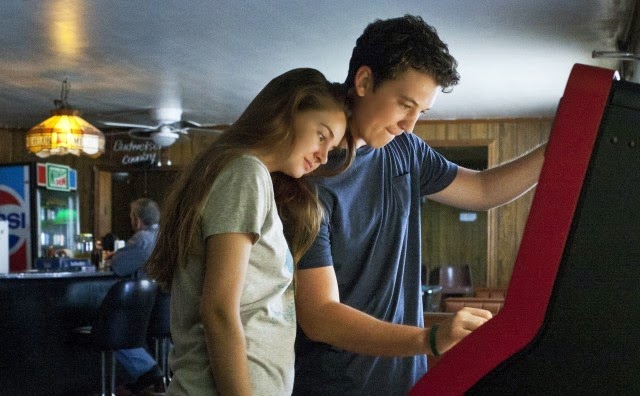
Miles Teller plays popular, but unambitious high school senior Sutter Keely, whose daily life consists of an endless stream of drinking and partying, with little thought given to his future. In a rare touch for the genre, Sutter's vices don't look fun in the least, depicted instead as a serious addiction that's taking over. He's basically a teenage alcoholic. His equally popular girlfriend (Brie Larson) dumps him and it's gotten to the point that even his mother (Jennifer Jason Leigh) can't put up with it anymore.

After a late-night partying binge he wakes up on the lawn of classmate Aimee Finnicky (Shailene Woodley), a pretty but socially invisible "girl next door" who reads manga and has a paper route. They start seeing each other. Sort of. That their relationship can't easily be classified because of how different they are is one of the film's biggest strengths and what follows is complicated, but in an authentic, messy kind of way.

Upon Sutter realizing he's actually falling hard for this girl, his thoughts shift to him not being deserving of her and there's this intriguing mystery that develops involving Sutter's long-absent dad (a brilliant Kyle Chandler). It's a supporting performance perfectly calibrated to subvert and challenge expectations of not only the character and story, but the actor playing him. Even seemingly minor players like Sutter's boss, Dan (Bob Odenkirk) are so richly drawn in their brief appearances you'd imagine a film focusing on them would be just as rewarding. As Sutter's older sister Holly, Mary Elizabeth Winstead conveys that there's even more to her than originally thought, the character's snobby demeanor merely a defense mechanism masking the emotional pain of their upbringing.    

Ponsoldt knows not to try too hard and at a turning point where everything could have flown off the rails, he resists the temptation, choosing even more honesty. That this takes place in unnamed "Smalltown, U.S.A" in an unidentifiable era brings a universality to the story, allowing it to exist in a timeless vaccum. No one will be laughing at the music and clothes years down the line, as is usually the case with most other high school movies. What will be remembered is how Teller and Woodley take familiar character types and make them feel completely fresh, him with offbeat goofy charm and her with a realness and authenticity that never come off as "acting." And just watch what she does in that killer final scene. She's too good to be toiling away in YA franchises, even if this was ironically adapted from a young adult novel. Let's just pretend the giant check she's cashing for Divergent is really for this.


Fruitvale Station
Director: Ryan Coogler
Starring: Michael B. Jordan, Melonie Diaz, Octavia Spencer
Running Time: 85 min.
Rating: R

★★ ½ (out of ★★★★)

Despite certain misgivings I have about about the film itself, none of them affect my feelings about Michael B. Jordan's performance as Oscar Grant, the young man shot and killed by a Bay Area Rapid Transit police at Oakland's Fruitvale Station on New Year's 2009. If anything, I wish that first-time writer/director Ryan Coogler's effort had the subtly and nuance of Jordan's performance, which sets a high bar the picture can't quite reach. There's little doubt that Oscar Grant was far from perfect. He was only human. And there's also little doubt what happened on that train platform was an avoidable tragedy with more than enough blame to go around, along with some unfortunate coincidences and bad luck. To say the transit cops handled the situation poorly would be a gross understatement, but it's hard not to feel Coogler's trying to unnecessarily stack the deck. The facts tell the story, yet he insists on going beyond that, to the point that by the film's finish it almost feels like we've gotten a public service announcement.

The film follows the last day of the 22-year-old Californian's life before being fatally shot on that train platform, circumventing the rocky relationship he has with his girlfriend and the mother of their infant daughter, Sophina (Melonie Diaz, really strong), and his own mother, Wanda (Octavia Spencer). It paints a picture of an ex-con trying to do right and get on the straight and narrow for his family. For all we know much of it may have gone down as depicted. But certain details feel too convenient, with Coogler going so far out of his way to avoid portraying his subject as a saint that he ends up doing exactly that.

There's an early scene in which Oscar tries to save a dying dog hit by a car. Besides the incident being drenched in heavy-handed symbolism and blatant foreshadowing, I could have done without animal cruelty (real or simulated) to show us Oscar's a good guy. And just to level things out we also get a scene where he threatens his boss. No one thinks this young man "deserved" what eventually happens so it's perplexing that we're being lectured on his morality with contrived situations. Maybe they happened. Maybe not. But it rings false in the context of this film.

It's when we finally get to that train platform that things start to feel real. How the situation escalates to the point it does is so fascinating and disturbing that you almost wish the whole movie was this incident in real time, if it wasn't so difficult to watch. Coogler's clearly a skilled director, making excellent use of shaky cam to give us a found footage feel and show various points of view from different witnesses. Certain details from earlier pay off in surprising ways, creating a storm of events that tragically converge at the station. The last half hour earns its emotional response by doing away with the editorializing and grandstanding and just showing what happened .

Anyone who's seen Friday Night Lights knows how great an actor Michael B. Jordan is and so much of that natural charisma and quiet intensity is on display here. We care about Oscar because of his performance, one that too often must battle to overcome the script's flaws. It's a problem when a film is based on true events and you can't believe much of what happened even it it's completely true. The last shot reveals the film's true intentions. And that's the roadblock when tackling a controversial real life issue. Judgments and intentions are best checked at the door.

Thursday, January 31, 2013

Zero Dark Thirty


Director: Kathryn Bigelow
Starring: Jessica Chastain, Jason Clarke, Joel Edgerton, Mark Strong, Jennifer Ehle, Kyle Chandler, Chris Pratt, Edgar Ramirez, Mark Duplass, Frank Grillo, Harold Perrineau, James Gandolfini
Running Time: 157 min.
Rating: R

★★★★ (out of ★★★★)

When we first meet Jessica Chastain's Maya in Zero Dark Thirty, she's silently and nervously watching her CIA colleague Dan (Jason Clarke) interrogate a potential Al-Qaeda suspect. It's an interrogation that soon turns to torture when he tells her to fill a bucket of water. She can barely bring herself to do it and we're thinking there's no way this is the same woman the agency nicknames "killer," much less the one who eventually brings down the most dangerous man in the world. It'll be only moment of hesitancy we see because, like everyone else, we've underestimated her.

At its core this is about a woman who's beyond exceptional at her job, steadfastly refusing to take "no" for an answer. Wherever there's red tape, she walks through it. When superiors are in her way, she plows right over them. Operating with an emotionless, laser-like focus and precision, it's impossible for anyone to deter her from her main objective: Finding and killing Osama Bin Laden. In many respects she's the most patriotic, inspirational protagonist we've seen on screen in some time, but Oscar-winning director Kathryn Bigelow (again corroborating with Hurt Locker writer Mark Boal) won't let us get all warm and fuzzy about it. In fact, she hardly even gives us a moment to come up for air.

The chain of events start on September 11, 2001 but for the film's purposes the really begin in 2003 when Maya's career-long obsession with Bin Laden and Al-Qaeda leads her to be reassigned to the U.S. Embassy in Pakistan where she witnesses and learns Dan's interrogation tactics and gets a potential lead on the whereabouts of Bin Laden's courier and right-hand man, Abu Ahmed. For all the complaints and controversy concerning the depiction of torture to gain valuable intel one of the more under-reported stories about the film is the sheer quantity of it, as the opening thirty minutes of the film is nearly all waterboarding.

The lead Maya gets isn't concrete (as few are) but it's one that stays with her and she obsesses over as she moves up the ranks in the CIA. Her biggest obstacles and bureaucratic and political as she faces off against the agency's Islamabad Station Chief Joseph Bradley (Kyle Chandler), who's more interested in adding notches to his belt by preventing domestic attacks than locating bin Laden. He'll learn that you don't stand in Maya's way. So will his boss (Mark Strong) and so will the CIA's director (James Gandolfini). Maya's greatest strength is in how by sheer force of will and determination she can eliminate those who won't fight for her cause and sympathetically convince those on the fence who she needs (like Edgar Ramirez's Special Division officer) to cooperate.

Maya lives, breathes and sleeps catching bin Laden and has little time for others who won't. When her co-worker (exceptionally played by Jennifer Ehle) asks why she doesn't have a boyfriend her response is exactly what you'd expect. She doesn't care, or she does, she sure as hell won't show it.  This isn't an actor's showcase or typically the type of role that lets a performer show off their chops, which is what makes Chastain's work that much more miraculous. The movie may be ice but somehow she isn't, despite infusing the distant Maya with all the characteristics that should make her difficult to root for under other circumstances. Or it could be that we're just not used to having our female characters written this strongly. It's the rare case where you could change the name on the script to a man's and still be able to leave the rest of the screenplay alone. And to think anyone would claim Chastain's performance isn't paramount to the film's success or somehow takes a back seat to the terror or torture sequences. She's in every scene, carrying this whole thing on her back.

This is a cold, clinical, procedural showing its only signs of a pulse in its unforgettable final scene, which is as strong a finish as you'll see in any film this year. But much like the mission itself, it feels meticulously executed, even as plans constantly change. One lead takes Maya to another lead and then to another after that until the SEAL Team arrives at Bin Laden's compound in the final, thrilling hour. Our appreciation of the steps Boal's script takes us to get there and all suspense rests entirely on the fact that we know the ending, but not necessarily everything. Will we get to see him? Will he say anything? Will we get to know who shot him? And yet these are all trivial questions in Bigelow's world, where the cold, hard truth is a far cry from the sensationalistic dramatization everyone likely expected going in.

It's also about risk. In one key scene a character talks about how it's easy measure the dangers of doing something but the risk of not acting is always trickier to figure out. It's all about weighing the options and for Maya it's her skill, confidence and even a little bit of luck that lands bin Laden on her lap. Her problem is convincing everyone there's a shot, including the members of the Team being thrown into the lion's den. The two we meet (played by Joel Edgerton and Chris Pratt) express concerns of their own and they're pretty logical ones. The last 40 minutes of the film are unbearably suspenseful and masterfully edited, almost literally bringing us in the compound to experience details we've only partially been privy to or have just wildly speculated on. Bigelow and Boal could have easily called it a day there, but they thankfully keep going, giving us a glimpse of its aftermath.

If there's a single decision that got Bigelow and Boal into the most trouble it's the disclaimer that appears before the film starts, informing us that it's "based on first-hand accounts of actual events."  If only they knew what they stepped into with that statement, however true it may be. And to be honest, I don't particularly care. This isn't a documentary and they can fudge the truth as much or as little as they want. You don't have to like it, but it's the filmmaker's right. Despite allegations, the movie doesn't automatically take a pro-torture stance by showing. And if Boal did embellish, or even if he made the whole thing up (which by all accounts he didn't), I still wouldn't have cared, just as long as the final product on screen delivers.

All the "controversy" surrounding the film feels like a convenient excuse to have political arguments that should be taking place outside the theater. Still, it's tough to deny any film generating this kind of discussion is at all a bad thing, provided that anger isn't directed at those who made it. The focus should be on how Boal's script somehow condenses a decade's worth of intelligence information into a sustainable, compelling narrative and how Bigelow was able to make an even more muscular and unrelenting film than The Hurt Locker. But Zero Dark Thirty's most controversial stance comes in an ending that's anything but celebratory. It's strangely sad and uncertain, bravely daring to ask the important question: What now?   
              

Friday, August 12, 2011

Friday Night Lights: The Fifth and Final Season

Producers: Peter Berg, Brian Grazer, Jason Katims
Starring: Kyle Chandler, Connie Britton, Michael B. Jordan, Matt Lauria, Aimee Teegarden, Jurnee Smollett, Madison Burge, Grey Damon Taylor Kitsch, Zach Gilford, Adrianne Palicki,
Original Airdate: 2010

★★★ ½ (out of ★★★★)
 
Let's just go ahead and add Friday Night Lights to the list of shows that should have been one of TV's most watched, but for whatever reason, wasn't. Praised to high heaven by critics but ignored by audiences, the big question remains "Why?" It's easy to blame NBC, who dropped the ball with their constant schedule shuffling and lack of promotion, but you could also argue the network saved its life when they struck a deal with DirectTV extending its run for three more seasons, which is three more than anyone thought it would get. FNL may have never amassed the rabid cult following of other ratings-challenged shows that got the axe, but this lasted longer, and those who watched all five seasons still feel like part of an exclusive club. Whether you chalk it up to it being "too real" or not sensationalistic enough (its two best attributes in my mind), the show didn't catch fire nationally like it should have. But it's very difficult to care when you look back at the finished product over five years and consider the creative high it's departing on. And in achieving what no other drama in television's history can by not just surviving, but somehow thriving when most of the cast departed, there's nothing at all for fans to be disappointed about here. In keeping with that trend of final seasons never representing any series' creative pinnacle, season 5 definitely isn't its best, but it sure is great, cementing its status as being head and shoulders above any recent drama on TV.

Coach gives the team a pep talk before State
The series' fourth (and best) season saw a major upheaval for Eric Taylor (Kyle Chandler), after being replaced as the head football coach of the Dillon Panthers and initially struggling in his new position as coach of the East Dillon High Lions, the school where his wife Tami (Connie Britton) works as guidance counselor. The show's writers have had to literally rebuild the series from the ground up after losing some major players, both on and off the field. Gone over the past two seasons were Minka Kelly's former Panther cheerleader Lyla Garrity, Adrianne Palicki's bad girl Tyra Collette, Scott Porter's paralyzed Jason Street, Zach Gilford's star QB Matt Saracen, Jesse Plemons' geeky Landry Clarke and Taylor Kitsch's troubled ex-Panther running back Tim Riggins. While the last three stuck around for much of the fourth season before departing as series regulars, these blows were enormous and would have killed any other show outright. Instead, the writers were brilliant in how they maneuvered around it using the big three characters that were left last season to gradually get us to warm up to the new faces who would now be carrying the show, and succeeding. Before long, I'd forgotten that almost the entire cast was gone. Turning the tables and repositioning the Dillon Panthers (who we'd been conditioned to cheer since the pilot) as the spoiled, dominant villains in a rivalry against Coach Taylor's poor, underdog Lions from East Dillon breathed new life into the series and gave every character (with the exception of Brad Leland's underutilized Buddy Garrity) a fresh purpose and direction.

Lions booster Buddy Garrity has a heart-to-heart with troubled son Buddy, Jr.
As the star Lions QB Vince Howard, Michael B. Jordan has been a revelation but this season sees an already troubled home life with his recovering addict mother, Regina (Angela Rawna) complicated by the return of an important figure from his past. With his ego swelling to gigantic proportions, Vince must also adjust to his off again, on again girlfriend Jess Merriweather (Jurnee Smollett) taking a job as the team's equipment manager, while farm boy teammate Luke Cafferty's (Matt Lauria) somewhat controversial relationship with Becky Sproles (Madison Burge) moves to the next level despite her shocking abortion last season. The relatively new cast have no problems carrying a full season on their own for the first time without the help of any of the originals and any problems are relegated to the first half of the season and have little to do with them. Half-hearted attempts to add more new supporting characters to an already seamless cast results in failure as there just isn't enough room to define them. The arrival of Buddy Garrity's son, Buddy, Jr. (Jeff Rosick) is a bust since he spends the whole season on the sidelines doing nothing, while a new addition to the Lions' squad, former basketball player Hastings Ruckle (Grey Damon), is forgotten about as quickly as he's introduced. Tami's sub-plot involving her attempts to rescue a troubled student named Epyck (Emily Rios) feels more like an after-school special than a development befitting one of TV's most restrained dramas. 

Julie Taylor reunites with Matt Saracen in Chicago.
The season's worst storyline revolves around Julie Taylor (Aimee Teegarden), the weakest character on the series who's always been borderline intolerable whenever separated from soulmate Matt Saracen. Topping previous hall of shame Julie moments like drunkenly coming on to Tim Riggins in season 1 or hooking up with the "Swede" in season 2, the writers take it to a whole new level of embarrassment this time as we actually follow Julie to college, where she has an affair with a sleaze bag teaching assistant. Tonally inconsistent enough to conjure up bad memories of Landry the murderer from season 2, FNL was always so strong because it avoided over-the-top, teen soap histrionics in favor of subtle, more realistic storytelling. I understand the need to get Julie back to Dillon and reunited with Matt but the same thing could have been accomplished without us having to follow Julie to college, watch her struggle to fit in on campus, then endure a cringe-worthy spectacle that has nothing to do with the show, even if it was only for a few episodes. Then again, if they did that, I wouldn't have anything to complain about, and whining at length about this silly storyline is probably more fun than I'd want to admit. Luckily, Julie is mostly redeemed in the second half of the season when she does reunite with the returning Matt twice. And therein lies the conundrum with Julie Taylor. Teegarden's always been handed the worst material on the show so it's nearly impossible to judge her worth as an actress, yet whatever craptastic storyline gets thrown the character's way, you still can't bring yourself to actively dislike her. A big part of that just might be she's Coach Taylor and Tami's daughter, and since they're the heart and soul of the show, we view her as we would an annoying little sister, at times empathizing with her growing pains. So in a strange way, there is some real truth in the character.

Vince's recently paroled father, Ornette plots his son's future.
The possibility that Coach Taylor could leave Dillon, Texas at some point has always loomed large so it's fitting that this final season presents the biggest chance yet of that happening as he fields offers from interested universities, while deeply considering what such a move would mean for not only for him, but his marriage, family and players. This is juxtaposed against Vince dealing with the return of his recently paroled father, Ornette, played by Cress Williams in a season-stealing guest performance that invokes fright and uncomfortable laughter. An unpredictable loose cannon who helps Vince violate every college recruitment regulation in the book, the character is presented with the subtlety of a sledge hammer but in this case it's completely called for since the storyline itself is so gripping, bringing Vince's inner demons to the surface and tearing his relationship with Coach apart. You're on edge waiting to see what this delusional, but oddly well-intentioned nut job will do next, knowing it can't possibly end well. It's a testament to Williams' work as this villain we love to hate that there's more to Ornette than just his scary side and at times you see shades of the cool dad Vince wants to view him as and please. Vince's worst enemy has always been his past so this was the perfect way to go with him as he has to finally stand up and be the man his father couldn't. Even by the finale, it's clear that battle will be ongoing.

A depressed Tim Riggins is comforted by the returning Tyra.
The final hours rank among the series' best as the writers go all out bringing back  Saracen, Saracen's Grandma, Landry, Tyra, Jason Street and the recently incarcerated Tim Riggins who took the fall for his brother Billy's (Derek Phillips) chop shop last season and now emerges from prison a sad, depressed shell of his former self. That storyline really hogs the spotlight for the last couple of episodes and it's really tough to argue with that decision since the final episodes represent the best acting work Taylor Kitsch has done since the series' inception and the issues with his brother and sister-in-law Mindy (Stacey Oristano), is given the closure we've been hoping for. Sad and defeated in a way he he's never been before, his readjustment the daily life is almost tortuous to watch until you realize he's finally hit rock bottom and emerged with a new outlook and set of morals, obvious when Tim is the only sane person who sees a problem with a 17-year-old girl working as a waitress at a strip club. One of my favorite surprises of the season was the blustery, boisterous Buddy Garrity embroiled again in the town's football politics as he returns to his pushy, annoying Panther roots. Given how vital Brad Leland's work was to the show's success in the first three seasons, it was great to see him back in the forefront for the home stretch.

The Taylors contemplate the decision of their lives.
The show's biggest strengths during its run has always been how the football action on the field helps tell the story of what's happening off it and the amazing music choices, whether it's a slow-burning southern rock anthem after the team's win or lose or the perfect indie song played at just the right time to make a potentially sappy moment (like Matt and Julie in Chicago) connect on the right level. At the end there is a "big game" but for a change it's outcome has never been less relevant. It's all about Coach Taylor and Tami as it's always been and the writers deserve credit for knowing that's where it should leave off. Kyle Chandler and Connie Britton have given us one of the most honest depictions of marriage on television in years. That the decision Coach Taylor makes in the final minutes actually comes as a surprise and feels earned is all due to the Emmy-worthy Chandler, who's been the glue holding this show together for five years, playing the part with an unsentimental blend of toughness and compassion.  

"Clear Eyes, Full hearts, Can't Lose."
Despite giving us as good a closer as it gets, there are still rumors of a movie, as there always seems to be when any critically hailed series with a following leaves the air. But unlike other promised movies based on canceled shows, I'm betting this is the one that'll actually happen since it makes sense. For one, it was already based on a successful novel and feature film directed by series creator Peter Berg. And though Berg's creative output as a feature director has been spotty at best (Hancock, anyone?), there's still no denying his movies made money and he's had success outside of the show. Add to that the fact that many of actors' stocks have risen considerably since leaving the series and the idea starts to make even more sense. Of course, this still isn't a guarantee it needs to happen but I'd give this a much better chance at succeeding than most. For a show that's always seemed like a feature length film each week, it just might work.

Crafting a fully satisfying final season has to be the most difficult challenge any screenwriter or showrunner could possibly face and if you don't believe me you can just ask the Lost creators. Delivering a truly great series finale is even harder. It's near impossible to tie up every loose end, give closure to each character past and present, close the door (but leave it slightly ajar "just in case") and send all the fans home happy. So difficult is it I almost feel funny criticizing anything that goes wrong, since it's a given whatever occurs on screen won't match expectations. A couple of storylines don't work, but what does work is superb and even its minor flaws are kind of absorbing too. Whatever debate lingers about the quality of the season as a whole is tempered by the final 43 minutes, which are unarguably perfect, putting the focus exactly where it needs as the show signs off for good. Series finales are rarely ever as strong or as emotional as this. Coach Taylor's motivational catchphrase over the past five years may have been "clear eyes, full hearts, can't lose" but it's unlikely any loyal fans watching the final few episodes of one of television's best written and acted series will have clear eyes at the end.

Thursday, June 23, 2011

Super 8


Director: J.J. Abrams
Starring: Joel Courtney, Kyle Chandler, Elle Fanning, Riley Griffiths, Noah Emmerich, Ron Eldard, Ryan Lee, Zach Mills, Gabriel Basso, Amanda Michalka
Running Time: 112 min.
Rating: PG-13

★★★ (out of ★★★★)

Nostalgia is a powerful thing. If it hits in just the right spot it can even trick you into believing you're watching something great by reminding you of a time when you felt you did. Writer/Director J.J. Abrams clobbers us with nostalgia in Super 8 and the results are so wildly mixed I've actually avoided sitting down to share my thoughts on it for days, mostly unsure of what they'd be. Attempting to invoke the spirit of vintage 80's Spielberg directed and produced movies like E.T. and The Goonies is a risky proposition in that it could either alienate or win over audiences in my age bracket who grew up with those films and know how special they are. It takes guts for Abrams to even try to invite comparisons to them for the sake of exposing younger audiences to a type of film that's becoming increasingly uncommon.

At points feeling like an homage and at others a lesser rip-off, moments in the first hour of this Spielberg-produced project (and his fingerprints are all over it) succeeded in making me feel like a 12-year-old again, until the plot careens off the rails and almost crashes and burns like the doomed train in the film. Luckily, it recovers in the last third to finish strong, thanks mostly to the child actors whose staggeringly authentic performances save Abrams as he loses touch with the movie it seemed he set out to make. Part of me wants to shake him silly for falling short of what could have been accomplished for stupid reasons, yet he also deserves a hearty handshake for even attempting to try something like this because we do badly need it. There are far worse things than trying to make a Spielberg-style coming-of-age summer blockbuster devoid of all cynicism but not quite getting all the way there. While I'm convinced I'm more impressed with the idea behind the movie (and maybe also the movie-within-the-movie) than the actual film itself, it's still a fascinating, if flawed, discussion starter that's entertaining and not easily forgettable. Abrams' execution may be sloppy, but he knows the right buttons to push.

Set in the small steel town of Lillian, Ohio in the summer of 1979 12-year-old Joe Lamb (Joel Courtney) is still emotionally traumatized by the accidental death of his mother four months earlier and a strained relationship with his father, Jack (Kyle Chandler), the town's sheriff. He wants to send him to sports camp for a few months, insensitive to Joe's desire to stick around to help best friend and bossy aspiring director Charles (Riley Griffiths) film his low-budget 8mm zombie movie with buddies Martin (Gabriel Basso), Preston (Zach Mills) and Cary (Ryan Lee). He's also somehow been able to recruit Joe's dream girl, Alice Dainard (Elle Fanning) to play the female lead, even as she endures a family drama of her own with alcoholic father Louis (Ron Eldard). During filming the kids witness a train wreck, the results of which are stranger than your usual train wreck and are captured by their Super 8 camera. What that footage uncovers raises a lot of questions and causes much chaos, even as the military, led by Colonel Nelec (Noah Emmerich) arrive on the scene with an agenda.

The one aspect of this film that's unquestionably a grand slam are these kids and nearly all its memorable moments are supplied by these child actors who are so good together (in both the real movie and the movie within) that for a while it doesn't even feel like a homage or a tribute to better films from the 80's, but the real deal.  The dialogue between them is smart and funny, they're clearly defined and we care about the relationships between them, especially the dynamic between Alice and Joe. You'd never know this was Joel Courtney's very first appearance in a feature film and Elle Fanning leads the charge with her performance, trumping even her recent work in Somewhere as far as the layers of complexity she brings to it. She has this one huge scene everyone will be talking about involving her character's performance within the zombie movie that works on so many different levels you're likely to get a headache trying to figure out how she does it.  All the kids' performances are great and the first hour resembles the best elements of The Goonies, complete with a map and some of the character types even being dead ringers for those in that family classic. But I still couldn't help but wish it was in the service of a more inventive story.

Once the action gets rolling I couldn't help but wish the young actors' efforts were in the service of a better story.  Problems start with the big train crash sequence, which relies too much on fake looking CGI and reminds us we're watching an everyday modern day blockbuster reliant on cheesy effects rather than character. How did it not occur to Abrams that approach is completely at odds with a period coming-of-age adventure set in the late 70s? The decision to do this is so ill-conceived it made me think Spielberg could have been behind it given his inexplicable (and embarrassing) over-use of the technology in the recent Indian Jones sequel. This also doesn't really feel like it's 1979 so much as a movie that's supposed to be set during that era with kind of a close approximation of the the wardrobe and music, but little else. Not once did I think I was watching anything that took place in the 70's or even early 80's, but rather a picture paying tribute to the values of that era and the movies made during it, present especially in the relationships between the kids and their parents. Fans of his work on Friday Night Lights will be excited to finally see Kyle Chandler on big-screen, then be deflated to discover he's just being asked to play Coach Taylor with a badge instead of a whistle, but slightly meaner. As little as he's given, he's still solid, which is more than can be said for a hilariously miscast Ron Eldard who somehow plays the archetype of the drunken dad even more cartoonishly than it's written. But like an early Spielberg classic, adults are only always seen through the eyes of children, so if it worked then, it's kind of hypocritical to condemn the approach now even if Spielberg was never this blatant about it.

Mid-way through the movie turns into a sequel to Abrams' own Cloverfield mish-mashed with The War of the Worlds. And I'm not even exactly sure how the military gets involved, why citizens are being evacuated or anything. It just kind of happens all of the sudden and we go with it because we're along for the journey with these kids and they're the movie's saving grace. The decision to keep the alien creature's appearance a secret for most of the running time is perplexing, especially considering what it ends up looking like and how little a surprise that is. This isn't about unraveling mysteries, even if it would have helped to have more of the J.J. Abrams who created Lost and Fringe than the one who rebooted Star Trek. Stranger still is the decision to concoct an elaborate backstory for the alien shown in grainy black and white flashback footage that resembles the Dharma Initiative films from Lost minus the intrigue. Yet it all somehow still comes together in an ending that's already been criticized as E.T. meets Close Encounters, if you can call that a criticism. For me it rescues the movie since it recreates the sense of wonder that was present in the first hour but lost somewhere in the middle of all the chaos. Michael Giacchino's soaring, emotional score (which intentionally sounds lot like John Williams' compositions for Spielberg in the 80's) goes a long way in helping.

Being such a grab bag of plusses and minuses, when this ended I was sure I didn't like it (and reading this you're probably thinking I still don't), but that it's worth checking out despite its flaws should give you an idea how good it could have been, or maybe how badly I was rooting for its success. Spielberg's being credited as the producer but the extent of his actual involvement could been anything from being heavily involved on a day-to-day basis to just putting some money down and visiting the set once, so it isn't fair to single him out for what worked or didn't. That said, he did slap his name on it with a full endorsement and it's essentially a tribute to his filmography so it's hard to not walk away feeling its failings are somehow his fault, despite Abrams writing and directing it on his own. You also can't help but wonder why it didn't turn out as good as it could have been with all the tools and inspiration he had at his disposal. Super 8 works well enough, but in doing so only proves that past Spielberg casts a shadow too large for even he himself to escape.