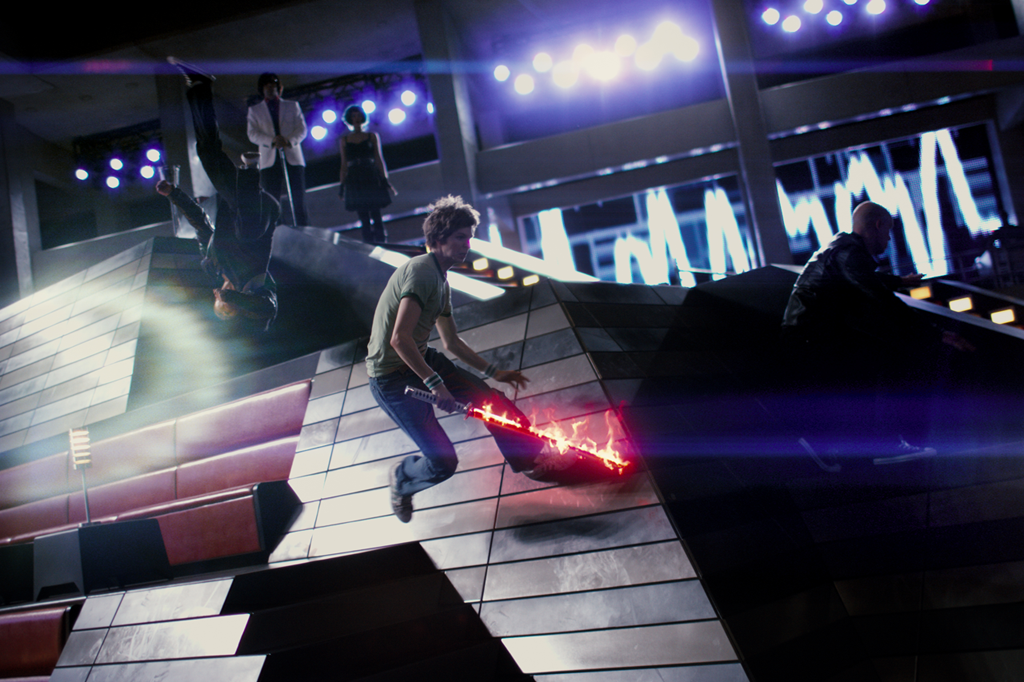
Showing posts with label Michael Cera. Show all posts

Friday, June 19, 2026

The Running Man (2025)

Director: Edgar Wright
Starring: Glen Powell, Josh Brolin, Colman Domingo, Lee Pace, Michael Cera, Emilia Jones, William H. Macy, Daniel Ezra, Jayme Lawson, Alyssa and Sienna Benn, Katy O' Brian, Karl Glusman, Martin Herlihy, Sean Hayes, David Zayas, Angelo Gray, Oluniké Adeliyi
Running Time: 133 min.
Rating: R

★★★ ½ (out of ★★★★)     

Of the many Stephen King adaptations that hit screens in 2025, a new take on The Running Man always seemed the most logical on paper. That's mainly due to so much happening in the world since the author first published his 1982 novel about a dystopian reality show that sees its protagonist competing in a nationally televised battle for his life. But when the Arnold Schwarzenegger original hit theaters a few years later, it arrived as a cheesy guilty pleasure very much of its era, yet ripe for a potential revisiting down the road. 

Now, with the confluence of reality TV, the internet, smart phones, digital surveillance, artificial intelligence and socio-political conflicts, key aspects of King's eerily prophetic tale have come to pass, creating a wealth of new ideas from which co-writer/director Edgar Wright can draw. And does he ever, which only makes the chilly reception this received from critics and audiences even more perplexing. Unfolding at a breakneck pace, it's edited and constructed well enough to earn a lengthy run time, with much of its success attributable to Wright's world building, a smart script, its great cast and a handful of mind blowing action set pieces. 

In a near future, the United States is governed by an authoritarian media entity called the Network, which ensures the country's population lives in poverty with little access to affordable healthcare. Rearing the nation's viewers on a trashy diet of reality TV and violent game shows, ordinary citizens are given a chance to beat the odds in rigged televised competitions that offer substantial monetary rewards. The most popular is The Running Man, where three "runners" have a shot at winning $1 billion if they survive 30 days without being killed by the Network's five "hunters." But for recently unemployed blue collar worker Ben Richards (Glen Powell), it could be his only chance at affording medicine for he and wife Sheila's (Jayme Lawson) sick two-year-old daughter, Cathy (Alyssa and Sienna Benn).  

Despite Sheila's pleas, Ben auditions for the show, bringing him face-to-face with producer Dan Killian (Josh Brolin), who senses he might have a huge ratings draw on his hands. Ben signs on the dotted line, but when the hunt begins, he quickly realizes fans are being duped by Killian and bombastic show host Bobby Thompson (Colman Domingo) into viewing him as a cold, calculated criminal. But while Ben captivates the audience and outsmarts mysteriously masked lead hunter Evan McCone (Lee Pace), Killian orchestrates the ultimate finale, as the show's latest breakout star fights for his survival. 

Even before the film's title card appears, we see a desperate, quick tempered Ben pleading for his old job back, having risked standing up for co-workers in a society where selfless actions aren't just frowned upon, but punished. Now with a sick child and his wife pulling double duty waitressing at a shady establishment, desperation starts sinking in. It's also our first glimpse of this corporate media dictatorship that strikes just the right balance of hewing close enough to certain aspects of contemporary culture while also having a semi-futuristic feel firmly rooted in sci-fi.  

Wright and co-writer Michael Bacall are threading a thin needle here, but the execution is backed up by Andrew Whitehurst's VFX and some really impressive set design from Marcus Rowland that help move this far past the TV-centric plot of its 1987 cinematic predecessor. And though a certain cheese factor remains, it's considerably less, passing as an actual game show you'd watch, albeit one that serves the story's many thematic goals. 

This battle-to-the-death manhunt presided over by its sleazy, carnival barker of a host manipulates viewers into accepting whatever constantly changing "rules" Killian sees fit. But it also accomplishes a larger, more sinister goal in keeping the lower class subservient to the Network, who dangle the possibility of hope over helpless contestants who don't stand a chance at winning. They're aware how stacked the deck is, but don't have a say, knowing their only shot at escaping poverty is surviving to the end. Cunning, athletic and angry enough for that to seem attainable, Ben's in a different league than fellow contestants Jenni (Katy O' Brian) and Tim (Martin Herlihy), creating an intriguing dynamic with Killian, who sees dollar signs for at least as long as he can control him.

The show's presentation and format is concisely explained without slowing the momentum, but it's what happens once Ben leaves the studio that makes for such a thrilling ride. If the '87 film failed at opening up King's story, this better explores Ben (given some flimsy disguises by William H. Macy's store owner Molie) contending with a bloodthirsty public eager to give him up for a reward. As the hunters close in, the film cleverly incorporates social media and drone cameras, making it clear even the highly skilled Ben needs more help. This is evident when mandatory video testimonials he mails in to air on the program are edited and manipulated by Killian to push the Network's agenda and turn viewers against him.  

There's a relentless, brilliantly staged hotel action sequence that sees Ben attempting to escape the hunters' clutches that's somehow topped by a latter one that plays like a deranged and dangerous Home Alone reenactment. All of it eventually leads to a plane ride from hell that finds Ben in an explosive final showdown that'll determine his ultimate fate. Along the way we get some lively supporting turns from Daniel Ezra as a Running Man-obsessed streamer aiding Ben in his escape and a wildly entertaining Michael Cera, whose rebellious survivalist Elton will do anything to exact revenge on the Network that killed his father. 

Cera's brief, but incredibly memorable and eccentric performance strikes just the right tone while Emilia Jones appears late in the third act as Amelia, a highfalutin woman taken hostage by Ben. Yes, her character's a plot device, but you'd never know that considering all she brings to a role that serves an such an important function in Ben's quest to open the public's eyes to government crimes and corruption. 

Though Pace strikes an evil, imposing presence as masked vigilante McCone, it's Brolin's Svengali-like Killian who calls the shots, filtering instructions through Colman Domingo's flamboyant emcee. The latter puts his own unique spin on Richard Dawson's '87 outing while the ideally cast Brolin personifies this smarmy, manipulative mastermind with more than a few twists in store. He may respect Ben's will to win, but primarily sees him as a tool for further strengthen the Network's grip over society. 

Ben becomes a symbol, and whether he survives the ordeal or not, his impact could prove longer lasting by showing citizens their potential power to invoke change. Powell provides a worthy mix of anger, desperation, physical prowess and morality to the rebellious Ben, demonstrating again why he received all those early Tom Cruise comparisons. While he's not there yet, and his best work remains 2024's overlooked Hit Man, this project can't help but feel like another step forward in further showcasing that versatility.        

Aside from a pat, overexplanatory final few minutes that tells rather than shows, The Running Man flirts with perfection and may even be superior to King's similarly themed The Long Walk adaptation from the same year. Easily putting to shame the '87 version, it'll rattle Scott Pilgrim fans to hear it's a strong contender for Wright's best film, or at least his most focused and accessible. Free from any polarizing quirks, this looks and feels like a big deal, rarely letting up as it makes the most of its inspired premise. And by using time and technology to expand on the original's ideas, it enhances the potency of a message that's only grown in the decades since. 

Saturday, August 16, 2025

The Phoenician Scheme


Director: Wes Anderson
Starring: Benecio del Toro, Mia Threapleton, Michael Cera, Riz Ahmed, Tom Hanks, Bryan Cranston, Mathieu Amalric, Richard Ayoade, Jeffrey Wright, Scarlett Johansson, Benedict Cumberbatch, Rupert Friend, Hope Davis, Bill Murray, Charlotte Gainsbourg, Willem Dafoe, F. Murray Abraham, Stephen Park
Running Time: 101 min.
Rating: PG-13

★★★ (out of ★★★★)       

For anyone wondering how a Wes Anderson directed international espionage picture would play out, an answer comes with The Phoenician Scheme, which looks and feels a lot like previous Anderson efforts. But that's only bad news if you happen to detest his dry humor, twee tone, penchant for recycling the same actors in different roles, or even that unmistakable Futura font. And while it all converges into a distinctive style sometimes known as the "Anderson aesthetic," it has just as many fans as detractors, many of whom eagerly await each new release. 

When cinephiles rank Anderson's' divisive output there's largely agreement on what they've seen, often causing them to love and hate chosen titles for exactly the same reasons.  But after the visual and narrative spectacle of Asteroid City hinted at more complex themes bubbling just under the surface of its meta structure, this satire reprsents the latest signpost for his brand of mannered quirkiness. And though it can't help but feel like a slight step back in comparison, there's no denying it still showcases what he does best. 

It's 1950 and eccentric arms dealer/industrialist Anatole "Zsa-Zsa" Korda (Benicio del Toro) is busy trying to evade multiple assassination attempts until a horrific plane crash nearly does him in. Fearing time may be running out, he attempts to reconnect with his only daughter, Liesel (Mia Threapleton), a Catholic nun repulsed by her father's behavior and suspicious he murdered her mom. Still, he persuades her to leave the Church to help run his business on a trial basis, also hiring Norwegian entomologist and family tutor Bjørn (Michael Cera) as administrative assistant.

Risking his wealth on a scheme to overhaul Phoenicia's infrastructure with slave labor, Korda plots to thwart the government's plans to bankrupt him by duping investors into covering the budget shortfall. Joined by Liesel and Bjørn, he starts with Californians Leland (Tom Hanks) and Reagan (Bryan Cranston) before moving on to French nightclub owner Marseille Bob (Mathieu Amalric), Newark investor Marty (Jeffrey Wright), and even his own cousin, Hilda (Scarlett Johansson), an heiress to the family fortune. Infuriating them with his lies, Korda refuses to enlist the help of estranged half-brother Nubar (Benedict Cumberbatch) due to their troubled history. But as Liesel spends more time with her dad, she reluctantly holds out hope that he's capable of change.

Somehow both convoluted and mind numbingly simple, the plot's almost beside the point, serving as an excuse for its characters to engage in the absurd, but highly entertaining hijinx put in motion by Korda's embarrassing scheme. Much of why involves the road trip element, which gives Anderson's troupe of regulars a chance to shine in wildly different roles. But none of that would be possible without del Toro's brilliantly bonkers performance as Korda, a clear amalgamation of narcissistic industrialists like William Randolph Hearst and Aristotle Onassis. 

Anderson employs a treasure trove of cultural, historical and cinematic references to fill out this story centering around his main character's eccentric peculiarities, such as adopting as many kids as possible and organizing his business files into separate shoeboxes. Del Toro has to walk a thin line line here, playing a selfish swindler, deadbeat dad and charmingly likable rogue all wrapped into one, showing just enough humanity for us to understand why Leisel bothers sticking around.

Amid a flood of famous faces, it's a revelatory Threapleton who makes the strongest impression as Liesel, whose faith is tested when confronted with the prospect of not only forgiving her emotionally inaccessible dad, but somehow forging an actual relationship with him. And it's when her character experiences Korda's moral failings up close that Threapleton's sarcastic wit and bemused facial expressions supply the film its heart. And opposite both in his largest Anderson role to date, an ideally cast Cera plays the awkward, bumbling Bjørn to perfection, just as we'd expect.  

While Hanks and Cranston's appearances do feel more like celebrity cameos than fleshed out parts, they're still sort of a hoot as brothers, with Wright and Johansson managing to give the looniest, most worthwhile turns of the investors. Others like Bill Murray, Willem Dafoe, Hope Davis and F. Murray Abraham only pop in and out. It's really the uncomfortable camaraderie between Korda and his two travel companions that carry this, leading right into the eventual sibling showdown with Cumberbatch's scary, bushy eyebrowed Nubar. The result is a surprisingly sentimental finale that prioritizes substance over style. 

Anchored by a charismatically flawed character in the vein of odd, ornery Anderson protagonists like Royal Tenenbaum and Steve Zisssou, it's hard not to wish this was at least slightly better, or even a little less messy. But with a trio of tremendous lead performances, a clever structure and stretches of hilarity, there's a lot to appreciate. Those rooting for Anderson to completely step outside the box may have to wait a little longer, but in giving us more of the same he continues to prove that few do it better.                        

Sunday, January 28, 2024

Dream Scenario

Director: Kristoffer Borgli
Starring: Nicolas Cage, Julianne Nicholson, Michael Cera, Tim Meadows, Dylan Gelula, Dylan Baker, Kate Berlant, Lily Bird, Jessica Clement, Marnie McPhail-Diamond, Paula Bondreau, Noah Centineo
Running Time: 100 min.
Rating: R

★★★ (out of ★★★★)

Nicolas Cage has taken on so many wild roles over the past decade it's easy to forget just how skilled he is at inhabiting average, everyday people trapped in circumstances beyond their control. In writer/director Kristoffer Borgli's black comedy Dream Scenario, we're reminded, which isn't to say Cage's bland, middle-aged protagonist doesn't have his fair share of quirks and eccentricities. But for the most part, he's almost painfully normal. At least until stumbling upon overnight fame for a really unusual reason, creating far more problems than it solves.  

In asking viewers to consider how they'd endure a similar situation, most of the film's surprises come from unfamiliar places. He might be the butt of the joke, but it's likely most couldn't handle things any better, as this sci-fi fantasy morphs into an existential nightmare that offers a scathing social commentary about the cost of fame. Once the public starts projecting their own ideas of him into the world, we get a story that wouldn't seem out of place in The Twilight Zone. And at its center is Cage, who isn't playing the agent of chaos this time, but its unsuspectingly hapless victim.

Socially awkward, mild-mannered biology professor Paul Matthews (Cage) can't seem to catch a break. An adjunct at a local university, his lectures on zebras bore students while his supportive wife Janet (Julianne Nicholson) and daughters Sophie (Lily Bird) and Hannah (Jessica Clement) roll their eyes at him. Desperately wanting to be published, the timid Paul halfheartedly confronts a former colleague (Paula Bondreau) over an allegedly stolen idea before encountering ex-girlfriend Claire (Marnie McPhail-Diamond), who confesses he's been inexplicably appearing in her dreams. 

After Paul grants Claire permission to write about these dreams for an article, strangers start coming out of the woodwork claiming to recognize him from their dreams. As his celebrity profile rises, he hires a forward thinking PR firm to help manage his suddenly limitless opportunities. But when everyone's dreams turn increasingly violent and sinister, an angry, unsympathetic public blame Paul, making him their number one target.

The one thing all these dreams (cleverly referred to as a "collective Mandela Effect") have in common is that this bearded, balding man's walk through role in them is limited to passive observance, no matter how dire or outrageous the situation. While irked by how closely that resembles his actual tendencies, there's still a large part of him enjoying the newfound fame, with the best scenes revolving around how his undersized personality conflicts with it. Previously defined by a small, anonymous existence, this strange phenomenon makes his world a whole lot bigger, flipping whatever life he had upside down. 

Paul's lectures are now not only well attended, but exciting, with students eager to pick the brain of the world's most recognizable face. But the gap between Paul's desires and people's expectations grow, most noticeably in his interactions with goofy, people pleasing public relations CEO Trent (Michael Cera) and the firm's smitten assistant Molly (Dylan Gelula) who becomes obsessed with recreating her explicit dreams of Paul, to disastrous results.

Paul becomes sort of an everyman symbol society can embrace until these dreams turn to nightmares. But what's most astonishing is just how far the script goes with this, depicting a cancel culture catastrophe where popularity hinges on fans' fickle whims. Their dreams aren't "real," but they're still emotional triggers, representing at least some piece of them or they view reality.

Borgli's even more interested in the concept of entering someone else's consciousness, culminating in a great visual payoff involving Paul's marriage that's as strangely moving as it is comical. There's also a heavy emphasis on how his plight connects to the ethical conundrum surrounding dream technology. If there's any drawback, it's that the film sometimes trips over itself in the delivery, unsure how to get this all out. Still, there are deep ideas in here that make a good enough case for subsequent viewings.    

Playing an introverted, unassuming professor battling perceptions of his more dangerous nocturnal counterpart, there are definite echoes of Cage's work in Charlie Kauffman's Adaptation, with the actor again proving why he's an ideal fit for off-the-wall parts that amount to more than they first appear. And given how he's resisted critics and audiences placing him in a box throughout his career, it's only appropriate he's playing someone trapped in such a predicament. But with as much to say about us as his embattled character, Dream Scenario rarely backs down when it comes to exploring the full ramifications of its oddball premise.                                  

Thursday, September 28, 2023

Barbie

Director: Greta Gerwig
Starring: Margot Robbie, Ryan Gosling, America Ferrera, Kate McKinnon, Issa Rae, Rhea Perlman, Will Ferrell, Simu Liu, Ariana Greenblatt, Michael Cera, Helen Mirren, Alexandra Shipp, Emma Mackey
Running Time: 114 min.
Rating: PG-13 

★★★ ½ (out of ★★★★)

The toughest challenge facing a film based on Barbie is convincing viewers to set aside their worst preconceived notions, some of which may seem justified. As a concept, there's little reason to believe anyone other than Mattel and Warner Bros. benefits from bringing the most famous doll in contemporary culture to the big screen. And there are countless ways for this to go wrong, making all that trepidation understandable. But co-writer/director Greta Gerwig gets this, incorporating those potential criticisms into the plot and boldly addressing them head on.

The script stays about four or five steps ahead, disarming reluctant audiences by deconstructing the entire Barbie myth and using it to convey bigger ideas about gender, conformity, aging, masculinity, femininity, capitalism, consumerism and social change. And if that reads more like a syllabus than an easily accessible mainstream blockbuster based on a toy line, it's not. This still manages to be ridiculously fun, with a subversive, self-deprecating sense of humor to go along with the surprising performances and ambitiously elaborate comedic sequences. 

Closer to The Truman Show than The Lego Movie, it's obvious from its opening 2001: a Space Odyssey spoof and accompanying Helen Mirren narration that this will be something. We haven't a clue exactly what, though that becomes part of the charm. Immersing us in a universe that visually astounds and serves as the backdrop around which its entire meta fantasy revolves, Gerwig not only conceives a populist film, but a smart one that's worth revisiting to fully appreciate all it has to offer. 

"Stereotypical" Barbie (Margot Robbie) lives in Barbieland, a brightly colored community inhabited by various versions of Barbies and Kens, some current and others discontinued. While Kens spend most of their days at the beach hanging out, Barbies hold prestigious occupations like doctors, scientists, lawyers and politicians, garnering greater respect within society. One particular Ken (Ryan Gosling) exists solely to gain the attention and affections of Barbie, who appears uninterested in taking their relationship to another level. But when Barbie awakens in her Dreamhouse like every other morning, she realizes that something's gone horribly wrong. 

After coming down with inexplicable symptoms such as a sudden fear of death, flat feet and cellulite, Barbie seeks out disfigured outcast Weird Barbie (Kate McKinnon), who reveals the only way to cure this is by traveling to the real world to find the child playing with her. So with Ken in tow, Barbie travels to Venice Beach, California to locate tween girl Sasha (Ariana Greenblatt), whose mom Gloria (America Ferrera) is a Mattel executive. But as Barbie suffers from serious culture shock and the company's bumbling CEO (Will Ferrell) plots to send her back to Barbieland, Ken picks up some damaging real world philosophies that threaten their happy community.

From the start you can tell things aren't what they appear in this seemingly utopian environment, and by the time Barbie hops in her convertible and boat for answers, the gamut of possibilities Gerwig and Noah Baumbach bring to the table start playing out. Accompanying the outrageous scenes of Barbie and Ken's attempts to assimilate into real life are crippling emotional blows to her entire sense of identity and purpose. But at least she has one, which is more than you can say for Ken, who tires of being an appendage and yearns to reinvent himself.   

Barbie realizing she doesn't have legions of female fans lined up to greet and thank her is a harsh wake-up call, but even harsher are the very valid reasons why. Spanning decades as a corporate product that's reflected both Mattel's whims and the values of those who purchased her over generations, she has a complicated history. The landscape's evolved since 1959, with the company often playing catch up, as many legitimate critiques of the toy line end up forming the script's foundation. So does the strained mother-daughter relationship Barbie lands right in the middle of, connecting like the best Toy Story installments do by bottling up nostalgic themes of outgrowing childhood. 

It's fittingly ironic this is what's garnered Margot Robbie her strongest notices and biggest box office when she's made a career cleverly evading inferior parts that could have resembled superficially written versions of Barbie. But this only makes it easier to respect everything she does to humanize a character who's also a knowing commentary on the actress playing it, as Mirren's narrator memorably acknowledges. Such a physical match for Barbie that they actually place the word "stereotypical" in front of her name, Robbie makes this a referendum on the doll's entire existence, shaken out of her complacency and contentment to see the world through real eyes rather than those of a billion dollar corporation.

If Barbie must now account for unfamiliar feelings of embarrassment and humiliation, Ken makes a different kind of discovery about himself that goes beyond pining after her. This epiphany results in the film's funniest montage, as images of horses, American flags and Sly Stallone flash before his eyes, planting the narcissistic seeds for a newfound patriarchal obsession. From there, Gosling's turn only grows more wildly unhinged, reaching its pinnacle with his show stopping "It's Ken" musical number. As a power struggle develops between the sexes, the onus is on Barbie to prevent the only home she knows from backsliding into Don't Worry Darling's retro prison. But it comes with the recognition that their former situation wasn't exactly the picture of equality either.

Nearly everyone else also get their opportunities to shine, managing to convey uniquely distinctive personalities amidst an entertaining assembly line of Kens and Barbies. America Ferrara and Ariana Greenblatt really deliver as the mother/daughter duo with a relatably strained relationship, even as the former is called upon to carry a lot of the script's trickiest material toward the end with a hugely important monologue. 

More recognizable names like Ferrell and McKinnon have rarely been used as purposefully, including a hilariously deadpan Michael Cera who steals every scene he's in as the ostracized and ignored Allan. A great Rhea Perlman plays what's best described as an essential mystery part that cuts to the story's core. It's brief, but she makes the most of every minute, radiating a warmth and sarcastic authenticity that helps sell the film's pivotal moment.

An elaborate musical beach battle squashes any lingering doubts Gerwig can't hold this all together, doing it in just under two hours to boot. And in constructing a Mattel playset come to life, production designer Sarah Greenwood's Barbieland creation is as fun to take in as the characters themselves, ensuring that the purely frivolous fluff everyone assumed this would be can still co-exist alongside biting satire.  

Even when slightly losing its grip as subtext becomes glaringly literal messaging, there's an almost immediate recovery, leading to a final act that skillfully ties all the preceding themes and ideas together. It comes as a relief in a year we've been pummeled by films about popular products, showing just how hard it is to walk that tightrope of not desecrating the brand while placating audiences weary of a feature length commercial. But what's still most mind boggling about the entire phenomenon is that when Gerwig was hired to make Barbie movie, this somehow ended up being her response. 

Thursday, October 31, 2013

This is the End


Directors: Seth Rogen and Evan Goldberg
Starring: Seth Rogen, Jay Baruchel, James Franco, Jonah Hill, Danny McBride, Craig Robinson, Michael Cera, Emma Watson, Rihanna, Mindy Kaling, David Krumholtz, Christopher Mintz-Plasse, Aziz Ansari, Kevin Hart, Martin Starr
Running Time: 106 min.

★★ ½ (out of ★★★★)

Sometimes it can be freeing for viewers to be given a break from the rigid constraints of what we've come to expect from comedies. To be filled with the feeling that literally anything can happen at anytime and what we're watching isn't dependent on a specific formula that's been tried before. This is the End provides that tantalizing proposition, as a group of talented, likable actors are given the opportunity to just cut loose and poke fun at their own celebrity by playing versions of "themselves." It's a golden idea from the minds of Superbad co-writers Seth Rogen and Evan Goldberg, even if it looked more enticing on the page than it ends up being on screen. I kept wondering if maybe these guys setting just a few ground rules would have done the film some good, as it starts out promising until devolving into kind of a mess about midway through.

The admittedly inspired central conceit starts running on fumes after a while, with all the actors in on a joke that wears out it's welcome. And it's a shame because what starts so promisingly eventually amounts to a bunch of actors hanging out on set smoking weed and cursing at each other for almost two hours. What nearly rescues this are all these performers since it can't be overstated how big a fan of theirs I am, only making this disappointment sting just a bit more.

When actor Jay Baruchel arrives in L.A. to meet up with his old friend Seth Rogen, he sees it as an opportunity to get high, eat junk food and play video games. But Rogen has other plans, dragging his unwilling and visibly uncomfortable pal to James Franco's debaucherous housewarming party, which includes celebrity attendees such as Jonah Hill, Craig Robinson, Michael Cera, Rihanna, Christopher Mintz-Plasse, Emma Watson, Mindy Kaling, Jason Segel, Aziz Ansari, Kevin Hart, David Krumholtz and Martin Starr. But when Baruchel goes out for cigarettes with Rogen, the two discover mass chaos on the streets, with explosions, fire, and a strange blue light shooting pedestrians up into the sky. It isn't long after they return that a massive crack opens in the earth, swallowing most of Franco's famous partygoers while leaving Baruchel, Rogen, Franco, Hill and Robinson hauled up in his house hoarding supplies and waiting for help. Franco also has an uninvited houseguest in Danny McBride, whose belligerent behavior and glutenous consumption of food and drink is making survival extremely difficult. As tempers flare and tensions escalate at the Franco compound, Jay's bold prediction that the biblical Apocalypse is upon them is looking more more believable by the second.

To call a movie like this "self-indulgent" is not only beside the point, but possibly a high compliment. We wouldn't expect anything else from these guys and would worry if they didn't take every opportunity to lampoon their own images with tongues planted firmly in cheek. That's by far the film's strongest aspect and it's made very clear within the opening minutes with Michael Cera's extended cameo a self-absorbed, drug-addicted celebrity man whore who heinous acts include blinding Christopher Mintz-Plasse with cocaine and sexually harassing Rihanna, The movie never quite repeats it's magic once he departs (in the most spectacularly hilarious way possible). All the dirty, filthy comedy with Cera works because it's truly shocking to see him specifically act like a spoiled Hollywood brat and he just throws himself into it with reckless abandon. And of course there's his unbelievably colorful windbreaker, which should really have its own movie.

When they try to repeat much of Cera's over-the-top hijinx with everyone else it doesn't work as well. We completely expect Rogen, Franco, Hill, McBride, and Robinson to do the craziest things possible, but what's most surprising is just how much of a slog the middle portion of the picture is, with the six of men under lockdown in Franco's house hurling insults at each other and doing drugs for almost an hour straight.  While an "end of the world" scenario with these actors should be exciting, the premise actually turns out to be creatively limiting, almost as if Rogen and Goldberg didn't know what to do once the party stopped and they had to switch gears into Apocalyptic action-comedy. There's this nagging feeling that a real-time movie that revolved entirely around this party would probably be superior to much of what follows. 

That's not say this still doesn't have its moments, most of them coming in smaller doses when the actors spoof their own reputations. Franco is the pretentious "artiste," with his living room doubling as a gallery adorned with Freaks and Geeks paintings and a basement containing a Spider-Man 3 cardboard standee and an Harvey Milk sign. And that's not even mentioning what happens with his prized pistol from Flyboys. Really clever. Jonah Hill is re-imagined as disinengenous and strangely effeminate, competing with Baruchel for Rogen's attention. Craig Robinson's "Mr. Robinson" hand towel never leaves his shoulder while Danny McBride is, well, Danny McBride. Or more accurately, he's Kenny Powers. He also appears in an epic breakfast montage sure to make Walt Jr. and Ron Swanson jealous, as well as a homemade Pineapple Express sequel trailer with Rogen and Franco you almost wish were real. While it's hard to categorize these as "performances," they really are in every sense. Even that's a joke in itself when in one of the film's first scenes Rogen is harassed at the airport by a papparazzo asking why he always plays the same role over and over. That these guys all definitely seem in on it and clearly don't take themselves seriously in the slightest is at the crux of all the best scenes.

They have the right lead in Baruchel, who's great as a socially awkward hipster struggling to hang on to his friendship with Rogen despite his disdain for L.A. and everyone in it. It was smart making him the only semi-normal character in the movie, giving the audience an eyes and ears, not to mention someone really likable to root for. That everyone now gets to see just how good the former Undeclared star is may end up being this movie's biggest contribution. There's definitely a lack of female presence, with the exception of Emma Watson's extended cameo that puts her at the center of a joke that really isn't funny. While I can't say it directly contradicts with the rest of the film's tone, something about it does seem especially mean and tone-deaf. While it's arguable this joke could have even worked under any circumstances, they're undeniably way off with the execution, revolving the film's cruelest joke around an actress that whose presence instantly makes the situation seem horrifyingly uncomfortable rather than comical.

Very little needs to be said about the apocalyptic aspect of the story because if it were excised entirely I'm not sure you'd be left with something that's all that different. The special effects strike the right balance in that they're cheap enough looking to be funny, yet impressive enough looking to pass off as disaster movie worthy. But the actual apocalypse is the weak link in this, taking a backseat to all the meta references and existing primarily as the creative catalyst to strengthen Rogen and Baruchel's bromance. So by those standards it does undeniably succeed, especially at the finish line.

If I could pick a project from these actors that this most reminds me of in terms of tone it would probably be the Franco-McBride starring lowbrow comedy Your Highness, only with the Apocalypse standing in for a medievel adventure. It's ironic they justifiably trash that during this, and while actually comparing the two may be stretching it, there are definite similarities in terms of the style of humor. This is the End is much smarter and funnier, but gets most of its leverage from extremely likable actors just having a blast together, even as the audience is sometimes left out in the cold.                   

Wednesday, June 5, 2013

Arrested Development (Season 4)


Creator: Michell Hurwitz
Starring: Jason Bateman, Portia de Rossi, Will Arnett, Michael Cera, Alia Shawkat, Tony Hale, David Cross, Jeffrey Tambor, Jessica Walter, Ron Howard, Isla Fisher, Terry Crews
Original Airdate: 2013

★★★ (out of ★★★★) 

All the addictive elements that made Arrested Development so brilliant and groundbreaking when its three universally acclaimed, but ratings-challenged seasons first aired on Fox, is also what ultimately led to its cancellation in 2006. Creator Mitch Hurwitz predicted our addiction to serialized storytelling years before it actually arrived and the bitter feelings surrounding its cancellation only seemed to grow worse when we realized it possibly could have thrived in an era of DVR's and Netflix. Back then viewers just weren't ready for a comedy series that dense and complex, requiring them to do some work--and maybe some rewatching--to pick up on all the inside jokes, call-backs and references.

It's Netflix's Arrested Development
The single-camera format and incorporation of rare for its time devices such as narration, flashbacks and archival footage demanded and rewarded a long term commitment, but made ratings success an impossibility. It may have only lasted three seasons but what it accomplished during them felt richer and more developed than any longer running comedy series to air before or since. More importantly, it was a show made for binge viewing before we even knew what that meant. The question was never if it would come back, but when, and whether we'd want it to with the risk that it may not be at the same level of quality. New episodes would be compared to what's arguably TV's all-time greatest comedy series. Not the most enviable position to be in if you're a writer.

It turns out the biggest revelation coming out of AD's fourth season streaming on Netflix is that it doesn't feel like it's back. At least in the form we knew. Forget about catching up on the first three seasons in preparation, because, with few exceptions, it really is a completely fresh start. And I've decided that's okay because much as the show revolutionized comedy TV when it first aired, it's doing it all over again in a new way, albeit with decidedly more mixed results. Reaction to the new episodes from fans and critics have been all over the map and that feels right. The first few episodes are really rough, and almost downright shocking in how much they diverge from the AD we all knew and loved. But the deeper you go, the more sense it makes and the funnier it gets, making it the only season of the show youll have to watch twice in order to fully grasp what's happening. Ridiculously dense and even more ambitious, it makes the most complicated season of Lost seem almost straightforward by comparison.

Trying to explain the narrative of the season would be a fool's errand but fans remember exactly where we left off in 2006 when Michael Bluth (Jason Bateman) escaped with his son George Michael (Michael Cera) on Gob's (Will Arnett) yacht, fleeing his dysfunctional family for good and leaving overbearing, alcoholic matriarch Lucille (Jessica Walter) to deal with the legal fallout from her role in the Bluth Company's accounting scandal. Of course, as the responsible, likable one, Michael can never truly escape his family or resist bailing them out, so the biggest, most jarring development for fans occurs in the first episode ("Flight of the Phoenix") when we discover the past 7 years haven't treated him well. A failed real estate venture and the shame surrounding his family has derailed his personal and professional life to the point that he's pathetically dorming with his son at college (much to George Michael's embarrassment) while taking classes online.
 
Michael Bluth falls on hard times in "Flight of the Phoenix"
Considering much of the series' initial creative success hinged on Bateman playing straight man to the craziness and infantility surrounding him, this decision is easily the season's boldest and most polarizing. If nothing else, it pushes and challenges the actor (who appears in every episode) in a way he wasn't before, proving he's basically capable of anything the writers throw at him.  After being the solid anchor for his troubled family for years, it's now Michael who needs something from them that can help turn his fortunes around. Each character gets their own episode, with a few getting more than that, as we're clued in on the details of what happened to "a family whose future was abruptly cancelled." All the intersecting events eventually come to a head on a Bluth-created holiday known as "Cinco de Quatro."

Nearly everything is told out of chronological order, sometimes making it difficult to distinguish an event that's happening in the present from a flashback. And it's an adjustment getting used to Ron Howard's narrator explaining copious amounts of plot detail and narrative exposition to get us up to speed. Gone from the show are the days where random jokes would come rapid-fire at a mile a minute and you'd have to worry about blinking in fear you'd miss an absurd inside sight gag. Well, there's still some of that, but it's spread wider throughout the course of the season as something you may have noticed in the second or third episode will pay off in the tenth. In this sense, you have to give the writers credit. It would have been easy to fall back on the same successful jokes (and there are still a few), but they came up with completely new ones at the risk of alienating their core fanbase. About as many work as don't, but there's an unmistakable difference in the type of humor, as it's less laugh-out-loud funny and subtler, letting the audience fill in the blanks. But as it wears on, it's apparent some of the jokes are as strong as the ones in the show's original run. It just takes a while to get there.

The writing has definitely lost a step or two, an issue at times unflatteringly highlighted by the extended, character-focused format which seems almost intentionally made for Netflix binge viewing. Without commercials to pad the running time, the show's a good ten to twelve minutes longer, which can seem more like an enternity when trudging through the first few episodes focusing on George Sr. (Jeffrey Tambor) and Lindsay Bluth-Funke (an unrecognizable Portia de Rossi). Of course, the problem is that some of these characters are better to build episodes around than others, as the show evolves into something slower paced and darker in tone. As expected, there's a noticeably smaller budget, which isn't really that big an issue when you this show was never dependent on expensive effects begin with. Just about the only time it's distractingly obvious is when they try to digitally insert actors into scenes with each other, which serves as another argument against this new, but seemingly unavoidable character-based format  

An injured Tobias Funke with wife Lindsay
The George, Sr. episodes ("Borderline Personalities," "Double Crossers") are especially problematic, if only in just how convoluted they are and how few laughs they offer. Much like everything else, it does eventually come together, but this is the one sub-plot where viewers are unlikely to care. Of course, Tambor is once again spot-on doing double duty as George and his twin brother Oscar but his scheme involving a corporate sweat lodge retreat and the building of a wall never seems to click. It's almost as if they didn't know what to do with George once his legal problems were over, and for the first time, the twin gag actually feels a little forced.  You know you're in trouble when even guest star John Slattery as a hippie anesthesiologist can't even save these.

Lindsay's episodes ("Indian Takers," "Red Hairing") try to return her to her to disingenuous activism roots but instead she's at the center of one of the season's most unfunny gags, as the formerly edgy and materialistic Lindsay character is softened to the point that she's almost nice and normal now. But at least de Rossi proves to be a good sport for letting them joke about her plastic surgery, which otherwise would have been a giant elephant in the room. The George Sr./Lindsay episodes are the only ones that truly drag in a big way, compounded by the fact they come at the start, creating a palpable fear of disappointment for a series that once spoiled us for three years straight without a single clunker.

It's around episode 4 or 5 when the show starts to show shades of its former glory, but a good enough argument can be made that it takes even longer. Hurwitz's plan starts to present itself, the puzzle pieces fall into place and his layout of the season as kind of a Rubik's cube starts making some more sense. The potential movie deal with Ron Howard (fantastic as himself) and Imagine entertainment about the Bluth family that was teased in the third season/series finale starts taking shape, giving Michael a new job as producer ("The B. Team") and injecting the rest of the remaining episodes a greater sense of purpose and unity. New jokes start paying off and everything seems to flow better as it chugs along. It shouldn't come as much of a surprise that the two actors who really knock it out of the park (again) are David Cross as "never nude" and aspiring actor Dr. Tobias Funke and Arnett as master illusionist and womanizer Gob.

"The Final Countdown" to Gob's most spectacular illusion yet.
Of all the episodes, Tobias's ("A New Start," "Smashed") are by far the funniest and come closest to capturing the magic of the show's original run without directly recreating it. Whether he's showing up at a methadone addiction group for his method acting class, accidentally getting busted on a To Catch a Predator-style program, or putting together a musical stage production of the Fantastic Four with rehab patients, nearly everything involving Tobias is comic gold with Cross so earnestly selling the most absurd situations with a goofy cluelessness. Thankfully, Gob's just as sleazy and over-the-top as ever, staging his most elaborately ridiculous "illusion" yet, finding himself trapped in an endless "roofie cycle" and reigniting an old feud with a bitter rival ("Colony Collapse", "A New Attitude"). He also has this huge nervous breakdown scene that's so bizarre and transfixing it defies any conventional description, proving that the series is still capable of perfection when you least expect it.

Of the main main players, Lucille and hook-handed "mother boy" Buster (Tony Hale) are probably the most underutilized, though the latter's single episode ("Off The Hook"), in which he attempts to break away from his domineering mother, is the season's darkest and creepiest, actually playing out out the most disturbing aspects of their relationship that were only implied during the first two seasons. It also leads to Ron Howard's best pop culture reference as narrator. Buster's appearances are primarily limited to only he and Lucille's episode ("Queen B."), making Hale the odd man out and sidelining him with far less screen time than many of the guest stars.

But it's Michael Cera who who brings everything he gained on the big screen back with him to deepen and expand his portrayal of George-Michael in "It Gets Better," which isn't only the best written episode of the season, but an absolute joy to watch from start to finish. Creating the "anti-social network," a fake piracy software program called "Fakeblock," George Michael finds himself entangled in a few giant lies that cause a rift with his father and Cera's astounding in how he keeps the character the same "nice kid" he was while adding dimensions and maturity that make him even funnier.

A reunited George Michael and Maeby
The nature of the relationship between he and his dad (always a strong component of the show) is much more intriguing now that the character is older and there are more directions to go with it. It's work Cera couldn't have done 7 years ago and the one glaring improvement made on a show where no improvements seemed possible. The George Michael greatness even extends into his rebellious "cousin" Maeby's (Alia Shawkat) surprisingly entertaining episode ("Señoritis"), which answers the big question of what became of their semi-incestuous sort of romantic friendship. That reunion doesn't disappoint, and with all the problems with scheduling actors we can at least be thankful they have plenty of scenes together and pick up exactly where they left off. It was near the top of the list of details Hurwitz had to get right, and he nails it, as George Michael and Maeby's weird bond remains just as warm, awkward and hilarious as it was.

AD jump-started the now popular TV trend wherein guest stars can be just as important to the story as the main cast. Anticipation was high and they've done a pretty good job keeping a lid on which favorites would be returning, as well as the size and nature of their roles. A moment comes in the first few minutes of the first episode that convinced me everything was going to be alright and the season would probably work. I smiled and laughed uncontrollably as a bruised, desperate Michael climbed the Bluth Company stair car and proceeded to intentionally induce the vertigo of Lucille Austero (Liza Minnelli), the show's most valuable and hilarious recurring character.

A big surprise is just how much Lucille 2 we get, with her role greatly expanded to the point that she may as well be considered a regular. Her impact is felt in some way through every episode, as Lucille 1's kooky social rival seems to have her hands in all the family business this time around, with Minnelli again proving just how skilled she is at delivering this material. And if that wasn't enough, there's also a great sub-plot involving her rehab clinic, "Austerity," run by her bizarre younger brother Argyle (Tommy Tune) who in just his few outlandish appearances makes an impression that somehow rivals hers in sheer hilarity. Of all the new characters introduced, he feels like the one who most needs to come back.    

A desperate Michael propositions Lucille Austero
Also among the returning favorites are the Bluth's bumbling attorney Barry Zuckerkorn (Henry Winkler), George Sr.'s former secretary and mistress Kitty Sanchez (Judy Greer), the notoriously plain George Michael ex Ann Veal (Mae Whitman), magician Tony Wonder (Ben Stiller), lawyer Bob Loblaw (Scott Baio), screenwriter and former prison warden Stefan Gentles (James Lipton), acting coach Carl Weathers and Andy Richter as themselves, follically challenged Stan Sitwell (Ed Begley, Jr.) and his daughter Sally (Christine Taylor), a heavily aged, completely unrecognizable Steve Holt (!) (Justin Wade Grant) and a lot more.

It ends up being the new faces who, for better or worse, have the biggest impact on the season. The idea of Michael unknowingly getting involved with Ron Howard's "illegitimate daughter" Rebel Alley is a good one, but Isla Fisher just never seems right for the role despite how hard she tries. Maybe the problem is that she does always seems like she's trying, which is an occupational hazard in the AD universe where random spontaneity rules the day. Charlize Theron's mentally handicapped Rita was admittedly a tough act to follow, but part of me thinks casting Bryce Dallas Howard as herself in Fisher's place with Michael not knowing her identity would have been far funnier and better suited to the meta comedy the show specializes in. Instead, Fisher comes off as if she's performing in a traditional sitcom, which this definitely isn't. What saves her is being sandwiched between the two strongest storylines, and Bateman and Cera, who are clearly the MVP's.

Terry Crews fares pretty well as Herman Cain-like conservative politician, Herbert Love, who's in cahoots with George Sr. in his building of the wall and takes a romantic liking to Lindsay. Unfortunately, those are the season's two weakest sub-plots, so his game performance is mostly done a disservice. Maria Bamford is a memorably goofy addition as Tobias's meth-addicted girlfriend DeBrie while Chris Diamantopolous is buried in nonsense as Lindsay's love interest, the "face blind" ostrich farmer Marky Bark. The stunt casting of Kristen Wiig and Seth Rogen as a young Lucille and George Sr. in flashbacks has generated a lot of discussion, and while the execution of it never really works and Rogen just phones it in, Wiig actually seems to have studied Jessica Walters, impressively incorporating many of the actress's mannerisms into the performance.

Guest star Isla Fisher as Rebel Alley.
So now we know. Everyone was wondering what Arrested Development would look and feel like if it ever came back and here's our answer. Fans hoping for the return can probably be split into two camps. Those who demanded it maintain the same exact tone, style and quality of the original episodes and others who just wanted the characters come out for a curtain call or reunion special. What we got was closer to the latter, which is fine, but if Hurwitz and company plan to keep going with this (and right now it looks like they are), I'm not sure they can successfully continue this approach without making some changes. The episodes definitely need to be shorter and tighter and there was too much reliance on the narration, which likely stemmed from the need to catch viewers up on 7 years worth of backstory for eight main characters. There's a lot potential here if they play their cards right and plenty of open-ended storylines to be continued in another season or movie. The finale ("Blockheads") is basically a cliffhanger.

While I can certainly understand the fact that the well deserved boost these actors' careers got as a result of the series made scheduling impossible, it's also easy to sympathize with fans who may feel this shouldn't have been attempted unless the entire cast was available at once. Actors need to pay the bills with other projects but I'm still not sure how I feel about the series being treated as a gig everyone does on the side, as there's no question not having an the entire ensemble together limited the creative possibilities. But within those limits, they came up with something truly inspired and original, refusing to rely on the old stand-bys (no Banana Stand!) in favor of expanding the universe and tweaking its format for new kinds of laughs. Like the Bluths themselves, it's kind of a mess, but with an undertaking this ambitious, that was inevitable. Compared to its previous incarnation, it's tough not to view this new more binge-friendly AD as somewhat of a disappointment. But, honestly, anything would have been. What matters most is that it's still more clever and innovative than any comedy currently on TV.           

Monday, December 13, 2010

Scott Pilgrim vs. The World


Director: Edgar Wright
Starring: Michael Cera, Mary Elizabeth Winstead, Kieran Culkin, Ellen Wong, Alison Pill, Mark Webber, Johnny Simmons, Anna Kendrick, Brie Larson, Eric Knubsen, Aubrey Plaza, Satya Bhabha, Chris Evans, Brandon Routh, Jason Schwartzman
Running Time: 108 min.
Rating: PG-13

★★★ (out of ★★★★)

Talk about biting off more than you can chew. Scott Pilgrim vs. The World is so ambitious that at moments I wasn't even sure what I was watching. I didn't really care what happened to the protagonist, it doesn't work as an action adventure, super-hero, romance, coming-of-age movie, or an indie comedy and seems to have nothing important to say. It does work as a comic book and video game, but considering it's based on the former and literally interprets the latter that isn't exactly a huge surprise. Yet something clicks. It probably has something to do with the film existing in its own self-contained universe that seems to make up its own rules as it goes along, giving me something I can't honestly say I've seen onscreen before. That's the hardest thing possible for a filmmaker to do so it's a credit to writer/director Edgar Wright that the world he creates for this 108 minute stretch that feels more like 5, occupies that special space. It's such an unusual accomplishment you're almost tempted to just go with it and forgive its many flaws because even the flaws are kind of endearing as would be expected when the aim is this high. Taking a battering ram to conventional storytelling, it's also as relentlessly annoying, overly hip and juvenile as its lead actor has been accused of being so in a way it's the ideal vehicle for him. Call it the era-defining Michael Cera since none of his movies have as accurately captured the enigma and ongoing debate over his skills as a performer. It's kind of a big deal so all his haters should brace themselves because they're in for their worst nightmare. I've always fallen down the middle on Cera so it's almost appropriate I fall right down the middle on this also, respecting the hell out of what it's trying to do, while still realizing it doesn't quite get there.

Awkward, mop-haired 22 year-old Canadian Scott Pilgrim (Cera), bass guitarist for the garage band "Sex Bob-omb," hasn't exactly had the best luck in relationships of late, mourning his painful break-up with rocker Envy Adams (Brie Larson) by dating overly enthusiastic high schooler Knives Chau (Ellen Wong), much to the shock and disapproval of his friends. That is until he literally meets the girl of his dreams in rollerblading Amazon.ca carrier Ramona Flowers (Mary Elizabeth Winstead) who changes boyfriends as often as she does hair color. Smitten and obsessed, he's convinced himself she's "the one" and is wiling to do anything, including breaking up with Knives, to win her affections. During a concert he's attacked by the first of Ramona's ex-boyfriends, Matthew Patel (Satya Bhabha) and discovers that in order to officially date her he must defeat seven evil exes (or X's) in video game style fights. If he can he'll then earn the honor of being her nicest boyfriend, even if he's not exactly sure that's a compliment.

How I describe this, the whole plot almost seems sensible and straightforward, but it's far from that in presentation, almost as if Wright took TRON, Eternal Sunshine of the Spotless Mind, (500) Days of Summer, The Wizard and a teenage version of Crank and threw them all in a blender to see what would happen. What happens is a glorious mess that's impossible to take your eyes off of but gets tiresome after a while and makes little sense. The film appears to exist in a normal reality and while no one's sucked into a video game per se, the entire film and the protagonist's daily life functions as one. Complete with title cards, 1960's Batman "Bam!" and Pow!" graphics and meters indicating characters' bodily functions as well as their thoughts and feelings, it's all an extension of Scott's existence rather than something that just comes into play when he meets Ramona and faces his challenge. Some will say the ending is garbled (and it is) but that's actually being kind since everything is a garbled mess from beginning to end, but just too much fun visually that you forget you're supposed to care.

The film is fully-loaded with talent like Anna Kendrick as Scott's gossipy sister, Alison Pill as  bandmate Kim Pine and Chris Evans as one of Ramona's more memorable exes, a big name actor action star, and a perfectly cast Jason Schwartzman is Gideon, the centerpiece of "The League of Evil Exes" who wields more control over Scott's fate than he'd think.  We also have an Arrested Development reunion of sorts as Mae Whitman appears alongside Cera again as Ramona's fourth evil ex, the "bi-furious" lesbian ninja Roxy. But the two actors who most impress are Kieran Culkin as Scott's gay roommate  and an unrecognizable Brandon Routh as the most arrogant of Ramona's exes, a vegan bass player with psychic powers. With his brillaint brilliant delivery of the housekeeper dialogue Routh deserves a free pass to continue playing Superman for the rest of his life. Both do the most while seemingly trying the least, which is no small feat in a movie starring the most apathetic actor of them all.

At the risk of beating an already tired issue into the ground, Cera is Cera again in this but his droll, deadpan delivery finds its comfiest home yet amidst all the craziness surrounding his character. He'll never win any Oscars but as I've said before there is something admirable about his refusal to stretch dramatically and just stick to his strengths, as well as a comfort in knowing exactly what we'll get from him. After teasing us with a departure of sorts in Youth in Revolt (a smarter, more mature film than this actually) he's back to his old tricks again and if nothing else he's always been consistent, giving us the choice to either take him or leave him. His reward for not stretching at all? Co-stars like Mary Elizabeth Winstead, who returns to the screen after a three-year absence, which is a relief since I was worrying she didn't survive that encounter with the mechanic at the end of Death Proof. After that and her role in Live Free or Die Hard, this feels like a regressive move. It's really a high school part even though Ramona Flowers is supposed to be 25 (truthfully, both leads are too old for their roles) but what it does at least offer her is the first on screen opportunity to convey emotional depth and inner turmoil, and she does, to the extent it's allowed. Hidden behind crazy hair, her usually obvious beauty for once isn't the centerpiece. Still, another variation on the unattainable "Manic Pixie Dream Girl" character feels beneath her, even having not really gotten a read on her full talents as an actress. But at least she's back and can hopefully use this increased exposure as a stepping stone to better roles.

It's easy to see why this flopped. This is aimed squarely at two niche groups: Comic-book geeks and hipsters (key target age for both: 25 and under). So as someone failing to meet the age requirement or fall exclusively into either category, this turns into a film I can respect from a distance rather than love. Is the movie making fun of people who like these kinds of movies or is this really supposed to be that kind of movie? Does it even matter? But those groups are passionate viewers that deserve great movies made for them because even if their impact is sometimes overestimated in terms of box office drawing power, they've got great taste. Those who read Bryan Lee O' Malley's graphic novels would know better than I how true this is to it, but judging from the cult response to the film, I'm guessing that in spirit and tone it probably did. But even I can tell there are a number of people who will really connect with this. It's fun, but I can't claim it had anything important to say, at least to me. And that's fine. For many it'll feel as if it were made just for them. But I already had that movie this year, so the biggest joy watching Scott Pilgrim will have to be in knowing it's someone else's favorite movie of the year and recognizing they owe me no explanation as to why.

Wednesday, July 21, 2010

Youth in Revolt

Director: Miguel Arteta
Starring: Michael Cera, Portia Doubleday, Jean Smart, Mary Kay Place, Zach Galifianakis, Jutin Long, Ray Liotta, Steve Buscemi

Running Time: 90 min.

Rating: R


★★★ (out of ★★★★)

Youth in Revolt is one of those movies that plays by its own rules, even seeming to make some up as it goes along. If someone asked to fully explain the plot I'm not sure I could since at about the midway point it totally flies off the rails without looking back. It almost seems constructed with the primary purpose of further infuriating anyone who already can't stand Michael Cera. They could have just gone ahead and titled it, The Further Adventures of Michael Cera and that would have given audiences just as good an idea of what to expect. But here's the thing with him: Yes, he does play the same geeky, awkward part over and over again and I was ready to completely write him off after starring in junk like Nick and Norah's Infinite Playlist and Year One, but when he's actually given sharp, witty material, I'm quickly willing to forgive. Shows you how far three years of Arrested Development goes. Maybe for the first time here, we're at least given a glimmer of hope that Cera might be playing this card as a career strategy rather than because of his potential limitations as an actor. It's a good sign, even if his biggest detractors will overlook that and be put off by this oddball film which features not only a strong performance from him, but an unconventional leading lady and some hilarious turns from well-known supporting players. It's messy and not for everyone, but it delivers the laughs.

Cera is 16-year-old Nick Twisp, a virginal outcast who hates his awesome last name, spins Frank Sinatra records and enjoys Fellini films. He lives in a dysfunctional household in Oakland with his emotionally fragile mother (Jean Smart) and her slimy live-in boyfriend, Jerry (Zack Galafianakis), who finds his life threatened by a group of sailors whom he owes money. He takes the family and escapes to a trailer park in Clearwater, where Nick meets the girl of his dreams in Sheeni Saunders (Portia Doubleday), a beautiful, offbeat intellectual who just might be the only female who comes close to understanding him, or at least if she doesn't, is putting on a pretty good show. His competition is Trent Preston (Jonathan Bradford Wright), her poetry writing, star jock boyfriend, who spends most of the film as an unseen legend. When it's time to leave and Nick is faced with the harsh reality of never seeing her again, he creates an mustachioed, cigarette smoking bad boy alter-ego named Francois Dillinger in an effort to get himself kicked out of the house so he can move in with his biological father, George (Steve Buscemi) and closer to Sheeni.

"Awkward" is the only word that could accurately describe nearly every interaction, line of dialogue and event that occurs in this picture. The dialogue has this stilted, deadpan quality to it that the actors seem to have all perfected with varying degrees of nonchalance. It's the kind of dialogue that can get under your skin really quickly if you're not a fan of that kind of humor and you'll probably know within the first few minutes where you stand on it. Anyone's tolerance for Cera is likely to be another big determining factor since he's in every scene and playing a dual role, even if his arrogant alter ego doesn't get as much screen time as the trailers and commercials hinted at (to the point that you'd think it would be a film about multiple personality disorder). It's really just a variation on the geek gets the girl, only we're not sure if Sheeni's even remotely interested or just taking him for a ride thanks to Doubleday's performance, which is what makes the story click. The unknown steals the film from under Cera with her charm, even occasionally upstaging her co-star in the sarcasm department. She's worth keeping an eye on.

In his scenes as Nick's alter-ego, Francois, Cera is finally pushed a little bit out of his comfort zone with a character different from the sensitive nerds that have become his specialty and responds to the challenge. It's hardly a major test of his skills as a dramatic actor, but it's enough to show that he's capable of playing unlikable if necessary. Most of the big laughs come from everyone else though. Justin Long as Sheeni's stoned-out brother. M. Emmett Walsh and Mary Kay Place as her religiously fanatic parents. Fred Willard as a kooky neighbor. The best is Ray Liotta as Officer Wescott, basically playing a variation on his psychotic cop from last year's Observe and Report, which is welcome since he's really good at it and works as the perfect foil for Nick. When we finally meet the infamous antagonist Trent Preston, it's to the film's credit that he fulfills every negative expectation we have of him in hilarious ways. The movie goes crazy in the third act when Nick goes on a road trip to a French boarding school, but as shameful as it is to admit, I was laughing through most of it. Cheap laughs for sure, but you can't tell me it isn't funny seeing Cera set an entire town ablaze.

The film is based on the 1993 cult novel, Youth in Revolt: The Journals of Nick Twisp, by C.D. Payne and it does come off like something that's intended more for the page than screen. Director Miguel Arteta nicely finds ways around that by employing quirky gimmicks like cartoon fantasy sequences and claymation in an attempt to visually capture the novel's eccentricities. Having not read the novel I can't say if it does, but his choices fit the screenplay, taking us into the mind of the protagonist(s). Despite being based on a teenage coming-of-age novel and containing all the elements of that genre, the black humor seems more sophisticated than you'd typically expect from a movie about teens. This could be a welcome case of a risky adaptation that dares to turn off the very audience you'd figure it's aimed at. I can't imagine this being any less stranger than the novel or dumbed down in any way, which is a relief, even if the story is as familiar as Michael Cera. Youth in Revolt can almost be seen as his warm-up for the upcoming, highly anticipated Scott Pilgrim Vs. The World, which may or may not be Cera's send-off for the character type he's spent his brief career mastering. Until then I'll just keep complaining has to try something new and end up enjoying his usual act anyway.

Saturday, February 7, 2009

Nick and Norah's Infinite Playlist

Director: Peter Sollett
Starring: Michael Cera, Kat Dennings, Ari Graynor, Alexis Dziena, Aaron Yoo, Rafi Gavron

Running Time: 90 min.

Rating: PG-13

*1/2 (out of ****)

On the surface Nick and Norah’s Infinite Playlist is safe and vanilla, lazily chugging along to its predictable finale. Look closer though and you’ll see it’s actually a whole lot worse that that. What’s the point of watching a character go through the motions of a contrived script so he can discover what’s fairly obvious to us in the opening minutes? Maybe to remind us yet again that Michael Cera enjoys playing really awkward characters, a point made very abundantly clear in every scene. What a relief that Cera’s holding up the Arrested Development movie so he can star in junk like this. At worst I expected the movie to be a mildly entertaining diversion but it turns out it hasn’t gotten nearly enough credit for how bad it is.

When it ended I came to the epiphany that this isn’t merely just a bad film, but one that reflects our times in the most negative way possible and represents the alarming direction pop culture has been going in lately. The “playlist” in question may as well be that of tween girls who love listening to Miley Cyrus and The Jonas Brothers. They watch American Idol every week….and vote. Ryan Seacrest is their hero. And now this can be their movie, which is fine. They should enjoy it. But why does it have to pretend to be something deep?

If the film were upfront and honest about its goal to dispense disposable, cotton candy flavored entertainment it would still be a colossal failure, but its raw nerve in pretending to actually be meaningful makes it far worse. It’s so careful not to offend or challenge that it’s almost a perfect match for our politically correct era. And in desperately trying to please audiences of all genders, races, nationalities and religions with its cornball story and stereotypical characters, it pleases no one, especially me.

Earnest hipster Nick (Cera) is urged by his two best friends and bandmates to hit New York City in an effort to get his mind off of ex-girlfriend Tris (Alexis Dziena) and hopefully find their favorite band, Where’s Fluffy, who are playing a secret gig. It’s worth noting that Nick’s two friends (played by Aaron Yoo and Rafi Gavron) are gay (or rather gay stereotypes), if only because the film itself can’t seem to stop dwelling on that pointless information. By writing them as broad caricatures it comes off as if they offensively shoved the characters into the story to meet a gay best friend quota. Norah (Kat Dennings) ends up joining them on this adventure to search for her missing (and very drunk) pal, Caroline (Ari Graynor). I usually love movies that take place over one night and throw different characters together for the sake of an important mission. Maybe that’s why I found myself so turned off by this forced, contrived scenario involving important “clues” written on napkins and public restroom grossness.

Norah has harbored a secret crush on Nick for a while now, even though she knows him only through the mix CD’s Tris has thrown in the trash. They’re destined to be together, but Nick is a little slow to figure it out because he’s still distraught over being dumped by Tris. One of the film’s biggest failures is in convincing us that he and Tris could at any time have been a couple, or even dated. Another big mistake comes a few minutes later when we’re expected to believe Norah would be drooling over the gawky, socially inept Nick as he robotically performs onstage. Cera is most effective when his awkward tendencies are played for comic effect but here we’re supposed to believe those same qualities would have girls swooning like he was Brad Pitt. Say what you want about Juno, but at least it was never dumb enough to try that. Cera’s at his best when playing characters that stumble into situations or are out of their element. If this is any indication, romantic leading man roles are just not for him. His performance at times borders on being insufferable, though it’s hard to pinpoint a specific thing that makes it so. It’s more everything, from his delivery to his annoying, awkward (there’s that word again) pauses.

The choice of Cera for this role is worth examining though because it very much reflects a larger problem. It reeks of a choice made by a group of studio suits who thought his casting would appeal to the tween girl demographic, yet be just geeky enough so their boyfriends would tag along without complaint. Forget about whether he’s right for the part. It’s a safe and inoffensive decision. That’s all that matters.

Remember when teen movies were smart and appealed to all audiences? One came out not too long ago. It was called Charlie Bartlett and it co-starred Kat Dennings. Here though she’s just playing a watered down version of her far more interesting character in that film. The script makes little effort to give Norah a history or any reason for existing other than to fall in love with Nick and go through the motions of the contrived scenario. Dennings is a good actress (she more than held her own with Robert Downey Jr. in Bartlett) who will probably headline a great film someday but there’s only so much she can do with material this vacuous.

Seemingly out of nowhere the writers also thought it would be a good idea to make big deal out of the fact that Norah is Jewish and has a famous music executive as her father. At least the latter detail leads to the only decent, real-feeling scene in the film but the former earns its place about as well as Nick’s two gay best friends. I’m waiting for the day where we can have gay and Jewish characters in movies without the constant need for the filmmakers to point it out. That would be something to celebrate. It’s bad enough to litter the story with stereotypical characters but to then stick a label on them like “Gay” or “Jewish” is just plain offensive. Though by dwelling on it here it seems like I've fallen right into their trap, which just annoys me more.

Dzienza is playing an even dumber than usual “high school slut” stereotype, nearly identical to her annoying character from Fool’s Gold. I can’t think of anyone who saw that film who was clamoring for more of her. Ari Graynor (who looks about twice the age of her contemporaries in the film) isn’t funny, nor is her character’s drunken misadventures. They’re just disgusting and I found every second she was onscreen to be a repulsive experience. The only minor character who works is Norah’s ex-boyfriend, well played by a cast against type Jay Baruchel, but he’s not around enough to make any kind of impact.

Considering the title of the film is Nick and Norah’s Infinite Playlist and unmemorable music seems to constantly be playing on the soundtrack, it doesn’t figure into the plot much at all. We’re supposed to believe these two are “musical soulmates” but other than a one-minute conversation in the car about the topic we’re not given any inkling as to what kind of music they love, why they love it and what it means to their lives.

I shudder even mentioning movies like Say Anything or Almost Famous in a review for this, but that does seem to be the tone Lorene Scafaria’s brain dead screenplay and Peter Sollett’s direction is going for. It really is trying to be a teenage version of Before Sunrise, which is what makes this so insulting. You either go all the way with something like that or you don’t attempt it at all. But this film wants to have its cake and eat it too, laughably believing it’s provoking real insight and introspection. The story is adapted from a popular young adult novel (by Rachel Cohn and David Levithan) but that doesn't mean it had to be dumb. Hopefully it played out much better on paper because from all indications that’s where it should have stayed. The only thing infinite about Nick and Norah’s Infinite Playlist are the amount of problems with it.

Friday, February 22, 2008

Juno

Director: Jason Reitman
Starring: Ellen Page, Michael Cera, Jennifer Garner, Jason Bateman, Allison Janey, J.K. Simmons, Olivia Thirlby

Running Time: 91 minutes

Rating: R

***1/2 (out of ****)


I see a lot of movies. So many in fact that it’s virtually impossible to review all of them. Every once in a while I’ll have to skip writing about a couple which usually occurs with little damage done and no looking back. Occasionally though, films I didn’t have time to review have a way of rearing their heads later and making me second guess whether I made the right call. Two of those lesser-seen films were Jason Reitman’s 2005 directorial debut Thank You For Smoking and 2006's jolting drama Hard Candy. I thought the first was a clever, biting film that I all but forgot about five minutes after it ended. I can’t say the same for Hard Candy, a certifiable masterpiece that featured an unforgettable powerhouse performance from Ellen Page as a disturbed young girl who entraps a pedophile that should have earned her an Academy Award.

Little did I know at the time that the director of one of those films and the star of the other would team up for Juno, one of the most critically acclaimed and over-hyped movies of 2007. Nor did I know that I wouldn’t be able to turn on the television without hearing their names or the personal story of the film’s screenwriter, Diablo Cody. Logging into any web site these past couple of months without seeing that ubiquitous orange stripe and the title character’s baby bump became impossible, with the media saturation of Juno reaching unrelenting heights. If everyone’s rooting for the underdog, can it really even be considered the underdog? I do wish I had gotten in on the ground level and saw it months ago because I don’t think I fully realized just how sick I was of hearing about the film until I actually entered the theater to watch it and the opening credits rolled. I asked myself why I was there and the movie answered me, erasing all my doubts for the next hour and a half.

Hype or not, any film lives or dies by its own merits and while Juno isn’t completely perfect, it’s pretty damn close and supercedes in what it’s trying to do. It takes the thankless topic of pregnancy, which was already butchered in two brain-dead films this past year, and invests it with warmth and intelligence, a small miracle considering how meager the premise is on paper. Looking beyond the quirky and sometimes unconventionally ridiculous dialogue it’s a movie that gets the little details of real life just right and features some of the best supporting performances of the year. But make no mistake about it the movie belongs to Ellen Page for her Oscar nominated turn as a pregnant teenager who the movie doesn’t ask us to necessarily like or even tolerate, but just understand. That’s an important distinction many of the film’s growing detractors have failed to recognize. But by the end of the movie Page’s performance gives us little choice but to like her, whether we want to or not. And believe me, I went in dead set against it.

After a pretty cool opening credit sequence the film has an off-putting start with quasi-hipster dialogue being sprayed all over the place that’s tough to make heads or tails of. So much so that it doesn’t even sound like the characters are speaking the English language and it takes a good ten minutes to adjust to their manner of speech because at first it sounds unlike anything you’ve heard before, either in life or in a movie. I’m suspecting that’s a major reason why Cody’s script has been attracting so much positive and negative attention, even though that really shouldn’t be what’s primarily focused on (despite how endlessly quotable and hilarious most of the quirky dialogue is). Most of these zingers are delivered by wise-cracking 16-year-old Juno MacGuff (Page) who’s gotten herself into a little bit of a “pickle,” as it’s referred to throughout the film, after sleeping with her best friend, the shy and nerdy school track team member Paulie Bleeker (Michael Cera).

A few EPT tests later she discovers she’s pregnant and at the urging of her best friend Leah (a scene-stealing Olivia Thirlby) comes clean to her maintenance man dad (J.K. Simmons) and dog-loving step-mom (Allison Janey). They’re reaction to the news is surprising and not at all what I expected and I think the reason why is because they actually reacted how real parents would. The scene is both hysterical and touching, as well as the first true sign that underneath all that showy verbiage is a story with genuine substance. A lot of credit can also go to Simmons and Janey who play their roles with pitch-perfect precision. They seem real, which is high praise considering most movie parents seem like overprotective cartoons.

After a briefly flirting with the idea of abortion and a scary clinic visit, Juno decides she’s going to give the baby up for adoption. The lucky couple (found through a PennySaver ad) is Mark and Vanessa Loring (Jason Bateman and Jennifer Garner), a pair of rich yuppies who look like they just stepped out of Town and Country magazine. Mark is a commercial jingle composer who dreams of rock stardom and seems more interested in hanging around the house watching low budget horror movies than being a dad. The uptight Vanessa’s whole world literally revolves around adopting a child. You could categorize them as stereotypes, but really, aren’t all yuppies stereotypes?

Cody’s script takes those stereotypes and somehow finds a way to present them as fresh, while at the same time investing them with considerable depth. The relationship between Mark and Vanessa just may be the most complex in the film and the turns they both take during the course of the story is surprising (or at least would have been had every media outlet not taken the liberty of spoiling it for me). Neither is exactly what they seem to be or how we perceive them at first. Nearly every relationship in this film means something and contributes to the story. The major one is obviously between Juno and Paulie but that doesn’t even begin to scratch the surface of how deep everything goes.

The real skill of the movie is how it depicts the little details between the cracks. Like how the popular cheerleader is best friends with an oddball like Juno. Or how that same best friend has a hysterically unhealthy attachment to her teacher. Or how no one can believe Bleeker is capable of getting anyone pregnant. It’s tough to explain but every scene contains a little surprise or two you don’t expect, and what’s most amazing is that everything seems to look so effortless and flow so well. We see Paulie’s track team running in their ridiculous attire throughout the film indicating the passing of the seasons as we get closer to the due date. Reitman overdoes it a little with the music (provided by indie singer/songwriter Kimya Dawson) at times but no one could say it doesn’t perfectly fit Juno’s quirky sensibilities or the film’s tone. The ending is sappy and sentimental, but this is a story that actually earns it for a change. Going in I expected this to be a writer’s film more than a director’s but it’s actually Reitman’s assured handling of the material and tight control over the story that reigns in a lot of Cody’s over-the-top and occasionally self-indulgent dialogue, especially in the beginning.

It’s often forgotten that the job of a screenwriter is two-fold. The first is the actual writing of the dialogue and construction of the story, but the second tougher underlying job is making that story actually mean something. Some movies contain brilliant, snappy dialogue but behind it is no substance because we don’t care about the characters. I don’t necessarily have to believe that real people talk this way, but rather that these people would and I did for every minute of the picture.

Everyone does speak pretentiously but it doesn’t ring false because they use it as a defense mechanism against dealing with the uncomfortable situation with which they’ve been presented. That’s most true with Juno and what makes Page’s performance so special is not her ability to so naturally deliver all that quirky dialogue (although that is a huge accomplishment) but what she hints at beneath it. Yes, this girl made a stupid mistake but the movie and the characters acknowledge just how idiotic it was and deal with it. Even her.

Juno’s witty sarcasm is just her way of coping with a disaster she knows was her own doing. Saying the movie fails because the dialogue is “too clever” is completely missing the point and doesn’t take into account the bigger picture. I don’t care so much about the dialogue as much as the context it’s presented in and the purpose behind it. Page’s performance here isn’t at the level of her work in Hard Candy but considering few female performances I’ve ever seen are that’s not such a bad thing. It’s a tricky, tightrope walk that couldn’t have been executed nearly as well by any other actress and it would have been a different, far lesser film without her in the lead. If she took home the gold Oscar night you wouldn’t hear any complaints from me.

So you think the executives at Fox television have suffered enough yet for their mistreatment of Arrested Development? Have they learned their lesson? Previously known only for starring in a brilliant, but ratings-challenged show, it seems almost ironic now that Jason Bateman and Michael Cera (who don’t share a single scene together in this) are in one of the most profitable movies of the year that’s up for four Academy Awards. For anyone who watched that show this isn’t a surprise at all. What was surprising to me was how big and important a role Bateman had in the film. As I was exiting the theater I overheard an elderly couple raving about how great a job they thought Bateman did in the film. I thought the exact same thing and it just may be the great, overlooked performance of the movie that should have generated Oscar buzz of it’s own.

At times it carries the movie and the friendship that develops between his Mark and Juno is really interesting. You’re never exactly sure how the movie will handle it and a lot of that credit goes to Bateman who plays him both as a really cool guy, but someone who’s dealing with some big issues of his own as well. This is the best film work of his career so far. Cera actually doesn’t have as much screen time as you may think, but the role is invaluable and I actually thought Reitman found a way to dial his awkwardness down a notch and he gives a quietly effective, intelligent performance. Jennifer Garner doesn’t fair nearly as well as everyone else and could be considered the one weak acting link in the film. At times she seems almost a little too mannered and stilted.

The recent backlash against this film has been some of the strongest I’ve ever seen. It’s been downright scary to read the internet venom spewed, specifically at Diablo Cody. Eli Roth must be thrilled to have a couple of months off as movie buffs have channeled all their hatred toward her of late. It’s both uplifting and depressing that a script written by a ex-stripper/blogger during her lunch breaks at Target gets optioned and she’s hits the jackpot. Uplifting because it proves anything’s possible, yet depressing because it means there may be other brilliant undiscovered spec scripts hiding out there that may never see the light of day because Hollywood is too busy greenlighting Norbit 2. Considering how many aspiring screenwriters there are out there I can’t help but think that some of the anger directed at her is just pure jealousy.

The big question is whether Juno really is as good as everyone’s been saying it is. In the midst of all the hype surrounding it it’s impossible for me to answer that question right now. Time will tell whether this holds up really well or not. Its Oscar trajectory has been compared a lot recently to another small film that could, last year’s Little Miss Sunshine (also released by Fox Searchlight). That was nominated for Best Picture, shoved down our throats by the press, yet now the film seems almost trite and insignificant (and it’s only been a year). There’s no telling if the same fate will await this but as much as it pains me to say it I can’t name any more than a few films in ’07 that I thought were better than it…so far.

While part of me wonders if the film seems so good because its ambitions are so modest, there is something undeniably special and unique in feel about it and it’s hard to put a finger on exactly what. It has an original voice and at its center is a strong female character, something we’re not given nearly enough of in mainstream movies these days. I can’t say I’ll be rooting hard for it on Oscar night but that’s the media fault, not the film’s. If Reitman, Cody and Page are normal people like I suspect they are they’re probably as burnt out and as sick of talking about the movie as we are hearing about it. I’m sure they’re ready to move on to the next thing and I know I’ve had my fill of pregnancy movies. Any more and I’ll probably go into labor myself. But at the end of the day, the fact that Juno is a very good film is tough to ignore. And that’s all that should matter.